Vehicle-to-Everything V2X enhances road safety with real-time alerts, improved traffic flow, and efficient driving. Explore its impact on modern transportation.
What Is V2X Technology and How It Works
Estimated reading time: 13 minutes
Imagine a world where vehicles communicate with each other and their surroundings. This is the promise of V2X technology. It stands for “Vehicle-to-Everything” and enables real-time data exchange between cars, infrastructure, and even pedestrians. The goal is to make roads safer, reduce traffic jams, and cut emissions.
Consider these findings:
- When 10% of vehicles used V2X, traffic jams dropped to 3.6 minutes.
- With full adoption, emissions fell by 15%.
- Experts believe 90% of crashes caused by human error can be avoided.
This technology is shaping a smarter and safer future for transportation.
What Is V2X Technology?
Definition and Purpose of V2X Technology
V2X technology stands for “Vehicle-to-Everything.” It allows vehicles to communicate with their surroundings. This includes other vehicles, infrastructure, pedestrians, and networks. The main goal is to improve road safety and traffic flow. It also helps reduce fuel consumption and emissions.
This technology uses wireless communication to share real-time data. For example, a car can warn another car about sudden braking. Traffic lights can send signals to vehicles about upcoming changes. Pedestrians with smartphones can alert nearby cars of their presence. These interactions create a safer and more efficient transportation system.
Key Components of V2X Systems
V2X systems rely on several key components to function effectively:
- Onboard Units (OBUs): These are installed in vehicles. They send and receive data to and from other devices.
- Roadside Units (RSUs): These are placed on infrastructure like traffic lights or signs. They communicate with vehicles and other RSUs.
- Sensors: Vehicles use sensors to detect their surroundings. These include cameras, radar, and LiDAR.
- Communication Protocols: V2X uses two main methods: Dedicated Short-Range Communication (DSRC) and Cellular V2X (C-V2X). Both enable fast and reliable data exchange.
These components work together to create a connected ecosystem. They ensure vehicles and infrastructure can share information seamlessly.
Importance in Modern Transportation
Urban areas face challenges like traffic congestion and accidents. V2X technology offers solutions to these problems. It improves communication between vehicles and infrastructure. This leads to smoother traffic flow and fewer delays. It also enhances fuel efficiency and reduces emissions, which is vital for the environment.
Here are some key statistics that highlight its importance:
- Global spending on V2X systems grew at a rate of over 170% from 2019 to 2022.
- By 2022, the V2X market reached a value of $1.2 billion.
- Nearly 6 million vehicles worldwide now use V2X systems.
V2X also plays a critical role in urban mobility. It addresses issues caused by outdated infrastructure. By reducing accidents and improving fuel economy, it supports sustainable urban development. This makes it a cornerstone of modern transportation systems.
How V2X Technology Works
Communication Methods: DSRC vs. C-V2X
V2X technology relies on two main communication methods: Dedicated Short-Range Communication (DSRC) and Cellular V2X (C-V2X). DSRC uses a Wi-Fi-based protocol. It enables vehicles to exchange data directly without relying on cellular networks. This method ensures low latency and high reliability. However, its range is limited.
C-V2X, on the other hand, uses cellular networks. It supports both direct communication between vehicles and long-range communication through cellular towers. This method offers greater scalability and better integration with 5G networks. It also provides higher communication range and improved performance in urban areas.
| Metric | Description |
|---|---|
| Latency | Time delay in communication between vehicles and infrastructure. |
| Jitter | Variation in packet arrival times, affecting the consistency of communication. |
| Signal-to-noise ratio | Measure of signal strength relative to background noise, impacting reliability. |
| Packet drops | Instances where packets are lost during transmission, affecting data integrity. |
| Packet error rates | Frequency of errors in transmitted packets, indicating communication quality. |
Both methods play a critical role in ensuring seamless communication. However, C-V2X is gaining popularity due to its compatibility with modern cellular networks.
Types of V2X Communication: V2V, V2I, V2P, V2N
V2X technology supports various types of communication. Each type serves a specific purpose:
- Vehicle-to-Vehicle (V2V): Cars share information like speed and location. This helps prevent collisions.
- Vehicle-to-Infrastructure (V2I): Vehicles communicate with traffic lights and road signs. This improves traffic flow.
- Vehicle-to-Pedestrian (V2P): Cars detect pedestrians using smartphones or wearables. This enhances safety.
- Vehicle-to-Network (V2N): Vehicles connect to cloud servers for real-time updates. This includes weather and traffic conditions.
| Communication Type | Accident Avoidance | Injury Reduction | Packet Delivery Success | Communication Range |
|---|---|---|---|---|
| LTE-V2X PC5 | Higher | Higher | Higher | Higher |
| IEEE 802.11p | Lower | Lower | Lower | Lower |
These communication types work together to create a connected ecosystem. They ensure safer and more efficient transportation.
Role of Sensors and Connectivity in V2X
Sensors and connectivity are the backbone of V2X technology. Vehicles use sensors like cameras, radar, and LiDAR to detect their surroundings. These sensors collect data on nearby objects, road conditions, and traffic.
Connectivity ensures this data is shared in real-time. For example, a car can alert others about sudden braking. This reduces the risk of accidents. Connectivity also enables vehicles to receive updates from infrastructure. This includes traffic light changes or road closures.
By combining sensors and connectivity, V2X technology creates a smarter transportation system. It enhances safety and improves traffic efficiency.
Integration with Smart Infrastructure
V2X technology works best when paired with smart infrastructure. This integration creates a connected ecosystem where vehicles and infrastructure communicate seamlessly. It improves safety, traffic flow, and energy efficiency.
Smart infrastructure includes traffic lights, road signs, and sensors. These components collect and share data with vehicles. For example, a smart traffic light can send signals to cars about light changes. This helps drivers adjust their speed and avoid sudden stops.
Here’s how V2X integrates with smart infrastructure:
- Real-Time Data Sharing: Smart infrastructure collects data on traffic and road conditions. It sends this data to vehicles instantly. This helps you make better driving decisions.
- Adaptive Traffic Management: Traffic lights adjust their timing based on real-time traffic. This reduces congestion and improves flow.
- Emergency Vehicle Priority: Smart systems detect emergency vehicles. They change traffic lights to give them a clear path.
- Pedestrian Safety: Sensors detect pedestrians at crosswalks. They alert nearby vehicles to slow down.
Tip: Cities with smart infrastructure see fewer accidents and smoother traffic.
Smart infrastructure also supports autonomous vehicles. It provides them with accurate data about their surroundings. This ensures safer and more efficient navigation.
| Feature | Benefit |
|---|---|
| Real-time traffic updates | Reduces delays |
| Emergency vehicle priority | Saves lives |
| Pedestrian detection | Enhances safety |
| Adaptive traffic signals | Improves fuel efficiency |
By integrating V2X with smart infrastructure, cities become smarter and safer. This technology transforms how you experience transportation.
Benefits of V2X Technology
Enhancing Road Safety and Collision Prevention
V2X technology significantly improves road safety by enabling vehicles to share real-time data. This communication helps prevent accidents and reduces their severity. For example, vehicles can warn each other about sudden braking or lane changes. Pedestrians equipped with smartphones can alert nearby cars of their presence, reducing collision risks.
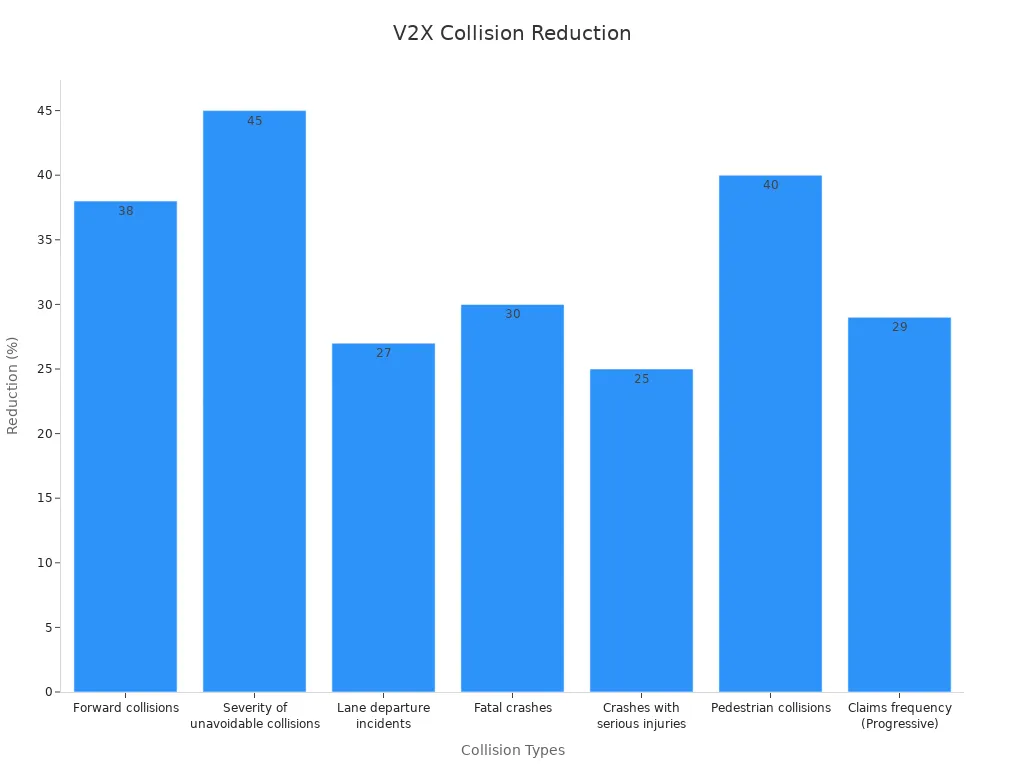
Statistics show the impact of V2X systems on collision prevention:
| Collision Type | Reduction Rate |
|---|---|
| Forward collisions | 38% |
| Severity of unavoidable collisions | 45% |
| Lane departure incidents | 27% |
| Fatal crashes | 30% |
| Crashes with serious injuries | 25% |
| Pedestrian collisions | 40% |
| Claims frequency (Progressive Insurance) | 29% |
| Average accident rate reduction | 20-35% |
The benefits extend beyond collision reduction. V2X technology can save lives and reduce injuries. It also minimizes vehicle damage and lowers costs.
| Benefit | Estimated Impact |
|---|---|
| Fatalities avoided per year | Up to 10,000 |
| Injuries avoided per year | Up to 800,000 |
| Damaged vehicles reduced per year | Up to 2,800,000 |
| Cost savings per year | Up to $12.6 billion |
Improving Traffic Flow and Reducing Congestion
V2X technology enhances traffic flow by enabling vehicles and infrastructure to communicate. Traffic lights equipped with V2X systems can adjust their timing based on real-time data. This reduces congestion and improves travel times. Vehicles can also receive updates about road closures or accidents, allowing you to choose better routes.
Cities that adopt V2X technology experience fewer traffic jams. Studies show that when 10% of vehicles use V2X, traffic jams drop to just 3.6 minutes. With full adoption, congestion decreases even further. This improvement not only saves time but also reduces stress for drivers.
Adaptive traffic management systems powered by V2X also prioritize emergency vehicles. These systems clear paths for ambulances and fire trucks, ensuring faster response times. Pedestrian safety improves as well, with sensors detecting people at crosswalks and alerting nearby vehicles.
Energy Efficiency and Environmental Benefits
V2X technology contributes to energy conservation and emission reduction. By improving traffic flow, it reduces idle times and fuel consumption. Vehicles spend less time stuck in traffic, which lowers greenhouse gas emissions. Studies show that V2X can reduce vehicle emissions by up to 25%.
The technology also supports innovative applications like Vehicle-to-Grid (V2G), Vehicle-to-Home (V2H), and Vehicle-to-Building (V2B). These applications optimize energy use and reduce reliance on traditional power sources.
| Application Type | Description |
|---|---|
| Vehicle-to-Home (V2H) | Allows EVs to supply power to homes, reducing energy demand from the grid. |
| Vehicle-to-Grid (V2G) | Enables EVs to return energy to the grid, supporting grid stability and reducing emissions. |
| Vehicle-to-Building (V2B) | Facilitates energy exchange between EVs and buildings, optimizing energy use. |
V2X technology plays a vital role in creating a sustainable future. It reduces emissions, conserves energy, and supports green initiatives. By adopting V2X systems, you contribute to a cleaner and healthier environment.
Supporting Autonomous Vehicle Development
Autonomous vehicles rely on advanced systems to operate safely and efficiently. V2X technology plays a crucial role in their development. It enables vehicles to communicate with their surroundings in real time. This communication helps autonomous cars make better decisions.
One key benefit of V2X is its ability to provide real-time data. Autonomous vehicles use this data to detect road conditions, traffic patterns, and potential hazards. For example, a car can receive alerts about icy roads ahead. This allows it to adjust its speed and avoid accidents.
V2X also enhances the accuracy of autonomous systems. Sensors like cameras and radar have limitations. They may struggle in poor weather or low visibility. V2X fills these gaps by sharing information from other vehicles and infrastructure. This ensures autonomous cars have a complete understanding of their environment.
Another advantage is improved traffic management. Autonomous vehicles equipped with V2X can coordinate with each other. They can form platoons, which are groups of vehicles traveling closely together. This reduces congestion and improves fuel efficiency. Traffic lights with V2X can also prioritize these vehicles, ensuring smoother travel.
Safety is another critical area where V2X supports autonomous driving. The technology enables vehicles to predict and prevent collisions. For instance, if a pedestrian steps onto the road, V2X can alert nearby cars. This quick response reduces the risk of accidents.
Tip: Cities with widespread V2X adoption see fewer traffic incidents involving autonomous vehicles.
V2X also aids in the integration of autonomous vehicles into smart cities. It connects cars to infrastructure like parking systems and charging stations. This makes urban transportation more efficient and user-friendly.
Challenges and Limitations of V2X Technology
Infrastructure and Deployment Costs
Deploying V2X technology requires significant investment. Building the necessary infrastructure, such as roadside units (RSUs), can be expensive. For example, a project in Maricopa County, AZ, allocated $19.6 million to connect 750 roadside units with 400 vehicle units. This project focused on emergency response and freight applications. Similarly, Greater Houston, TX, invested $19.2 million to improve road safety and efficiency for all users.
| Project Location | Funding Amount | Description |
|---|---|---|
| Maricopa County, AZ | $19.6 million | Connecting 750 RSUs to 400 vehicles for emergency and freight applications. |
| Greater Houston, TX | $19.2 million | Enhancing safety and efficiency for various road users. |
The automotive V2X market is growing rapidly. It is expected to increase from $619 million in 2021 to over $2.2 billion by 2025, with an annual growth rate of 38%. However, these costs can discourage smaller cities or regions from adopting the technology. You may notice that high initial expenses often delay large-scale implementation.
Regulatory and Standardization Barriers
Regulations and standards play a crucial role in V2X adoption. Different countries follow different communication protocols, such as DSRC or C-V2X. This lack of standardization creates compatibility issues. For example, a vehicle using DSRC may not communicate with infrastructure relying on C-V2X. These inconsistencies slow down global adoption.
Governments also face challenges in creating unified policies. You might see delays in approving new technologies due to lengthy regulatory processes. Without clear guidelines, manufacturers and cities hesitate to invest in V2X systems.
Security and Privacy Concerns
V2X technology relies on constant data exchange. This raises concerns about cybersecurity and privacy. Hackers could exploit vulnerabilities to disrupt communication or steal sensitive information. For instance, a cyberattack could manipulate traffic signals, causing accidents.
Privacy is another issue. V2X systems collect data about vehicle locations and movements. If not protected, this information could be misused. You might worry about how your data is stored and who has access to it. Ensuring robust encryption and secure networks is essential to address these concerns.
Note: Strong cybersecurity measures can build trust in V2X systems.
The Future of V2X Technology
Role in Advancing Autonomous Driving
V2X technology plays a key role in making autonomous vehicles safer and smarter. It allows vehicles to communicate with their surroundings in real time. This improves decision-making and reduces risks. For example, V2X can warn a car about sudden braking ahead or a pedestrian crossing the road.
Autonomous vehicles rely on cooperation among traffic participants. V2X enhances this by enabling both implicit and explicit interactions. Implicit interactions let vehicles infer intentions based on behavior. Explicit interactions involve direct communication, such as warnings or maneuver negotiations.
| Evidence Description | Key Points |
|---|---|
| V2X Communication | Enhances cooperation among traffic participants, essential for high levels of automation. |
| Implicit Interaction | Vehicles infer intentions based on behavior, improving safety and efficiency. |
| Explicit Interaction | Vehicles exchange information, enabling warnings and maneuver negotiations. |
V2X also complements onboard sensors. Sensors like cameras and radar may fail in bad weather. V2X fills these gaps by providing additional environmental data. This ensures autonomous vehicles operate reliably in all conditions.
Integration with 5G and Emerging Technologies
The integration of V2X technology with 5G networks unlocks new possibilities. 5G offers ultra-low latency, high reliability, and faster data speeds. These features enhance V2X performance, especially in urban areas.
| Metric | 5G Performance | 4G LTE Performance |
|---|---|---|
| Latency | 1 ms | Higher than 1 ms |
| Reliability | Low packet loss | Higher packet loss |
| Data Throughput | Up to 20 Gb/s | Lower than 20 Gb/s |
With 5G, vehicles can share data almost instantly. This improves safety and traffic flow. Emerging technologies like artificial intelligence (AI) and edge computing also boost V2X capabilities. AI analyzes data to predict traffic patterns. Edge computing processes data locally, reducing delays.
Potential Impact on Smart Cities and Urban Planning
Smart cities depend on V2X technology for efficient transportation. V2X reduces traffic congestion and improves road safety. It also supports intelligent transportation systems.
- The V2X market is projected to grow from USD 2.5 billion in 2023 to USD 15.7 billion by 2032, with a CAGR of 22.5%.
- Smart city initiatives are driving this growth. They use V2X for better traffic management and public safety.
- The Global Smart City Market is expected to grow from USD 762.7 billion in 2023 to USD 4,605.7 billion by 2033, with a CAGR of 19.7%.
Smart cities also benefit economically. They could generate $20 trillion by 2026. V2X technology plays a vital role in achieving these outcomes. It creates safer, more efficient urban environments.
Overcoming Current Challenges
Overcoming the challenges of V2X technology requires strategic solutions. These challenges include high costs, regulatory barriers, and security concerns. Addressing these issues can accelerate the adoption of this transformative technology.
To reduce infrastructure costs, governments and private sectors must collaborate. Public-private partnerships can fund the deployment of roadside units (RSUs) and other infrastructure. Sharing resources between cities and regions can also lower expenses. For example, integrating V2X systems with existing smart city projects can save money and time.
Standardization is another critical step. Regional differences in communication protocols, like C-V2X and DSRC, create compatibility issues. You need unified global standards to ensure seamless communication. Industry leaders and policymakers must work together to establish these standards. This will make V2X systems more reliable and easier to implement.
Testing in real-world conditions is essential for improving reliability. Congested urban areas present unique challenges for V2X communication. Rigorous testing in these environments ensures the technology performs well under stress. Conducting congestion control stress tests in heavy traffic can validate the safety and efficiency of V2X modules.
Security and privacy concerns also need attention. Strong encryption methods can protect data from cyberattacks. Regular software updates can address vulnerabilities. Educating users about data privacy can build trust in V2X systems. Governments should enforce strict regulations to safeguard personal information.
By addressing these challenges, you can unlock the full potential of V2X technology. Collaboration, standardization, and rigorous testing will pave the way for safer and smarter transportation systems.
Closing Remarks
V2X technology is revolutionizing transportation. It enables vehicles to communicate with their surroundings, improving safety, efficiency, and sustainability. By sharing real-time data, it reduces accidents, optimizes traffic flow, and lowers emissions. This innovation supports autonomous vehicles and integrates with smart infrastructure, creating smarter cities.
Its impact is undeniable:
| Impact Type | Description |
|---|---|
| Logistics Efficiency | Faster deliveries and lower operational costs through better coordination. |
| Environmental Benefits | Reduced fuel consumption and emissions, improving urban air quality. |
| Economic Advantages | Cost savings for companies and consumers. |
| Safety Improvements | Fewer accidents by addressing one-third of road fatalities caused by human errors. |
V2X also promotes green practices. It reduces fuel use and supports renewable energy by enabling electric vehicles to discharge power back to the grid. These advancements align with sustainable goals.
Tip: Stay informed about V2X developments. This technology is shaping the future of transportation and energy systems.
- Author
- Latest Posts

Jinesh Abhay Singatkar holds a master’s degree in computer applications. He is passionate about new and innovative technologies that can bring safety and comfort to mankind. He specializes in Python and RPA, concentrating on crafting high-performance web applications and pioneering data solutions.