An AI home care robot uses advanced artificial intelligence, smart sensors, and autonomous navigation to assist elderly users with daily tasks safely and independently.
AI Home Care Robot for Aging Adults
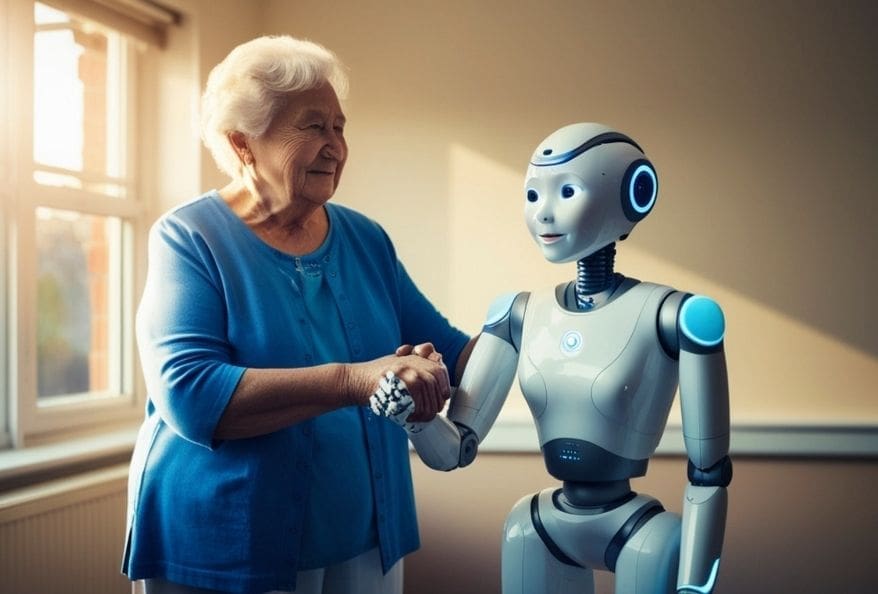
An AI home care robot is redefining how aging adults and people with mobility challenges manage daily life. Unlike traditional assistive devices, this intelligent system combines artificial intelligence, smart sensors, and autonomous navigation to provide safe and reliable home support. As a result, users can complete everyday tasks with greater independence and confidence.
Moreover, recent research published in Robotics shows that AI-powered robotic systems significantly enhance object retrieval and delivery in real home environments.
How an Autonomous Home Care Robot in Real Homes
Smart Navigation in the Intelligent Home Care Robot
First, the AI home care robot uses RGB-D Cameras to capture both color and depth information. Consequently, it can understand distances, detect obstacles, and move safely through indoor spaces.
In addition, SLAM (Simultaneous Localization and Mapping) allows the AI home care robot to build a live 3D map while tracking its own position. Therefore, it can calculate efficient and safe routes automatically.
As a result, the system moves smoothly without bumping into furniture or walls.
AI Home Care Robot Object Recognition Technology
Equally important, the Autonomous home care robot uses deep learning to recognize common household objects. For example, it can identify medication containers, water bottles, phones, and books — even in cluttered rooms.
Furthermore, adaptive grippers adjust to different shapes and sizes. Because of this flexibility, the robot can safely grasp fragile or small items.
Over time, machine learning improves performance. In other words, the more tasks it completes, the more accurate it becomes.
Benefits of an Autonomous Home Care Robot
for Independent Living
Greater Independence with an Intelligent Home Care Robot
For many home users, simple actions like retrieving medication can be physically demanding. However, an AI domestic care robot reduces this strain.
For instance, when a user says, “Bring my medicine,” the system autonomously navigates, retrieves the item, and delivers it safely. As a result, daily life becomes easier and more manageable.
Moreover, this technology supports aging in place by reducing reliance on constant assistance.
Improved Safety Through Intelligent Home Care Robot
Home accidents often occur while bending or reaching. Therefore, reducing unnecessary movement is critical.
Because the AI home care robot delivers items directly, users avoid risky stretching or climbing. Consequently, the risk of falls and injuries decreases significantly.
In addition, built-in sensors provide extra protection during operation.
Emergency Response Support from an AI Home Care Robot
During urgent situations, time matters. Fortunately, an AI home care robot can quickly fetch a phone or medical supplies.
As a result, individuals living alone gain an added layer of security. Furthermore, caregivers can feel reassured knowing that essential items are accessible when needed.
User-Friendly Interface
Another key advantage is accessibility. The AI home care robot supports:
- Voice commands
- Touchscreen interaction
- Simple task-based instructions
Meanwhile, complex navigation and object detection processes run automatically in the background. Therefore, users do not need technical knowledge to operate the system.
Real-World Results
Clinical evaluations demonstrate strong performance. Specifically:
- High task completion rates
- Positive user satisfaction
- Safe operation without major incidents
Overall, participants reported improved confidence and independence. Thus, real-world testing confirms that AI domestic care robot technology is ready for broader adoption.
The Future of AI Home Care Robot Technology
Looking ahead, AI domestic care robot systems will become more advanced and affordable. As artificial intelligence continues to evolve, these robots will offer expanded capabilities in healthcare and home assistance.
Importantly, this technology does not replace caregivers. Instead, it supports them by handling repetitive tasks and enhancing daily living.
Additionally, to stay updated with the latest developments in STEM research, visit ENTECH Online. Basically, this is our digital magazine for science, technology, engineering, and mathematics. Also, at ENTECH Online, you’ll find a wealth of information.
Reference
Kassahun, Y., Taddese, A., & Tadesse, Y. (2024). An autonomous robotic system for object retrieval and delivery: Enhancing independence for users living with disability and older adults. Robotics, 15(2), 41. https://doi.org/10.3390/robotics15020041
- Author
- Latest Posts

Kottauppari Venkat Raghava
I am a technology-driven IT graduate with a strong passion for science and innovation. I am fascinated by how innovations like artificial intelligence, robotics, and emerging technologies are shaping our world. I specialize in analyzing complex scientific and technological research and presenting it in a clear, accessible way. My goal is to make science and technology understandable and engaging for students, tech enthusiasts, and professionals alike. By breaking down advanced concepts into simple, insightful narratives, I strive to inspire curiosity, learning, and innovation, helping readers stay informed about the breakthroughs that are shaping the future.