High-resolution Cosmic Web maps reveal the universe’s hidden structure, showing dark matter filaments, galaxy clusters, and cosmic networks.
Cosmic Web: Mapping the Universe’s Hidden Structure
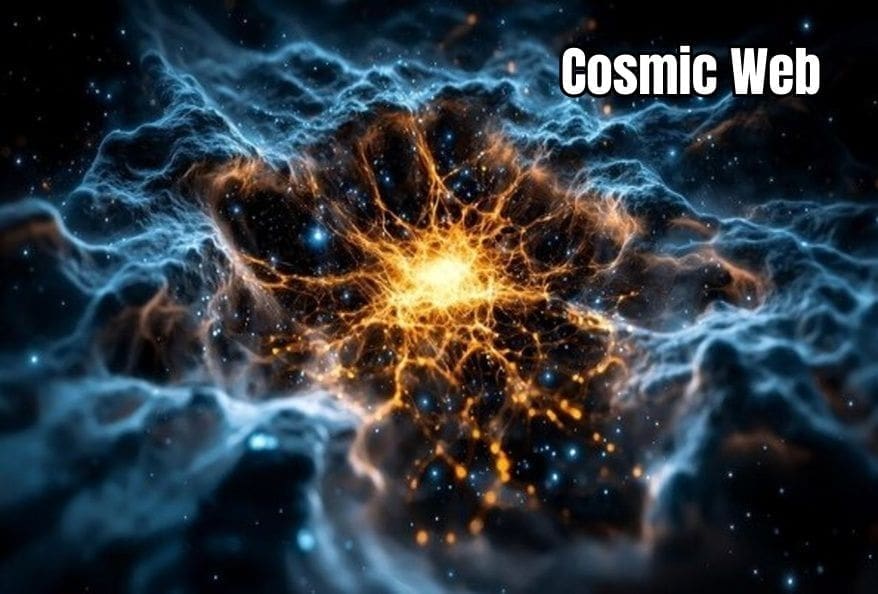
Galaxies light up the night sky, yet most of the universe remains invisible. This hidden mass, primarily dark matter, forms the scaffolding of the cosmic web, connecting galaxies across vast distances. By mapping the dark matter scaffolding, astronomers can visualize the universe’s large-scale structure and understand how matter organizes itself into filaments, voids, and clusters. Studying this cosmic network is essential for uncovering the origins and evolution of galaxies.
Scognamiglio D, Leroy G, Harvey D, Massey R, Rhodes J, Akins HB, Brinch M, Berman E, Casey CM, Drakos NE, Faisst AL. published their research under the title “ An ultra-high-resolution map of (dark) matter” in January 2026.
ENTECH STEM Magazine has included this research in its list of Top 10 STEM Discoveries and Innovations of January 2026.
How Scientists Map the Cosmic Web
Mapping the Cosmic Framework is challenging because most of its mass is dark matter, which cannot be observed directly. Therefore, astronomers rely on gravitational lensing, where massive objects bend light from distant galaxies. By analyzing these distortions, researchers reconstruct the distribution of dark matter and create detailed cosmic web maps.
Moreover, advancements in AI and next-generation telescopes now allow high-resolution mapping of the cosmic framework, revealing its intricate filaments and dense nodes. These maps act as blueprints, showing how matter flows and accumulates across the universe’s large-scale structure.
Techniques for Mapping the Cosmic Web
Modern galactic web mapping combines several innovative techniques:
- Gravitational Lensing Observations: Measure distortions in galaxy light to infer dark matter locations.
- Cosmological Simulations: Predict how dark matter and galaxies form networks across cosmic time.
- Machine Learning Algorithms: Analyze massive datasets to refine maps of the universe’s large-scale structure.
Together, these methods produce detailedcosmic network maps, revealing the network of filaments connecting galaxy clusters, vast voids of emptiness, and dense nodes where galaxies cluster.
Potential Benefits of High-Resolution Cosmic Web Maps
High-resolution cosmic mesh are crucial for modern astrophysics because they:
- Test Cosmological Models: Observing the cosmic network validates or challenges theories of gravity and universe formation.
- Reveal Dark Matter Distribution: Determine whether dark matter is clumpy or smooth across cosmic filaments.
- Predict Galaxy Formation: Show where gas collapses into stars guided by the universe’s large-scale structure.
- Study Voids and Filaments: Explain why some regions are densely packed while others remain nearly empty.
- Understand Dark Matter Interactions: Track how dark matter interacts with itself and ordinary matter.
Therefore, mapping the cosmic network is indispensable for understanding the universe’s hidden structure.
Research Opportunities
Detailed cosmic web maps open new avenues for scientific research:
- Compare cosmological simulations with observed cosmic network maps.
- Apply AI algorithms to analyze the dark matter scaffolding and cosmic filaments.
- Study rare cosmic events, including galaxy mergers and collisions along filaments.
- Foster international collaboration to refine models of the universe’s large-scale structure.
By leveraging cosmic web maps, cosmologists can explore both common and rare phenomena in the universe’s intricate network.
Educational Applications
Students and educators can explore the cosmic web interactively:
- Visualize the Cosmic Network in 3D: See filaments, voids, and galaxy clusters using real datasets.
- Learn AI and Big Data through Cosmic Web Analysis: Hands-on experience with real astronomical datasets.
- Encourage Interdisciplinary STEM Learning: Explore physics, astronomy, and computer science through cosmic web mapping.
Thus, cosmic web maps serve as a powerful educational tool to inspire future scientists.
The Future of Cosmic Web Mapping
Upcoming observatories such as the Vera C. Rubin Observatory and the Nancy Grace Roman Space Telescope will expand cosmic network, offering even higher resolution views of the universe’s large-scale structure. Consequently, astronomers will gain unprecedented insights into the flow of matter, formation of galaxies, and evolution of cosmic filaments.
Cosmic web mapping is essential for tracing the universe’s origins from galaxy formation to the evolution of stars and planetary systems. Furthermore, as these maps continue to improve, the invisible structure of the cosmos becomes increasingly visible, thereby opening doors for new discoveries.
Additionally, to stay updated with the latest developments in STEM research, visit ENTECH Online. Basically, this is our digital magazine for science, technology, engineering, and mathematics. Also, at ENTECH Online, you’ll find a wealth of information.
Reference
Scognamiglio, D., Leroy, G., Harvey, D. et al. An ultra-high-resolution map of (dark) matter. Nat Astron (2026). https://doi.org/10.1038/s41550-025-02763-9
- Author
- Latest Posts

Kottauppari Venkat Raghava
I am a technology-driven IT graduate with a strong passion for science and innovation. I am fascinated by how innovations like artificial intelligence, robotics, and emerging technologies are shaping our world. I specialize in analyzing complex scientific and technological research and presenting it in a clear, accessible way. My goal is to make science and technology understandable and engaging for students, tech enthusiasts, and professionals alike. By breaking down advanced concepts into simple, insightful narratives, I strive to inspire curiosity, learning, and innovation, helping readers stay informed about the breakthroughs that are shaping the future.