Boost your agency’s delivery capacity with white label WordPress development. Deliver custom builds and complex migrations under your brand without hiring in-house.
How White Label WordPress Development Helps Agencies Deliver More Without Hiring
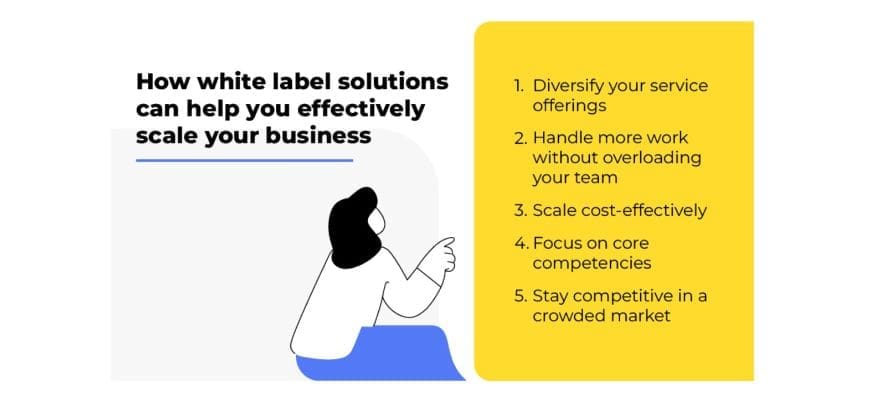
Image source: Mavlers
Is it better to hire an in-house WordPress developer or use White label WordPress development?
This question hits that very real “we want to grow, but payroll is scary” nerve many agencies have to battle with. Inability to balance client demands, unpredictable freelance developer, and limited in-house resources prevent them from supporting the continuous growth of their WordPress development agency.
If you’re running a WordPress development agency without investor backing, you’re likely operating on tight margins. In other words, putting your back into doing more with limited resources just to keep projects moving and clients happy.
In that case, expanding your service offerings without increasing overhead may seem like a far-fetched dream…. until you find a reliable white label WordPress development service. Outsourcing WordPress development is not just a feasible way to client satisfaction but also creates scalable revenue streams. While agencies can spend their energy on marketing and client relationships, expert developers take the technical work off their shoulders.
If you are also one of those digital agencies that turn down projects for lack of technical resources, this is the read for you. Let’s understand how white-label web development services can help you increase delivery capacity without having additional full-time headcount.
What is white label WordPress development?
Before we understand white label WordPress development or WordPress VIP silver agency partner, start with the term “white label.”
In business, white labeling means one company creates a product or service. And another company sells the product or service under its own brand. The end client sees only the agency they hired. The production partner remains invisible.
Applied to WordPress, this model lets an agency delegate technical execution. Site builds, custom theme development, plugin integrations, performance tuning, migrations, maintenance—to an external WordPress team. The work is delivered as if it were produced entirely in-house.
The agency calls the shots when it comes to the client relationship. It handles discovery calls, proposals, contracts, timelines, feedback loops, invoicing, and post-launch communication. The white label partner works in the background, and follows the agency’s processes and quality standards.
Think of a branding agency that wins a project to rebuild a mid-sized eCommerce brand’s website. The client expects strategy, design, and a fully functional WordPress build with custom checkout logic.
The agency has a knack for brand systems and UX, but doesn’t have senior WordPress engineers on payroll. Hiring full-time developers for a project that may last three months deemed less profitable. So, they bring in a white label WordPress partner. The white label partner built, tested, optimized, and handed back the project to the agency, which presented it to the client under its own name.
From the client’s perspective, it stays the same. They hired your agency. They continue working with your agency. Every milestone, update, and deliverable carries your branding.
Don’t confuse agency white label solutions with hiring a random freelancer on a project marketplace. White label partnerships are more like structured, ongoing relationships. The external team, like your extension, understands your workflows, documentation standards, coding practices, and turnaround expectations. Over time, they function less like “outsourced help” and more like a remote technical department that you can scale up or down based on demand.
In short, white label WordPress development is not just subcontracting. It’s a delivery model. One where your agency expands its technical capability without expanding headcount, while retaining full control over client experience and brand perception.
For agencies working with enterprise clients or high-traffic publishing platforms, partnering with a WordPress VIP silver agency partner like Mavlers can add an extra layer of technical confidence. Such partners support agencies in–
- API integrations
- Custom WordPress builds
- Complex migrations
- Headless CMS implementations
- Multisite setups
- VIP-level standards long after launch.
How white label WordPress development works for agencies
On the ground, white label WordPress development changes very little about how your agency engages with clients. But what it does change a lot is about how the projects get delivered behind the scenes.
As an agency, you are still in-charge of:
- Pitching the project.
- Scoping the work.
- Run discovery calls.
- Defining timelines.
- Mapping out the core architecture of the website. From CRM integration and secure member portals to enabling location-based landing pages.
The difference shows up once the technical build begins.
Unlike the in-house WordPress development, you don’t assign the project to an in-house developer. Nor do you rush through a risky hiring process. While outsourcing your WordPress development to a white label partner–
- You hand off the blueprint to their team.
- The partner team takes over the technical grind of project execution.
- Coding your designs into pixel-perfect themes, building custom features, configuring plugins, and setting-up staging environments—are all their tasks. Hitting performance benchmarks? Yes, that too.
What’s your agency’s role?
You keep the driver’s seat. Your agency remains the project lead, filtering every client request and managing the flow of communication.
Behind the scenes, your partner handles the technical execution, but you control the–
- Feedback loops
- Testing phases
- Launch timelines
All this is internally managed, mirroring the workflow of an internal department, without the overhead.
An example.
- Take a content marketing agency that has traditionally offered SEO and blog management.
- A long-term client now wants to restructure their website to support a resource hub with dynamic filtering, author pages, and downloadable assets.
- The agency understands the content architecture, but lacks the backend expertise to implement custom post types or taxonomy-driven layouts in WordPress.
- Rather than decline the work or delay delivery while looking for a developer, they onboard a white label partner to handle the build.
- The white label WordPress development partner develops the required functionality in a staging setup. The agency reviews it against the client brief, requests adjustments where needed, and presents the working environment to the client as part of its own delivery process.
- From there, deployment happens under the agency’s name. What if the client needs ongoing updates? Say, they want you to add multilingual support later or optimize the site for better Core Web Vitals. You can use the same partner and continue offering the support with the agency remaining the single point of contact and command.
Depending on the project, agencies may use white label support for anything from quick theme-based builds to fully custom-coded WordPress websites. Some projects require only layout implementation using page builders and existing plugins. Others demand coding bespoke functionality from scratch to support membership logic, booking systems, or complex data relationships.
Across all these cases, the white label workflow stays consistent: the agency owns strategy and client experience; the white label partner owns development execution. This division of responsibility is what allows agencies to run multiple web projects at the same time, without expanding their internal development team.
The road ahead: Choosing the right white label partner
Adopting white label WordPress development is less about outsourcing work, and more about deciding how your digital agency wants to scale from here.
Some agencies bring in a white label partner because they want the partner to handle occasional overflow when timelines start stacking up.
Whereas, some agencies count on white label support more consistently to deliver complex builds they don’t have the in-house expertise for.
In either case, the long-term value depends on choosing a partner that suits the type of web development projects you typically acquire.
As you move forward, it’s worth asking:
- Do your client projects require custom functionality or mostly standard builds?
- Will you need ongoing support after launch?
- How important are turnaround times during peak delivery cycles?
Can your partner adapt to your internal workflows and tools?
Additionally, to stay updated with the latest developments in STEM research, visit ENTECH Online. Basically, this is our digital magazine for science, technology, engineering, and mathematics. Further, at ENTECH Online, you’ll find a wealth of information.
- Author
- Latest Posts

A driven and dedicated IT professional specializing in web development and research. Backed by a strong academic foundation and extensive hands-on experience at Coneixement INDIA, I consistently deliver innovative, high-quality digital solutions that enhance user experience and drive measurable business growth.
With a passion for continuous learning and advancing my technical expertise, I am eager to take on new challenges in dynamic, larger organizations where I can contribute to transformative projects, optimize digital strategies at scale, and help elevate the company’s online presence. My commitment to excellence, combined with a results-oriented approach, makes me a valuable asset ready to support business objectives and future-proof digital initiatives in competitive markets.