The Cranium Nebula, captured by the Webb Telescope, reveals a brain-like planetary nebula in breathtaking infrared detail.
Cranium Nebula Captured by Webb Telescope
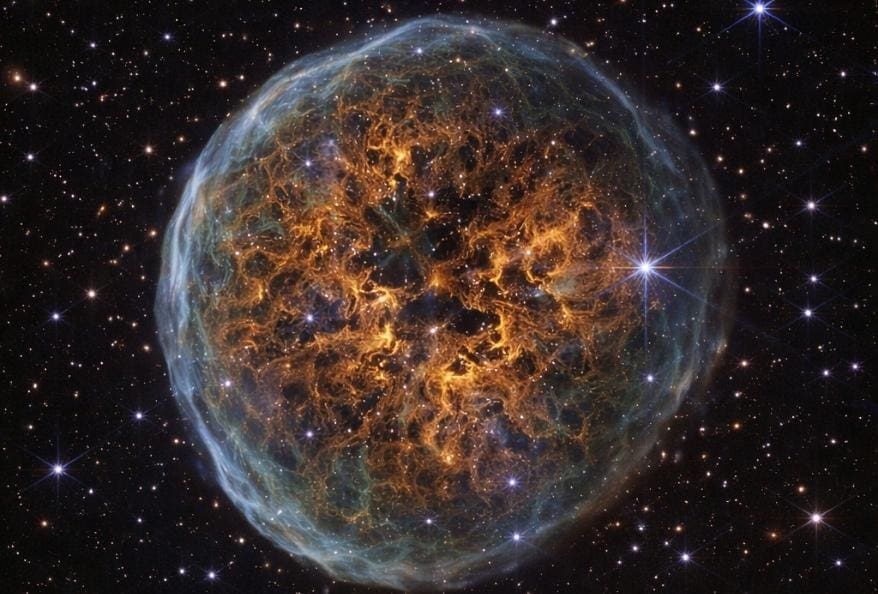
At the present time, the James Webb Space Telescope continues to transform astronomy. Most recently, it captured a breathtaking image of the Cranium Nebula, a cosmic object that appears strikingly similar to a glowing human brain.
At first glance, the structure looks like science fiction. However, in reality, this object is a planetary nebula—an expanding cloud of gas and dust expelled by a dying star. Because Webb observes the universe in infrared light, it reveals hidden layers that traditional optical telescopes cannot detect.
What Is the Cranium Nebula?
The Cranium Nebula (PMR 1) formed when an aging star reached the end of its life cycle. Prior to this stage, the star burned steadily for millions of years. Eventually, it began shedding its outer layers into space.
As a result, multiple shells of gas now surround the stellar core. The outer region forms a bright bubble, while the inner region contains intricate, cloud-like structures. Consequently, these layered formations create the remarkable “skull and brain” appearance seen in Webb’s images.
Moreover, a dark central lane runs between two bright lobes, enhancing the illusion of left and right hemispheres. In addition, powerful twin jets extend outward from the top and bottom. These jets provide valuable clues about how the dying star expelled its material.
Therefore, astronomers study this nebula to better understand stellar evolution and mass loss in aging stars.
How the James Webb Space Telescope Captured the Cranium Nebula
To capture the Cranium Nebula, the James Webb Space Telescope used two advanced instruments:
NIRCam Imaging of the Cranium Nebula
On one hand, NIRCam highlights cooler gas and the central dark lane. It also reveals distant background stars shining through the nebula.
MIRI (Mid-Infrared Instrument)
On the other hand, MIRI detects warm dust and glowing molecular structures. In contrast to visible-light images, mid-infrared data exposes previously hidden ejections and outflows.
Balanced together, these instruments provide a complete multi-wavelength view. In other words, Webb allows scientists to “see the invisible” by detecting infrared radiation blocked by cosmic dust.
The Fate of the Star Inside the Cranium Nebula
At the center of the Cranium Nebula, a stellar core remains. Its ultimate fate depends on its original mass.
If the star was relatively small, it will become a white dwarf—a dense, Earth-sized remnant. In fact, just a teaspoon of white dwarf material would weigh tons on Earth. Over billions of years, it will gradually cool and fade.
However, if the star were significantly more massive, it could end in a supernova explosion. Based on current observations, scientists believe this object will likely leave behind a white dwarf rather than explode.
Thus, this nebula represents a transitional phase in stellar life cycles.
Why the Cranium Nebula Matters
The Cranium Nebula provides a real-time glimpse into how stars like our Sun will eventually evolve. Furthermore, planetary nebulae enrich space with heavier elements such as carbon and oxygen—materials essential for planets and life.
Because Webb delivers unprecedented resolution, astronomers can now analyze fine structures within the nebula’s jets and dust lanes. As new data becomes available, researchers will refine models of stellar wind interactions and gas dynamics.
In short, this discovery is more than a beautiful image—it is a scientific breakthrough.
Looking Ahead
All things considered, the Cranium Nebula reminds us that the universe is constantly changing. Although vast distances separate us from these cosmic events, advanced technology brings them within reach.
In conclusion, Webb’s stunning infrared image not only amazes viewers but also deepens our understanding of stellar life cycles. Indeed, space remains full of massive surprises—waiting for the next generation of scientists to explore.
Additionally, to stay updated with the latest developments in STEM research, visit ENTECH Online.
Reference
National Aeronautics and Space Administration. (2026, February 25). NASA’s Webb examines Cranium Nebula. NASA Science. https://science.nasa.gov/missions/webb/nasas-webb-examines-cranium-nebula/
- Author
- Latest Posts

Kottauppari Venkat Raghava
I am a technology-driven IT graduate with a strong passion for science and innovation. I am fascinated by how innovations like artificial intelligence, robotics, and emerging technologies are shaping our world. I specialize in analyzing complex scientific and technological research and presenting it in a clear, accessible way. My goal is to make science and technology understandable and engaging for students, tech enthusiasts, and professionals alike. By breaking down advanced concepts into simple, insightful narratives, I strive to inspire curiosity, learning, and innovation, helping readers stay informed about the breakthroughs that are shaping the future.