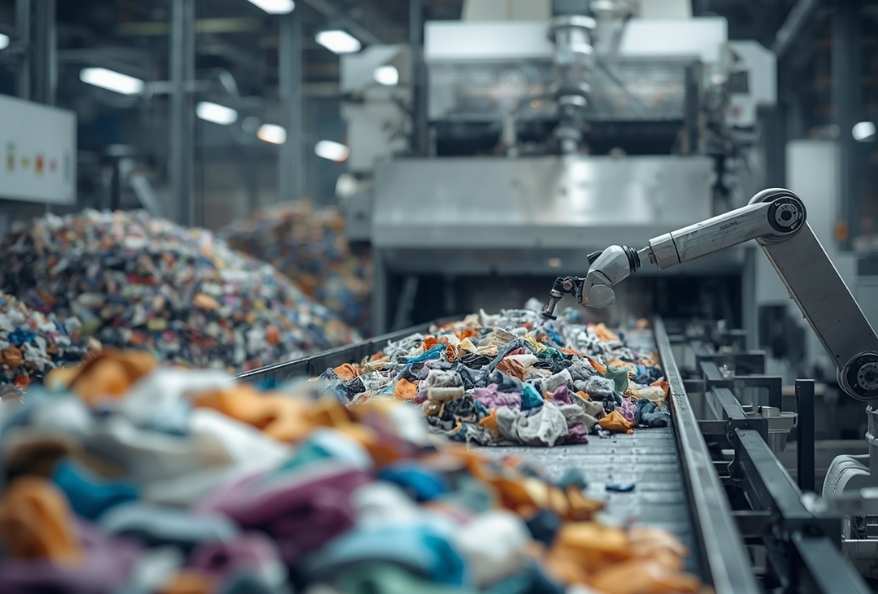
Automated textile recycling technologies are revolutionising how fashion waste is processed, using AI-driven systems to sort, recycle, and create sustainable materials.
Automated Textile Recycling Technologies Changing Fashion
The worldwide fashion market is worth a mind-boggling 1.66 trillion euros, but we still can’t figure out how to deal with all the trash it makes. So, I looked into the most recent studies on automated textile recycling technologies to see if it can ultimately solve this huge environmental issue.
Specifically, researchers are focusing on three main areas to help:
- Identification: Using sensors to figure out what a fabric is made of, like cotton or polyester.
- Sorting: Physically moving clothes into different bins.
- Contaminant detection: Finding buttons and zippers that ruin recycling machines.
Scaling Upstream Recovery with Automated Technologies
Furthermore, textile automation is helping us move beyond just guessing what a fabric is. Some researchers use hyperspectral imaging, which creates a detailed map of a garment to find different fabrics in a single piece of clothing. This level of detail is exactly what we need to make recycling efficient. However, I noticed a big problem knowing what a shirt is made of is only half the battle.
The Real Struggle: Moving Floppy Clothes
Currently, we still need machines that can actually pick up the clothes and move them to the right bin. Right now, only about 19% of the studies I looked at actually showed a robot or a machine physically sorting the items.
Most of the time, the AI just identifies the fabric, but it doesn’t have a mechanical arm to do anything about it. We need more systems that can handle deformable objects, which is just a fancy way of describing floppy, wrinkled clothes.
Another huge challenge is dealing with contaminants, like zippers and buttons. If a metal zipper gets into a recycling machine, it can cause serious damage or lower the quality of the new fabric. I found that only a few researchers are working on robots that can find and rip these parts off automatically.
Bridging the Gap to a Greener Future
Ultimately, I believe that once we bridge this gap between “seeing” and “doing,” we will finally see a circular economy where our old clothes never truly die.
It will take better datasets and more industrial testing, but the future of fashion looks a lot smarter than it used to. I am excited to see a world where my old T-shirt becomes a new one without ever touching a landfill.
Starting Your Career in Textile Automation
The future of recycling depends on moving from labs to factories. Computers are great at identifying cotton versus polyester. However, we must improve how machines handle clothes. Identifying a fabric is only the first step. Sorting millions of garments without mistakes is much harder.
This challenge creates STEM careers for you. You can help solve environmental problems. Do you enjoy AI? Do you like building robots? You could design the next textile automation systems. We need experts in computer vision. We need engineers to build fast tools. You can help keep clothes out of landfills. The future of fashion is in your hands.
The Future of Automated Textile Recycling Technologies
In conclusion, I believe the future of automated textile recycling technologies depends on moving from the lab to the factory floor. While computers are getting very good at recognising a cotton shirt from a polyester one, we still need to perfect the way machines physically handle these items in a continuous flow.
It is one thing to identify a fabric, but it is a whole other challenge to build a system that can sort a million garments a year without making a single mistake.
Additionally, to stay updated with the latest developments in STEM research, visit ENTECH Online.
Reference
- Lopes, D., Pires, E. J. S., Filipe, V., Silva, M. F., & Rocha, L. F. (2026). Intelligent and Automated Technologies for Textile Recycling Pre-Processing: A Systematic Literature Review. Technologies, 14(4), 200. https://doi.org/10.3390/technologies14040200
- Author
- Latest Posts

Kottauppari Venkat Raghava
I am a technology-driven IT graduate with a strong passion for science and innovation. I am fascinated by how innovations like artificial intelligence, robotics, and emerging technologies are shaping our world. I specialize in analyzing complex scientific and technological research and presenting it in a clear, accessible way. My goal is to make science and technology understandable and engaging for students, tech enthusiasts, and professionals alike. By breaking down advanced concepts into simple, insightful narratives, I strive to inspire curiosity, learning, and innovation, helping readers stay informed about the breakthroughs that are shaping the future.