The CRS-24 mission is a major NASA cargo mission to ISS delivering over 11,000 pounds of supplies. Discover how it connects STEM learning to real-world space exploration.
CRS-24 Mission: The Space Breakthrough You Should Know
Estimated reading time: 6 minutes
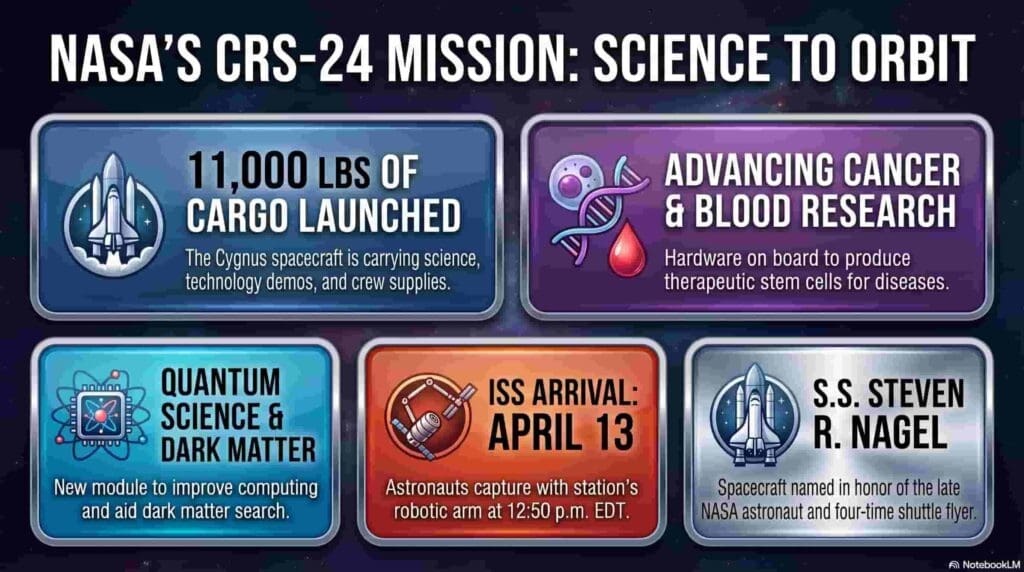
The CRS-24 mission is an important step in space research. To begin with, on April 11, 2026, NASA worked with Northrop Grumman to launch a NASA cargo mission to ISS. The mission carried more than 11,000 pounds of supplies and experiments.
In simple terms, this mission helps astronauts live and work in space. At the same time, it supports new scientific research. Because of this, space missions are becoming more efficient, more reliable, and more frequent.
Moreover, this mission shows how teamwork drives progress. Government agencies and private companies now work together closely. As a result, new ideas move faster from planning to launch. This is one reason space exploration is growing so quickly today.
Key Takeaways
- The CRS-24 mission is a major NASA cargo mission to ISS
- It delivered over 11,000 pounds of supplies
- It used advanced systems like Falcon 9 and Canadarm2
- It connects directly to STEM learning
- It supports future space exploration
CRS-24 Mission Launch and Key Highlights
Launch Overview
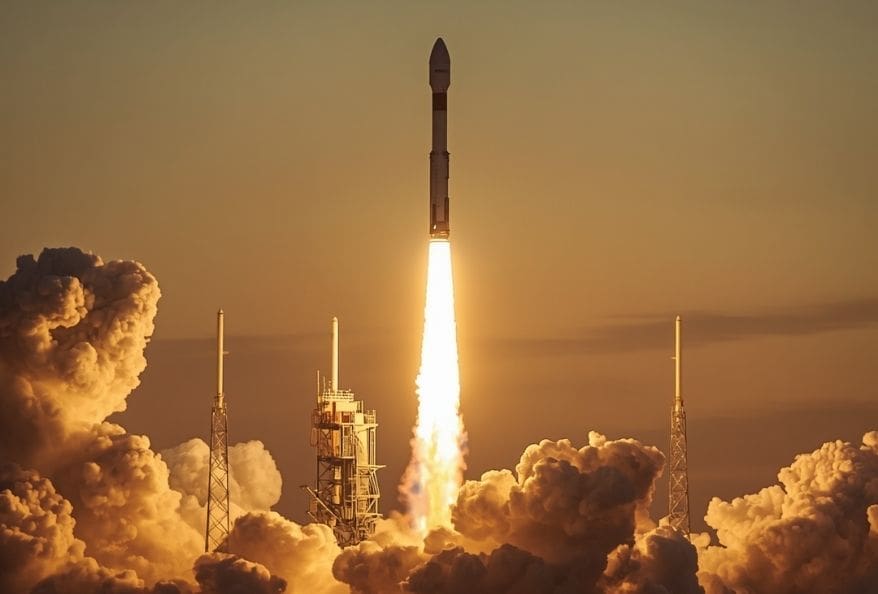
The CRS-24 mission launched on a Falcon 9 rocket built by SpaceX. Importantly, this rocket can be reused. As a result, this reduces the cost of space travel, allowing for more missions.
In addition, reusable rockets reduce waste. Instead of building a new rocket each time, engineers can use the same one again. Because of this, space programs save both time and money.
Cargo Overview
The NASA cargo mission to ISS carried many useful items that support life and research in space:
- Food and daily supplies for astronauts
- Scientific equipment for experiments
- Tools for testing new technology
- Spare parts for station maintenance
Furthermore, these supplies help astronauts stay safe and productive. Without regular cargo missions, long-term space research would not be possible.
Simultaneously, every mission incorporates fresh experiments. These endeavors allow scientists to expand their understanding of space, while also contributing to advancements that benefit life here on our planet.
Docking Process
Once the spacecraft was launched, it made its way to the International Space Station. Astronauts then utilized the Canadarm2 to secure it.This step is critical. It demands precision and impeccable timing. A tiny error could lead to significant complications.
Consequently, astronauts undergo extensive training before attempting this. They collaborate closely with teams on the ground to guarantee a successful operation.
Technology Behind the CRS-24 Mission
The CRS-24 mission’s success depends on several technologies working together. Before looking at each system, it’s helpful to understand this.In other words, no single machine can complete the mission alone.
Key Systems Used In CRS-24 Mission
Cygnus XL Spacecraft
- Carries cargo to the ISS
- Holds large amounts of supplies
- Supports longer missions
The Cygnus spacecraft acts like a delivery vehicle in space. Because of its design, it can safely transport equipment and experiments over long distances.
Falcon 9 Rocket
- It sends spacecraft into orbit.
- The first stage is reusable.
- This helps keep mission costs down.
The Falcon 9 rocket represents one of the most sophisticated launch systems currently in use.
Canadarm2 Robotic Arm
- Captures incoming spacecraft
- Helps with docking operations
- Controlled by astronauts
The Canadarm2 is a key part of the docking process. Without it, capturing the spacecraft would be much harder.
These systems work together to ensure the mission’s safety and success. As a result, the CRS-24 mission demonstrates how modern engineering solves complex problems.
STEM Subjects Behind a NASA Cargo Mission to ISS
The NASA cargo mission to ISS connects directly to what students learn in school. For example, each STEM subject plays an important role:
- Physics provides the foundational principles of motion, force, and gravity.
- Biology investigates the survival mechanisms of organisms in the space environment.
- Chemistry is essential for the development of propellant and durable materials.
- Engineering is responsible for the design of rockets and spacecraft.
- Mathematics is employed to compute velocity, distance, and temporal parameters.
Furthermore, these subjects are interconnected.So, learning them together builds strong problem-solving skills.
For instance, engineers use math and physics to plan rocket paths. At the same time, scientists use biology to study how humans adapt to space.
Why the CRS-24 Mission Matters for Students
Many students wonder how classroom learning applies to real life. However, the CRS-24 mission provides a clear answer.
Real-World Benefits
- Advances in medical research.
- Materials that are both stronger and lighter.
- A deeper understanding of human health.
- Ongoing technological innovation.
Consider, for instance, the work scientists do to understand how the human body functions in space. This research leads to improved treatments for diseases right here on Earth.
How Space Missions Affect Daily Life
Space missions might feel distant, but their impact on our everyday existence is significant.
Satellites, for instance, have revolutionised communication. GPS technology, a direct result of space exploration, makes travel and navigation far simpler. Weather forecasts are now more accurate and, consequently, safer, thanks to data gathered from space.
Furthermore, Earth observation satellites play a crucial role in monitoring climate change.
Consequently, missions such as the CRS-24 mission provide tangible benefits to people globally.
Future Impact of the CRS-24 Mission
The CRS-24 mission aligns with the broader, enduring objectives of space exploration. Consequently, it contributes to:
- Venturing further into the cosmos.
- Developing the infrastructure needed for extended space habitation.
- Facilitating fresh scientific breakthroughs.
- Fostering international collaboration.
Current missions serve as a proving ground for novel concepts and the refinement of existing technologies, according to scientists.
Challenges in a NASA Cargo Mission to ISS
Space missions are inherently complex undertakings. Each one demands meticulous planning and flawless execution.
- Launch timing must be exact
- Docking requires high precision
- Equipment must survive extreme heat and cold
- Communication delays must be managed
Despite these hurdles, engineers persist in refining and enhancing every system.
Skills Students Can Learn from This Mission
The CRS-24 mission also teaches important life skills.
- Problem-solving
- Critical thinking
- Teamwork
- Attention to detail
In addition, students learn how science applies to real-world challenges. Therefore, studying STEM subjects can lead to exciting careers.
Final Thoughts
The CRS-24 mission is more than a supply trip. Instead, it shows how science, technology, and teamwork come together.
This NASA cargo mission to the ISS demonstrates the usefulness, practical application, and excitement of STEM fields. Therefore, if students stay curious and keep learning, they can participate in future missions.
Additionally, to stay updated with the latest developments in STEM research, visit ENTECH Online.
Frequently Asked Questions (FAQs)
Why is the CRS-24 mission important?
It supports research and daily operations on the ISS.
How is this different from other missions?
The NASA cargo mission to ISS focuses on supplies, not astronauts.
How much cargo did the CRS-24 mission carry?
The CRS-24 mission carried over 11,000 pounds of supplies, including food, research tools, and technology equipment.
Which rocket was used in the CRS-24 mission?
The mission used a Falcon 9 rocket, known for its reusable design and cost efficiency.
Reference
- NASA (2026, April 11). NASA Science, Cargo Launch Aboard Northrop Grumman CRS-24. Retrieved from https://www.nasa.gov/news-release/nasa-science-cargo-launch-aboard-northrop-grumman-crs-24/.
- Author
- Latest Posts

Kottauppari Venkat Raghava
I am a technology-driven IT graduate with a strong passion for science and innovation. I am fascinated by how innovations like artificial intelligence, robotics, and emerging technologies are shaping our world. I specialize in analyzing complex scientific and technological research and presenting it in a clear, accessible way. My goal is to make science and technology understandable and engaging for students, tech enthusiasts, and professionals alike. By breaking down advanced concepts into simple, insightful narratives, I strive to inspire curiosity, learning, and innovation, helping readers stay informed about the breakthroughs that are shaping the future.