Firstly, he put plants into groups by their parts and where they grew. Secondly, he used steps to sort plants. Thereafter, he looked at roots, stems, leaves, and flowers. Finally, he also checked how plants…
Father of Botany Showdown 3 Big Differences
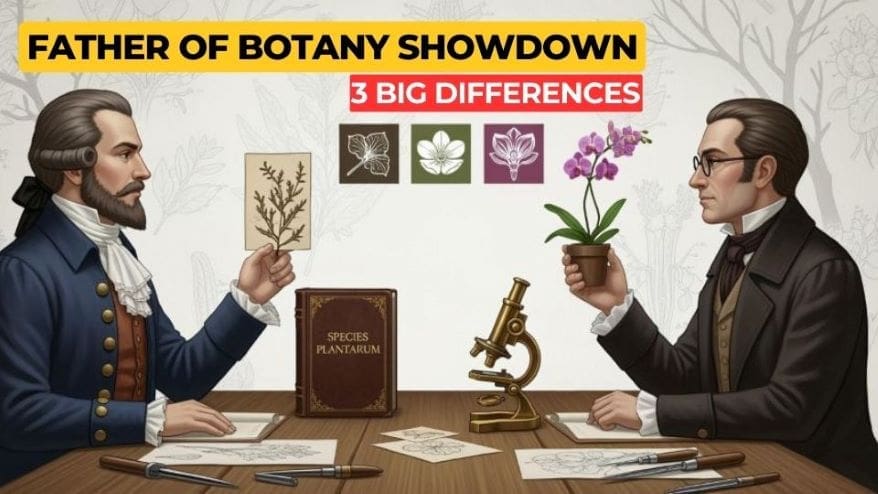
Who is father of botany
Theophrastus, who is father of botany, is different from other early botanists in three main ways. Firstly, he wrote in a very careful and clear way. Secondly, he looked at how plants could help in medicine and farming. Finally, he talked about rituals and beliefs from people who sold herbs.
Theophrastus’s special way of studying plants helped make botany more useful. These differences explain why people call him the father of botany and why his work is important for learning how botany has changed.
Key Takeaways
- Theophrastus made simple steps to sort plants.
- In particular, this helped botany become a true science.
- With this intention, he learned how plants help people in health and farming. Vis a vis, he showed how plants are useful in real life.
- For that, he watched plants closely and set rules for other scientists.
- Theophrastus wrote key books that helped later plant studies.
- Without doubt, his thoughts changed how we group plants today. This helps us know and name plants now.
Plant Classification Methods
Theophrastus’s Systematic Approach
Theophrastus changed how people studied plants. He did not just make lists. Firstly, he put plants into groups by their parts and where they grew. Secondly, he used steps to sort plants. Thereafter, he looked at roots, stems, leaves, and flowers. Finally, he also checked how plants made seeds and grew in places.
Theophrastus carefully showed how plants are different. He made big groups and then smaller groups inside them. He studied plant parts, shapes, and how they make new plants. He also looked at where plants live and how people grow them.
He used real plants to show his ideas. Indeed, he watched plants closely. In fact, his careful work made his system special. Theophrastus’s way of studying helped science grow.
He wrote two important books. The first book, Enquiry into Plants, has nine parts and talks about over 500 plants. The second book, On the Causes of Plants, explains how plants grow and change.
| Title | Description |
|---|---|
| Enquiry into Plants | This book has nine parts. It shares Theophrastus’s notes and groups for more than 500 plants. |
| On the Causes of Plants | This book has six parts. It tells how plants grow and why, adding to his grouping work. |
Other Early Botanists’ Methods
Other early botanists did not use careful steps. In fact, they grouped plants by where they grew or how people used them. Their ways were simple and not as neat.
- Aristotle: Grouped plants by where they lived and how they made new plants.
- Andrea Cesalpino: Made the first big plant groups in 1583, putting plants in order.
- John Ray: Came up with the idea of species and gave rules for telling plants and animals apart.
Theophrastus’s way was not the same. Actually, he used details and examples. While, others used easy rules or habits.
Why Classification Matters in Botany
Grouping plants helps people learn about nature. Also, it makes studying and using plants easier. Theophrastus’s ideas helped later scientists. Linnaeus used these ideas to make a better system. As a result, this helped people sort new plants from all over the world.
Theophrastus’s work made botany a true science. Undoubtedly, his careful groups helped others learn and grow the field.
Scope and Impact in Botany
Theophrastus’s Lasting Influence
Theophrastus changed how people learned about plants. He wrote about 550 kinds of plants. Firstly, he put them into groups like trees, shrubs, and herbs. Thereafter, he explained how plants grow and what things help them. Actually, he did more than just make lists. Moreover, he showed how people use plants for food and medicine. Additionally, he also wrote about how weather and soil help plants.
Theophrastus’s books helped later scientists learn. His work gave people steps to study plants.
Here is a quick look at what he did and how it helped botany:
| Contribution | Impact on Botany |
|---|---|
| Systematic classification of plants | Started the way we sort and name plants today. |
| Detailed observations of plant parts | Helped people see how plants are different. |
| Practical uses of plants | Showed how plants are used for medicine and farming. |
Contributions of Other Pioneers
Other early botanists did not do as much as Theophrastus. They mostly wrote about simple uses or where plants grew. Some wrote about plants for healing. While, others talked about plants in stories or myths. To emphasize, they did not use careful steps or group plants by their parts.
Comparing Breadth and Depth
Theophrastus wrote 227 works. As can be seen, he wrote about many things, not just plants. His book Enquiry into Plants became a guide for later studies. As a matter of fact, he used ideas from farmers, herbalists, and his own work. While, other early scientists wrote less and only focused on one part of plants.
| Aspect | Theophrastus | Contemporaries/Successors |
|---|---|---|
| Scope of Research | Wrote about many plant topics | Wrote about one use or story |
| Integration of Knowledge | Used ideas from many people | Mixed fewer ideas |
| Influence on Future Studies | Made rules for botany | Stayed in one field |
Legacy in Modern Botany
Today, people still use Theophrastus’s ideas. By and large, his way of grouping plants helped Carl Linnaeus make the naming system we use now. To that end, his books became the first textbooks for botany. Students and scientists still learn from his methods.
| Contribution | Impact on Modern Botany |
|---|---|
| Systematic classification of plants | Helped us name and group plants today |
| Detailed observations | Showed how to study plants carefully |
| Foundational texts | Became the base for teaching and learning about plants |
Theophrastus is important in plant studies. He made botany a science, not just a list of plants.
Observation and Experimentation in Early Botany
Theophrastus’s Empirical Methods
Theophrastus changed how people studied plants. He used careful observations and real experience. In fact, he watched plants grow in different places. Thereafter, he wrote down what he saw. He did not guess or use stories. He made a plan to group plants by their parts and where they lived.
- He looked at roots, stems, leaves, and flowers.
- He checked how plants grew in different soils and weather.
- He wrote about how people used plants for food and medicine.
In his book, enquiry into plants, he showed how to study plants step by step. He wanted others to use the same method. He believed that the scientific study of plants needed clear rules.
Techniques of Other Botanists
Other early botanists used different ways. For the same reason, they liked stories and old beliefs. In fact, they did not always check facts. While, some wrote about plants from myths or what healers said. Certainly, they did not use a system to group plants.
- Many focused on how people used plants in rituals.
- Some trusted herbalists and root diggers for plant facts.
- Others talked about plants in a more philosophical way.
They did not use careful observations like Theophrastus. Their work was less organized.
Shaping Scientific Botany
Theophrastus’s way helped make botany a science. He showed that people should watch plants and write down facts. Then, he asked questions about how plants grow and change. He wanted to know why plants act a certain way.
“We must consider the distinctive characters and the general nature of plants from the point of view of their morphology, their behaviour under external conditions, their mode of generation and the whole course of their life.”
— Theophrastus, Enquiry into Plants
His work set the rules for later scientists. He helped others see that botany needs clear steps and real evidence. His methods made the scientific study of plants stronger and more trusted.
Why Theophrastus Is Called the Father of Botany
Foundational Contributions
Theophrastus is called the father of botany for many reasons. He did more than just write about plants. He made a way to group them. In his book enquiry into plants, he talked about many kinds of plants. He told where they grow and how people use them. Later, he studied roots, stems, leaves, and flowers. He wrote about how plants make seeds. His work gave easy steps for learning about plants. He turned botany into a real science, not just a list of plant names.
Theophrastus’s careful notes and groups helped people learn about plants. He showed how plants live in different places. He explained how soil and weather change how plants grow. His book enquiry into plants became a guide for other scientists.
Influence on Future Generations
Theophrastus’s work changed how people study plants. Many scientists learned from his ways. They used his system to group plants. His ideas helped Carl Linnaeus make the system we use now. Theophrastus’s notes on plant ecology helped people learn how plants live together. His writing about healing plants started herbal medicine.
- Theophrastus’s system made plant study a real science.
- His ideas about plant names helped scientists talk to each other.
- His careful watching of plants led to better ways to study them.
His teaching style inspired many students. Later botanists called him the father of botany. His work helped botany grow into areas like farming and medicine. Theophrastus’s ideas still help people study plants today.
Theophrastus stood out in three ways:
- He used clear steps to group plants.
- He wrote about how plants help people.
- He watched plants and wrote down facts.
These differences made botany a real science. Learning about Theophrastus helps people see how plant study changed. His ideas shaped how scientists work today.
To stay updated with the latest developments in STEM research, visit ENTECH Online. This is our digital magazine for science, technology, engineering, and mathematics. Furthermore, at ENTECH Online, you’ll find a wealth of information.
Frequently Asked Questions
What made Theophrastus different from other early botanists?
Theophrastus used clear steps to group plants. He watched plants closely. He wrote about how people use plants. Other botanists used stories or simple lists.
Why do people call Theophrastus the “father of botany”?
People call him the “father of botany” because he started using science to study plants. He grouped plants by their parts. His books helped others learn about plants.
How did Theophrastus study plants?
He used observation and facts. For this purpose, he watched how plants grew. He wrote down what he saw. He did not use myths or guesses.
Did Theophrastus’s work help modern science?
Yes! His grouping system helped later scientists. Carl Linnaeus used his ideas to make the plant naming system we use today.
What are Theophrastus’s most famous books?
His two best-known books are Enquiry into Plants and On the Causes of Plants. These books share his plant groups and ideas.
Tip: Reading Theophrastus’s books can help you see how plant science began!
Reference
Pennazio S. (2014). Elements of plant physiology in theophrastus’ botany. Theoretical biology forum, 107(1-2), 97–108. https://pubmed.ncbi.nlm.nih.gov/25936216/
- Author
- Latest Posts

I completed my Master of Science from the University of Allahabad in 2017 with a strong academic background in life sciences and chemistry. My specialization included Molecular Biology, Microbiology, Genetics, Plant Breeding, Phycology, Paleobotany, and Bioinformatics, along with Organic Chemistry, Inorganic Chemistry, and Physical Chemistry. This multidisciplinary training provided me with a comprehensive understanding of biological systems and analytical scientific approaches.
After completing my postgraduate studies, I gained valuable professional experience in both the education and social development sectors. I worked at A.M. Oxford Public School, where I was actively involved in guiding students toward academic excellence. In this role, I focused on creating an engaging learning environment, encouraging critical thinking, and nurturing students’ curiosity for scientific learning. My experience as an educator strengthened my communication, mentoring, and classroom management skills.
In addition to my teaching experience, I worked with Jeevan Jagriti Foundation, where I contributed to community-based initiatives aimed at improving educational access and awareness among underprivileged sections of society. Through this work, I participated in programs designed to support social development and promote the value of education in marginalized communities.
These professional experiences helped me develop strong interpersonal, leadership, and organizational skills while reinforcing my commitment to education and community service.