The Future of Flexible Tech Is Here—and It’s Bendy, Tough, and Smarter Than Ever.
This Bendy Sensor Just Survived 100,000 Stretches—Here’s Why That’s a Game-Changer
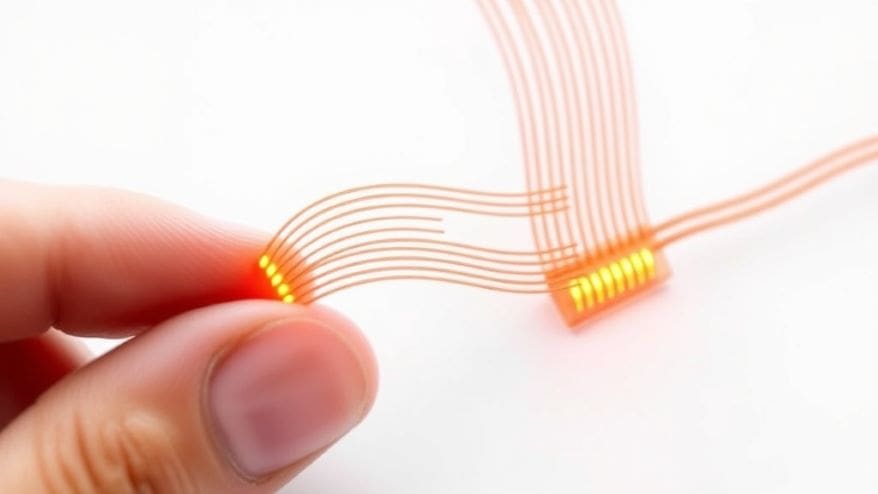
Imagine wearing a smart shirt that monitors your movements. The sensors in the fabric bend and stretch with you. Scientists in Japan created a flexible strain sensor that survives over 100,000 bending cycles. This breakthrough matters for wearable technology. Athletes could track their performance in real-time. Patients could monitor their health continuously. The sensor maintains accuracy even after extreme repetitive stress. This discovery opens doors to practical applications. Your future career in materials science or engineering could build on this work.
Key Takeaways: Why This Discovery Matters to You
- Magnetic tunnel junctions are flexible sensors that detect strain and stress
- The sensors withstand over 100,000 bending cycles without losing performance
- This technology works on polyimide substrates that bend easily
- Applications include wearable devices and health monitoring systems
- The thick bottom electrode layer acts as a protective buffer
- High gauge factor (100-1000) means extremely sensitive detection
- Low power consumption makes these sensors practical for real devices
What Makes This Discovery Game-Changing?
The Problem Scientists Solved
Traditional sensors break when you bend them repeatedly. At first, flexible strain sensor seemed impossible. Engineers struggled with durability issues. The sensors would degrade after a few thousand cycles. Now, scientists have solved this major problem. To explain, researchers created magnetic tunnel junctions (MTJs). These devices measure strain by detecting resistance changes. Prior to this study, nobody knew if MTJs could survive extreme bending.
The team tested their sensor repeatedly. They applied tensile strain up to 1.25% of the original length. The sensor endured this stress for over 100,000 cycles. Remarkably, the device showed no significant degradation. This is a major achievement in materials science.
Why You Should Care Right Now
Here’s why this matters to your future:
- Wearable technology will become more reliable and practical
- Sports equipment can include real-time performance monitoring
- Medical devices can track patient health continuously without failure
- Structural monitoring systems can detect damage in buildings and bridges
- Robot sensors will survive demanding industrial environments
- Consumer electronics will be more durable and flexible
- Career opportunities will expand in flexible electronics engineering
How Does This Flexible Sensor Actually Work?
Understanding Magnetic Tunnel Junctions
A magnetic tunnel junction combines several thin layers. As an illustration, picture a sandwich with three main layers. The middle layer is magnesium oxide (MgO). The top and bottom layers are cobalt-iron-boron (CoFeB). These materials are magnetic.
The magnetic properties change in response to stretching. This change affects how electrons tunnel through the middle layer. The electrical resistance increases or decreases accordingly. Scientists measure this change to determine strain. The sensor basically translates physical bending into electrical signals. Engineers can then read these signals with simple circuits.
The Secret to Durability of Flexible Strain Sensor
What’s more, the design includes a clever protective layer. Below the main sensor stack sits a thicker buffer layer. This layer consists of tantalum, ruthenium, and tantalum (Ta/Ru/Ta). To put it differently, this layer absorbs some of the strain energy. It prevents all stress from reaching the sensitive magnetic layers. Think of it like a shock absorber in a car. The buffer layer protects delicate components underneath.
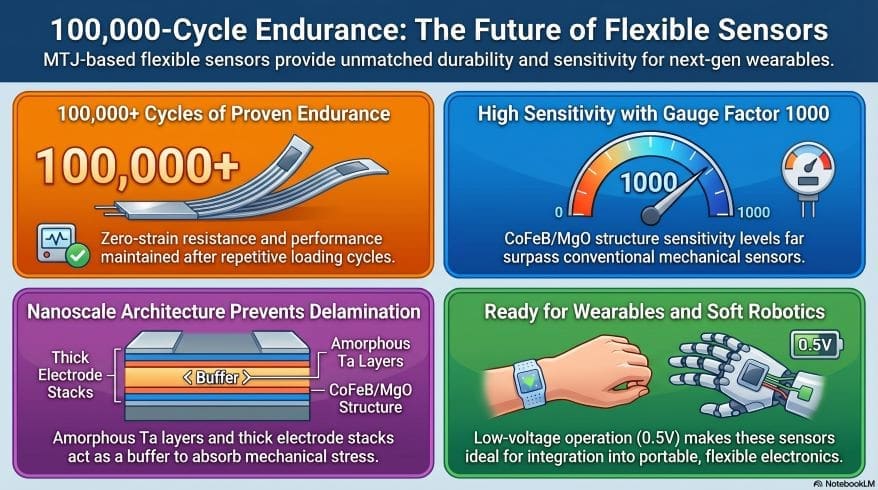
Another key point involves the material composition itself. Cobalt-iron-boron (CoFeB) is inherently tough at the nanoscale. The partial oxidation in the tantalum layer actually helps durability. This wasn’t accidental—it’s a natural consequence of the manufacturing process. Scientists recognized this beneficial effect during analysis.
Real-World Applications That Could Change Everything
Where These Sensors Will Go?
To enumerate the practical uses:
- Wearable fitness trackers that measure strain on muscles and joints
- Smart clothing that monitors posture and movement patterns
- Medical rehabilitation devices that track recovery progress
- Athletic performance monitoring in sports equipment
- Prosthetic limbs that detect limb movement and adjust accordingly
- Structural health monitoring for bridges and buildings
- Aerospace components that detect stress in aircraft structures
- Robotics applications requiring sensitive force feedback
In this case, athletes represent the most exciting early adopters. With this intention, companies could embed sensors in compression sleeves. Up to now, athletes relied on camera-based motion tracking systems. These new sensors offer continuous, accurate data. The sensors require minimal power consumption. Athletes could wear them all day without battery changes.
Healthcare Applications That Matter
Medical professionals need reliable monitoring systems. So as to improve patient outcomes, doctors track recovery progress. For the purpose of early detection, continuous monitoring works better than periodic checks. Patients recovering from surgery need movement tracking. These flexible sensors could be sewn into bandages. At the present time, hospitals use expensive rigid sensors. Prior to this breakthrough, flexible alternatives failed quickly. Now, durable flexible sensors become available.
Provided that companies manufacture these sensors affordably, medical costs could decrease. Patients would accept the technology more readily. Trust develops when devices survive daily use without failure.
What Challenges Remain Before Market Launch?
Manufacturing at Scale
Currently, scientists produce these sensors in laboratories. To rephrase it, mass production hasn’t started yet. Engineers must develop new manufacturing processes. At this instant, costs remain too high for consumer products. The devices need more testing in real-world conditions. Seeing that production requires specialized equipment, scaling presents challenges.
Industrial partners must invest in new facilities. Training technicians takes time and resources. Quality control systems need development. At least five years may pass before widespread availability. As has been noted, this timeline matches typical electronics development cycles.
Integration With Electronic Systems
Sensors alone don’t solve problems. They need electronic components to read their signals. So that data becomes useful, signal processing circuits are essential. To sum up, complete systems require several supporting technologies. Wireless transmission capability adds complexity and cost. Power management systems must minimize consumption. At any rate, integration represents the next major hurdle.
How Could You Get Involved? Careers to Explore
1. Study the Right Subjects
- Physics: Learn about magnetism, materials, and electronics.
- Chemistry: Understand how layers bond and react.
- Engineering: Dive into mechanical, electrical, or materials engineering.
2. Skills to Build Now
- Coding: Python or MATLAB for simulating sensors.
- 3D Printing: Design and test flexible prototypes.
- Lab Work: Join science clubs or summer research programs.
3. Jobs of the Future
| Career | What You’d Do |
| Materials Scientist | Design new flexible, durable materials. |
| Robotics Engineer | Build robots with “sensitive skin.” |
| Wearable Tech Designer | Create smart clothes or health monitors. |
| Nanotechnologist | Work with super-thin layers for next-gen sensors. |
| AI Hardware Engineer | Develop flexible chips for AI devices. |
4. Universities Leading the Way
- MIT (USA): Robotics and materials science programs.
- ETH Zurich (Switzerland): Flexible electronics research.
- University of Tokyo (Japan): Spintronics and wearable tech.
- Stanford (USA): AI and sensor technology.
- Tohoku University (Japan): Where this MTJ research happened!
Skills You Should Develop Now
As a matter of fact, high school students can start preparing. To illustrate, taking physics and chemistry classes builds foundation knowledge. Advanced placement courses in both subjects help tremendously. What’s more, computer programming skills are increasingly important. Engineers need to write code for signal processing. Attending science camps or robotics clubs provides hands-on experience.
Balanced against other opportunities, materials science offers strong career prospects. By and large, engineering fields experience job growth faster than many industries. This time around, flexible electronics specifically shows explosive growth potential.
FAQs About Flexible Magnetic Sensors
To address common doubts, here’s what you need to know:
How small are these sensors?
The magnetic layers measure just nanometers thick. The entire device fits in an area smaller than a postage stamp. In detail, dimensions depend on application requirements.
How soon will we see these sensors in stores?
Within 5 years, expect wearable health tech with MTJ sensors.
Can these sensors get wet?
That depends on encapsulation design. Protected sensors can survive in wet environments. Current laboratory versions require careful handling. Further development will improve water resistance.
How much do these sensors cost?
Laboratory prototypes cost hundreds of dollars. Mass production could reduce costs dramatically. In effect, consumer versions might cost dollars instead. At this time, commercial pricing remains uncertain.
What’s the difference from regular strain gauges?
Regular gauges measure resistance changes mechanically. Magnetic sensors use quantum effects instead. Gauge factors of 100-1000 surpass mechanical sensors. Low power consumption gives magnetic sensors an advantage.
Can students build these at home?
No, these require specialized laboratory equipment. Vacuum deposition systems create the thin films. Access requires university partnerships or internships. Career exploration starts with academic programs instead.
The Big Picture: Why This Matters for the Next Generation
All things considered, this discovery is a glimpse into the future—one where technology bends, stretches, and adapts to us. As a matter of fact, the scientists behind this breakthrough didn’t just invent a sensor. They opened the door to a world where:
- Your clothes monitor your health.
- Robots feel like humans.
- Gadgets survive drops, bends, and spills.
To put it differently, this is your generation’s chance to shape that future. Whether you’re a future engineer, scientist, or designer, the tools to innovate are right at your fingertips. So long as you’re curious, creative, and willing to learn—the next big breakthrough could be yours.
All in all, this discovery represents genuine progress. While it may be true that commercialization takes time, the fundamental challenge is solved. Scientists proved that flexible magnetic sensors survive real-world stresses. Prior to this work, skeptics doubted it was possible.
Flexible electronics is growing rapidly right now. Companies need engineers and scientists more than ever. If you enjoy physics, materials science, or engineering, explore this field. In conclusion, breakthrough discoveries like this create opportunities for the next generation of innovators.
Reference
Chiba, D., Imai, A., & Ando, A. (2026). Flexible magnetic tunnel junction-based strain sensor with over 100 000-cycle endurance. APL Electronic Devices, 2, 016114. https://doi.org/10.1063/5.0293081
- Author
- Latest Posts

Charudatta Pathak was a student at St. Aloysius High School in Bhusawal, established in 1874, making it one of India’s oldest convent institutions. He earned his bachelor’s degree in mechanical engineering from SSVPS College of Engineering, Dhule in 1995, demonstrating exceptional academic achievement. Thereafter, he launched his career as a CNC programmer in a toolroom. He has utilized FANUC, Deckel, Maho, and Mikron controllers to operate 2-axis and 3-axis machines for the fabrication of jigs, fixtures, dies, and molds. He commenced his career as an academic in 1996, when he assumed the role of lecturer at SSVPS College of Engineering, Dhule. Additionally, he earned his post-graduate degree in CAD/CAM from L. D. College of Engineering, Ahmedabad, in 2000, and then acquired a Ph.D. from COEP in 2011 while concurrently engaged in teaching. Until 2023, he occupied many academic roles, including lecturer, assistant professor, professor, dean, principal, director, and vice chancellor at both public and private universities throughout India. From 2008 to 2010, he served as the project lead in the CAE department of a European multinational firm. During his 28-year professional tenure, he identified a need for dependable books targeted at students in grades 8 to 12, particularly for nascent career planning. He founded ENTECH Digital Magazine, a free monthly publication available on entechonline.com and magzter.com. Teens with a strong interest in Science, Technology, Engineering, and Mathematics (STEM) who aspire to pursue careers in these fields may find ENTECH Digital Magazine beneficial.