By closely comparing the old vintage images with the fresh new data, astronomers spotted some truly shocking details hiding in plain sight.
This Giant Space Cloud Hid a Massive Secret for 24 Years… Until Hubble Looked Again!
What happens to a star after it completely explodes? Crab Nebula is my absolute favorite example in the night sky. Recently, excited astronomers used the famous Hubble Space Telescope to take a fresh look at this beautiful cosmic cloud. Honestly, it has been 24 long years since Hubble last captured a full picture of this expanding wreckage back in the year 2000. I find it so cool to see exactly how a giant space cloud changes over two full decades.
3 Mind-Blowing New Discoveries
I really want to share a fun listicle of my absolute favorite specific findings from this amazing telescope study. By closely comparing the old vintage images with the fresh new data, astronomers spotted some truly shocking details hiding in plain sight. Let me break down the top three secrets that Hubble finally revealed to us.
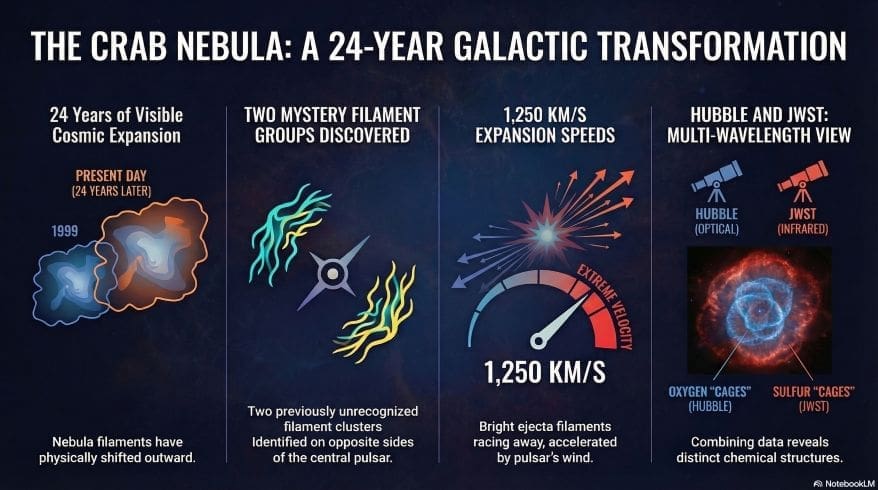
- Ghostly Energy Shifts: The totally invisible energy field surrounding the center actually changed its glowing shape! Over our 24-year wait, precious energy slowly leaked away from the central star engine. This caused the giant background glow to visibly shift in patchy, large-scale ways. It proves that the entire cloud is a living, continuously changing beast.
- A Strange New Clump: Scientists accidentally found a weird new grouping of chunky gas far up in the distant northwest corner. Nobody really noticed this hidden feature in the older pictures. Over the last two decades, this mystery structure visibly moved outward by about 3.7 arcseconds. It moves smoothly across our line of sight like a fast car.
- The Twin Clump: They also surprisingly found a second weird clump sitting right on the exact opposite side of the spinning star. These two clumps are perfectly balanced on totally far edges. However, this southeast clump aggressively moved in the opposite direction by about 2.8 tiny units. It is actually rushing straight toward us out of the dark background.
Let us travel back in time for just a moment to truly understand this cloud. The original star was incredibly huge, and when it finally ran out of fuel, its heavy core suddenly collapsed. This created a spectacular supernova explosion that violently ripped the entire star into tiny pieces. Ancient people living on our world actually saw this bright explosion vividly light up the night sky almost a thousand years ago! Today, we can still clearly see the remaining gas aggressively flying outward into the deep darkness.
Speeding Into the Dark Unknown
You might think space is perfectly still, but this gas cloud is actually highly restless. The outer edges of the glowing debris are zooming away from the center at terrifying speeds. Even crazier, I recently learned that this giant expansion is actually getting faster over time! This bizarre acceleration happens because a super-dense, spinning star called a pulsar sits right in the middle of the chaotic wreckage. It acts exactly like a powerful engine that constantly pushes the surrounding gas outward into the galaxy.
Unchanging Shapes in a Fast World
Despite this violent outward push, something very strange immediately caught my eye in the new data. The actual fine shapes of the delicate gas threads stay surprisingly stable as they forcefully travel through the vacuum of space. They beautifully move forward together like a giant balloon without noticeably stretching, ripping, or changing their delicate forms. For instance, weird structures that look like long skinny fingers simply moved forward while keeping their exact original shape. Even the thick, dark dust shadows hiding inside the bright ribbons look exactly the same today as they did 24 years ago.
Why Does This Even Matter?
You might be quietly asking yourself why I care so incredibly much about an old space cloud. The beautiful truth is, these exploded stars are the exact reason we all exist on planet Earth today. When massive stars violently blow up, they generously scatter essential life-giving elements entirely into the empty universe. By carefully studying how this debris moves, cools, and changes, we learn exactly how new planets are eventually born.
To quickly wrap things up, the long 24-year wait was absolutely worth every passing second. The main gas ribbons are rapidly speeding up, yet their delicate shapes miraculously remain perfectly frozen in passing time. The ghostly background glow is constantly shifting, and we finally found two mysterious new clumps flying through the dark void. I truly hope you highly enjoyed this incredibly fun journey through the beautiful night sky!
Reference
Blair, W. P., Sankrit, R., Milisavljevic, D., Temim, T., Laming, J. M., Slane, P., Ding, Z., & Martin, T. (2026). The Crab Nebula Revisited Using HST/WFC3. The Astrophysical Journal, 997(1), 81. https://doi.org/10.3847/1538-4357/ae2adc
- Author
- Latest Posts

Charudatta Pathak was a student at St. Aloysius High School in Bhusawal, established in 1874, making it one of India’s oldest convent institutions. He earned his bachelor’s degree in mechanical engineering from SSVPS College of Engineering, Dhule in 1995, demonstrating exceptional academic achievement. Thereafter, he launched his career as a CNC programmer in a toolroom. He has utilized FANUC, Deckel, Maho, and Mikron controllers to operate 2-axis and 3-axis machines for the fabrication of jigs, fixtures, dies, and molds. He commenced his career as an academic in 1996, when he assumed the role of lecturer at SSVPS College of Engineering, Dhule. Additionally, he earned his post-graduate degree in CAD/CAM from L. D. College of Engineering, Ahmedabad, in 2000, and then acquired a Ph.D. from COEP in 2011 while concurrently engaged in teaching. Until 2023, he occupied many academic roles, including lecturer, assistant professor, professor, dean, principal, director, and vice chancellor at both public and private universities throughout India. From 2008 to 2010, he served as the project lead in the CAE department of a European multinational firm. During his 28-year professional tenure, he identified a need for dependable books targeted at students in grades 8 to 12, particularly for nascent career planning. He founded ENTECH Digital Magazine, a free monthly publication available on entechonline.com and magzter.com. Teens with a strong interest in Science, Technology, Engineering, and Mathematics (STEM) who aspire to pursue careers in these fields may find ENTECH Digital Magazine beneficial.