Scientists achieve direct black hole mass measurement using advanced observations, improving accuracy in astrophysics, space research, and future cosmic studies.
A New Direct Black Hole Mass Measurement Changes Black Hole Science
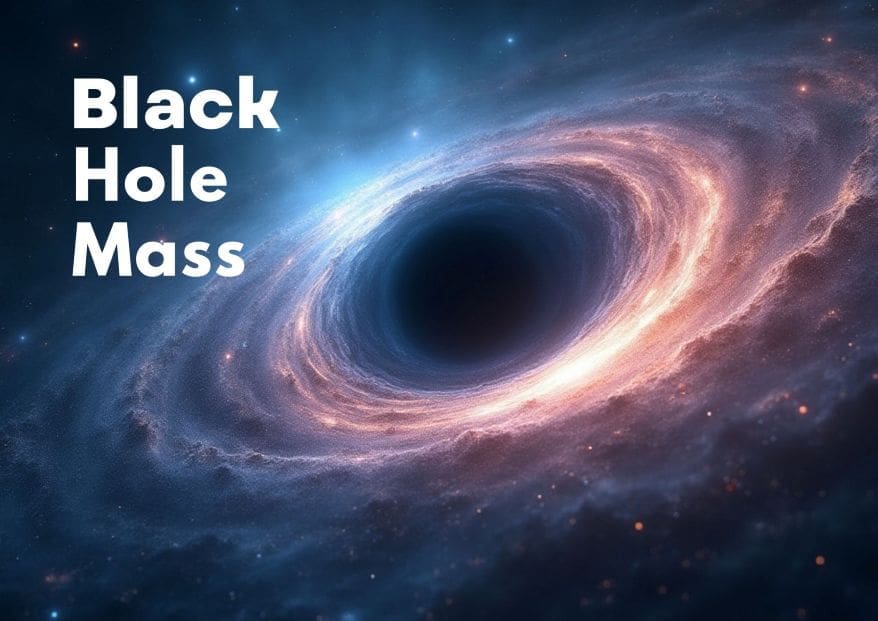
During the epoch of reionization, astronomers successfully determined the supermassive black hole mass that is located in a quasar system that is quite far away. The purpose of this study is to determine the black hole mass by utilizing strong dynamical evidence. New information regarding the growth of huge black holes in the early universe is provided by this measurement, which may also assist scientists in refining their models of the development of galaxies at the beginning of the universe.
Ignas Juodžbalis, Cosimo Marconcini, Francesco D’Eugenio, Roberto Maiolino, Alessandro Marconi, Hannah Übler, Jan Scholtz, Xihan Ji, Santiago Arribas, Jake S. Bennett, Volker Bromm, Andrew J. Bunker, Stefano Carniani, Stéphane Charlot, Giovanni Cresci, Pratika Dayal, Eiichi Egami, Andrew Fabian, Kohei Inayoshi, Yuki Isobe, Lucy Ivey, Gareth C. Jones, Sophie Koudmani, Nicolas Laporte, Boyuan Liu, Jianwei Lyu, Giovanni Mazzolari, Stephanie Monty, Eleonora Parlanti, Pablo G. Pérez-González, Michele Perna, Brant Robertson, Raffaella Schneider, Debora Sijacki, Sandro Tacchella, Alessandro Trinca, Rosa Valiante, Marta Volonteri, Joris Witstok, Saiyang Zhang conducted this research and published it under the title “A direct black hole mass measurement in a Little Red Dot at the Epoch of Reionization” in September 2025.
ENTECH STEM Magazine has included this research in its list of Top 10 Physics Discoveries and Innovation of 2025.
Measuring a Black Hole’s Mass in the Young Universe
The Target: A Little Red Dot at Redshift 7.04
The object studied, called QSO1, lies at redshift z = 7.04, which means we see it as it was just 700 million years after the Big Bang. At this early cosmic time, the universe was still transitioning from neutral gas to its modern ionized state. This era is known as the epoch of reionization. The term “Little Red Dot” refers to the appearance and spectral properties of the quasar. Which shows broad emission lines yet appears faint in optical wavelengths.
The Innovation: A Direct Dynamical Measurement
To determine the black hole mass directly. The team used deep spectroscopic data from state-of-the-art instruments, including JWST NIRSpec Integral Field Spectroscopy combined with gravitational lensing. These tools provided spatially resolved data on gas motion around the black hole.
By analyzing the rotation curve from hydrogen emission lines. The researchers found that the motion of gas is consistent with rotation around a central point mass rather than a surrounding stellar component. This allowed them to estimate the black hole’s mass at about 50 million times the Sun’s mass.
This measurement was possible because the rotation remained visible even at tiny spatial scales, thanks to precise spectroscopic techniques and spectroastrometry.
Why This Direct Measurement Matters
A Black Hole in Its Youth
Most black hole mass measurements at such high redshifts come from indirect methods. Such as using virial mass estimates from emission line widths. Those methods rely on assumptions about gas dynamics and may introduce uncertainties.
The current work, by contrast, directly traces gas movement and rotation. Consequently, it offers a more reliable measure of the central mass. Moreover, the study represents one of the first direct dynamical mass measurements of a black hole this early in the universe’s history.
Impact on Galaxy Evolution Studies
Supermassive black holes are thought to influence their host galaxies through feedback processes like jets and radiation pressure. However, understanding how such massive black hole masses formed and grew so quickly remains a major challenge in astrophysics.
The direct mass measurement at z = 7.04 aids in refining models of early black hole formation. In particular, it provides evidence that massive black holes existed when the universe was less than one billion years old. Pushing theories about how early gravitational collapse and accretion might occur.
Practical Uses of This Research
Refining Cosmological Models
The new measurement feeds directly into simulations of galaxy formation and evolution. Many models require inputs about early black hole populations and mass distributions. By providing a dynamical mass rather than an estimate. This work allows theorists to test assumptions about black hole mass growth and the interplay with cosmic gas and stars.
Benchmark for Future Observations
Direct measurements at such distances serve as benchmarks for future studies with instruments like JWST and upcoming extremely large telescopes. As data accumulates, astronomers can compare other early quasars against it. This measured mass improves our understanding of both typical black hole mass growth and the diversity of early black hole environments.
When might this discovery influence commercial or broader research tools?
At present, this discovery is primarily a scientific measurement rather than a technology ready for commercial application. However, the techniques and data analysis tools used here, especially those involving spectroastrometry and integral field spectroscopy, are pushing observational capabilities forward.
Over the next decade, similar methods may become part of analysis pipelines for large observational projects. Enhanced data processing software that grew out of these research tools could eventually find use in broader fields such as remote sensing, imaging science, and advanced signal processing.
While there is no defined commercial product yet, the ripple effects of this work could influence data analysis platforms and astronomy software that benefit academic and industry users alike.
Research Areas and Career Paths for Students
Observational Astronomy and Instrumentation
Students interested in observational astronomy can focus on techniques like integral field spectroscopy, gravitational lens modelling, and spectroastrometry. These skills are essential for working with instruments like JWST and future space telescopes.
Cosmology and Galaxy Formation
This measurement fits within the broader field of cosmology; therefore, researchers study the origin and evolution of the universe. Moreover, students in this domain often explore simulations of cosmic structure formation and early galaxy populations.
Data Science and Spectral Analysis
Handling large spectral datasets and extracting precise rotational curves involves advanced data analysis. Students with interests in data science, machine learning, or numerical modelling can apply these skills to both astrophysics and fields like medical imaging or remote sensing.
Theoretical Astrophysics
On the theory side, understanding black hole formation and growth engages topics like general relativity, accretion physics, and feedback processes. Students training in these areas may contribute to developing and testing simulations that incorporate the latest empirical measurements.
A New Window on the Early Universe
This direct black hole mass measurement pushes observational astronomy forward by showing that we can measure the mass of distant black holes with precision. By studying a massive black hole mass at z = 7.04, astronomers are improving our understanding of how early cosmic structures formed and evolved.
This work highlights how combining advanced spectroscopy with clever observational strategies brings us closer to answering some of the biggest questions in astrophysics: How did massive black holes grow so quickly? How did early galaxies evolve? With future telescopes and continued research.
Additionally, to stay updated with the latest developments in STEM research, visit ENTECH Online. Basically, this is our digital magazine for science, technology, engineering, and mathematics. Further, at ENTECH Online, you’ll find a wealth of information.
Reference:
- Juodžbalis, I., Marconcini, C., D’Eugenio, F., Maiolino, R., Marconi, A., Übler, H., Scholtz, J., Ji, X., Arribas, S., Bennett, J. S., Bromm, V., Bunker, A. J., Carniani, S., Charlot, S., Cresci, G., Dayal, P., Egami, E., Fabian, A., Inayoshi, K., . . . Zhang, S. (2025). A direct black hole mass measurement in a Little Red Dot at the Epoch of Reionization. arXiv (Cornell University). https://doi.org/10.48550/arxiv.2508.21748
- Author
- Latest Posts

I’m a web developer and science writer with a Master’s degree in Computer Applications (MCA) from Pune University.
I work in tech, building websites and staying updated with the latest developments. I also love writing about physics, chemistry, technology, robotics, mathematics, and breakthrough innovations. My passion is breaking down complex scientific topics into simple, easy-to-understand stories.
My goal is to help everyone stay informed about the exciting changes happening in science and technology. I believe understanding science shouldn’t be complicated—it should be accessible to all.