Mars is the best candidate in our solar system for terraforming.
Terraforming Mars: How Science Could Transform the Red Planet
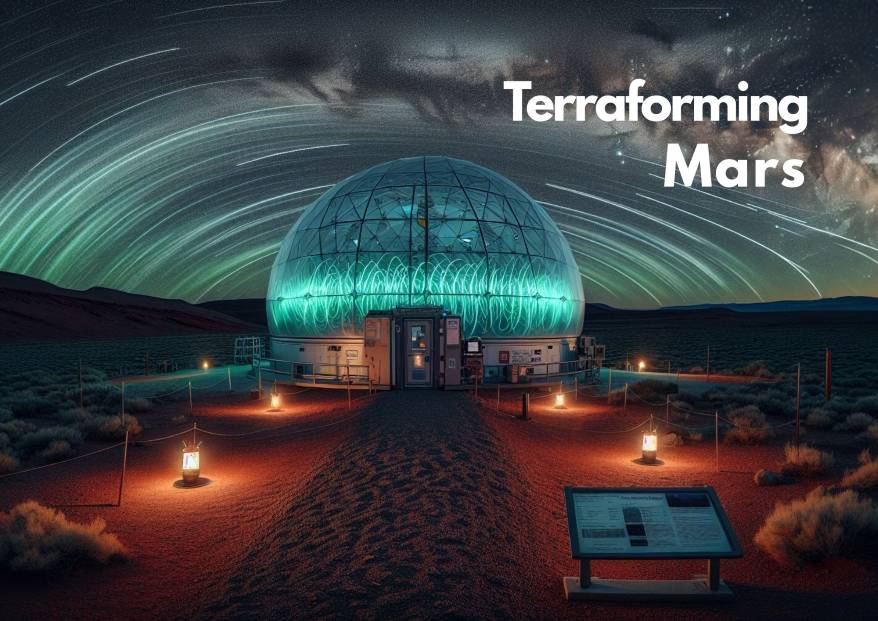
Estimated reading time: 4 minutes
Imagine a future where humans can live not only on Earth but also on Mars. This concept, called terraforming, involves changing Mars’ environment so that it becomes habitable—allowing people to breathe, grow food, and build communities. Once just science fiction, recent scientific research now suggests terraforming Mars could be possible centuries from today.
What Is Terraforming Mars?
Terraforming means altering a planet’s atmosphere and surface to make it similar to Earth. For Mars, this means increasing the temperature, creating an atmosphere rich in oxygen, and developing liquid water sources. Scientists believe that these changes could support human life in the future.
Why Mars?
Mars is the best candidate in our solar system for terraforming. It has days about 24 hours long and contains frozen water beneath its surface. However, Mars lacks a thick atmosphere and experiences freezing temperatures due to its thin air layer.
The goal of terraforming mars is to solve these problems by warming the planet and thickening its atmosphere.
The Science Behind Terraforming
Among the most prominent proposals for Terraforming Mars is the idea of releasing greenhouse gases into the planet’s atmosphere in order to trap heat. As a result of this warming, ice caps may melt, releasing water vapor and carbon dioxide into the atmosphere. These modifications would contribute to the creation of an environment that is more conducive to supporting life on Mars.
Another major Terraforming Mars strategy involves directing sunlight onto the Martian surface using giant mirrors placed in space, which would help raise surface temperatures. There is also the possibility that scientists could introduce specially engineered bacteria designed to produce oxygen over time, gradually transforming the planet’s atmosphere and making it more Earth-like.
Steps Toward Making Mars Habitable
Beginning With Warming
The first step in Terraforming Mars focuses on raising surface temperatures using greenhouse gases such as perfluorocarbons (PFCs) or factories that release carbon dioxide into the atmosphere. This action mimics Earth’s greenhouse effect but is applied on a planetary scale for Mars. As part of the Terraforming Mars process, warming the planet would help melt frozen soil layers that contain water ice, which is a crucial resource for supporting future life and long-term habitation.
Building an Atmosphere
A thicker atmosphere protects against harmful radiation from space and helps retain heat toward habitability levels. Releasing gases can contribute here, while technologies may one day import gases from outer space objects or use Martian minerals pressed into service for gas production.
Creating Water Sources
In order to sustain life, such as agriculture, the existence of liquid water is essential. Additionally, researchers suggest tactics such as melting polar ice caps or controlled asteroid impacts, which they consider to be capable of delivering sufficient water straight onto surface areas in order to maintain ecosystems that people will eventually create there.
The Importance of Research Today
The concept of making Mars habitable remains primarily theoretical, but ongoing research helps answer important scientific issues that researchers must resolve before they can make progress more quickly in the future. For example:
- How much energy is needed?
- What new materials work best?
- Which microbes thrive in harsh climates?
- How do extreme conditions affect sustainability over long periods?
According to DeBenedictis (2025), the study summary that was developed for the Green Mars Workshop in 2025 provides a number of solutions while also drawing attention to unidentified issues that call for concentrated efforts right now. Additionally, the study of terraforming on Mars is beneficial to fields that are located closer to home, such as climate engineering and the development of sustainable technology here on Earth.
Additionally, to stay updated with the latest developments in STEM research, visit ENTECH Online. Basically, this is our digital magazine for science, technology, engineering, and mathematics. Further, at ENTECH Online, you’ll find a wealth of information.
Reference
Stork, D., & DeBenedictis, E. (2025). An Introduction to Mars Terraforming, 2025 Workshop Summary. arXiv (Cornell University). https://doi.org/10.48550/arxiv.2510.07344
- Author
- Latest Posts

I’m a web developer and science writer with a Master’s degree in Computer Applications (MCA) from Pune University.
I work in tech, building websites and staying updated with the latest developments. I also love writing about physics, chemistry, technology, robotics, mathematics, and breakthrough innovations. My passion is breaking down complex scientific topics into simple, easy-to-understand stories.
My goal is to help everyone stay informed about the exciting changes happening in science and technology. I believe understanding science shouldn’t be complicated—it should be accessible to all.