Achieves high accuracy in forecasting and detecting extreme events (e.g., droughts), supporting climate monitoring and risk management.
What is Autoregressive Model (Adaptive) for Multivariate Extreme Climate Analysis
Climate change affects us all, making weather predictions more vital than ever. Advanced technology now helps scientists better forecast extreme events like droughts. Artificial intelligence (AI) uses big data and smart algorithms to analyze complex climate patterns—raising the question, what is autoregressive model? It’s a method that predicts future trends using past data, helping spot problems early so communities can prepare in time. For teens curious about STEM careers, this shows how science and technology combine to solve real-world challenges. Keep reading to discover a new AI tool transforming environmental monitoring.
TL;DR ‘What is Autoregressive Model’
Introduces what is autoregressive mode in the the MV former model, integrating adaptive auto-regression, neural volatility modeling, and clustering to analyze multivariate climate time series. By bringing together multiple disciplines, this breakthrough connects biology, chemistry, and health science. In doing so, it inspires students to pursue future careers in STEM fields.
Key Takeaways
- Multivariate Time Series (MTS) data: This means tracking multiple linked weather factors over time.
- MTS challenges: Complex relationships and changes make predictions difficult.
- A new AI model called the Multivariate Time Series Former (MVformer) improves both forecasting and clustering of climate data.
- This model handles data scarcity better using meta-learning, which adapts the AI smartly.
- The MVformer also links prediction and pattern detection to spot extreme events early.
Above all, using AI in climate science helps researchers predict trends faster and more accurately—leading to the question, what is an autoregressive model? It’s a technique that uses past data to forecast future patterns. The MV former breaks from older methods that treated forecasting and grouping as separate tasks, combining them into one system. This integration strengthens early warning systems for droughts and other hazards, supporting better safety and planning efforts.
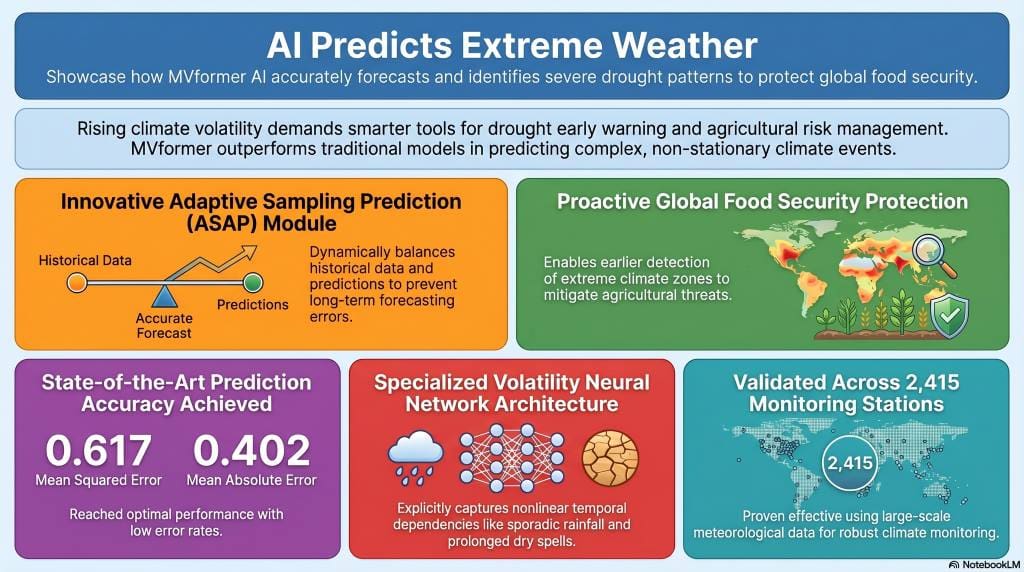
AI Predicts Extreme Weather
- To explain, multivariate time series track complex data.
- For the most part, sensors collect temperature details.
- At the same time, rainfall data is collected.
- In detail, MVformer studies these massive data sets.
- As a result, it spots drought patterns fast.
- To point out, deep learning models learn automatically.
- What’s more, neural networks process sequential data easily.
In essence, old statistical models work far too slowly, which raises the question: what is an autoregressive model? It is a method that uses past data to predict future outcomes. By comparison, this advanced AI learns much faster, showing why understanding what is an autoregressive model matters in modern forecasting. In like manner, it quickly uncovers hidden data trends, again highlighting what is an autoregressive model and how it improves predictions. Sooner or later, this powerful technology will help save lives.
The Tech Behind It
- To list, the tool uses an ASAP module.
- In this case, ASAP means adaptive sampling prediction.
- To point out, it mixes old and new data.
- What’s more, it groups similar weather events together.
- To sum up, we call this extreme clustering.
- To explain, transformers use special self-attention tech mechanisms.
- In short, this handles very long data sequences.
As has been noted, proper data collection is quite hard. To be sure, some sensor readings will very often fail. At any rate, MVformer easily cleans up this bad data. Together with math, it smartly fixes missing numerical values.
Math Saves The Day
- To illustrate, scientists tested Chinese weather monitoring stations.
- At this time, they checked summer temperature records.
- Then again, they checked summer rainfall amounts closely.
- In general, rainfall changes more than regional temperature.
- To that end, the AI caught these changes.
- In fact, experts used mean absolute percentage error.
- To repeat, low error means high prediction accuracy.
In fact, the new model accuracy was truly amazing. As can be seen, prediction errors dropped quite significantly. With attention to details, it easily beat other tools. All things considered, the important weather test was successful.
Real World Action
- To explain, farmers really need early drought warnings.
- In like fashion, cities need water supply alerts.
- Summing up, MV former helps leaders make informed choices.
- For the purpose of safety, warnings save food.
- All in all, risk management improves every day.
- To that end, anomaly detection finds weird weather.
- In essence, this prevents sudden massive crop deaths.
With this intention, smart government leaders plan properly ahead. So long as they listen, local farms will safely survive. At least, they avoid total economic crop failure completely.
Why MVformer Matters To Future STEM Careers
- Diverse skill set: Combines knowledge of math, computer science, statistics, environmental science, and engineering.
- A solution-driven mindset: Helps students see project goals like real disaster prevention or resource management in practice.
- Evolving technologies: Opens opportunities in AI research, software development for earth sciences, or sustainability innovation roles.
- Lifelong learning: Shows skills like meta-learning improve machine adaptability beyond traditional coding techniques.
Frequently Asked Questions
1. What is multivariate time series data?
It tracks several variables changing over time together—like temperature, rainfall levels, wind speed all at once
2. Why do traditional models struggle?
Older statistical methods assume simple linear connections; however weather systems show nonlinear behaviors needing better adaptive tools.
3. What makes MVformer special?
It integrates forecasting with cluster analysis while improving learning efficiency when little labeled example data is available
4. How can I learn more about technologies like transformers?
Study deeper computer science topics related to neural networks along with math foundations such as linear algebra.
Reference:
- Xu J., Tang H., Wang Y., et al. (2026). Meta-learning based Multivariate Time Series Former towards joint forecasting-clustering environmental monitoring applications. Scientific Reports. https://doi.org/10.1038/s41598-026-40558-8
- Author
- Latest Posts

I completed my Master of Science from the University of Allahabad in 2017 with a strong academic background in life sciences and chemistry. My specialization included Molecular Biology, Microbiology, Genetics, Plant Breeding, Phycology, Paleobotany, and Bioinformatics, along with Organic Chemistry, Inorganic Chemistry, and Physical Chemistry. This multidisciplinary training provided me with a comprehensive understanding of biological systems and analytical scientific approaches.
After completing my postgraduate studies, I gained valuable professional experience in both the education and social development sectors. I worked at A.M. Oxford Public School, where I was actively involved in guiding students toward academic excellence. In this role, I focused on creating an engaging learning environment, encouraging critical thinking, and nurturing students’ curiosity for scientific learning. My experience as an educator strengthened my communication, mentoring, and classroom management skills.
In addition to my teaching experience, I worked with Jeevan Jagriti Foundation, where I contributed to community-based initiatives aimed at improving educational access and awareness among underprivileged sections of society. Through this work, I participated in programs designed to support social development and promote the value of education in marginalized communities.
These professional experiences helped me develop strong interpersonal, leadership, and organizational skills while reinforcing my commitment to education and community service.