Discover How Diabetes Drugs Could Change Addiction Treatment Forever
Diabetes Drugs Offer Promising New Therapeutic Options

Estimated reading time: 4 minutes
Scientists have discovered an important connection between diabetes drugs and mental health. Imagine a medicine originally made for diabetes now helping treat addiction. Scientists are studying this breakthrough. They found that GLP-1 receptor agonists (GLP-1 RAs), used to control blood sugar, might also reduce cravings for substances like alcohol, nicotine, and opioids. What’s more, they could help with mental health problems and protect the kidneys. Certainly, this discovery connects what you learn in biology about hormones and brain function to real-life medical advances. With this in mind, students passionate about STEM can see how their science knowledge relates to future careers in medicine and research.
TL;DR
GLP-1 drugs, originally for diabetes, now revolutionize medicine by aiding weight loss, protecting the heart and kidneys, and potentially improving mental health. This breakthrough connects biology, chemistry, and health science, inspiring future STEM careers for students.
Diabetes drugs and mental health: Key Takeaways
- Developed for diabetes: GLP-1 RAs control blood sugar by affecting hormones.
- Addiction impact: These drugs lower cravings for alcohol, nicotine, cocaine, and opioids.
- Mental health benefits: They may reduce depression symptoms and improve mood.
- Kidney protection: GLP-1 RAs help slow kidney damage in diabetic patients.
- Ongoing studies: Large clinical trials are testing their full potential across diseases.
This article from the Journal of Clinical Medicine highlights cutting-edge research on these medications. So far, the results offer hope beyond typical diabetes care—showing promise for multiple health challenges.
The Science Behind GLP-1 Receptor Agonists
The body naturally produces a hormone called GLP-1 after meals. Also, It signals the pancreas to release insulin and slows stomach emptying. Because natural GLP-1 breaks down quickly, scientists created synthetic versions called receptor agonists (GLP-1 RAs) that last longer.
- Mimic natural hormone: They activate receptors involved in glucose control.
- Weight management: These drugs reduce appetite by acting on brain centers that control hunger.
- Treatment evolution: Drugs like semaglutide now come as injections or pills approved for obesity too.
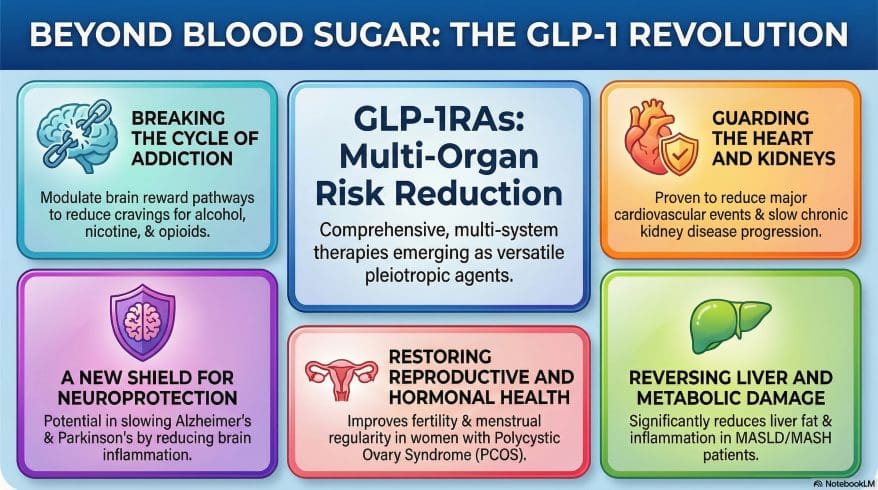
Taken together, these effects improve metabolism and overall health. With this purpose in mind, researchers started exploring additional benefits related to brain functions linked to addiction and mood disorders.
Pleotropic Effects: From Addiction Treatment to Mental Health
This means one medication has multiple positive effects beyond original use. Some notable findings include:
Tackling Addiction Disorders
- Alcohol Use Reduction: Studies found semaglutide lowered alcohol intake and relapse risk by affecting the brain’s reward system.
- Cigarette Smoking Help: Smokers using GLP-1 RAs showed less nicotine dependence; these drugs also prevented post-quitting weight gain.
- Cocaine & Opioid Dependence: Animal models reveal reduced drug-seeking behavior after treatment with these medicines.
Mental Health Improvements
- Lowers Depression Symptoms: Patients taking GLP-1 RAs reported feeling less depressed compared with other treatments.
- Anxiety Relief Potential: Early studies suggest better regulation of mood-linked neurotransmitters like serotonin through receptor activation.
Apart from mental wellness benefits, their protective role against kidney disease has major clinical importance especially in diabetes patients at risk of chronic kidney failure. Additionally, the FLOW clinical trial demonstrated significantly slower kidney damage when using semaglutide versus placebo controls—highlighting both cardiovascular and renal advantages too.
Careers Inspired by Diabetes Drugs and Mental Health
This breakthrough offers an excellent case study for high school students loving biology or chemistry concepts around hormones and drug design—and wondering where it all leads professionally:
- Biosciences Researcher: You could contribute by developing new therapies enhancing human health across diseases like diabetes or addiction disorders. Explore more about Biomedical Engineering Career Opportunities here.
- Chemical Engineer: You may design efficient ways to produce stable medicines such as long-lasting peptide drugs. Explore more about chemical engineering education here.
- NHS/Healthcare Professional: You could play a key role applying novel treatments to patients while educating others on healthy lifestyles tied closely with scientific advancements going forward.
The present time is perfect for youth interested in medical sciences or technology because innovation impacts many fields simultaneously and brings opportunities never imagined before at school level alone. As all things considered here point out—the world needs bright minds willing to turn scientific discoveries into reality improving quality of life globally!
Additionally, to stay updated with the latest developments in STEM research, visit ENTECH Online.
Reference
- Matuszewski, W., Wołos-Kłosowicz, K., Włodarczyk, P., Waśniewska, P., Modzelewski, R., Górny J.M., et al.(2026). Beyond glycemic control: GLP‐1RA–based therapies and emerging targets beyond the metabolic axis. Journal of Clinical Medicine, 15(7), Article2786. https://doi.org/10.3390/jcm15072786
This article was written by Rakshanda Jabbar and reviewed for editorial accuracy by our editorial team. It has not yet undergone independent review by a professional.
- Author
- Latest Posts

I completed my Master of Science from the University of Allahabad in 2017 with a strong academic background in life sciences and chemistry. My specialization included Molecular Biology, Microbiology, Genetics, Plant Breeding, Phycology, Paleobotany, and Bioinformatics, along with Organic Chemistry, Inorganic Chemistry, and Physical Chemistry. This multidisciplinary training provided me with a comprehensive understanding of biological systems and analytical scientific approaches.
After completing my postgraduate studies, I gained valuable professional experience in both the education and social development sectors. I worked at A.M. Oxford Public School, where I was actively involved in guiding students toward academic excellence. In this role, I focused on creating an engaging learning environment, encouraging critical thinking, and nurturing students’ curiosity for scientific learning. My experience as an educator strengthened my communication, mentoring, and classroom management skills.
In addition to my teaching experience, I worked with Jeevan Jagriti Foundation, where I contributed to community-based initiatives aimed at improving educational access and awareness among underprivileged sections of society. Through this work, I participated in programs designed to support social development and promote the value of education in marginalized communities.
These professional experiences helped me develop strong interpersonal, leadership, and organizational skills while reinforcing my commitment to education and community service.