Critical zone processes limit natural weathering rates significantly. Soil thickness, water flow paths, and secondary mineral formation all restrict alkalinity release from basaltic systems
Basaltic Alkalinity Export: A Discovery in Critical Zone Processes
Estimated reading time: 6 minutes
Basalt rocks cover about 5% of Earth’s land surface. These dark volcanic rocks interact with water and air. This interaction can remove carbon dioxide from the atmosphere. For years, scientists thought basaltic alkalinity export was a simple chemical reaction. New research changes this view completely. A study published in Nature reveals that critical zone processes significantly limit how much alkalinity export occurs from basalt landscapes. This finding matters for climate change solutions. Many companies plan to use crushed basalt on farmlands. They believe this will capture carbon quickly. The new data suggests the process is more complex than expected. Understanding these limitations helps us design better carbon removal strategies. Let us explore what this means for our planet’s future.
ENTECH STEM Magazine has included this research in its list of Top 10 STEM Discoveries and Innovations of August 2026.
Key Takeaways: Basaltic Alkalinity Export
- Critical zone processes reduce alkalinity flow from basalt by 30-50%
- Basaltic landscapes show slower weathering rates in natural settings
- Soil thickness and water flow patterns control alkalinity release
- Current carbon removal models may overestimate basalt’s potential
- Real-world measurements differ from laboratory predictions
Understanding Basalt Weathering and Alkalinity Production
What Happens When Basalt Weathers?
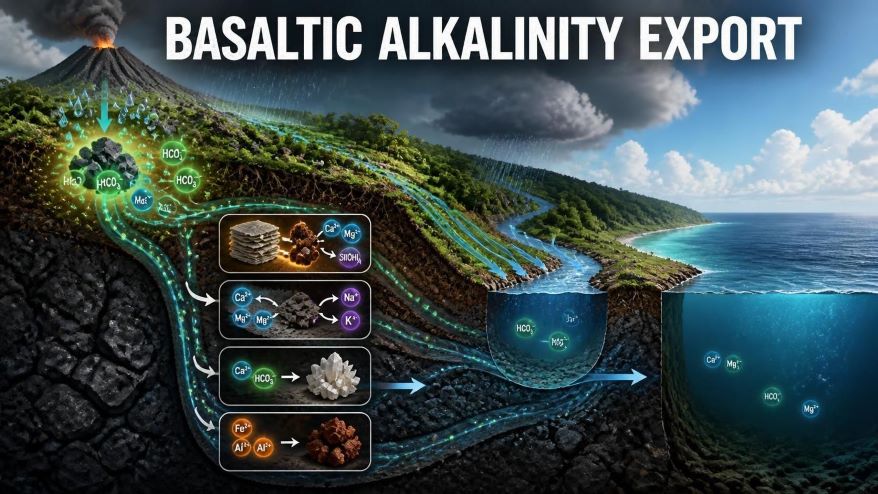
To begin with, basalt contains silicate minerals rich in calcium and magnesium. Prior to reaching the rock, rainwater mixes with atmospheric carbon dioxide. Consequently, this mixture forms a weak acid. Over time, this acid dissolves basalt minerals slowly. As a result, the reaction releases calcium, magnesium, and bicarbonate ions into water. These dissolved ions then create alkalinity. In essence, alkalinity measures water’s ability to neutralise acid. Above all, higher alkalinity export means more carbon dioxide gets locked away. For the most part, scientists call this process enhanced silicate weathering. After all, it represents a natural carbon sink operating over geological timescales. At any rate, this process is fundamental to long-term climate regulation. To put it another way, the Earth uses this mechanism to balance atmospheric carbon levels over millions of years.
The Critical Zone Concept Explained
First of all, the critical zone goes from tree tops to deep ground water. This thin layer feeds all land life. It holds soil, old rock, and living things. Inside this zone, body, chem, and life acts mix all the time. These mixes steer how alkalinity from basaltic systems gets to rivers and seas.
To start with, think of a hillside full of basalt rocks. Rain falls and goes into the soil. Water moves through small holes and cracks. Plant roots let out weak acids that break down rock. Tiny life forms eat these plant bits and make more CO₂.. The water chem changes a lot.
The Nature Study: Key Findings on Basaltic Alkalinity Export
Research Methods and Site Selection
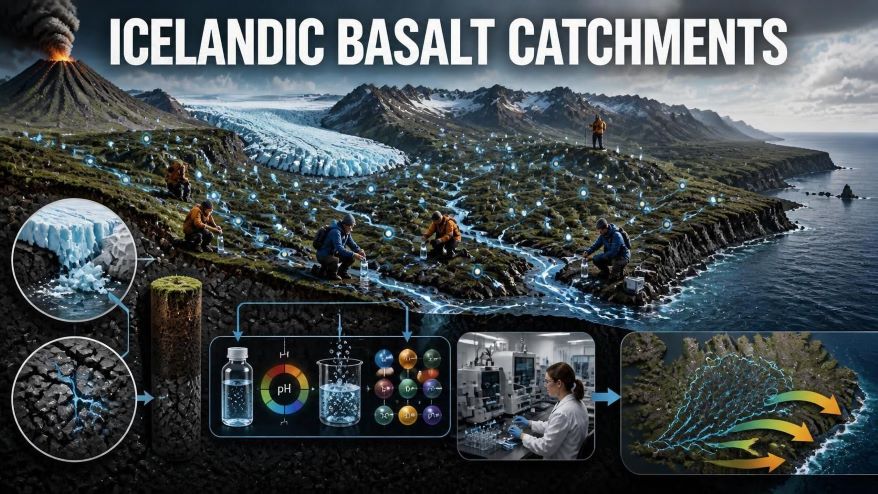
First of all, researchers from multiple institutions studied Icelandic basalt catchments. To be sure, Iceland provides ideal conditions for this work. As a matter of fact, young basalt rocks cover most of the island. In addition, glacial activity exposes fresh mineral surfaces continuously. Consequently, the study of basalt alkalinity here reveals fundamental processes.
After that, the team collected samples from 40 different streams. What’s more, they measured major ions, pH, and dissolved carbon. At the same time, they analysed soil profiles and bedrock fractures. As a result, this full approach let them calculate alkalinity fluxes with high precision.
Model Limitations and Overestimates
Carbon removal models often ignore critical zone buffering effects. These models assume all dissolved alkalinity reaches the ocean. In reality, alkalinity from basalt weathering can precipitate as secondary minerals. This re-precipitation returns carbon dioxide to the atmosphere. Clay minerals form during basalt weathering. These clays can absorb alkalinity ions and remove them from solution. The processes reduce the effective alkalinity export by 30-50%.
Environmental Factors Affecting Basaltic Alkalinity Export
Temperature Effects on Weathering
Temperature influences chemical reaction rates. Warmer conditions accelerate basalt dissolution. However, the Nature study found temperature effects are secondary. Soil water dynamics matter more than temperature alone. Cold climates with thin soils produce more alkalinity per unit area. This seems counterintuitive. But thin soils allow better water-rock contact. Basalt alkalinity export happens despite slower reaction kinetics.
Vegetation and Microbial Influence
Plants and microbes actively modify basalt weathering. Tree roots physically break rocks apart. Root exudates chemically attack mineral surfaces. Mycorrhizal fungi enhance nutrient release from basalt. These biological processes increase total alkalinity production. However, they also consume carbon dioxide through photosynthesis. The net effect on atmospheric carbon depends on ecosystem balance.
Future Research Directions in Basaltic Alkalinity Export
Quantifying Secondary Mineral Formation
First of all, researchers need to measure how much alkalinity turns into new rocks. To be sure, this requires good isotopic tracing tools. After all, the Nature study gives a start frame. What’s more, field tests with marked basalt bits could track rock break down. In addition, watching these bits for years would show true carbon grab rates. As a result, long-term watch studies are key for model check.
Developing Better Predictive Models
To start with, current models make the zone water flow too simple. By contrast, new models must add soil depth change and crack nets. In addition, they should put in life acts and dead plant bits. In the same way, machine learning tools could mix many site facts. As a result, these tools might guess basalt alkalinity export for all lands. Consequently, train data from many sites would boost model truth.
Conclusion: Basaltic Alkalinity Export
The Nature study fundamentally changes our understanding of basalt alkalinity export. Critical zone processes limit natural weathering rates significantly. Soil thickness, water flow paths, and secondary mineral formation all restrict alkalinity release from basaltic systems. Enhanced weathering projects must account for these limitations. Simple laboratory weathering rates do not apply in complex field environments. Real-world measurements show 30-50% less alkalinity export than predicted.
Frequently Asked Questions: Basaltic Alkalinity Export
What is basaltic alkalinity export?
Basaltic alkalinity export refers to the transport of dissolved bicarbonate ions from basalt weathering into rivers and oceans. This process removes carbon dioxide from the atmosphere over long timescales.
How does the critical zone affect basalt weathering?
The critical zone includes soil, weathered rock, and living organisms. These layers control water flow and chemical reactions. Thick soils limit water contact with fresh basalt, reducing alkalinity production.
Why is the Nature study important for climate solutions?
The study shows natural basalt weathering releases less alkalinity than expected. This means enhanced weathering projects may capture less carbon than current models predict. Realistic models improve climate strategy planning.
Reference
Derry, L. A., Maher, K., & Chadwick, O. A. (2026). Critical zone processes limit alkalinity export from natural basaltic systems. Nature, 657, 150–155. https://doi.org/10.1038/s41586-026-10936-3
Editorial Note: This article was written by Rakshanda Jabbar and reviewed for editorial accuracy by our editorial team. It has not yet undergone independent review by a professional.
Edited by Juveriya Khan
- Author
- Latest Posts

I completed my Master of Science from the University of Allahabad in 2017 with a strong academic background in life sciences and chemistry. My specialization included Molecular Biology, Microbiology, Genetics, Plant Breeding, Phycology, Paleobotany, and Bioinformatics, along with Organic Chemistry, Inorganic Chemistry, and Physical Chemistry. This multidisciplinary training provided me with a comprehensive understanding of biological systems and analytical scientific approaches.
After completing my postgraduate studies, I gained valuable professional experience in both the education and social development sectors. I worked at A.M. Oxford Public School, where I was actively involved in guiding students toward academic excellence. In this role, I focused on creating an engaging learning environment, encouraging critical thinking, and nurturing students’ curiosity for scientific learning. My experience as an educator strengthened my communication, mentoring, and classroom management skills.
In addition to my teaching experience, I worked with Jeevan Jagriti Foundation, where I contributed to community-based initiatives aimed at improving educational access and awareness among underprivileged sections of society. Through this work, I participated in programs designed to support social development and promote the value of education in marginalized communities.
These professional experiences helped me develop strong interpersonal, leadership, and organizational skills while reinforcing my commitment to education and community service.