Discovery of Efficient RNA Silencing Against Four Virulence Genes
Discovery of RNA Silencing Efficiency for Targeting Virulence Genes

Estimated reading time: 6 minutes
Plants and animals share a quiet defence system. RNA silencing spots foreign genetic material. It turns matching genes off afterward. Efficiency decides how well the system works. Fast silencing stops viruses early. Slow silencing leaves cells exposed. So research teams measure this trait often. The same machinery guides crop breeding. It also shapes modern medicines. Scientists call the best outcomes RNA silencing efficiency. Good efficiency means strong gene shutdown. Weak efficiency gives only partial protection. Small RNA molecules carry each target’s address. Matching triggers the molecular switch. Enzymes supply the needed power.
ENTECH STEM Magazine has included this research in its list of Top 10 STEM Discoveries and Innovations of August 2026.
Key Takeaways: RNA Silencing Efficiency
- RNA silencing switches matching genes off.
- DICER and AGO proteins run the core machinery.
- Small RNA size and sequence drive the outcome.
- Simple lab tests can measure silencing strength
What Is RNA Silencing?
In the study of RNA silencing efficiency, the first is that a gene makes a message. This message is called messenger RNA. It carries the code for a protein. Here is how RNA silencing works. Small RNAs find this message. They look for a matching sequence. Then, they cut the message. This stops the protein from being made. Many living things use this system. Plants use it every day. Animals and fungi use it too. The start is always the same. A double-stranded trigger is cut into small pieces. These small pieces then patrol the cell. They look for a match. If the match is perfect, the message is destroyed. If the match is only partial, the message is blocked. These same rules apply to all life. As a result, this pathway powers many modern tools. However, the strength of the effect is not the same in every cell. Some cells are stronger than others.
Researchers found the system almost by accident. First, petunia tests produced strange white patterns. Later, roundworm work confirmed the mechanism. That discovery earned a Nobel Prize in 2006. As a result, dozens of crops now carry useful traits. For example, vegetables stay fresh longer in several trials. In addition, fungal resistance appears in engineered lines. Furthermore, scientists track how silencing moves between cells. They call that spread systemic silencing. A signal travels from the start site onwards. Consequently, this movement multiplies the response’s reach. Therefore, mobile RNA silencing now ranks as a key focus. The signal can cross plant graft joints. Mobile RNA silencing shapes orchard protection choices. For instance, grafted vines share signals with rootstocks.
Why RNA Silencing Efficiency Matters
Efficiency is never a luxury in this system. Instead, it is a survival issue for any cell. First, weak silencing gives viruses room to multiply. In contrast, strong silencing clears invaders within hours. As a result, plant RNA interference protects crops from many pathogens. Moreover, efficiency also sets the speed of recovery. Fast responses stop disease from spreading. On the other hand, slow responses allow greater tissue damage. Consequently, growers watch these differences closely. Therefore, breeders select lines with stronger responses. What’s more, climate stress raises the stakes. Warmer seasons favour faster virus cycles. As a result, crops then need a dependable shield. So, RNA silencing efficiency becomes a breeding target. Good levels reduce pesticide use. In the end, the results help farms and ecosystems. Finally, researchers screen many lines for this trait.
Key Factors Behind RNA Silencing Efficiency
First of all, efficiency never comes from a single step. In fact, every stage in the chain matters. As a result, scientists weigh each stage separately. To begin with, sequence matching forms the first control point. In addition, the ratio of trigger to target changes the rate. Likewise, cell health sets the upper limit. Furthermore, temperature shifts alter enzyme speed. Surprisingly, nutrient status matters more than expected. Moreover, stress often weakens the response. For example, healthy plants silence faster under test. Also, delivery routes change local impact too. Therefore, each factor can be tuned alone. However, the full picture emerges from combined trials.
RNA Minimum Free Energy: A Critical Determinant of Gene Silencing Success
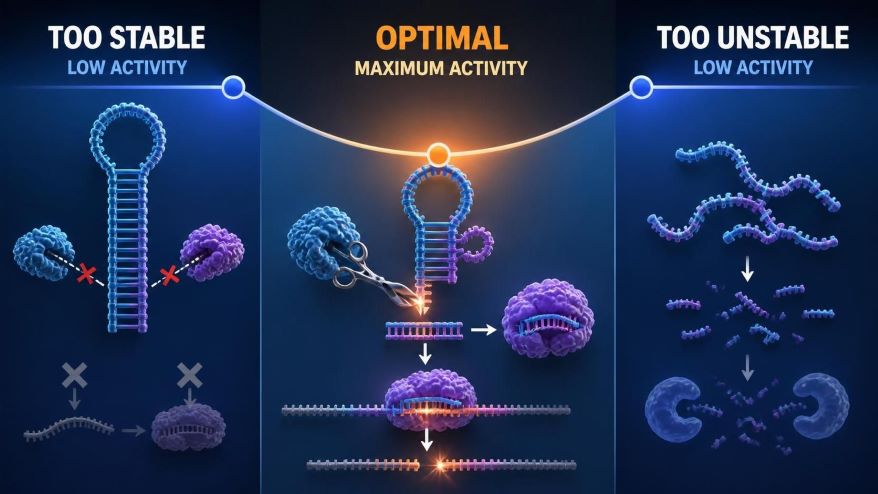
The study found that minimum free energy strongly correlates with silencing outcomes. Constructs with very stable stem structures (low free energy) performed poorly. Those with moderately stable stems showed maximum activity. Highly unstable constructs also failed to silence effectively.
Why does this happen? Excessively stable RNA resists unwinding. Dicer and RISC require single-stranded regions to initiate processing. When the stem is too tight, these enzymes cannot access the RNA. Conversely, very unstable structures degrade rapidly in cellular environments. They fail to reach or activate the silencing machinery.
Spacer Sequences Influence Processing and Stability
Spacer regions connect the two complementary arms in hairpin RNA constructs. These sequences affect how the molecule folds and how Dicer processes it. The research team tested spacers ranging from 30 to 200 base pairs. They also varied spacer composition.
Short spacers (30-50 bp) produced compact hairpins. These structures showed reduced RNA silencing efficiency. Long spacers (150-200 bp) allowed flexible folding. However, they also reduced overall construct stability. The optimal spacer length fell between 80 and 120 base pairs.
Differential Sensitivity Among Target Genes
Not all virulence genes respond equally to RNA silencing. The study revealed substantial differences between the four targets. One gene showed over 90% suppression with optimal constructs. Another reached only 40% maximum silencing. This differential sensitivity has important implications.
The highly sensitive gene encoded a key oxalic acid biosynthesis enzyme. This protein directly contributes to pathogenesis. Its mRNA may have features that enhance RNA accessibility. The less responsive gene encoded a regulatory protein. Its expression level and mRNA structure may reduce silencing susceptibility.
Practical Implications for RNA-Based Fungicide Development
These findings offer concrete guidance for product development. First, construct designers should calculate minimum free energy during the design phase. Software tools can predict RNA secondary structure. Targeting a free energy range of -30 to -50 kcal/mol provides a good starting point. Second, spacers should span 80-120 base pairs. They should avoid stable secondary structures.
Third, screening multiple target genes improves success rates. Some genes naturally respond better to silencing. Fourth, combining constructs targeting different genes may enhance overall efficacy. This also reduces resistance development risk. RNA silencing efficiency can be optimised through systematic design iteration.
Frequently Asked Questions
What is minimum free energy in RNA design?
Minimum free energy measures RNA secondary structure stability. Lower values indicate more stable folding. This affects how cells process double-stranded RNA for gene silencing.
How does spacer sequence affect RNA silencing?
Spacers connect complementary regions in hairpin RNA. Optimal length ranges from 80 to 120 base pairs. Spacers with stable secondary structures reduce silencing effectiveness.
Can RNA-based fungicides replace traditional chemicals?
RNA fungicides offer complementary control methods. They work well in integrated pest management programs. They may reduce but not entirely replace chemical fungicide applications.
Reference
Azizi, A., & del Río Mendoza, L. E. (2026). Effect of RNA minimum free energy and spacer on silencing of four Sclerotinia sclerotiorum virulence genes. Scientific Reports. https://doi.org/10.1038/s41598-026-68105-5
Editorial Note: This article was written by Rakshanda Jabbar and reviewed for editorial accuracy by our editorial team. It has not yet undergone independent review by a professional.
Edited by Juveriya Khan
- Author
- Latest Posts

I completed my Master of Science from the University of Allahabad in 2017 with a strong academic background in life sciences and chemistry. My specialization included Molecular Biology, Microbiology, Genetics, Plant Breeding, Phycology, Paleobotany, and Bioinformatics, along with Organic Chemistry, Inorganic Chemistry, and Physical Chemistry. This multidisciplinary training provided me with a comprehensive understanding of biological systems and analytical scientific approaches.
After completing my postgraduate studies, I gained valuable professional experience in both the education and social development sectors. I worked at A.M. Oxford Public School, where I was actively involved in guiding students toward academic excellence. In this role, I focused on creating an engaging learning environment, encouraging critical thinking, and nurturing students’ curiosity for scientific learning. My experience as an educator strengthened my communication, mentoring, and classroom management skills.
In addition to my teaching experience, I worked with Jeevan Jagriti Foundation, where I contributed to community-based initiatives aimed at improving educational access and awareness among underprivileged sections of society. Through this work, I participated in programs designed to support social development and promote the value of education in marginalized communities.
These professional experiences helped me develop strong interpersonal, leadership, and organizational skills while reinforcing my commitment to education and community service.