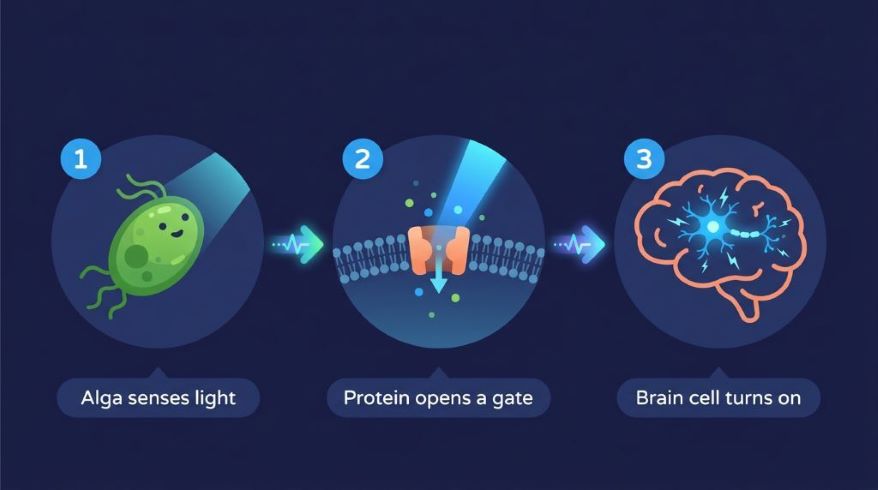
Optogenetics lets scientists switch chosen nerve cells on or off with light. Researchers first introduce a light-sensitive gene into those cells. They then aim pulses of light at the cells. The cells fire, or go quiet, right when the light arrives. This method won the 2026 Nobel Prize in Physiology or Medicine. Karl Deisseroth, Peter Hegemann and Georg Nagel share the award. Their story starts with a tiny alga that swims toward light. The protein that steers it became a switch for the brain.
Three terms help here. Neurones, for example, are brain cells carrying electrical signals. An ion channel, meanwhile, is a gate in a cell’s surface that lets charged particles through. Finally, channelrhodopsin is the algal protein that does jobs: it senses light and opens a gate.
Key Takeaways: 2026 Nobel Prize in Physiology
A swimming alga led to a light-gated channel, and that channel led to control of neurones in living brains.
Deisseroth, Hegemann and Nagel share the 2026 Nobel Prize in Physiology or Medicine.
Optogenetics switches genetically targeted cells on or off in milliseconds, demonstrating cause and effect.
It has changed textbook ideas about memory, reward, anxiety and parenting.
Clinical use is early. One patient regained partial vision, and other uses remain hopeful.
Who won the Nobel prize 2026 in Physiology or Medicine?
The Nobel Assembly at Karolinska Institutet announced this prize on 5 October 2026. First, the prize went to Karl Deisseroth, Peter Hegemann, and Georg Nagel for their discoveries concerning light-gated ion channels and optogenetics. Furthermore, the three scientists will share 12 million Swedish kronor equally.
Each scientist, however, solved a different part of the puzzle. First, Peter Hegemann and Georg Nagel discovered channelrhodopsin in a single-celled alga. This protein can respond to light and cause changes in electrical activity. Next, Karl Deisseroth used this discovery to develop a way to control nerve cells with light. As a result, researchers can switch selected nerve cells on or off and study their effects more directly.
Why Was Controlling Brain Cells So Hard?
The brain is the most complex organ in the body. First, its neural circuits are tightly connected, and neighbouring cells can perform very different functions. Moreover, brain activity can change within milliseconds. Therefore, for decades, the main challenge was not only to observe brain activity but also to change it precisely enough to test cause and effect (Nobel Assembly, 2026b).
In addition, scientists used several tools to study the brain. Electrical recordings, lesion studies, drugs, and brain imaging helped researchers connect neural activity with movement, emotion, and thought. However, these methods had important limits. For example, they could not easily switch one specific type of nerve cell on or off while the brain circuit remained intact. Furthermore, they could not provide the same level of precise control at the speed of normal neural activity. As a result, scientists needed a new method that could control selected nerve cells quickly and accurately
First, Francis Crick recognised this major gap in brain research many years ago. He argued that scientists needed a way to control specific groups of neurones. Furthermore, he suggested that light could be the ideal signal for this purpose. However, Crick himself considered the idea far-fetched.
Meanwhile, early researchers had already tried using light to control neurones. For example, during the 1970s and 1980s, scientists used lasers to stimulate nerve cells. However, strong laser light and chemical dyes could damage the cells. Later, methods developed in the early 2000s used multiple genes or injected chemicals. Although these approaches showed promise, they were often too slow or difficult to use with the precision needed for studying fast brain activity. Therefore, researchers still needed a safer, faster, and more precise way to control specific neurones.
How Did a Swimming Alga Lead to Optogenetics?
The green alga Chlamydomonas swims toward light. First, it senses light with an eyespot, a tiny orange dot that holds a light-catching molecule called retinal (Nobel Assembly, 2026a). In the early 1990s, Hegemann wanted to know how the alga reacts so fast. Therefore, he used minuscule electrodes to record its electrical signals. Remarkably, an impulse appeared half a millisecond after light hit the eyespot. By comparison, a human eye needs at least 10 milliseconds, so the alga was about twenty times quicker. As a result, Hegemann suspected that one protein both caught light and worked as an ion channel. However, many colleagues doubted him because no known channel reacted to light alone. Moreover, isolating the protein failed, as it fell apart outside the cell.
Fig. 1: The alga Chlamydomonas reacts to light in about half a millisecond, roughly twenty times faster than the human eye. (Generated by AI)
Around 2000, researchers mapped the alga’s genome, and Hegemann’s group found two genes resembling known light-sensitive proteins. He asked Nagel, an ion-channel expert, to help test them. Nagel injected the genes into frog egg cells, which made the proteins, and placed them on their surfaces. When illuminated, the channels opened and let ions flow. The team named the proteins channelrhodopsin-1 and channelrhodopsin-2 and in 2003 showed that channelrhodopsin-2 opened within 0.2 milliseconds. This discovery laid the groundwork for controlling brain cells with light—a development often discussed in connection with the 2026 Nobel Prize in Physiology.
How Did Deisseroth Bring the Protein Into the Brain?
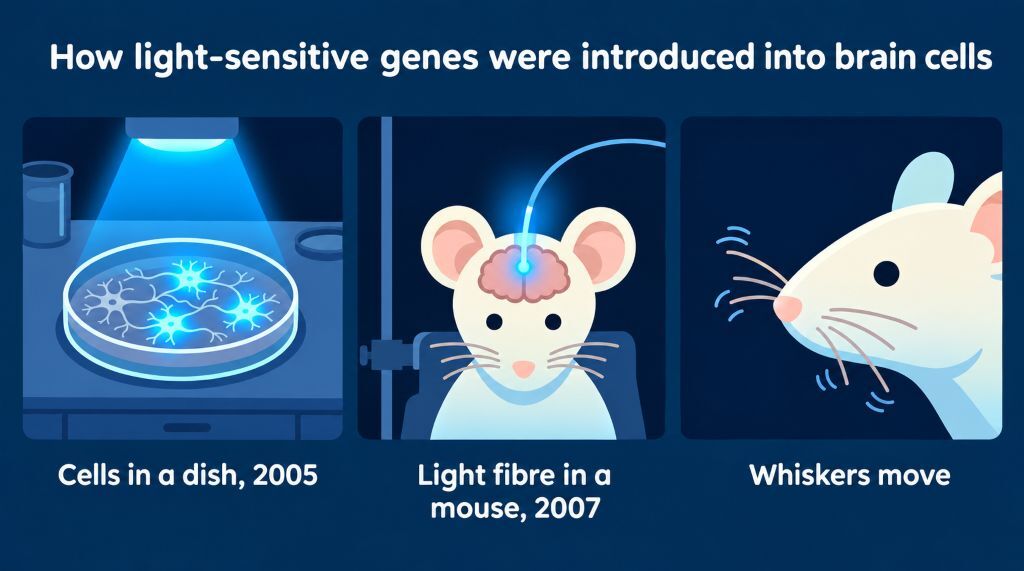
Karl Deisseroth trained as a doctor. He met psychiatric patients whose treatments rarely worked, so he decided to study how nerve cells behave in a living brain. After he read about channelrhodopsin-2, he wrote to Nagel and asked for the DNA. Deisseroth put it into rat nerve cells grown in dishes. He worried the foreign gene would harm them. It did not. Blue light made the cells fire, and the signal spread to neighbouring neurones. His team published the result in 2005. Two terms explain why it worked. “Genetically targeted” means only chosen cells carry the gene. “Light-gated” means the channel opens only while light shines (Nobel Assembly, 2026b).
Fig. 2: From cells in a dish in 2005 to a living mouse in 2007, light was used to trigger brain activity. (Generated by AI)
In 2006, Deisseroth and colleagues coined the term “optogenetics” in a review article. The following year, his team delivered light deep into a living brain using optical fibres connected to laser diodes. Light reached a mouse’s motor cortex, causing its whiskers to move. Researchers also demonstrated neural silencing: two 2007 studies adapted halorhodopsin, a light-driven chloride pump from an archaeon, to quiet neurons with yellow light. Together, these tools let researchers activate or inhibit neural circuits with light, a breakthrough relevant to discussions of the 2026 Nobel Prize in Physiology.
2026 Nobel Prize in Physiology: What Has Optogenetics Revealed About the Brain?
An adult human brain holds about 90 billion nerve cells, each with thousands of connections. Cells with different jobs sit side by side. Optogenetics lets researchers ask which cells control which function. Six findings show the range.
Fig. 3: Optogenetics showed that waking, memory, reward, anxiety and parenting are built from separate circuits (Generated by AI)
Waking up. Stimulating orexin neurones in the hypothalamus made sleeping mice more likely to wake. The delay before waking depended on the stimulation frequency.
Memory traces. An engram is the physical trace a memory leaves in a group of cells. In Susumu Tonegawa’s laboratory, researchers tagged hippocampal cells that were active during fear learning. Light later reactivated them, and the mice froze. A follow-up study made mice freeze in a place that had never scared them.
Reward and aversion. Midbrain dopamine neurones once looked like one system. Inputs from the laterodorsal tegmentum drive reward, while inputs from the lateral habenula drive aversion.
Anxiety. Activating amygdala projections to the central amygdala eased anxiety-related behaviour. Projections to the ventral hippocampus increased it.
Parenting. Separate groups of galanin neurons in the medial preoptic area govern gathering young into a nest, grooming them, and interacting with other adults.
Body signals. Forcing the heart to work harder can reinforce anxiety. Specific gut cells help explain why some people prefer sugar to sweeteners.
These results, recognized by the 2026 Nobel Prize in Physiology, changed how scientists picture the brain. States such as fear or parenting looked like single things. They turned out to be built from separate modules defined by their connections (Nobel Assembly, 2026b). The field moved from watching brain activity to steering it, one cell type at a time.
Can Optogenetics Treat Disease?
The clearest medical push targets the eye. In retinitis pigmentosa, the rods and cones die over time, and the patient goes blind. Early clinical work aims to restore vision after that loss. Animal studies showed the idea could work: channelrhodopsin-2 in retinal ganglion cells restored light responses in mice. In one reported case, a blind patient received a channelrhodopsin-like protein in the retina. Engineered goggles delivered light pulses to the treated cells. The patient regained partial vision, enough to see and grasp objects on a table. Several clinical trials are underway. This is early research, not an approved treatment.
Other possible uses remain more distant. Cochlear implants currently use electrical stimulation; optogenetics might one day stimulate the auditory nerve more precisely, but this is still being researched. A related approach, chemogenetics, uses designer receptors called DREADDs that respond to specially designed drugs rather than light. Its effects are slower to begin but can last longer, so the two methods may complement each other. These therapeutic possibilities are part of the broader research discussed in connection with the 2026 Nobel Prize in Physiology.
How This Guide Was Compiled
This guide draws on three documents from the Nobel Assembly at Karolinska Institutet: the popular-science background, the scientific background, and the press release of 5 October 2026. No other sources provide information on the science or the prize details. Where the documents differed, this guide used the more precise wording and named the source. The alga’s response time, for example, comes from a popular-science background.
Frequently Asked Questions: 2026 Nobel Prize in Physiology
What is optogenetics in simple terms?
Optogenetics is a method for turning specific nerve cells on or off with light. First, scientists add a light-sensitive gene to chosen cells; then, they shine light on them. As a result, the cells fire or fall silent on command. Thus, it gives researchers a switch for studying the living brain.
Who won the 2026 Nobel Prize in Physiology or Medicine, and how much is the prize?
The 2026 prize went jointly to Karl Deisseroth, Peter Hegemann and Georg Nagel for their discoveries concerning light-gated ion channels and optogenetics. It was announced on 5 October 2026. The three laureates share 12 million Swedish kronor equally.
What is channelrhodopsin?
Channelrhodopsin is a light-sensitive protein from algae. When blue light strikes it, a channel opens in the surface of the cell, and positive ions flow through. Hegemann and Nagel discovered it, and it became the foundation of optogenetics.
References:
Nobel Assembly at Karolinska Institutet. (2026a). A light-sensitive algal protein energised neuroscience [Popular science background]. NobelPrize.org.
Nobel Assembly at Karolinska Institutet. (2026b). Optogenetics: Discovery of a neuronal switch [Scientific background]. NobelPrize.org.
Nobel Assembly at Karolinska Institutet. (2026c, October 5). Light-seeking algae gave us a switch for nerve cells [Press release]. NobelPrize.org.
I completed my Master of Science from the University of Allahabad in 2017 with a strong academic background in life sciences and chemistry. My specialization included Molecular Biology, Microbiology, Genetics, Plant Breeding, Phycology, Paleobotany, and Bioinformatics, along with Organic Chemistry, Inorganic Chemistry, and Physical Chemistry. This multidisciplinary training provided me with a comprehensive understanding of biological systems and analytical scientific approaches.
After completing my postgraduate studies, I gained valuable professional experience in both the education and social development sectors. I worked at A.M. Oxford Public School, where I was actively involved in guiding students toward academic excellence. In this role, I focused on creating an engaging learning environment, encouraging critical thinking, and nurturing students’ curiosity for scientific learning. My experience as an educator strengthened my communication, mentoring, and classroom management skills.
In addition to my teaching experience, I worked with Jeevan Jagriti Foundation, where I contributed to community-based initiatives aimed at improving educational access and awareness among underprivileged sections of society. Through this work, I participated in programs designed to support social development and promote the value of education in marginalized communities.
These professional experiences helped me develop strong interpersonal, leadership, and organizational skills while reinforcing my commitment to education and community service.
I completed my Master of Science from the University of Allahabad in 2017 with a strong academic background in life sciences and chemistry. My specialization included Molecular Biology, Microbiology, Genetics, Plant Breeding, Phycology, Paleobotany, and Bioinformatics, along with Organic Chemistry, Inorganic Chemistry, and Physical Chemistry. This multidisciplinary training provided me with a comprehensive understanding of biological systems and analytical scientific approaches.
After completing my postgraduate studies, I gained valuable professional experience in both the education and social development sectors. I worked at A.M. Oxford Public School, where I was actively involved in guiding students toward academic excellence. In this role, I focused on creating an engaging learning environment, encouraging critical thinking, and nurturing students’ curiosity for scientific learning. My experience as an educator strengthened my communication, mentoring, and classroom management skills.
In addition to my teaching experience, I worked with Jeevan Jagriti Foundation, where I contributed to community-based initiatives aimed at improving educational access and awareness among underprivileged sections of society. Through this work, I participated in programs designed to support social development and promote the value of education in marginalized communities.
These professional experiences helped me develop strong interpersonal, leadership, and organizational skills while reinforcing my commitment to education and community service.