Small Intestine Absorption and Efficient Nutrient Transport
Small Intestine Absorption and Nutrient Uptake
Estimated reading time: 7 minutes
Every bite of food you eat embarks on a remarkable journey. Digestion starts in your mouth and stomach. However, the critical event occurs in your small bowel. This is where small intestine absorption transforms your meal into fuel. This process is vital for life. Your body needs energy to think, move, and repair itself. Without efficient nutrient uptake in the gut, even the healthiest diet is wasted. The small intestine is a specialised organ. It works tirelessly to extract vitamins, minerals, and macronutrients. It also manages water balance. Understanding this system helps you appreciate your body’s intelligence in small intestine absorption. It also guides better health decisions. This article explains the mechanics behind this incredible process. We will explore the structures involved, the fate of different foods, and how your body ensures nothing goes to waste.
Key Takeaways: Small Intestine Absorption
- The vast surface area created by villi and microvilli is essential for maximum nutrient extraction.
- Capillaries mainly transport water-soluble nutrients (glucose, amino acids) to the liver.
- Lacteals (lymphatic vessels) absorb fats and fat-soluble vitamins, bypassing the liver initially.
- Specific transport mechanisms exist for different vitamins and minerals, each with unique efficiency.
- Your small bowel recovers up to 9 litres of fluid daily, preventing dehydration.
The Master Architects of Absorption: Villi and Microvilli

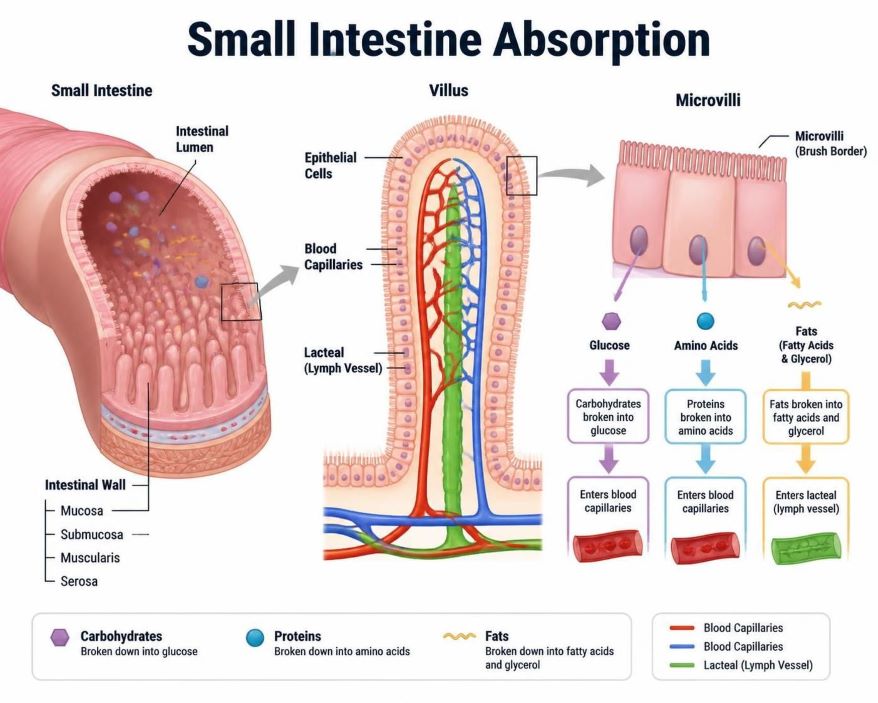
While studying small intestine absorption, the small intestine is not a simple tube. As a matter of fact, its inner lining is designed for maximum efficiency. Think of a smooth surface compared to a velvety carpet. Above all, the carpet has more surface area. To achieve this, the intestinal lining is folded into millions of finger-like projections called villi (VIL-eye). For the most part, each villus is about 0.5 to 1.5 mm long. In fact, there are roughly 30 to 40 villi per square millimetre of tissue. As a result, this structure dramatically increases the usable surface area.
To go deeper, each individual cell on a villus has microscopic projections called microvilli. Together with the villi, they form a dense brush border. In effect, this border is visible under a microscope. What’s more, it increases the surface area for absorption by a factor of 20 to 30. So, the combined effect of villi and microvilli gives your small intestine a total surface area of roughly 250 to 300 square metres. That is to say, it is the size of a tennis court. With this in mind, this massive expanse allows for rapid and complete nutrient uptake in the gut. After all, without this architecture, your body could not absorb enough food to survive.
Small Intestine Absorption: Capillaries and Lacteals
In the study of small intestine absorption, at the same time, each villus contains a microscopic transport network. To enumerate, this network has two main components. In the first place, the first is a cluster of blood capillaries. In the second place, the second is a single lymphatic vessel called a lacteal (LAK-tee-al). As can be seen, this design is strategic. Balanced against simple diffusion, it separates nutrient types based on their solubility.
In like manner, blood capillaries absorb water-soluble nutrients. Such as this includes amino acids, glucose, and electrolytes. As I have noted, these substances travel directly to the liver via the hepatic portal vein. Seeing that the liver is the main processor, it handles them immediately. On one hand, lacteals handle fats and fat-soluble vitamins (A, D, E, K). On the other hand, fats are too large to enter the blood directly. So as to manage this, the lymphatic system picks them up as chylomicrons. In contrast to blood vessels, this fluid bypasses the liver initially. After that, it empties into the bloodstream near the collarbone.
The Journey of Macronutrients in Small Intestine Absorption
Absorption of Glucose: Carbohydrates break down into simple sugars. The most important is glucose. Digestion via amylase and brush border enzymes creates glucose. It cannot cross the cell membrane by simple diffusion while small intestine absorption does. It requires active transport. The protein SGLT1 (Sodium-Glucose Linked Transporter 1) is the key. It uses a sodium gradient to pull glucose into the cell. After that, GLUT2 transporters allow glucose to exit the cell and enter the blood capillary. This is a tightly regulated process
Absorption of Amino Acids: Proteins break down into amino acids and small peptides. Similar to glucose, these need help. Multiple transport systems exist for different amino acids. Some are neutral. Some are acidic or basic. The brush border contains peptidases. These enzymes finish the digestion of small peptides. Then, separate transporters move the amino acids into the cell. They also use sodium co-transport. Once inside, they exit the cell into the blood. This system is fast and specific. It ensures all essential amino acids are captured.
Absorption of Fatty Acids: Fats are hydrophobic. They require bile salts to form micelles. Micelles bring the fats close to the brush border. Then, they diffuse into the cell. Inside the cell, fatty acids are reassembled into triglycerides. They combine with proteins to form chylomicrons. These packages are too big for blood. They enter the lacteals instead. This lymphatic route means fat takes longer to reach the liver. It also creates a feeling of fullness (satiation) that lasts longer
Micronutrients and Fluids
The journey of vitamins and water is just as complex. They play a vital role in enzyme function and life itself. To explore this further, we separate them into two categories: fat-soluble vs. water-soluble vitamins. Fat-Soluble Vitamins (A, D, E, K): These vitamins travel with dietary fat. They enter chylomicrons in the same manner as fatty acids. This means you need some dietary fat to absorb them properly. Any condition affecting fat absorption—such as liver disease or coeliac disease—also impairs the uptake of these substances.
Water-Soluble Vitamins (B-complex, C): Specific carrier proteins transport these vitamins. Vitamin B12 stands out as a special case. It requires Intrinsic Factor (IF). The stomach produces this protein. IF binds to B12 in the small intestine. The complex then absorbs only in the ileum (the last section of the small bowel). The jejunum absorbs folate (vitamin B9). Vitamin C uses sodium-dependent transporters. The body generally absorbs B vitamins efficiently, but competition can occur at high supplement doses.
Minerals and Water Absorption: Minerals use specific gateways. The body strictly regulates iron absorption. The duodenum handles most iron uptake. The body increases absorption when iron stores run low. Calcium requires vitamin D for optimal uptake. Zinc and magnesium use passive and active transport. The small intestine absorbs a massive amount of water—about 6 to 7 litres per day. The duodenum and jejunum absorb a lot of water passively in small Intestine Absorption. This process follows the movement of sodium and glucose. Water absorption maintains blood volume and prevents diarrhea. With this in mind, you can easily see why any damage to these transport systems causes severe dehydration.
Frequently Asked Questions: Small Intestine Absorption
What is the main function of the small intestine regarding food?
The main function is digestion and nutrient uptake in the gut. It breaks down food into tiny molecules and absorbs them into the blood or lymph
How long does small intestine absorption take?
It starts within minutes of eating. Peak absorption of glucose occurs about 30 to 60 minutes after a meal. Fat absorption takes longer, up to several hours
Can you increase your small intestine surface area?
You cannot grow new villi intentionally. However, eating a healthy diet and avoiding inflammation helps maintain existing villi. This keeps your surface area maximised.
References:
- Kiela, P. R., & Ghishan, F. K. (2016). Physiology of Intestinal Absorption and Secretion. Best practice & research. Clinical gastroenterology, 30(2), 145–159. https://doi.org/10.1016/j.bpg.2016.02.007
- Azman, M., Sabri, A. H., Anjani, Q. K., Mustaffa, M. F., & Hamid, K. A. (2022). Intestinal Absorption Study: Challenges and Absorption Enhancement Strategies in Improving Oral Drug Delivery. Pharmaceuticals, 15(8), 975. https://doi.org/10.3390/ph15080975
Editorial Note: This article was written by Rakshanda Jabbar and reviewed for editorial accuracy by our editorial team. It has not yet undergone independent review by a professional.
- Author
- Latest Posts
I completed my Master of Science from the University of Allahabad in 2017 with a strong academic background in life sciences and chemistry. My specialization included Molecular Biology, Microbiology, Genetics, Plant Breeding, Phycology, Paleobotany, and Bioinformatics, along with Organic Chemistry, Inorganic Chemistry, and Physical Chemistry. This multidisciplinary training provided me with a comprehensive understanding of biological systems and analytical scientific approaches.
After completing my postgraduate studies, I gained valuable professional experience in both the education and social development sectors. I worked at A.M. Oxford Public School, where I was actively involved in guiding students toward academic excellence. In this role, I focused on creating an engaging learning environment, encouraging critical thinking, and nurturing students’ curiosity for scientific learning. My experience as an educator strengthened my communication, mentoring, and classroom management skills.
In addition to my teaching experience, I worked with Jeevan Jagriti Foundation, where I contributed to community-based initiatives aimed at improving educational access and awareness among underprivileged sections of society. Through this work, I participated in programs designed to support social development and promote the value of education in marginalized communities.
These professional experiences helped me develop strong interpersonal, leadership, and organizational skills while reinforcing my commitment to education and community service.