Explore the fructose metabolic effects study to discover how fructose affects your liver and raises health risks over time.
Fructose Metabolism: How the Body Processes Fructose
Estimated reading time: 8 minutes
You grab a cold soda after class. It tastes great. But at this instant, something else is going on inside your body. A published fructose metabolic effects study has some eye-opening facts to share. Fructose — the sugar in sodas, candy, and snacks — does far more than add calories. In fact, it changes how your liver works. It raises your risk of obesity and diabetes. After that, it can damage your cells too. So, what is fructose really doing inside you? Read on to find out.
Key Takeaways: Fructose Metabolism
- Fructose is broken down mainly in the liver.
- It skips the body’s normal insulin control.
- Too much fructose makes fat build up in the liver.
- It raises blood sugar levels over time.
- It makes uric acid, which triggers joint pain.
- It causes oxidative stress — a type of cell damage.
- Teens and kids are among the most at-risk groups.
- Cutting added sugars from processed foods can help.
Fructose Versus Glucose: Two Different Sugars
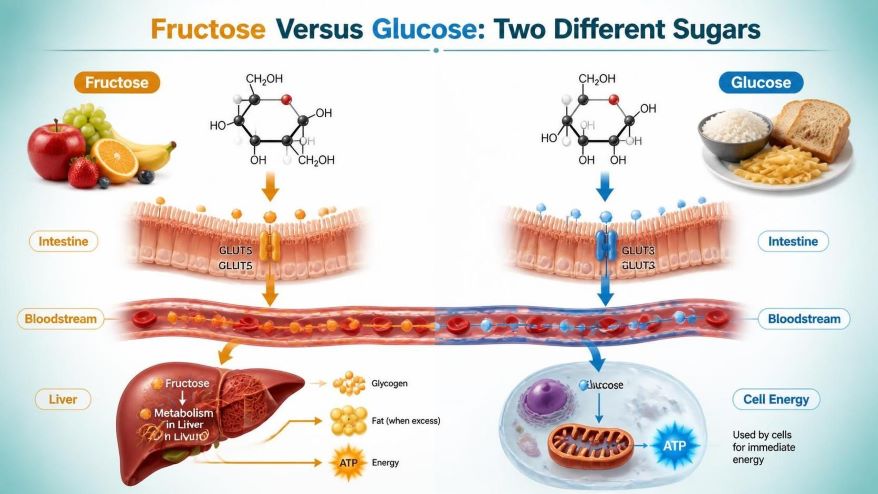
Fructose and glucose are both simple sugars. They share the same chemical formula. Their structures differ, to illustrate. This small change causes big differences. Glucose is your body’s preferred energy source. Every cell can use it directly. Fructose requires more processing first, after all. Your body handles them in unique ways.
How Your Body Absorbs Glucose
Glucose enters your bloodstream quickly after eating. Your pancreas releases insulin as a result. Insulin helps glucose enter your cells. Most cells have insulin receptors. They grab glucose for immediate energy. They also store some as glycogen in the liver and muscles. This process is efficient and well-controlled.
How Your Body Absorbs Fructose
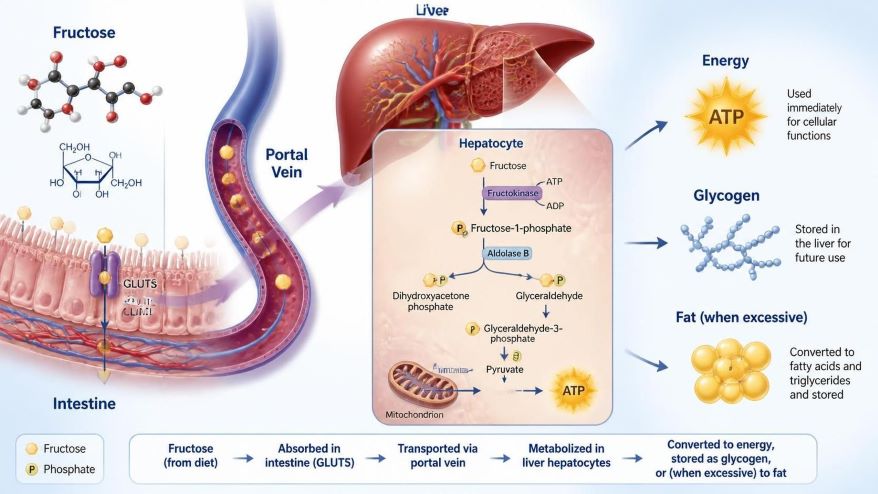
Fructose absorption happens in the small intestine. It uses a different transporter called GLUT5. This transporter does not need insulin. Fructose then travels to the liver via the portal vein. Some fructose metabolism occurs in the small intestine too, so far as research shows. But the liver handles the bulk of the work. To explain further, cells outside the liver cannot use fructose easily. They lack the necessary enzymes. This is why fructose is called a liver-specific sugar.
Impact on Blood Sugar Levels
Glucose raises blood sugar quickly. This triggers insulin release, as has been noted. Fructose raises blood sugar very little. It does not spike insulin the same way, to be sure. This sounds good at first glance. But the effects are more complex. Low insulin response means less satiety signaling. You might not feel full after eating fructose. This can lead to overeating later. The real issue is what happens inside your liver.
The Liver’s Role in Fructose Metabolism
Your liver is the main site for fructose metabolism. It converts fructose into usable compounds. This process bypasses a key control point. Glycolysis for glucose has a regulation step. Fructose entry skips this checkpoint. As a result, fructose can flood the metabolic pathway.
Fructose Conversion Pathway
Fructose enters liver cells. An enzyme called fructokinase adds a phosphate group. This creates fructose-1-phosphate. This step uses ATP, your cell’s energy currency. Fructose-1-phosphate then splits into smaller molecules. These molecules enter glycolysis at a later stage. They can also form glycerol and acetyl-CoA, with this intention. These are building blocks for fat synthesis.
ATP Depletion During Processing
The initial step of fructose metabolism consumes ATP. No new ATP is made during these early steps. This creates a temporary energy deficit in the liver cell. Your liver must regenerate ATP quickly, to that end. It uses a process that produces uric acid as a byproduct. High uric acid levels can cause inflammation. It increases risk for gout and high blood pressure. This ATP drain is unique to fructose processing.
Glycerol and Acetyl-CoA Production
After splitting, fructose fragments become dihydroxyacetone phosphate and glyceraldehyde. These can enter energy production directly. They can also make glycerol. Glycerol is a backbone for triglycerides (fats). The other main product is acetyl-CoA. This molecule has two fates, at any rate. It can enter the Krebs cycle for energy. Or it can be used to build fatty acids. High fructose intake pushes this pathway toward fat creation.
ATP Use and Uric Acid Connection
Fructose metabolism uses a lot of ATP quickly. This rapid consumption creates phosphate depletion. Your liver cell senses low ATP levels. It activates enzymes to make more ATP. These enzymes break down AMP (adenosine monophosphate). This breakdown produces uric acid as a waste product.
The AMP Degradation Pathway
When ATP is low, cells work to restore balance. They convert ADP back to ATP. Some ADP converts to AMP. Excess AMP gets broken down. The enzyme AMP deaminase starts this process. It removes a nitrogen group. The product goes through several steps. The final result is uric acid. This is a normal metabolic waste product. Too much uric acid becomes a problem.
Health Implications of High Uric Acid
Elevated uric acid is linked to several conditions. Gout is a painful joint inflammation. Uric acid crystals form in joints. High uric acid also affects blood vessels. It can reduce nitric oxide availability. Nitric oxide helps blood vessels relax. Less nitric oxide means higher blood pressure, in effect. Some studies link high fructose consumption to metabolic syndrome. Uric acid appears to be a key mediator. This connection shows how fructose metabolism impacts more than just the liver.
Fat Synthesis Risk from Excess Fructose
Your liver can convert fructose into fat. This is called de novo lipogenesis (making new fat). This process is normal in small amounts. At the same time, high fructose intake drives it too much. After all, your body evolved to handle occasional fruit sugar. At the present time, diets contain far more added fructose. This change overwhelms the liver’s capacity.
Fructose Metabolism: How Fructose Promotes Fat Storage
The acetyl-CoA from fructose provides the building blocks. The glycerol provides the backbone. Your liver assembles these into triglycerides. These fats can stay in the liver. They can also be packaged and sent out into the blood. To clarify, this is the main source of VLDL (very low-density lipoprotein) particles. High VLDL levels mean high blood triglycerides. With this in mind, it becomes a risk factor for heart disease. As a matter of fact, the pathway runs constantly when fructose intake is high. By and large, the process is efficient. Analogous to a factory running at full speed, your liver produces fat around the clock. What’s more, this fat does not leave quickly. So far, research shows the fat accumulates in liver cells.
Non-Alcoholic Fatty Liver Disease (NAFLD)
Excess fat accumulation in the liver is called NAFLD. It affects about 25% of adults worldwide. High fructose intake is a major driver. The fat builds up inside liver cells. As a result, this causes inflammation and damage over time. NAFLD can progress to more serious liver disease. In fact, it is now the leading cause of liver transplants in some countries. Reducing added fructose is a key treatment strategy. At any rate, early intervention helps reverse the condition. To enumerate the steps, doctors recommend cutting sugary drinks first. Second, limit processed sweets. Third, replace them with whole fruits. At last, combine these changes with exercise. With this purpose in mind, many patients see improvement within months. Another key point is that weight loss amplifies the benefits. All of a sudden, the liver starts clearing out stored fat. To sum up, small dietary changes produce large results for liver health.
Frequently Asked Questions about Fructose Metabolic
What does the fructose metabolic effects study actually show?
The study shows how fructose impacts the liver, body weight, blood sugar, and cells. It found that excessive fructose from processed foods causes obesity, NAFLD, diabetes risk, high uric acid, and oxidative stress.
Is fructose in fruit bad for you?
Not really. Natural fructose in whole fruits is absorbed slowly because of the fibre content. The real concern is added fructose in processed drinks and snacks. Whole fruit also contains vitamins and antioxidants that balance out the sugar.
How exactly does fructose cause liver disease?
The liver processes almost all ingested fructose. Too much of it forces the liver to produce excess fat through a process called de novo lipogenesis. This fat builds up in liver cells, eventually causing non-alcoholic fatty liver disease (NAFLD).
Can teens really develop type 2 diabetes from fructose?
Yes, the study warns that teens are especially at risk. High fructose intake reduces insulin sensitivity over time. Sooner or later, this progressive damage can increase the risk of type 2 diabetes significantly.
What foods should I check for hidden fructose?
Check labels on sodas, energy drinks, flavored yogurts, packaged cereals, ketchup, sauces, and most processed snacks. The key ingredient to look for is high-fructose corn syrup (HFCS).
Can lifestyle changes reverse fructose-related damage?
The study suggests yes — at least in part. The researchers noted that antioxidant supplementation and reducing fructose intake can ease oxidative stress and inflammation. Staying active and eating more whole foods also helps the liver recover.
Reference
Baharuddin B. (2024). The Impact of Fructose Consumption on Human Health: Effects on Obesity, Hyperglycemia, Diabetes, Uric Acid, and Oxidative Stress With a Focus on the Liver. Cureus, 16(9), e70095. https://doi.org/10.7759/cureus.70095
Li, Z., Fan, X., Gao, F., Pan, S., Ma, X., Cheng, H., Nakatsukasa, H., Zhang, W., & Zhang, D. (2025). Fructose metabolism and its roles in metabolic diseases, inflammatory diseases, and cancer. Molecular biomedicine, 6(1), 43. https://doi.org/10.1186/s43556-025-00287-2
Editorial Note: This article was written by Ayushi Shukla and reviewed for editorial accuracy by our editorial team. It has not yet undergone independent review by a professional.
- Author
- Latest Posts

Ayushi Shukla is a biotechnologist and science communicator specializing in the intersection of genomic data and public health. Previously, she served as a Core Member and R&D Lead at the HealthTech venture Eat Wisely Bro, where she spearheaded research initiatives and translated emerging medical data into product strategy. She holds an M.Sc. in Biotechnology from the TERI School of Advanced Studies, where her research at The Energy and Resources Institute (TERI), New Delhi, focused on Environmental Biotechnology and Bioremediation.
As a Research Scholar at TERI, Ayushi developed a plant growth-promoting bacterial consortium for high-salinity agricultural conditions, managing daily laboratory procedures and molecular workflows. Her technical portfolio on GitHub demonstrates her dry lab expertise, featuring end-to-end bioinfomatics pipelines for RNA-Seq analysis, Phylogenetic modeling, and a functional prototype for Mycobacterium tuberculosis Genomic Surveillance & Dashboard.
Her clinical foundation includes advanced training in Somatic NGS and Precision Oncology from the Cancer Research Centre at Tata Memorial Centre, and a professional certification in Good Clinical Practice (GLP) from the NIDA Clinical Trials Network. Ayushi bridges the gap between raw genomic data and student-friendly narratives to help the next generation of scientist understand the transformative power of modern biology.
- Author
- Latest Posts

I completed my Master of Science from the University of Allahabad in 2017 with a strong academic background in life sciences and chemistry. My specialization included Molecular Biology, Microbiology, Genetics, Plant Breeding, Phycology, Paleobotany, and Bioinformatics, along with Organic Chemistry, Inorganic Chemistry, and Physical Chemistry. This multidisciplinary training provided me with a comprehensive understanding of biological systems and analytical scientific approaches.
After completing my postgraduate studies, I gained valuable professional experience in both the education and social development sectors. I worked at A.M. Oxford Public School, where I was actively involved in guiding students toward academic excellence. In this role, I focused on creating an engaging learning environment, encouraging critical thinking, and nurturing students’ curiosity for scientific learning. My experience as an educator strengthened my communication, mentoring, and classroom management skills.
In addition to my teaching experience, I worked with Jeevan Jagriti Foundation, where I contributed to community-based initiatives aimed at improving educational access and awareness among underprivileged sections of society. Through this work, I participated in programs designed to support social development and promote the value of education in marginalized communities.
These professional experiences helped me develop strong interpersonal, leadership, and organizational skills while reinforcing my commitment to education and community service.




Good Job 👍