Discover the connection between brain plasticity learning and speech, and how new research alters our understanding of memory.
Brain Plasticity Learning: Why Listening Matters More Than Practice

Estimated reading time: 8 minutes
You have been speaking your whole life. But how does your brain actually learn to speak? Most scientists assumed the answer was simple — motor regions run the show. In other words, the movement side of the brain stores speech memories. A 2026 study says that is wrong. In fact, your brain stores speech memories in its sensory areas — not its motor areas. At first, this sounds like a small detail. But in reality, it changes everything we know about brain plasticity learning and how we recover speech after injury. In short, this study rewrites a long-held assumption in neuroscience.
Key Takeaways
Before we go further, here is what the study found:
- Scientists at Yale tested which brain regions store speech motor memories.
- They used TMS — transcranial magnetic stimulation — to temporarily switch off brain areas.
- They tested three regions: the auditory cortex, the somatosensory cortex, and the motor cortex.
- When the auditory or somatosensory cortex was disrupted, speech memory was lost.
- When the motor cortex was disrupted, speech memory stayed intact.
- In short, sensory brain areas — not motor areas — store newly learned speech.
- This has direct implications for stroke rehabilitation and language therapy.
- It also points to new targets for improving brain-computer interfaces.
What Does This Brain Plasticity Learning Study Tell Us About Speech?
Scientists have long believed that motor memory lives in motor parts of the brain. So, if you learn a new movement — like a tennis swing or a new speech sound — the motor cortex stores it. Prior to this study, the same assumption applied to speech. As a result, most speech rehabilitation research focused on the motor cortex. The Yale team set out to test whether that assumption was actually correct.
How Did the Researchers Test the Brain?
To explain how the study worked, the team used a clever two-step experiment. Here is what they did:
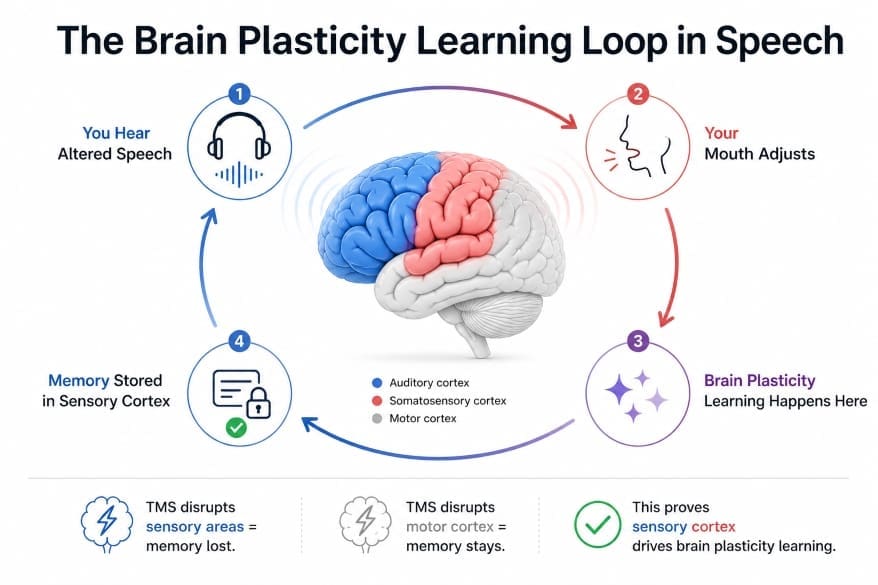
- First, they used altered auditory feedback to induce speech motor learning.
- Participants wore headphones. Their own speech sounds played back to them — but changed.
- In response, participants automatically adjusted how they spoke. That adjustment is the learning.
- After that, the team used TMS to temporarily disrupt one brain region in each group.
- Some had their auditory cortex (STG) disrupted. Others had their somatosensory cortex (S1) disrupted. Others had their motor cortex (M1) disrupted.
- Twenty-four hours later, researchers tested how much speech learning each group retained.
As a result, the team can directly identify which brain region supports memory retention. In effect, whichever disruption caused memory loss was the region that mattered most.
What Did the Brain Plasticity Learning Study Actually Find?
This is where the results get surprising. In fact, the findings flipped the old assumption completely. Here is what each group showed:
- Auditory cortex disruption → speech memory was significantly impaired.
- Somatosensory cortex disruption → speech memory was also significantly impaired.
- Motor cortex disruption → speech memory was not impaired. It stayed the same as the control group.
All in all, this means sensory brain areas are doing the heavy lifting. The motor cortex, by contrast, appears less critical for storing newly learned speech. To put it differently, your brain remembers how to speak through its ears and its sense of touch — not through its movement system.
“Our study challenges the assumption that new speech memories are solely reliant on changes in motor areas of the brain. Instead, it underscores the importance of changes in auditory and somatosensory brain areas in shaping how we learn to speak.” — Nishant Rao, Yale University
Table 1: What Happened When Each Brain Region Was Disrupted?
| Brain Region Disrupted | Region’s Function | Effect on Speech Memory |
|---|---|---|
| Auditory cortex (STG) | Processes what you hear | Memory significantly impaired |
| Somatosensory cortex (S1) | Processes touch and position of lips, tongue, jaw | Memory significantly impaired |
| Motor cortex (M1) | Sends movement commands to muscles | Memory NOT impaired |
| No TMS (control group) | No disruption | Normal memory retention |
Why Does Brain Plasticity Learning Happen in the Sensory Cortex?
In essence, this finding makes a lot of biological sense once you think about it. Your sensory systems are always active when you speak. In fact, every time you say a word, your brain receives two streams of sensory data. First, your auditory cortex hears the sound of your own voice. Second, your somatosensory cortex feels the position of your lips, tongue, and jaw. Together, these two streams give the brain a very precise record of each speech movement.
So, seeing that the brain already uses sensory data to monitor speech in real time, it makes sense that brain plasticity learning happens in sensory regions too. In like manner, when you learn a new sound in a foreign language, your brain rewires its sensory maps — not just its motor maps.
“Sensorimotor neuroscience has traditionally focused on frontal motor areas as the principal drivers of movement. This study changes that understanding by showing that human motor learning is extensively sensory in nature.” — David Ostry, Yale University
At the same time, the motor cortex still plays a role in executing speech. But the study shows that storing the memory of new speech movements is a sensory job. To put it another way, the sensory cortex acts as the brain’s long-term notebook for speech learning.
What Is Transcranial Magnetic Stimulation (TMS)?
Seeing that TMS was central to this study, it is worth knowing what it actually is. In short, TMS is a completely non-invasive brain tool. Here is how it works:
- A device held near the skull sends a magnetic pulse into the brain.
- That pulse temporarily slows down activity in a targeted brain region.
- No surgery, no drugs, and no lasting effects are involved.
- The disruption lasts only a short time — usually minutes.
- Researchers use it to test which brain region is needed for a specific task.
- In effect, TMS lets scientists temporarily “switch off” one area and see what happens.
As a result, TMS is one of the most powerful tools in cognitive neuroscience today. At this point, clinicians also use it to treat depression and certain neurological conditions.
How Does Brain Plasticity Learning Apply to Real Life?
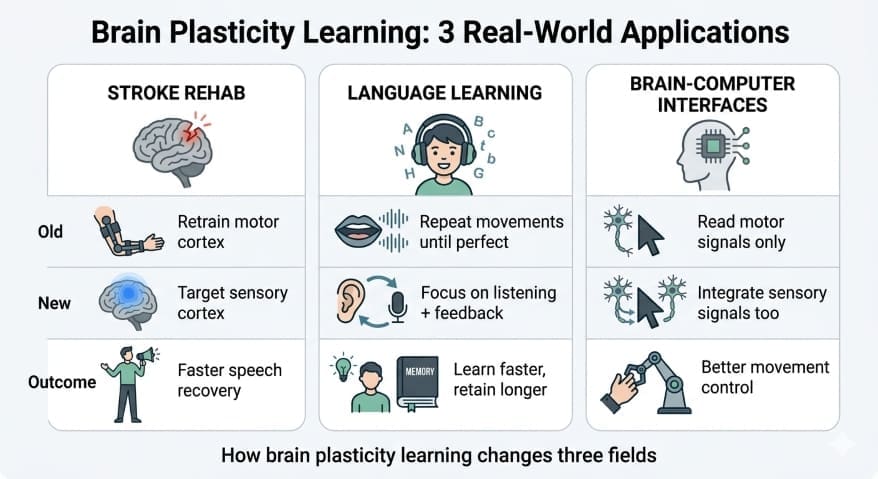
All things considered, the real-world implications of this study are significant. In fact, three fields stand to benefit directly from this discovery.
What Does This Mean for Stroke Rehabilitation?
To illustrate the biggest application, think about stroke recovery. When a stroke damages the brain, speech is often affected. In general, rehabilitation has focused on retraining the motor cortex. But provided that sensory areas are the actual storage sites for speech memory, targeting those areas instead could be far more effective.
In other words, this study gives speech therapists and neurologists a new map to work from. So, at this point, future rehab programme may focus on the auditory and somatosensory cortex as primary targets. Understanding how the brain recovers after stroke gives useful background on why this finding matters so much.
How Does Brain Plasticity Learning Help You Learn a New Language?
In like manner, this study also reshapes how we understand language learning. Prior to this, many models of second language learning focused on motor practice — repeating sounds until the mouth got it right. But seeing that sensory memory drives speech retention, the listening and feeling side of practice may matter even more. To sum up, paying close attention to how a sound feels to produce, not just how it sounds, might help you learn a new language faster.
What Does This Mean for Brain-Computer Interfaces?
What’s more, the findings may also help improve brain-computer interfaces. In effect, BCI systems that read brain signals to control movement could improve by including sensory cortex data. At the present time, most BCI systems focus on motor signals. After this study, engineers may start integrating auditory and somatosensory signals too. Understanding how brain-computer interfaces work puts this application in context.
Table 2: Three Fields That Brain Plasticity Learning Research Could Change
| Field | Old Assumption | New Direction After This Study |
|---|---|---|
| Stroke rehab | Target motor cortex to restore speech | Target sensory cortex as the memory storage site |
| Language learning | Repeat movements to build motor memory | Train sensory maps through listening and feedback |
| Brain-computer interfaces | Read motor signals to control movement | Integrate sensory cortical signals for better control |
| Neuroscience models | Motor regions store motor memories | Sensory regions are essential for movement memory |
Frequently Asked Questions (FAQs)
What is brain plasticity learning and what did this Yale study find?
Brain plasticity learning refers to the brain’s ability to rewire itself when we learn new skills. The 2026 study by Rao et al. found that speech memories are stored in sensory brain areas — not motor areas.
What is the somatosensory cortex and why does it matter for speech?
The somatosensory cortex processes touch, position, and movement sensations from the body. In the context of speech, it tracks the position of your lips, tongue, and jaw as you speak.
What is TMS and is it safe?
MS — transcranial magnetic stimulation — is a non-invasive tool that uses magnetic pulses to temporarily disrupt activity in a brain region. It involves no surgery or drugs. Researchers use it to test which brain areas are needed for specific tasks.
How does this study help stroke patients?
Stroke often damages speech. Prior to this study, rehabilitation mostly targeted the motor cortex. Seeing that sensory areas store speech memories, this study suggests that targeting the auditory and somatosensory cortex in rehab could be far more effective.
Reference
N. Rao, R. Gendron, T.F. Manning, & D.J. Ostry, Sensory basis of speech motor learning and memory, Proc. Natl. Acad. Sci. U.S.A. 123 (17) e2525468123, https://doi.org/10.1073/pnas.2525468123 (2026).
- Author
- Latest Posts
Ayushi Shukla is a biotechnologist and science communicator specializing in the intersection of genomic data and public health. Previously, she served as a Core Member and R&D Lead at the HealthTech venture Eat Wisely Bro, where she spearheaded research initiatives and translated emerging medical data into product strategy. She holds an M.Sc. in Biotechnology from the TERI School of Advanced Studies, where her research at The Energy and Resources Institute (TERI), New Delhi, focused on Environmental Biotechnology and Bioremediation.
As a Research Scholar at TERI, Ayushi developed a plant growth-promoting bacterial consortium for high-salinity agricultural conditions, managing daily laboratory procedures and molecular workflows. Her technical portfolio on GitHub demonstrates her dry lab expertise, featuring end-to-end bioinfomatics pipelines for RNA-Seq analysis, Phylogenetic modeling, and a functional prototype for Mycobacterium tuberculosis Genomic Surveillance & Dashboard.
Her clinical foundation includes advanced training in Somatic NGS and Precision Oncology from the Cancer Research Centre at Tata Memorial Centre, and a professional certification in Good Clinical Practice (GLP) from the NIDA Clinical Trials Network. Ayushi bridges the gap between raw genomic data and student-friendly narratives to help the next generation of scientist understand the transformative power of modern biology.