Uncover the connection between your immune response and Alzheimer's through an early blood test that could change detection practices.
Can a Routine Blood Test Predict Alzheimer’s Years Before Symptoms?

Estimated reading time: 8 minutes
Your immune system may warn you about Alzheimer’s years early. A 2026 study from NYU Langone Health found a striking link. Above all, a routine blood test could flag your dementia risk long before symptoms show. The test is already done in hospitals every day. In fact, no special equipment is needed at all. Researchers looked at data from nearly 400,000 patients. So how does an Alzheimer’s early blood test work? And what does your immune system have to do with your brain? Let’s find out.
Key Takeaways
- A study linking a common blood marker to future Alzheimer’s risk
- NYU Langone Health and the Veterans Health Administration
- Around 400,000 patients, data from 2011 to 2023
- High NLR links to higher dementia risk before any symptoms show
- Could lead to a real Alzheimer’s early blood test in routine check-ups
What Is NLR — and How Does an Alzheimer’s Early Blood Test Work?
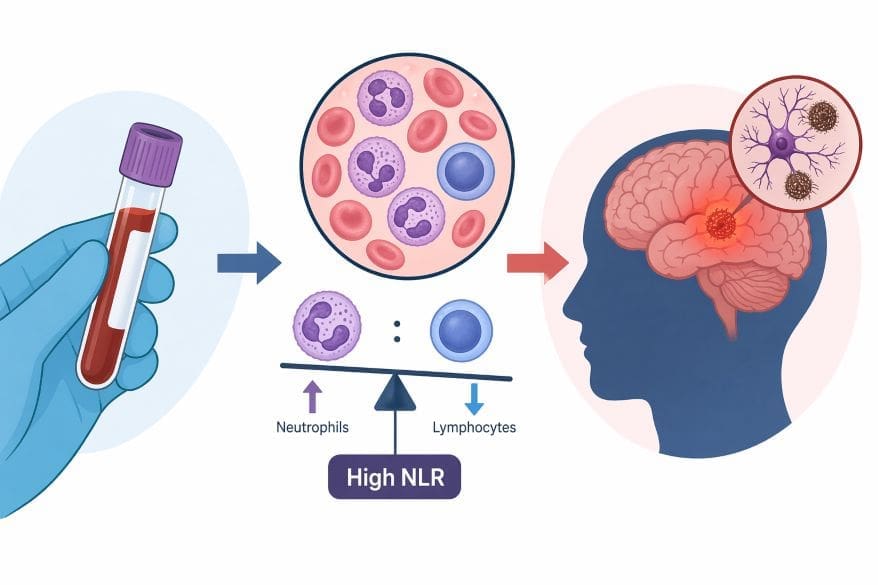
Think about the last time a doctor took your blood. That basic test is called a complete blood count, or CBC. It measures different cells in your blood. One type is called neutrophils. To explain it simply, these are your immune system’s first responders. They rush to fight infections and injuries fast.
As a result of infection or long-term inflammation, neutrophil counts go up. This changes a key ratio in your blood. Scientists call it the neutrophil-to-lymphocyte ratio, or NLR. To put it simply, NLR compares neutrophils to lymphocytes. Lymphocytes are another type of immune cell.
Prior to this study, doctors used NLR mainly to check for infections. But now, scientists think it could also work as an Alzheimer’s early blood test. That is a big shift in how we think about this routine test.
What Did Scientists Actually Measure?
- Researchers picked each patient’s earliest available NLR reading
- All patients had to be at least 55 years old at that time
- The blood test had to happen before any dementia diagnosis
- After that, the team checked who later got a dementia diagnosis
- The diagnosis had to come at least 6 months after the blood test
In effect, the study asked one key question. Can one old blood result predict a future brain disease.
What Did the Study Find? Is This Alzheimer’s Early Blood Test Reliable?
The research looked at nearly 285,000 patients at NYU Langone hospitals. It also studied around 85,000 patients from the Veterans Health Administration. Health records ran from 2011 to 2023.
In the NYU group, high NLR linked to a hazard ratio of 1.07. This means a 7% higher dementia risk. In the VA group, that number rose to 1.21. So, the link was even stronger there.
To explain what those numbers mean: a ratio above 1.0 means more risk. So 1.21 means people with high NLR had a 21% higher chance of getting dementia. This held true even after adjusting for age, sex, and medical history. In other words, NLR was an independent risk signal.
Why Does This Finding Matter?
Dr. Tianshe He led the study. He said neutrophil levels rise before any sign of memory loss. He called this a strong case for studying whether neutrophils actively drive disease. To put it differently, your blood changes first. Your brain changes later. That gap is exactly where an Alzheimer’s early blood test could save lives.
How Do Neutrophils Harm the Brain?
While it may be true that neutrophils protect you, they can cause harm too. Here is what they do in the brain:
- They create capillary stalls — they block tiny blood vessels and cut off blood flow
- They drive long-term inflammation — this slowly damages brain tissue over time
- They may break the blood-brain barrier — this is the shield that protects your brain
- Neutrophil inflammation has been found in the brain tissue of Alzheimer’s patients
- Animal studies show these cells can speed up Alzheimer’s disease progression
So these cells may, under certain conditions, slowly harm your brain over time.
Who Faces the Highest Risk?
Subgroup analyses showed a key pattern. Female and Hispanic participants with high NLR had a clearly higher dementia risk. This is important to point out. At the same time, this tells scientists which groups may benefit most from early Alzheimer’s screening.
How Is This Different From Existing Tests? What Makes an Alzheimer’s Early Blood Test a Breakthrough?
All things considered, earlier studies on NLR and dementia were too small. They could not draw strong conclusions. This study, on the other hand, used data from two large health systems. Records spanned more than a decade. That is what makes its findings so compelling.
At the present time, standard Alzheimer’s testing is hard to access. To enumerate what that looks like today:
- PET brain scans — very costly and not widely available
- Spinal fluid tests — invasive and uncomfortable
- Specialised biomarker panels — require advanced lab equipment
In contrast, NLR comes from a CBC. Doctors already run CBC tests every day. So this Alzheimer’s early blood test approach would be:
- Already available in most hospitals around the world
- Far cheaper than a brain scan
- Non-invasive — just a simple blood draw
- Part of routine health check-ups people already attend
What Does This Mean for the Future of Dementia Detection?
Researchers were clear on one point. A high NLR alone cannot confirm a dementia diagnosis. However, combined with other risk factors, it could flag who needs more testing. What’s more, it could push early action before any memory loss begins.
Dr. Ramos-Cejudo directs the VIDA lab at NYU Langone. He said the team hopes NLR becomes a gateway tool for at-risk patients. In due time, flagged patients could then get deeper tests like brain scans. After that, doctors could act much earlier than they can right now. This two-step method could make early detection far more affordable for everyone.
What Do We Still Not Know?
A clear causal link between neutrophils and Alzheimer’s is not yet proven. This is partly because neutrophils live only a few days. As a result, they must be studied from fresh blood samples. They cannot be frozen like other cell types.
So far, this is a signal — not a confirmed cause. Scientists are still asking the key question: do neutrophils drive dementia, or do they just show up early as a warning sign? Sooner or later, future studies will tell us more. In the meantime, the NLR remains a promising and practical early flag.
How Study Connects to This Alzheimer’s Early Blood Test Research?
This study sits at the crossroads of biology, data science, and medicine. In fact, it is a great example of how different STEM fields work together. This research points to some exciting career paths. It is especially relevant for Class 11 and 12 students.
Fields That Made This Discovery Happen
- Neuroscience — studying how the brain works and breaks down over time
- Immunology — learning how immune cells like neutrophils behave in the body
- Bioinformatics and Data Science — this team analysed 400,000 patient records; that needs coding skills
- Clinical Medicine and Research — designing tests that doctors use every day
- Epidemiology — studying how diseases develop across large and diverse groups
What You Already Know
Analogous to what you learn in class, here is how your syllabus links directly to this study:
- Human Health and Disease — immune response, white blood cells, and inflammation
- Biomolecules — how proteins like cytokines carry signals of inflammation in the body
- Biotechnology — how large health datasets power modern medical breakthroughs
- Biology in Human Welfare — finding disease early means fewer lives lost
All in all, this research shows your biology is far from abstract theory. It is, in essence, the base for real-world discoveries like an Alzheimer’s early blood test. Seeing that you are just beginning your science journey, the timing could not be better.
Frequently Asked Questions (FAQs) about Alzheimer’s early blood test
What is an Alzheimer’s early blood test?
It uses a blood value called NLR to spot people at higher dementia risk. Above all, this happens before any memory symptoms appear. This 2026 NYU Langone study is one of the first to prove this at a large scale.
What is the neutrophil-to-lymphocyte ratio or NLR?
NLR is a number from a standard blood count test. To put it simply, it compares neutrophils to lymphocytes — both are types of white blood cells. A higher NLR means more inflammation in the body.
Can this blood test diagnose Alzheimer’s on its own?
No. At this point, a high NLR alone cannot confirm Alzheimer’s. But with other risk factors, it flags who needs more tests. This works long before symptoms appear.
How many patients were in this study?
Nearly 400,000 patients in total. About 285,000 came from NYU Langone hospitals. Around 85,000 came from the Veterans Health Administration. Data covered 2011 to 2023.
Do neutrophils cause Alzheimer’s?
That is not yet confirmed. The study shows a clear link between high NLR and future dementia risk. However, whether neutrophils cause the disease or just signal its early start is still being studied.
Is this blood test available right now?
A CBC test is one of the most common blood tests in the world. But doctors do not yet use NLR as a standard Alzheimer’s screening tool. That could change as more evidence builds up over time.
Who is at the highest risk?
The study found higher risk among female and Hispanic participants with elevated NLR. In particular, these groups may benefit most from early and accessible screening programs in the future.
Reference
He, T., et al (2026). Neutrophil inflammation metrics are associated with the risk of future dementia in large data from NYU Langone Hospitals and the Veterans Health Administration. Alzheimer’s & Dementia. https://doi.org/10.1002/alz.71335
- Author
- Latest Posts

Ayushi Shukla is a biotechnologist and science communicator specializing in the intersection of genomic data and public health. Previously, she served as a Core Member and R&D Lead at the HealthTech venture Eat Wisely Bro, where she spearheaded research initiatives and translated emerging medical data into product strategy. She holds an M.Sc. in Biotechnology from the TERI School of Advanced Studies, where her research at The Energy and Resources Institute (TERI), New Delhi, focused on Environmental Biotechnology and Bioremediation.
As a Research Scholar at TERI, Ayushi developed a plant growth-promoting bacterial consortium for high-salinity agricultural conditions, managing daily laboratory procedures and molecular workflows. Her technical portfolio on GitHub demonstrates her dry lab expertise, featuring end-to-end bioinfomatics pipelines for RNA-Seq analysis, Phylogenetic modeling, and a functional prototype for Mycobacterium tuberculosis Genomic Surveillance & Dashboard.
Her clinical foundation includes advanced training in Somatic NGS and Precision Oncology from the Cancer Research Centre at Tata Memorial Centre, and a professional certification in Good Clinical Practice (GLP) from the NIDA Clinical Trials Network. Ayushi bridges the gap between raw genomic data and student-friendly narratives to help the next generation of scientist understand the transformative power of modern biology.