A Nigerian and Imperial College London team ran solar-powered phototherapy beds through hospitals and mission clinics, and all 663 treated newborns reached their bilirubin targets.
Many newborns turn slightly yellow in their first week. Usually, this jaundice fades by itself. Some babies, however, build up dangerous levels of a yellow waste chemical. Doctors treat them with blue light, but the lamps need electricity. In much of Nigeria, power cuts are a daily event. A new study tests a bold answer: solar-powered jaundice phototherapy that never touches the grid. Hippolite Amadi of Imperial College London led the work. Partners came from University of Calabar Teaching Hospital and Federal Medical Centre Keffi. The team published its results in Frontiers in Pediatrics on November 4, 2026. For reference, the DOI is 10.3389/fped.2026.1967434. In short, the team moved the device from expert wards into small mission hospitals. As a result, nurses and junior doctors ran much of the treatment there.
The numbers tell a clear story, yet they need careful reading. Across two years, community teams screened more than 2,000 babies for jaundice. Of these, 663 babies received light treatment, roughly one in three. Every treated baby reached the planned bilirubin target and went home. On average, treatment took about 16.5 hours, which is less than one day. The lights never stopped for a power cut. Also, no treated baby needed a later blood exchange. Even so, this is a feasibility study, not a head-to-head trial. In other words, no comparison group received ordinary lamps at the same time. So the study shows the idea can work in real clinics. It does not prove the device beats every other option. In this article, we test what the evidence really supports.
Why Newborn Jaundice Treatment Needs Reliable Power
Severe newborn jaundice harms many babies across sub-Saharan Africa. Nigeria carries a large share of this burden, according to the study. Untreated cases can cause brain damage or death. The MedlinePlus guide for parents explains the basic condition clearly. Standard care uses blue lamps that run on grid electricity. In Nigeria, however, hospitals often face long outages. Many facilities therefore depend on diesel generators or ration lamp time. As a result of this, treatment often stops halfway or never starts. Doctors then turn to exchange transfusion for the worst cases. That procedure swaps a baby’s blood in small amounts and carries real risks. On top of that, families often travel far and pay high costs. Put simply, unreliable power turns a gentle treatment into a risky gamble.
What Bilirubin Does to a Baby’s Body
Red blood cells wear out and break down every day. Their breakdown leaves a yellow substance called bilirubin. Normally, the liver clears it into the gut. A newborn’s liver, though, still works slowly. As a result, bilirubin can pile up in the blood and skin. That buildup gives the skin and eyes a yellow tint. Often, mild cases fade without help within days. At very high levels, on the other hand, bilirubin can enter the brain. There it may cause lasting damage to hearing, movement, and learning. For this reason, doctors track bilirubin levels closely after birth. In this study, teams used a skin meter that shines light onto the forehead. Such a reading gives a quick estimate without drawing blood. Lab blood tests then confirmed the levels where possible.
How the Solar-Powered Jaundice Phototherapy Study Worked
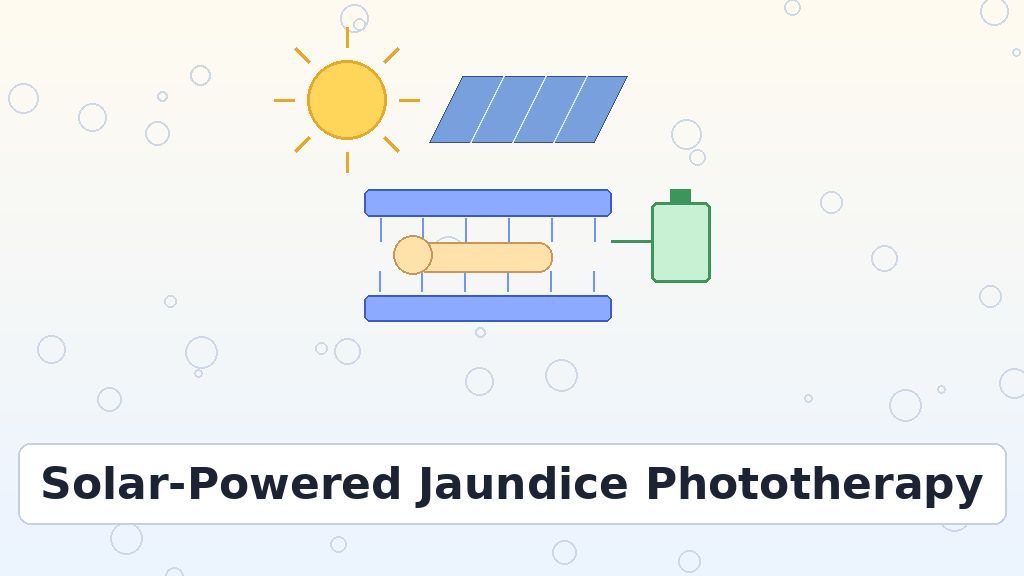
The device carries the name PoliteUltraLumen. It combines solar panels, a battery, and a bed with lights above and below. Because light hits the baby from both sides, more skin receives treatment. The team calls this design total-body phototherapy. Full details appear in the Frontiers in Pediatrics paper. Specifically, the panels charge the battery during the day. At the same time, the battery stores about 27 hours of reserve energy. That reserve covers more than one full day without sunshine. The lamps give blue light at a wavelength of 460 nanometers. In practice, the light sits near the middle of the blue color band. Babies lay under the lights in three-hour sessions. After each session, they took a 15-minute break for feeding and water. Finally, nurses kept babies’ eyes covered during treatment.
Three Stages From Hospital Wards to Mission Clinics
First, specialists ran the device at University of Calabar Teaching Hospital. That stage began in February 2024 with just one bed. Of 218 jaundiced babies there, 42 used it, about one in five. Next, the team moved devices to other tertiary hospitals in different climate zones. These larger hospitals included sites in Keffi, Lokoja, and Minna. After that came the hardest test, starting in April 2025. Catholic mission hospitals in southeast Nigeria set up special treatment rooms. The team named each room a Jaundiroom. Each one held the main bed plus two smaller support cots. Junior doctors, nurses, and health assistants delivered most of the care. In addition, they followed a short, simplified set of operating steps. Specialists also offered support from a distance rather than on site.
Results From Solar Phototherapy Across 663 Babies
Across all stages, every treated baby reached the planned endpoint. In turn, all 663 babies went home after treatment. Among 155 babies with full records, bilirubin fell by about 36% on average. That drop equals roughly one third of the starting level. Treatment averaged 16.5 hours, with most babies finishing in under a day. However, the clearance speed differed between sites, by up to two and a half times. Notably, no treated baby needed a later exchange transfusion. The team also reported no device-related serious harm and no treatment-related deaths. At the first hospital, the device ran for two years without a repair call. Light output, moreover, did not drop in a meaningful way at sunset. Still, one hard truth remains. Without a comparison group, these results describe success, not superiority.
Fig. 1: Key Results From Nigeria’s Solar Jaundice Study
Explainer: How Blue Light Clears Jaundice
Light carries energy in small packets called photons. Blue photons carry more energy than red ones because their wavelength is shorter. When blue light reaches a baby’s skin, bilirubin molecules absorb it. As a result, the molecules change their shape slightly. The new shapes dissolve more easily in water. Because of this, the body can flush them out without the liver’s full help. Doctors call this photoisomerization, which simply means a shape change caused by light. Our story on a smartphone jaundice detector app shows another early check. More skin under the light, in general, means more bilirubin gets changed. That idea explains the two-sided bed design. Stronger light at the right color also speeds up the change. Therefore, the treatment needs no needles or medicine.
Why Solar-Powered Phototherapy Keeps Running After Sunset
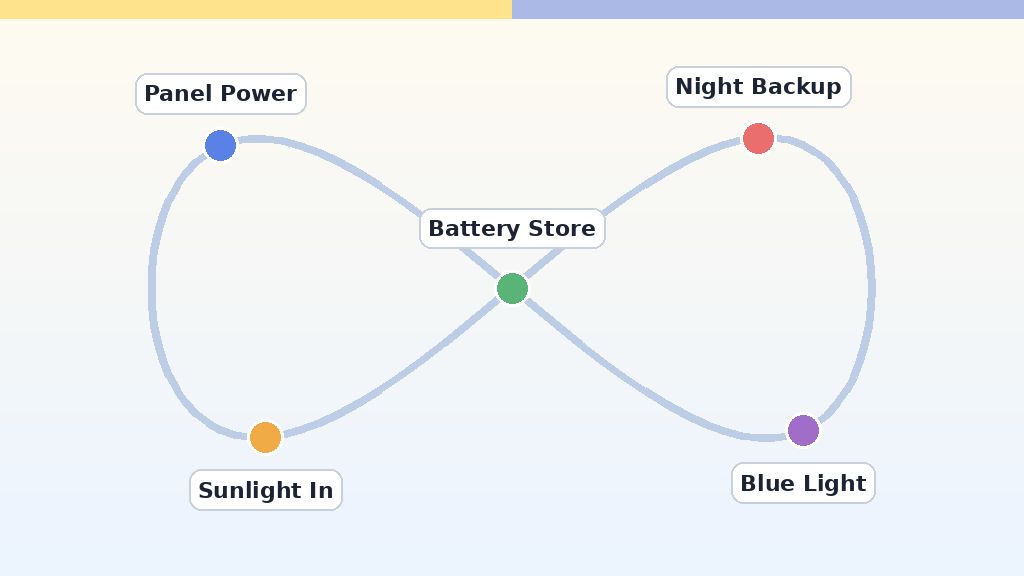
Solar panels turn sunlight into electricity through the photovoltaic effect. During the day, that electricity both runs the lamps and charges the battery. After dark, the battery takes over the job. In fact, the stored reserve lasts longer than a full day and night. The team measured light strength with a calibrated meter at several body points. At the body, the main bed reached about three times the starter cot’s strength. Even so, the smaller finisher cot still had enough light to complete treatment. Thanks to this setup, the main bed handled the heaviest work first. After that, a baby could move to the finisher cot to finish safely. Such a relay, in this way, freed the main bed for the next baby. Consequently, night sessions did not depend on the grid at all.
Fig. 2: How Solar Power Runs Blue-Light Therapy
Challenges and Motivation Behind Solar-Powered Jaundice Phototherapy
The motivation behind solar-powered jaundice phototherapy came from a stubborn problem. Many hospitals have the medical knowledge but not the steady power. Earlier, Amadi argued that Nigeria already owns useful newborn care inventions. In a 2024 Imperial College London news story, he made a pointed claim. “We already possess the necessary knowledge and technology,” he said. That remark came from a related review, not this exact study. Still, it explains why the team pushed treatment into small clinics. At the same time, the authors link the device to climate resilience. Solar beds cut the need for diesel generators and long transfers. Meanwhile, care closer to home means shorter trips for families. For this reason, the paper frames the design as low-carbon care. Even so, the team admits that weather effects need formal measurement later.
Limits That Keep This a Feasibility Study
The authors list several honest limits, and readers should weigh each one. To begin with, the study had no control group using ordinary lamps. As a result, it cannot prove the device works better than standard care. Second, many babies at smaller sites lacked complete records. In fact, full data existed for only 155 of 663 babies. Third, a batch of baby beds broke during the second stage. That fault forced a redesign and paused treatment at some sites. On top of that, some mission clinics could not run lab blood tests. Lastly, follow-up for the grassroots stage was still ongoing. Besides, the team did not measure weather data at first. The authors now plan comparison studies and cost studies next. In short, the device passed a real-world test, not a final exam.
Conclusion: What Comes Next for Off-Grid Newborn Care
This study argues that solar-powered jaundice phototherapy can work beyond big cities. On the one hand, all treated babies reached their targets without grid power. Yet, on the other hand, the evidence comes from one design without a comparison group. Future trials must test whether these beds truly beat standard lamps. For students, the work joins medicine with engineering and solar energy. Similar thinking appears in a village cervical cancer screening device built for rural clinics. Our report on a sun-powered nitrate cleaning reactor also shows clean energy solving local problems. Careers here include biomedical engineering, solar technology, and newborn nursing. Above all, the study shifts attention from fancy machines to reliable delivery. Real progress, the authors argue, means care that reaches every baby who needs it.
References
Amadi, H. O., Antia-Obong, O. E., Muoneke, L.-S. C., Meremikwu, M. M., Udo, J. J., & Ango, S. (2026). Solar-powered phototherapy for severe neonatal hyperbilirubinemia in low-resource settings: A multicentre implementation study in Nigeria. Frontiers in Pediatrics, 14, Article 1967434. https://doi.org/10.3389/fped.2026.1967434
M. Aftab brings a sharp, questioning edge that suits a story where the evidence needs careful handling. The piece could explain earlier how the forehead skin meter differs from a lab blood test, since that gap shapes how readers judge the results. A short line on what a future comparison trial would actually measure would also strengthen the limits section. For full methods and data, readers may wish to consult the original source paper behind this story.
Editorial note
From the desk: this explainer follows our newer, simpler reading-level rule, so the science stays plain and the figures stay few. ENTECH Magazine encourages readers to check the details independently by turning to the original research paper this story draws on.
Mohammed Aftab is a Science Communicator at ENTECH STEM Magazine and a Doctor of Pharmacy (Pharm.D) graduate with a strong interest in pharmaceutical sciences, medicine, and public science education. His areas of interest include pharmacology, pharmacotherapeutics, clinical pharmacy, clinical research, rational drug use, evidence-based medicine, medication safety, and medication errors. His research focuses on assessing intravenous-to-oral drug switching practices in a tertiary-care teaching hospital, reflecting his interest in appropriate medication use and evidence-based healthcare.
Aftab specializes in explaining complex medical and pharmaceutical concepts in simple, clear, and easy-to-understand language. Using relatable everyday examples and practical analogies, he helps teenagers and the general public understand medicines, how drugs work in the body, common health conditions, and the science behind medical treatments. Through his work at ENTECH STEM Magazine, he aims to bridge the gap between scientific knowledge and public understanding, making reliable medical and scientific information engaging, accessible, and relevant to everyday life.