Scaling production once meant adding more shifts, workers or machines. Today, however, that approach is reaching its limits. Supply chain volatility and stricter compliance standards are putting growing pressure on factory operations. Meanwhile, labor shortages and rising material costs are hitting mid-sized manufacturers across Southeast Asia hard. As a result, legacy systems and disconnected spreadsheets now cause costly production bottlenecks. To stay competitive, more manufacturers are turning to integrated manufacturing software. This approach links the shop floor with planning, procurement and finance. In addition, IT/OT integration removes the data silos that slow down decision-making. Every team therefore works from the same real-time data. Government programs such as Thailand 4.0 also encourage this shift toward the smart factory.
This guide explains what integrated manufacturing software is and how it reduces bottlenecks. It also covers measurable benefits and how to choose the right manufacturing ERP software. Finally, it outlines the challenges to plan for before implementation.
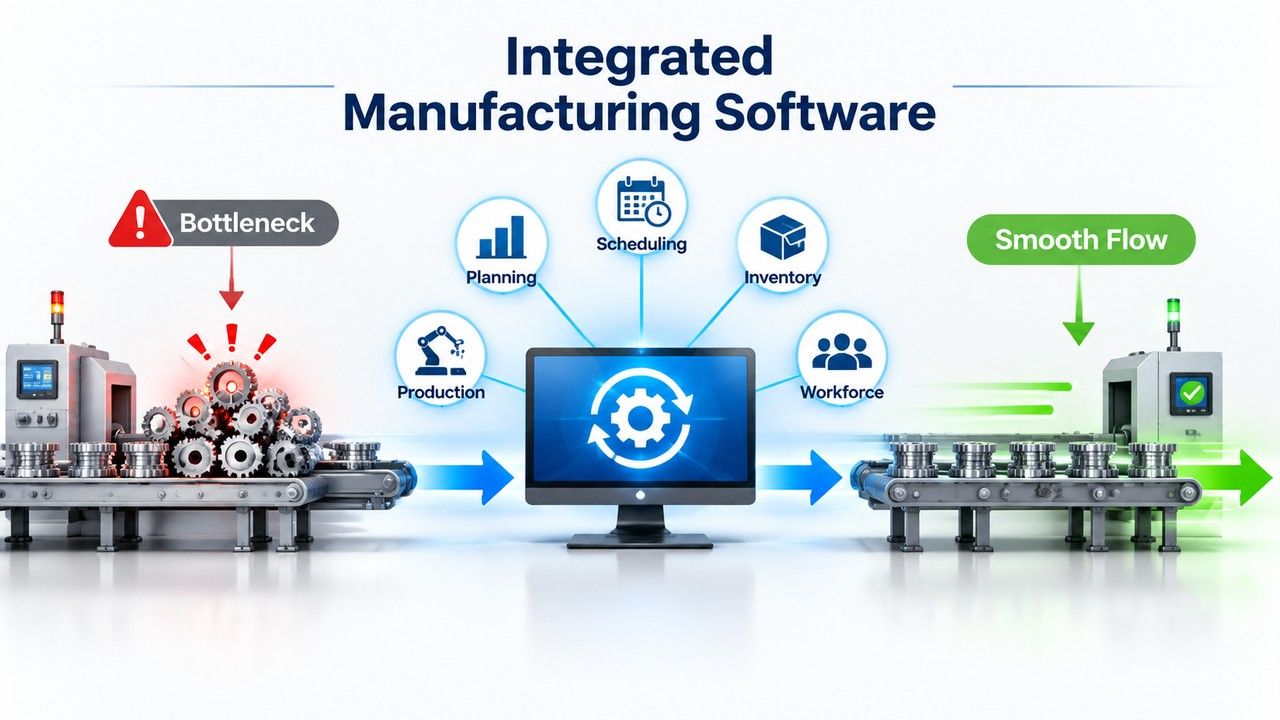
Integrated manufacturing software connects every core factory function on one platform. Instead of using separate tools, it links planning, production and business data. As a result, every department shares one accurate, real-time data source. At its core, manufacturing ERP software manages finance, procurement, inventory and sales. Alongside it, a manufacturing execution system (MES) tracks work orders and machine output. Advanced planning and scheduling (APS) tools then build schedules around real capacity. Similarly, a quality management system (QMS) records inspections and compliance data. Finally, IIoT sensors capture live machine data such as temperature and vibration.
By contrast, standalone tools keep data in separate systems. Teams then re-enter information by hand, which causes delays and errors. Integrated manufacturing software, however, updates every module automatically. For example, a finished work order instantly adjusts inventory and cost records. Many vendors also offer modular, industry-specific platforms. Therefore, manufacturers can start small and add modules as they grow.
Why Disconnected Systems Create Production Bottlenecks
The Real Cost of Unplanned Downtime
Unplanned stoppages put a heavy financial burden on growing manufacturers. On average, downtime costs manufacturers about $260,000 per hour, according to Aberdeen research. Automotive plants, however, face even steeper losses. In fact, Siemens estimates their downtime costs exceed $2.3 million per hour. Furthermore, unplanned downtime costs the world’s 500 largest companies $1.4 trillion a year. That figure equals 11% of their annual revenue.
In many cases, these losses trace back to disconnected systems. When data sits in separate tools, teams spot problems too late. Moreover, manual, labor-intensive operations and outdated spreadsheet reporting make delays worse.
Common Bottlenecks Caused by Data Silos
Data silos create bottlenecks across the entire production cycle. First, planners build schedules without live machine data. As a result, two orders often compete for the same line. Second, buyers cannot see real-time stock levels. Consequently, material shortages halt production without warning. Quality checks also slow down when inspectors log results on paper. Approvals then wait in inboxes while finished goods sit idle. Finally, managers wait days for manual reports to reach them. By then, the problem has already cost time and money. Integrated manufacturing software removes these delays by connecting every team to the same data.
Bridging the Gap Between IT and the Shop Floor with IT/OT Integration
Historically, factory floors operated on fragmented systems. The Purdue Reference Model strictly separated operational technology from information technology, often leading to severe latency bottlenecks and isolated data silos. Modern hyper-automation strategies now eliminate this divide by connecting machine-level programmable logic controllers directly to centralized enterprise platforms. This seamless flow of data allows production engineers to shift away from sequential, rigid reporting and embrace real-time connected architectures.
When data flows freely between the shop floor, procurement, and finance departments, decision-makers gain unparalleled visibility into their operations. They can spot deteriorating equipment trends well before a critical failure occurs, saving both time and resources. To achieve this level of synchronization, companies must evaluate the best ERP solutions tailored for their specific industrial needs. Implementing a modular, industry-specific platform acts as a digital nervous system, allowing factories to coordinate complex tasks instantly.
How Integrated Manufacturing Software Reduces Bottlenecks
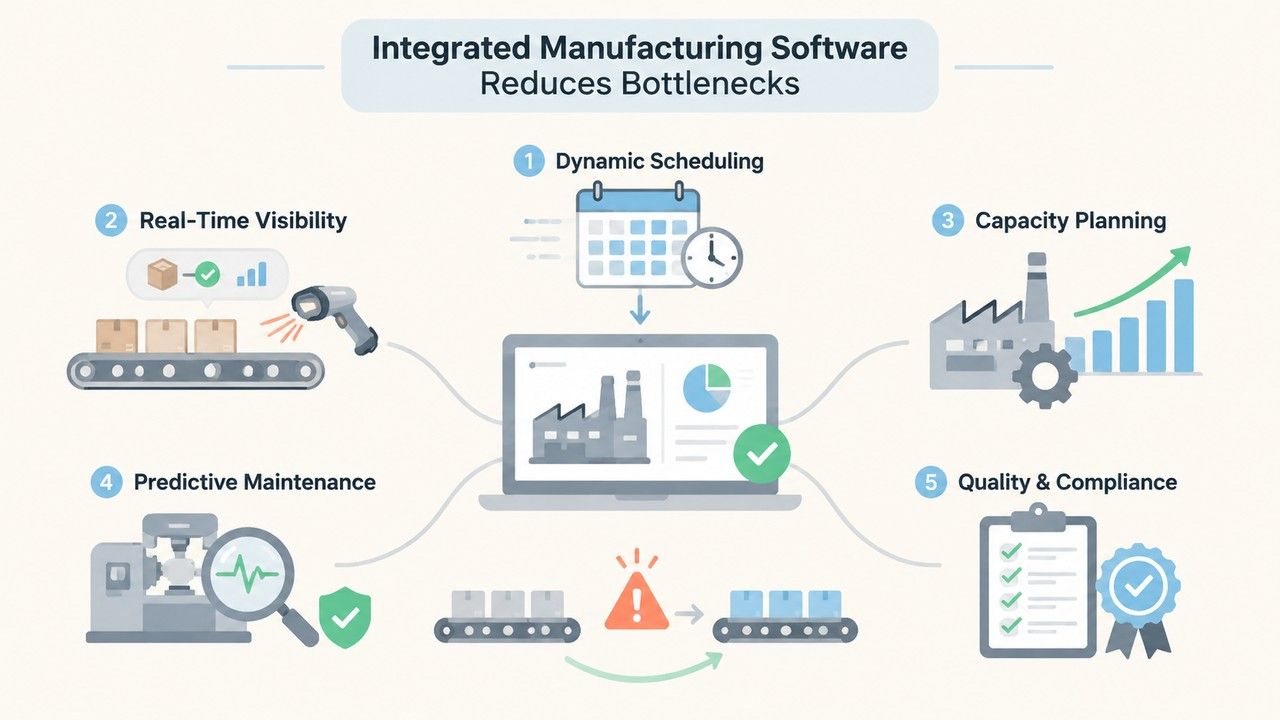
Integrated manufacturing software tackles bottlenecks at their source. It connects data, machines and people in one system. Here is how it removes the most common delays.
Static schedules break down as soon as conditions change. Advanced planning and scheduling (APS) tools, however, adjust plans in real time. For example, the system reroutes orders when a machine stops. It also reacts quickly to supply chain disruptions. Production engineers can then optimize factory layouts using live data. Technical discussions on efficient manufacturing systems explore this shift in more detail.
Real-Time Inventory and Material Visibility
Material shortages are a leading cause of line stoppages. With integrated manufacturing software, buyers see live stock levels across every warehouse. The system also flags low inventory before it affects production. As a result, procurement teams reorder materials on time. Furthermore, finance teams track fluctuating material costs as they happen. This helps managers protect margins when prices swing.
Capacity Planning and Constraint Management
Every factory has one process that limits total output. Integrated systems find this constraint using real machine data. Planners then schedule work around the slowest step. In addition, they check new orders against available capacity first. Consequently, sales teams make delivery promises the factory can actually keep.
Predictive Maintenance to Prevent Downtime
Equipment failures cause some of the costliest bottlenecks. IIoT sensors, however, monitor vibration, temperature and cycle times continuously. The software then analyses this data to spot early signs of wear. In many cases, managers can anticipate failures weeks in advance. Maintenance teams therefore schedule repairs during planned downtime. This approach also extends machinery lifespans.
Built-In Quality and Compliance Tracking
Manual quality checks often delay shipments. Integrated manufacturing software, by contrast, logs production variables automatically at every stage. Inspectors record results digitally, so approvals move faster. This makes it easier to meet strict standards such as IATF 16949. Moreover, complete digital records simplify customer audits and traceability requests.
Measurable Benefits of a Smart Factory
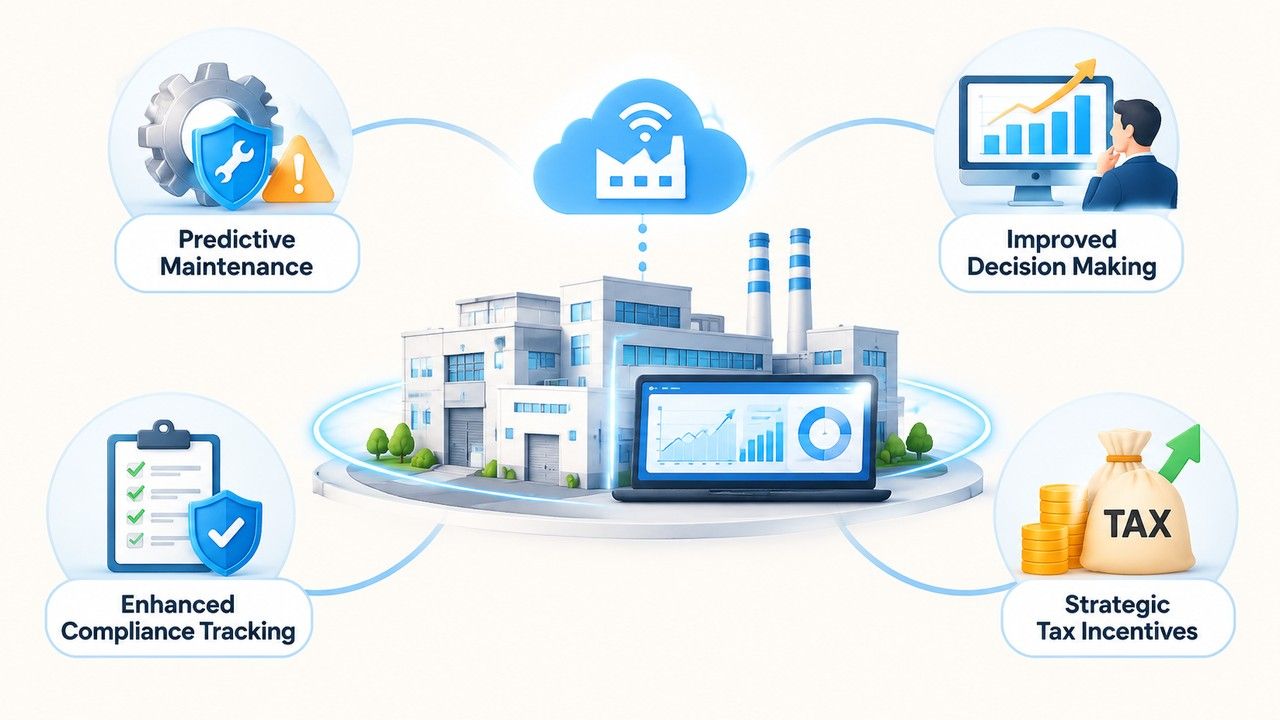
A connected smart factory delivers gains across every key performance metric. For instance, IIoT-connected platforms can improve supply chain efficiency by up to 35%. Automated workflows also cut production overheads in measurable ways. Furthermore, fewer stoppages and faster changeovers lower the cost per unit.
Fig. 2: Tangible Benefits of a Smart Factory (illustration – AI Generated)
Pharmaceutical manufacturers show what is possible at the advanced end. There, continuous manufacturing and digital in-line controls cut conversion costs by up to 50%. They also reduce cycle times tenfold. Results in other sectors will vary, however.
Moreover, 70% of manufacturers using integrated analytics report faster decision-making. As a result, leaders at every level act on live data, not old reports. In addition, overall equipment effectiveness (OEE) rises as machines run longer between stoppages. Ultimately, these gains translate directly into higher profitability. With integrated manufacturing software, managers track each metric on live dashboards. This makes it easier to prove return on investment.
Challenges to Plan For Before Implementation
Integrated manufacturing software delivers strong results, but it is not a quick fix. Manufacturers should plan for several common challenges before they commit.
Implementation Cost and ROI Timeline
Manufacturing ERP software licences, hardware and consulting fees add up quickly. Mid-sized factories also pay for data migration and testing. In addition, returns rarely appear in the first few months. Savings usually build gradually as teams adopt the system. Therefore, leaders should set realistic budgets and clear milestones early. A phased rollout also spreads costs and shows value sooner.
Legacy Equipment and Integration Complexity
Many factories still run older machines without modern connectivity. These machines often lack the protocols that new platforms expect. Engineers may need gateways or retrofit sensors to collect their data. Furthermore, old databases often hold duplicate or inaccurate records. Teams should therefore clean and map their data before migration.
Workforce Training and Change Management
New software only works when people actually use it. However, operators often trust familiar spreadsheets and paper logs. Without proper training, they may resist the system or create workarounds. For this reason, managers should involve floor staff from the start. Hands-on training and internal champions also speed up adoption.
Cybersecurity Risks of Connected Operations
IT/OT integration links once-isolated machines to enterprise networks. As a result, attackers gain more entry points into the factory. A single breach could halt production lines or expose sensitive data. Manufacturers should therefore segment networks and control user access carefully. In addition, regular patching and staff security training reduce the risk.
Future-Proofing Factory Operations with Integrated Manufacturing Software
The global manufacturing software market continues to grow quickly. Notably, the Asia-Pacific region leads this growth. Meanwhile, the gap between digitally mature and legacy-dependent factories keeps widening. As a result, manufacturers that delay modernisation risk falling further behind.
In Thailand, the Eastern Economic Corridor (EEC) also supports smart factory adoption. For example, EEC operations can claim 200% tax deductions for AI training. They can also import smart automation equipment duty-free.
Ultimately, integrated manufacturing software helps factories scale efficiently and adapt to sudden market changes. It also helps them maintain high quality standards. The challenges are real, but careful planning makes them manageable. Above all, a unified digital infrastructure is no longer just a technology up
Integrated manufacturing software puts ERP, MES, scheduling, quality and IIoT data on one platform. As a result, every department works from the same real-time data.
How does integrated manufacturing software reduce production bottlenecks?
It updates schedules in real time, flags low stock early and predicts equipment failures. Consequently, factories prevent many stoppages before they happen.
What is IT/OT integration in manufacturing?
IT/OT integration links shop floor machines, such as PLCs and IIoT sensors, to enterprise systems. Therefore, it removes data silos and gives managers real-time visibility.
Is manufacturing ERP software suitable for mid-sized factories?
Yes, many vendors offer modular manufacturing ERP software built for mid-sized factories. In fact, manufacturers can start with core modules and add more as they grow.
What are the main challenges of building a smart factory?
Common smart factory challenges include implementation costs, legacy equipment, staff training and cybersecurity risks. However, a phased rollout and careful planning keep these challenges manageable.
References:
Venanzi, R., Di Modica, G., Foschini, L., & Bellavista, P. (2025). Towards IT/OT integration in industry digitalization: A comprehensive survey. Journal of Network and Computer Applications, 245, 104373. https://doi.org/10.1016/j.jnca.2025.104373
Hrutanshu Kurankar is a Computer Engineering graduate from Marathwada Mitra Mandal’s College of Engineering, Pune. His interests span artificial intelligence, machine learning, cybersecurity, data science, and science communication. He enjoys exploring how emerging technologies work and translating complex technical concepts into clear, accessible explanations for students and young audiences.
His practical experience includes developing FlashCTI, a Retrieval-Augmented Generation (RAG) system for cyber threat intelligence and log analysis, exploring privacy-focused browser extensions, and building machine learning applications. His technical background includes Python, data analysis, machine learning frameworks, web development, vector databases, and cybersecurity tools. Through these projects, he has developed an interest in applying technology to real-world problems and making technical knowledge easier to understand.
Hrutanshu is associated with ENTECH STEM Magazine, where he contributes to science communication and editorial initiatives, including research outreach and activities supporting the Machine Learning Special Issue 2026. His work involves connecting with potential contributors and academic reviewers to encourage participation in STEM research and knowledge sharing. As a science communicator, he aims to bridge the gap between complex scientific ideas and everyday understanding through relatable examples, clear writing, and evidence-based explanations. He is particularly interested in making science and technology engaging and accessible to the next generation of learners.
Shoaib Khan is a mechanical engineering student, engineering enthusiast, and science communicator with a multidisciplinary interest in understanding the principles that govern both engineered systems and the natural universe. He is pursuing Mechanical Engineering at Veer Surendra Sai University of Technology (VSSUT), Burla, where he is actively involved in engineering projects and Formula Student vehicle development through Team VeerRacerss Electric. His technical interests span electric vehicle technology, automotive engineering, thermal management, computational fluid dynamics, finite element analysis, aerospace systems and advanced propulsion technologies. Beyond engineering, he has a strong interest in fundamental physics, particularly quantum mechanics, theoretical physics, astronomy and astrophysics. He is fascinated by questions surrounding the fundamental nature of matter, the evolution of the universe, black holes and the physical laws governing celestial objects. His approach to science combines theoretical curiosity with practical problem-solving, with a particular interest in exploring the intersection of mechanical engineering, computational methods, artificial intelligence and scientific research.