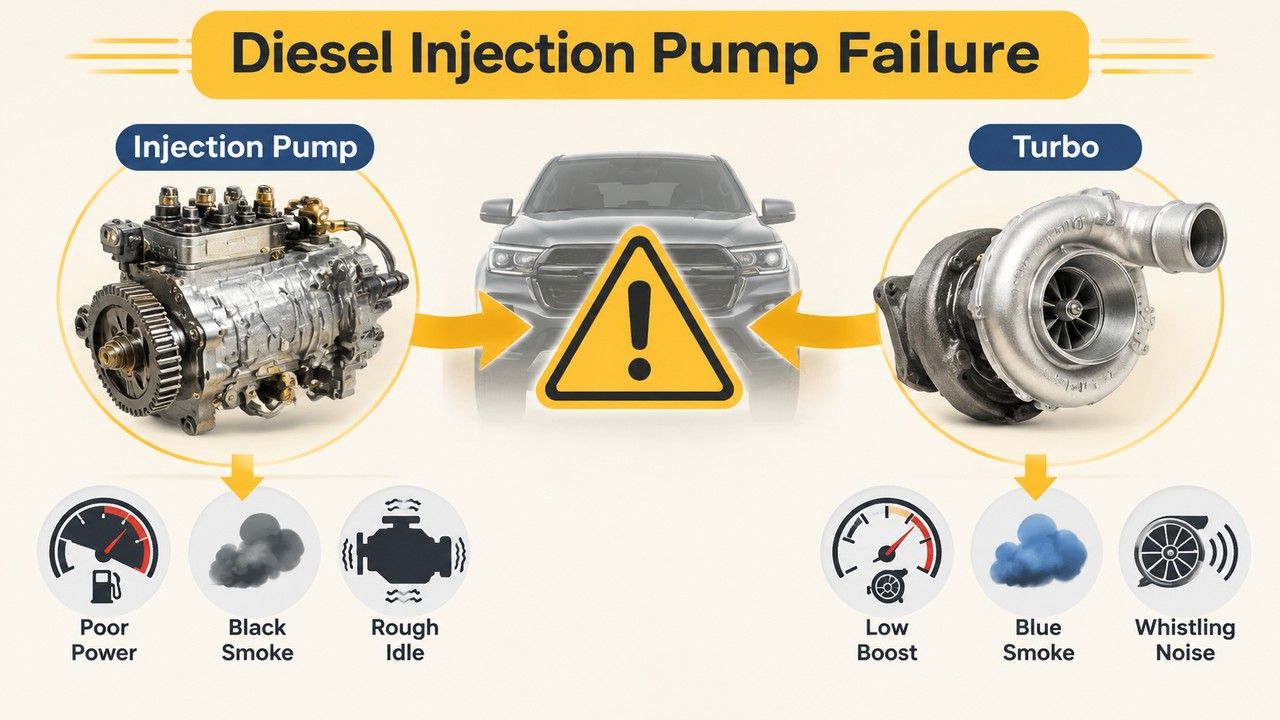
Your diesel engine won’t start. It pours black smoke under load. Or it suffers sudden power loss on every hill. Many owners assume diesel injection pump failure right away. However, the real fault is often smaller and cheaper. In fact, shops often replace the fuel injection pump or the turbocharger when neither part has failed. A clogged fuel filter, a boost leak or a wiring fault can cause the same symptoms. As a result, owners pay for costly parts and still have the same problem.
This guide helps you avoid that mistake. First, it explains how each system works. Then, it shows you how to separate real pump and turbo symptoms from look-alike faults with basic shop tools. Finally, it covers how to choose between new, rebuilt and used parts when you truly need a replacement. In short, you will learn to fix the cause, not just the part.
A diesel engine has no spark plugs. Unlike a gasoline engine, it also has no throttle plate to control power. Instead, power depends on how much fuel reaches the cylinder and when it arrives. The injection pump handles both jobs. First, it raises fuel from supply pressure to injection pressure. Then, it delivers that fuel at a precise moment relative to piston position. Pump designs do this work in different ways:
Inline pumps: Each cylinder has its own plunger and barrel. A camshaft inside the pump housing drives them. The pump meters fuel by rotating each plunger to change its effective stroke.
Rotary distributor pumps: A single pumping element builds pressure. A rotor then sends fuel to each outlet in firing order.
Common rail systems: These split the job in two. A high-pressure supply pump feeds a shared rail. Then, solenoid or piezo injectors control timing and quantity electronically.
Inline, Rotary and Common Rail: Why Pump Type Matters
Pump design changes what a symptom means. For example, take a rough idle. On a mechanical rotary pump, it usually points to internal wear, a sticking metering valve or air in the system. On a common rail engine, however, the same roughness more likely comes from an injector balance problem or a rail pressure control fault. In other words, not every rough idle signals diesel injection pump failure.
In short, learn where your system builds fuel pressure and where it meters fuel. That knowledge turns a thousand-dollar guess into a one-hour diagnosis. New to diesel work? It helps to review the fundamentals of automobile engineering and powertrain layout first. After all, the fuel path, the air path and the control system all affect each other.
Symptoms of Diesel Injection Pump Failure
Not every diesel fault starts at the pump. However, a few warning signs often do. Learn to read them before you reach for a wrench.
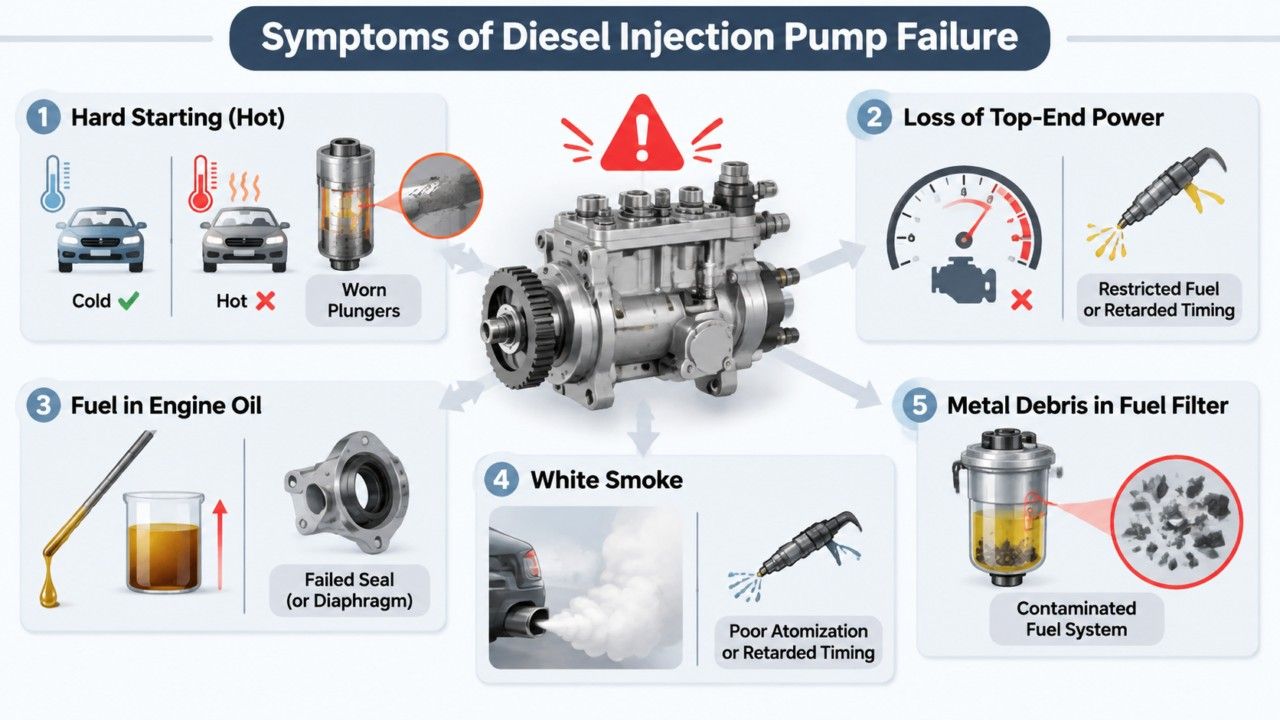
First, watch for hard starting when the engine is hot. If it starts fine when cold, worn plungers are a likely cause. Heat opens up internal clearances. As a result, fuel leaks past the worn parts. A failing transfer pump can also cause this problem. Next, look for a loss of top-end power with no boost fault. In this case, the engine makes rated boost but still won’t pull. This usually points to restricted fuel delivery or retarded timing. Also, keep an eye on the dipstick. Fuel in the engine oil often shows up as a rising oil level. On some pump designs, this means a failed shaft seal or diaphragm. White smoke that won’t clear after warm-up is another clue. Poor atomization or badly retarded timing leaves fuel unburned. Still, rule out a coolant leak first. Burning coolant can produce similar white smoke. Finally, check the fuel filter for metal debris. Nobody wants to find this warning sign. On common rail systems, debris has likely contaminated the whole fuel circuit. That includes the injectors. So the repair often goes well beyond the pump.
Even so, one symptom alone rarely proves diesel injection pump failure. Instead, look for a pattern. Then, confirm it with the cheap tests below.
Run the Cheap Tests First
Before you condemn any part, start with the cheap tests. First, check the fuel supply. Fit a clear hose between the filter and the pump inlet. Air bubbles in the hose point to a suction leak. Next, connect a vacuum gauge to the pump inlet. High vacuum reveals a collapsing suction line or a blocked tank strainer. Then, measure lift pump pressure at cranking and at rated speed. On electronic systems, read the live data before you pick up a wrench. Compare actual rail pressure with desired rail pressure. Also, check the injector correction values. Above all, check fuel quality. Dirty or wet fuel is the most common reason pumps “fail early.” Research on wear and lubrication behavior in diesel fuel injection equipment explains why. In short, water and dirt sharply shorten the life of pump elements.
How a Turbocharger Works and Why It Fails
A turbocharger is a simple machine with unforgiving tolerances. It has three main parts:
Turbine wheel: Exhaust gas spins this wheel.
Compressor wheel: It shares the same shaft. It forces extra air into the engine.
Center housing rotating assembly (CHRA): This housing supports the shaft. Engine oil feeds its journal or ball bearings.
Shaft speeds can exceed 100,000 rpm on smaller turbos. As a result, oil matters more than almost anything else. Oil pressure, oil cleanliness and drain flow all decide turbo life. In fact, most turbo failures trace back to oil starvation or dirty oil.
Three causes come up again and again. The first is delayed oil feed. After a cold start, oil takes time to reach the bearings. Meanwhile, the shaft spins with little protection. The second is coked oil. Hot shutdowns bake the oil left in the feed line. The carbon then restricts oil flow. The third is abrasive particles. Dirty oil carries grit into the bearings. Over time, this grit scores the journals.
Less often, foreign objects or overspeeding damage the wheels. Even so, check the oil system first. Like an injection pump, a turbo rarely fails on its own. In other words, something else usually kills it.
Turbo Failure Symptoms vs. Look-Alike Faults
Many turbo symptoms have other causes. Therefore, rule out the look-alikes before you blame the turbo.
Take blue smoke and oil in the charge pipe. Worn seals or bearings can cause this. However, a restricted crankcase breather creates the same picture. A blocked oil drain does too. In both cases, the turbo may be perfectly healthy.
Next, listen for a whistling or siren noise that changes with load. This often means a boost leak upstream. A damaged wheel is less likely.
Low boost with black smoke is another common trap. Here, the turbo may not be at fault at all. Instead, check for a stuck variable-geometry turbo (VGT) mechanism. A leaking intercooler can also cause it. So can a sooted wastegate actuator. Sometimes, a plugged air filter is the only problem.
Once you rule these out, inspect the turbo itself in a set order. First, examine the compressor and turbine wheels. Look for tip rub and foreign object damage. Next, check axial and radial shaft play. Compare both readings against the manufacturer’s limits. Then, pressure-test the charge air system for leaks. Finally, verify actuator travel and the vacuum or electronic control. Only then can you fairly blame the turbo.
Fix the Root Cause, Not Just the Part
A new part won’t fix an old problem. For example, say oil starvation killed your turbo. The replacement will fail too unless you fix the oil supply. Before you fit it:
Flush the oil feed line.
Change the engine oil and filter.
Confirm the oil drain is clear.
Otherwise, a second failure is almost guaranteed.
The same logic applies to injection pumps. Suppose you leave contaminated fuel in the tank. In that case, the new pump inherits the problem. So clean the fuel system before you install the pump.
On common rail engines, this step is often mandatory. Many remanufacturers require flushed fuel lines and new filters. Without them, they may not accept the installation as correct.
New, Rebuilt or Used Injection Pump: Which Should You Choose?
Sometimes a unit truly has to come off. In that case, you have three options. Each one suits a different job.
First, consider new units. A new pump has known-clean internals and matched calibration. Therefore, it suits fleets that can’t afford a repeat visit. Next, there are rebuilt units. A proper rebuild is the mainstream choice for older mechanical pumps. The rebuilder replaces wear parts such as plungers, barrels and delivery valves. It also swaps out the governor components. Then, the rebuilder recalibrates the assembly on a test bench. Some suppliers call these remanufactured pumps. Finally, used units have their place too. They make sense for housings and drive components. They also help with hard-to-find legacy pumps. For example, take an older tractor or standby generator. Suppliers may not even list a new assembly for it.
So how do you decide? Above all, weigh three factors. Start with the duty cycle, or how hard the machine works. Then, think about service life. How long must the machine stay in service? Lastly, check core availability. A core is your old, rebuildable unit. Suppliers often credit it against the replacement. As a result, a spare core can lower your cost.
In any case, you still need the exact part number. That’s where many buyers go wrong.
Sourcing Diesel Parts by Part Number
Identification is the hardest part of sourcing. Diesel pumps and turbos often carry three kinds of numbers: manufacturer, OEM and superseded part numbers. However, these numbers rarely match the tag on your unit. That’s why cross-reference searching beats browsing by engine model. Some suppliers specialize in this problem. For example, Goldfarb & Associates is based in Rockville, Maryland. Since 1997, the company has sold diesel fuel injection pumps and related parts. It offers new, rebuilt and used units. It also runs a parts finder with cross-reference part numbers. As a result, technicians can work from the number on the housing instead of guessing. This works for rotary, inline and common rail units alike.
The catalog goes beyond pumps, too. It covers turbochargers, CHRA cartridges, injectors and nozzles. In addition, it lists camshafts, ECMs, delivery valves, plungers and barrels. Say you’re tracing a stamped number on a Bosch injection pump. In that case, cross-referencing is usually the fastest way to confirm the part. The company also buys rebuildable cores from remanufacturers, brokers and fleets. So, does your shop have a shelf of old units gathering dust? Those cores may be worth money. Whichever supplier you choose, ask two questions first.
Was the unit bench-tested?
And does the supplier offer core exchange?
Step-by-Step Diesel Diagnosis Checklist
Good diagnosis follows a set order. Skip a step, and you risk replacing a healthy part. So work through this checklist before you remove a pump or turbo.
Record the symptom. Note exactly what happens. Also, note when it appears and what changes it.
Pull fault codes and live data. Do this before you disturb anything. Otherwise, you may lose useful clues.
Test the fuel supply. Check the filters and the return line for restriction. Then, sample the fuel for water and debris.
Test the air path. Pressure-test the charge air system. Next, confirm that the actuators work properly.
Remove the suspect part. Only then should you take the component off. After that, inspect it to find the cause of failure.
Note every part number. Record the numbers on both the tag and the housing. Then, source the replacement against both.
In short, this order moves from cheap checks to costly ones. As a result, you spend less time and money. It also keeps the new part from failing the same way.
References:
Howe, A., Poapongsakorn, P., Tanwar, M. D., Al-Qahtani, A. M., Doustdar, O., & Dearn, K. D. (2026). Lubricity and tribological performance of 2-methylfuran and 2-methyltetrahydrofuran blended with diesel. Proceedings of the Institution of Mechanical Engineers Part J Journal of Engineering Tribology, 240(10), 1946–1955. https://doi.org/10.1177/13506501261453670
Shoaib Khan is a mechanical engineering student, engineering enthusiast, and science communicator with a multidisciplinary interest in understanding the principles that govern both engineered systems and the natural universe. He is pursuing Mechanical Engineering at Veer Surendra Sai University of Technology (VSSUT), Burla, where he is actively involved in engineering projects and Formula Student vehicle development through Team VeerRacerss Electric. His technical interests span electric vehicle technology, automotive engineering, thermal management, computational fluid dynamics, finite element analysis, aerospace systems and advanced propulsion technologies. Beyond engineering, he has a strong interest in fundamental physics, particularly quantum mechanics, theoretical physics, astronomy and astrophysics. He is fascinated by questions surrounding the fundamental nature of matter, the evolution of the universe, black holes and the physical laws governing celestial objects. His approach to science combines theoretical curiosity with practical problem-solving, with a particular interest in exploring the intersection of mechanical engineering, computational methods, artificial intelligence and scientific research.