Nonlinear optical crystals change the color of laser light as it passes through them. Engineers rely on these materials because many useful wavelengths have no convenient laser source. Doubling the frequency of 1,064-nanometer infrared light, for example, gives green light at 532 nanometers. However, the crystals that do this work carry a hidden weakness. Tiny gaps in their atomic structure absorb light and turn it into heat. Under an intense beam, that heat can damage the material. This explainer looks at one such gap, the oxygen vacancy, and a recent repair. Researchers at Shandong University report the method in the journal Nature Communications. Their work also shows how chemistry, physics, and engineering meet inside one transparent solid.
The topic matters because lasers now reach far beyond the laboratory. Gas sensing and ultrafast pulse amplification both need light at specific wavelengths. Mid-infrared light is especially useful, yet few lasers produce it directly. Crystals offer a route, since they can shift common near-infrared beams into that range. Their usefulness, though, depends on how much intensity they survive. Han and colleagues describe a crystal that tolerated roughly twice the laser intensity after treatment. Understanding why requires a short tour of what nonlinear optical crystals do. Specialists often shorten the name to NLO crystals. It also helps to see how missing atoms change a solid’s response to light.
Ordinary glass lets light through without changing its color. Nonlinear optical crystals behave differently when the light becomes intense enough. Inside them, the beam drives electrons so hard that the response stops being proportional. As a result, the crystal emits light at new frequencies, such as double the original. Physicists call the strength of this effect the nonlinear coefficient. Another property, birefringence, means the crystal bends two polarizations of light by different amounts. Designers use that difference to keep the old and new waves in step. They call this condition phase matching. A third property decides whether the device survives, namely the laser damage threshold. This figure states the highest light intensity the material tolerates before it breaks down.
Different jobs ask nonlinear optical crystals for different output wavelengths. The National Institute of Standards and Technology (NIST) offers a practical example in its greenhouse gas measurements. According to the agency, its instruments use a lithium niobate crystal to reach the mid-infrared. That shift let the system identify gases that its near-infrared version could not detect. Wavelength choice also depends on the air itself. NASA explains that water vapor, carbon dioxide, and ozone absorb certain bands of radiation. Between those bands lie atmospheric windows, where the air is largely transparent. Han and colleagues note that their crystal transmits well across the 3–5 micrometer window. Consequently, a material that works there could suit measurements over open air.
* Original illustration prepared for ENTECH Magazine; concepts from Han and colleagues (2026) and NIST (2021).
Fig. 1: From pump laser to molecular spectroscopy
Why Oxygen Vacancies Limit Langasite Crystals
Several families of nonlinear optical crystals compete for mid-infrared work. Commercial options, according to a 2020 study in Scientific Reports, are semiconductors such as silver gallium sulfide. That study lists low damage thresholds and difficult crystal growth among their shortcomings. Han and colleagues cite thresholds in the tens of megawatts per square centimeter. Oxide crystals from the langasite family tolerate far more, around one gigawatt per square centimeter. Manufacturers can also grow them to large sizes directly from a melt. These oxides share a general recipe with four kinds of metal site. Lanthanum fills one site, while gallium and a partner element share others. That sharing is where the trouble begins, because the partners carry different electric charges.
When differently charged ions share one kind of site at random, local charge becomes unbalanced. The lattice compensates by leaving some oxygen positions empty. Chemists call each empty position an oxygen vacancy. Such vacancies absorb ultraviolet light and lower the damage threshold, the authors write. Earlier efforts relied on heating the finished crystals in oxygen. Even so, the vacancies in a niobium-based langasite persisted after prolonged treatment. The reason, according to the paper, lies in thermodynamics rather than in technique. Niobium holds a fixed charge, so the crystal needs its vacancies to stay electrically neutral. Refilling them would upset the balance again. A lasting repair therefore had to start with the choice of atoms.
How Titanium Lets the Crystal Heal
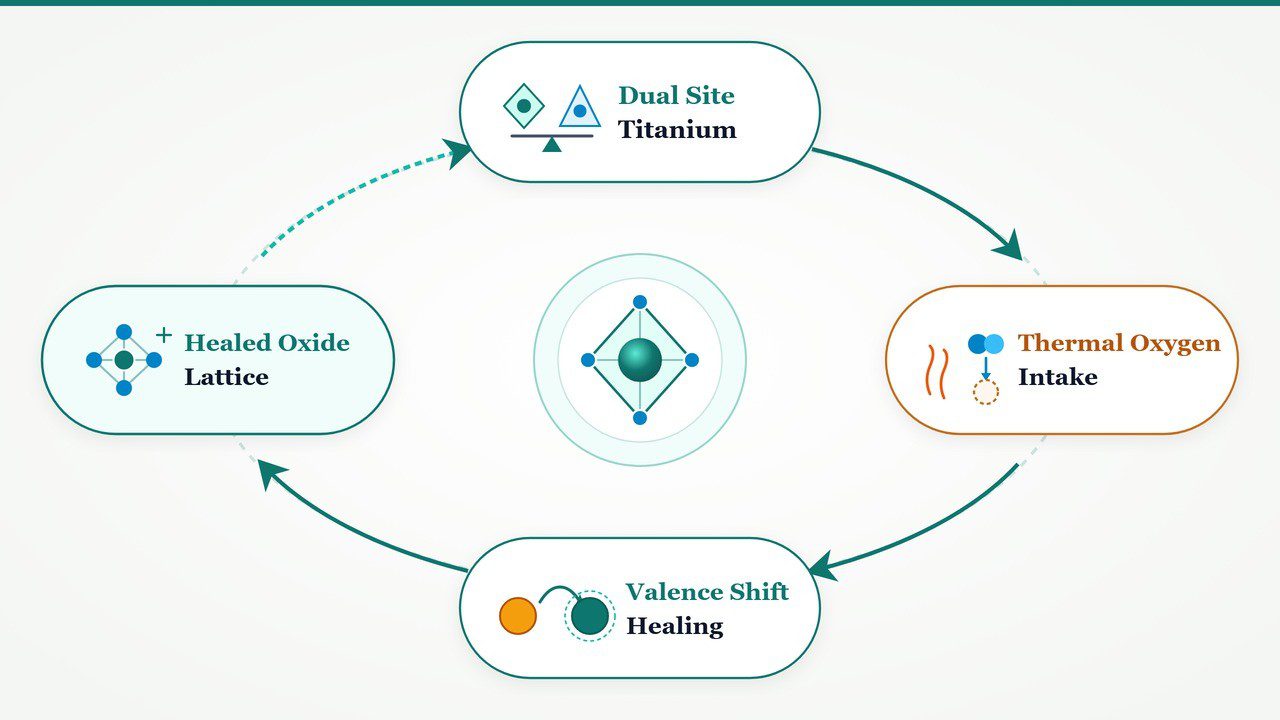
Han and colleagues replaced niobium with titanium, giving the compound La₃TiGa₅O₁₄. They shorten the name to LGTi. Titanium suits the task for two reasons that the team sets out. First, a titanium ion carrying four positive charges shows no strong preference between two sites. One site surrounds the ion with six oxygen atoms and the other with four. The group’s calculations put the energies of the two options at −5.407 and −5.366 electron volts. Because those values nearly match, titanium can settle into both sites at once. The authors name this behavior quasi-degenerate cation occupation. In plain terms, the ion treats two different seats as almost equally comfortable. Spreading across both seats may help even out the local charge.
The second reason concerns how titanium handles electrons. It can carry three positive charges or four, and oxidation moves it between them. During growth in an oxygen-poor atmosphere, some titanium takes the lower charge. Those ions and the oxygen vacancies commonly appear together as linked defects. Later heating in oxygen reverses the process. Titanium gives up an electron, returns to the higher charge, and an oxygen atom re-enters the lattice. The vacancy thus disappears without disturbing the overall balance. A fixed-charge ion such as niobium cannot make that exchange. Students may recognize the pattern as an oxidation reaction taking place inside a solid. Here, however, the reaction mends a structure instead of corroding one.
* Original illustration prepared for ENTECH Magazine; concepts from Han and colleagues (2026).
Fig. 2: How titanium heals an oxygen vacancy
Growing and Annealing the NLO Crystals
A design on paper still has to become a real crystal. Earlier studies had presumed that LGTi would not melt cleanly, which blocked high-quality growth. The Shandong team tested that assumption with thermal measurements. Their sample showed a single melting signal at 1,781 kelvin and no sign of decomposition. They then prepared more than ten nearby compositions to find a workable starting mixture. With that recipe, the group pulled a crystal 25 millimeters wide and 45 millimeters long. The technique, the Czochralski method, draws a growing crystal slowly upward from a melt. Compatibility with this melt-based route matters, the authors note, when large crystals are the goal. The fresh crystal, however, looked orange instead of clear.
* Original illustration prepared for ENTECH Magazine; growth details from Han and colleagues (2026).
Fig. 3: From tuned melt to finished crystal
Color offered the first clue about defects. Titanium in its lower charge state absorbs blue-green light, which leaves an orange tint. The researchers therefore heated it to 1,400 degrees Celsius in flowing oxygen for 48 hours. Afterward, the orange sample had turned colorless and transparent. Several instruments then searched the sample for remaining defects. Electron paramagnetic resonance, a method sensitive to unpaired electrons, found no signal from low-charge titanium. The same method found no signal from oxygen vacancies either. Both readings had fallen below what the instrument can detect. That wording matters, since a reading under the detection limit is not zero. The paper claims strong suppression, and this article follows that more careful phrasing.
* Original illustration by ENTECH Magazine; findings from Han and colleagues (2026).
Fig. 4: Four checks on the healed crystal
What the Measurements Show
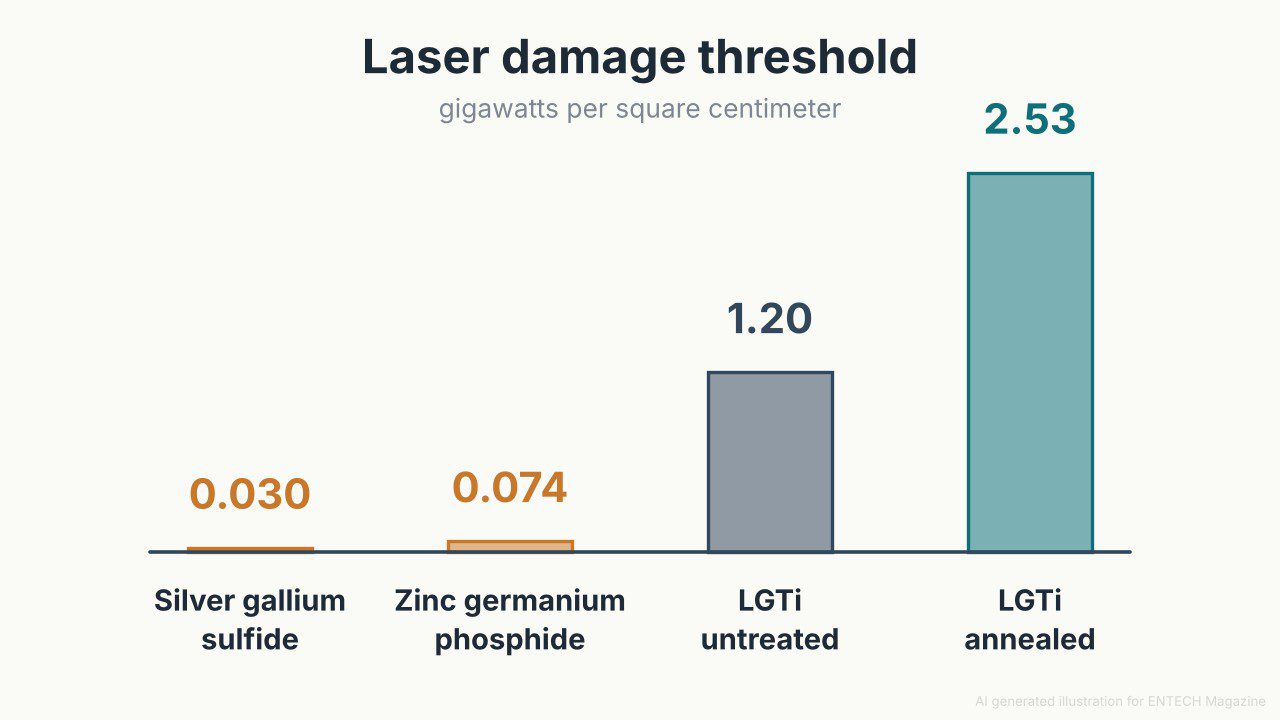
Clearer crystals may also be tougher, and the tests support that expectation. Before annealing, the damage threshold stood at 1.20 gigawatts per square centimeter. After annealing, it reached 2.53 gigawatts per square centimeter. The team measured both values with 10-nanosecond pulses of 1,064-nanometer light. By their comparison, the higher figure is about 80 times that of silver gallium sulfide. It also exceeds the values they list for other bulk langasite crystals. The nonlinear coefficient rose as well, from 3.14 to 3.51 picometers per volt. According to the authors, the low-charge titanium had been reabsorbing some converted green light. Removing it let more light escape, so the measured figure approached the intrinsic one.
* Original chart by ENTECH Magazine; values reported by Han and colleagues (2026).
Fig. 5: Laser damage threshold before and after
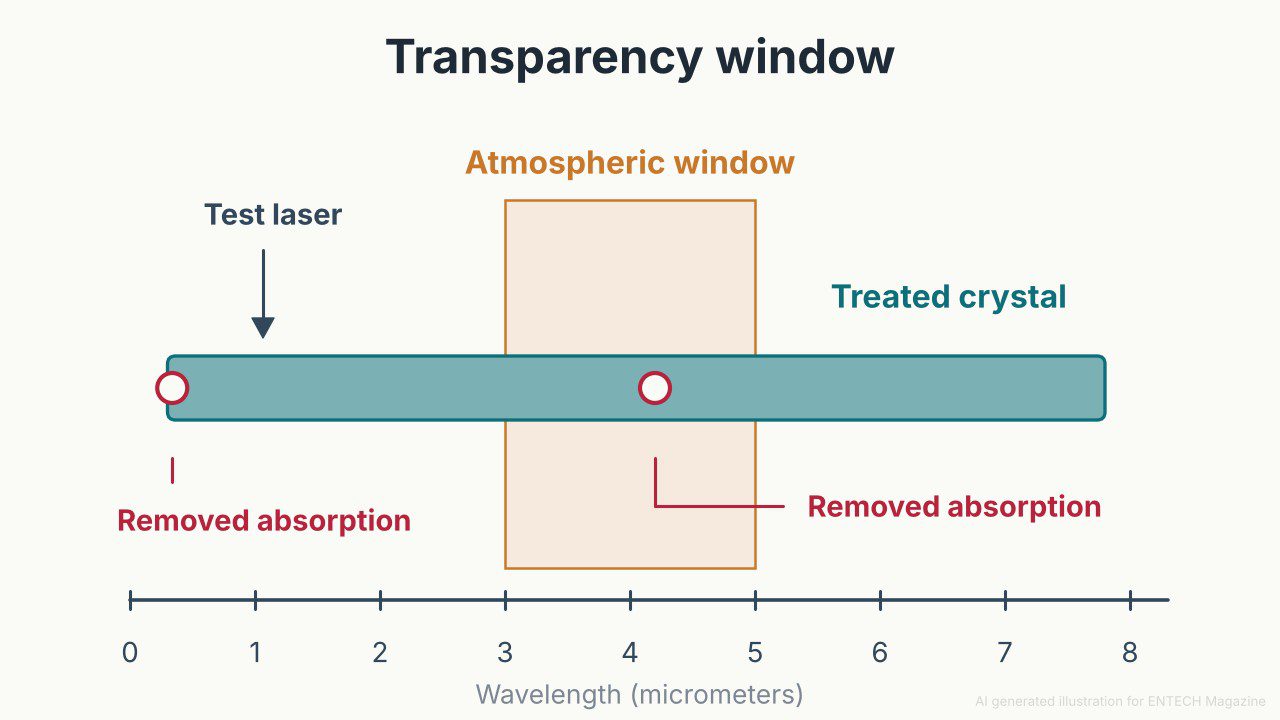
Other optical properties also changed in the same favorable direction. The optical bandgap, which limits short-wavelength transmission, widened from 3.95 to 4.07 electron volts. An absorption feature near 338 nanometers vanished, as did a weaker one near 4.2 micrometers. Overall, the treated crystal transmitted light from about 0.3 to 7.8 micrometers. Its birefringence measured 0.04 at 1,064 nanometers, the largest the team reports for this family. Vibration measurements, meanwhile, looked essentially unchanged before and after heating. That result suggests the treatment removed defects without distorting the underlying structure. The team’s models placed defect energy states inside the bandgap. Such states can trap energy and promote heating under an intense beam. Calculations on gallium oxide by Dong and colleagues likewise found deep oxygen-vacancy levels.
* Original illustration by ENTECH Magazine; wavelength values from Han and colleagues (2026).
Fig. 6: Transparency window of the treated crystal
Where Tougher Langasite Crystals Could Matter
Tougher nonlinear optical crystals could allow more powerful light sources. The authors point to one target, amplifiers for very short and intense mid-infrared pulses. An earlier design study modeled such an amplifier around a niobium-based langasite. Such systems push crystals hard, so extra headroom has direct value. Gas sensing offers a second possible use, as the NIST work with lithium niobate suggests. Because LGTi grows from a melt, producers might scale it with existing crystal-pulling equipment. That prospect could disrupt how suppliers choose between oxide and semiconductor NLO crystals. Further steps, such as larger crystals and working devices, may come first. Related ENTECH explainers cover near-infrared light sources and ultrafast ultraviolet laser pulses.
For students, the study works as a compact lesson in connected science. Charge balance and oxidation states come from chemistry classes. Energy levels, light absorption, and polarization come from physics. Meanwhile, crystal growth and furnace control belong to materials engineering. The project also relied on computer modeling, electron microscopy, and several kinds of spectroscopy. Each of those methods corresponds to a recognizable specialty in research and industry. People who grow crystals, build lasers, model materials, or run instruments all bring such skills. Entrepreneurs, too, may find openings in services such as crystal treatment or testing. None of these paths depends on this one material succeeding. Instead, the work illustrates how defect control has become a shared language across photonics.
Limits and Open Questions
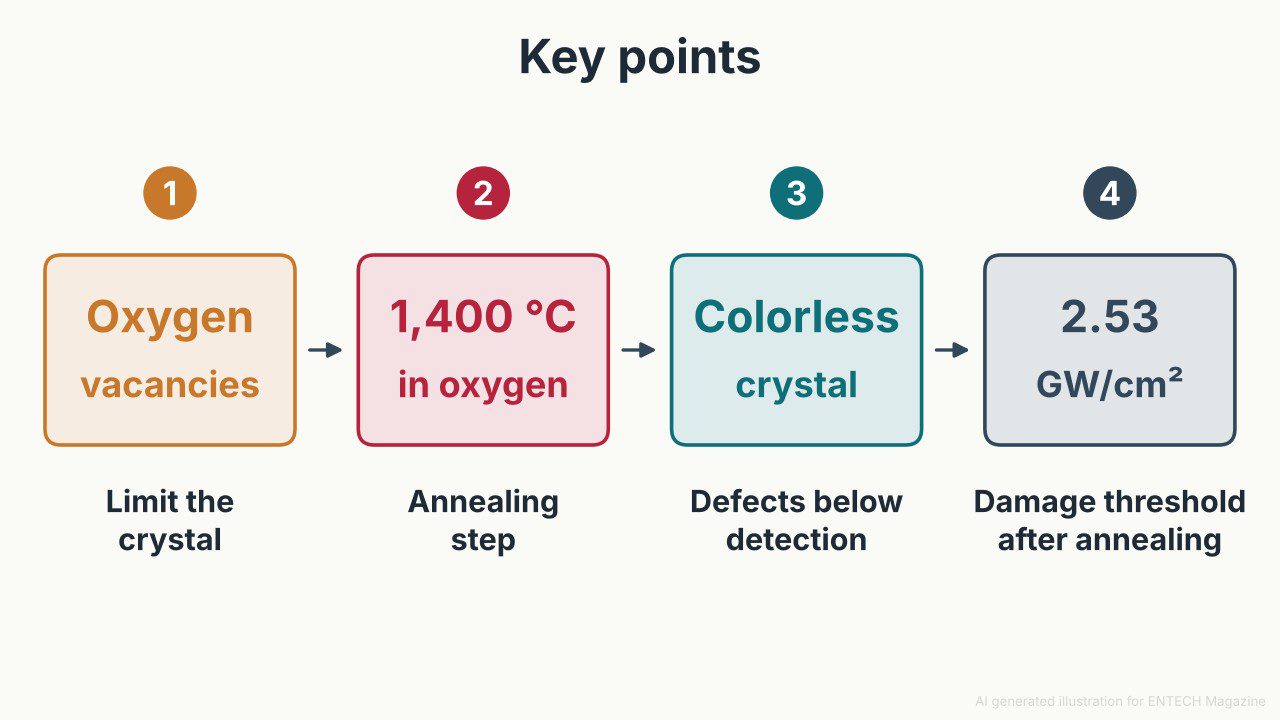
Several cautions apply to the findings described above. The paper reports results from one research group and one crystal composition. Its damage tests used one wavelength and pulse length, so other conditions may differ. The authors calculated phase-matching behavior but did not demonstrate a mid-infrared converter in this study. Device performance therefore remains a prediction. Whether the same titanium approach transfers to other crystal families is also untested. Han and colleagues suggest that it could, and they invite validation in further material systems. For now, the study adds a clear idea to the field of nonlinear optical crystals. An ion that fits two sites and changes charge may make permanent defects repairable. That idea, more than any single figure, seems the durable lesson.
* Original illustration by ENTECH Magazine; values from Han and colleagues (2026).
Fig. 7: Key points of the defect-healing study
References
Han, J., Liang, F., Wu, K., Lu, D., Cui, D., Yu, H., & Zhang, H. (2026). Quasi-degenerate cation occupation enables oxygen-vacancy defect healing in nonlinear optical crystals. Nature Communications. Advance online publication. https://doi.org/10.1038/s41467-026-79746-5
Liu, J., Ma, J., Wang, J., Yuan, P., Xie, G., & Qian, L. (2019). Toward 5.2 µm terawatt few-cycle pulses via optical parametric chirped-pulse amplification with oxide La3Ga5.5Nb0.5O14 crystals. High Power Laser Science and Engineering, 7, e61. https://doi.org/10.1017/hpl.2019.47
Wang, R., Liang, F., & Lin, Z. (2020). Data-driven prediction of diamond-like infrared nonlinear optical crystals with targeting performances. Scientific Reports, 10, 3486. https://doi.org/10.1038/s41598-020-60410-x
Dong, L., Jia, R., Xin, B., Peng, B., & Zhang, Y. (2017). Effects of oxygen vacancies on the structural and optical properties of β-Ga2O3. Scientific Reports, 7, 40160. https://doi.org/10.1038/srep40160
This article introduces how certain crystals convert laser light and why missing oxygen atoms weaken them. It then walks through a titanium-based design and the heat treatment used to repair those gaps. A later revision could add a worked example of phase matching, and further research on other crystal families would show how widely the idea applies.
Editorial note
Crystals that change the color of laser light sit inside many instruments, and small flaws in their atomic structure limit how much power they can handle. This article explains one such flaw, the oxygen vacancy, and a recent laboratory approach that may allow it to be repaired after the crystal has grown. The papers and pages under References hold the full methods and measurements. Readers are encouraged to consult them and to check each claim for themselves. ENTECH accepts no responsibility for statements made here or in those sources. This article is offered for information and education only, and it is not professional advice.
I am a Physics graduate with a strong academic interest in statistical mechanics, complex systems, computational physics, and the study of collective behaviour in interacting systems. During my undergraduate studies, I developed an interest in understanding physical phenomena not only through theoretical concepts but also through computational modelling and simulation. As part of my academic work, I explored the Ising model using Monte Carlo simulations and studied the Active Ising Model to investigate collective behaviour, density variations, and phase transitions in active systems. These projects introduced me to computational approaches in physics and strengthened my interest in understanding how simple microscopic interactions can give rise to complex macroscopic behaviour. Alongside my academic interests, I am passionate about education and science communication. I have experience helping students and peers understand concepts in physics and mathematics, with an emphasis on intuitive explanations rather than simply memorising formulas. I enjoy connecting scientific ideas to everyday experiences and presenting complex topics in a way that is clear, engaging, and accessible. I am also interested in the role of technology in education and the development of digital learning resources. Through writing, teaching, and educational projects, I hope to contribute to making scientific knowledge more accessible to students and curious learners. My broader interests include non-equilibrium statistical mechanics, active matter, phase transitions, computational modelling, complex systems, and science education. Through my work, I aim to continue developing as a researcher while contributing to science communication and education.