A pregnancy test gives an answer at home in minutes. Most cancer tests, by contrast, still need a distant lab and a long wait. For women in rural India, that wait can mean no test at all. A new cervical cancer screening device aims to change that. Researchers at the All India Institute of Medical Sciences (AIIMS) Bhopal led the work. Rajnish Chowdhary and Ujjawal Khurana share first authorship with a large team. Jagat R. Kanwar, in turn, is the senior author. Many doctors and engineers also joined the effort. Their study appears in Scientific Reports. In short, the portable reader tests a cervical swab on site. On top of that, it runs from a laptop’s USB port. As a result, health workers could screen women right in their own villages.
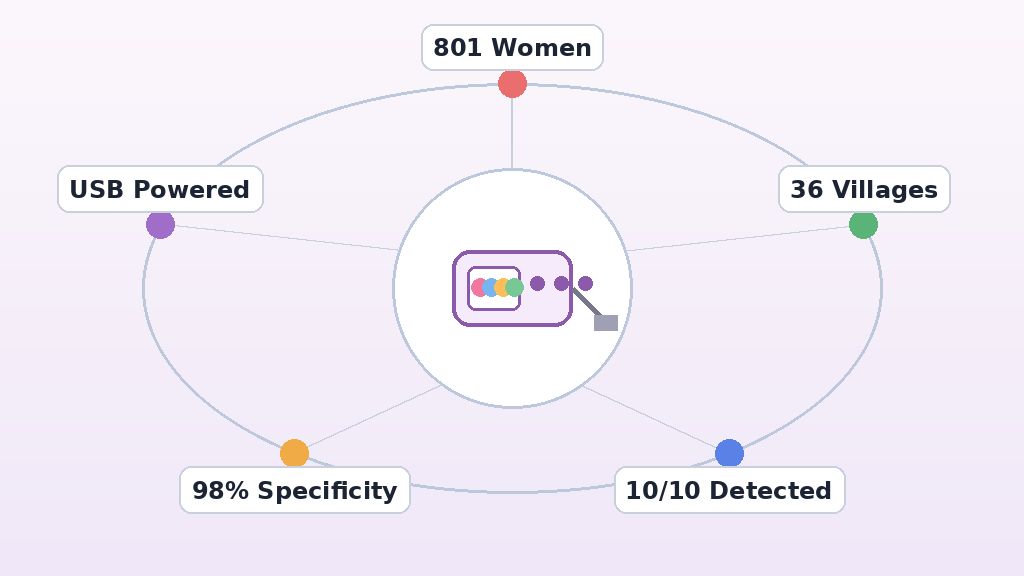
Cervical cancer grows slowly, which gives doctors time to act. Before it turns into cancer, the cervix shows early cell changes. If clinics catch those changes, treatment can stop the disease. The trouble, however, lies in reaching every woman in time. Many families live far from the nearest lab. Lab tests need trained staff, microscopes, and steady power. In practice, many villages lack all three. The new reader, called KayaCervi, checks a swab for four warning molecules at once. Then health teams tested it on 801 women from 36 villages. At the same time, every woman also received a standard lab test for comparison. The device caught all 10 confirmed cases. Still, it also raised 16 false alarms. In this article, we explain how the reader works and why caution matters.
Why India Needs a Cervical Cancer Screening Device
Cervical cancer ranks among the most common cancers in women worldwide. According to the WHO global fact sheet, it caused about 280,000 deaths in 2024. Low- and middle-income countries, in particular, carry the heaviest load. India sits among them. In addition, the paper cites prevalence figures of 6% to 30% across India. Persistent infection with human papillomavirus, or HPV, drives almost every case. For this reason, screening focuses on HPV and the cell changes it causes. Our guide to why pathology matters in healthcare explains how labs diagnose disease from tissue. Yet labs cluster in cities, far from many patients. Women in remote districts often travel far for a single test. As a result, many never go at all. So the AIIMS team set out to bring the lab to them.
Lab Tests Rarely Reach Villages
At present, the usual tests each have limits. A Pap smear needs a trained expert to study cells under a microscope. Liquid-based cytology, or LBC, improves sample quality but still needs a lab. HPV DNA tests, meanwhile, require special machines and reagents. As a result, results can take days or weeks. During that delay, some women never return for their reports. Visual checks with vinegar, for example, exist as a low-tech option. However, results depend heavily on the skill of the examiner. In rural clinics, power cuts and staff shortages add more hurdles. Therefore, the team wanted a test with four features. It should be portable, quick, simple, and accurate enough for mass testing. On top of that, it should not need a full laboratory nearby.
Global Targets for Cervical Cancer Screening
The World Health Organization has set a clear goal. This new paper cites the same plan. Under its elimination plan, member countries aim to hit three targets by 2030. First, 90% of girls should receive the full HPV vaccine by age 15. Second, 70% of women should get screened by ages 35 and 45. Third, 90% of women with precancer or cancer should receive treatment. The WHO elimination initiative explains these goals in detail. Of the three, testing often lags most in rural regions. For this reason, new tools matter a great deal. In other words, India needs faster ways to test millions of women. A test that works in a village hall could help close that gap. That need, above all, shaped the design of the new reader. Speed and portability, therefore, came first.
How the AIIMS Bhopal Team Built KayaCervi
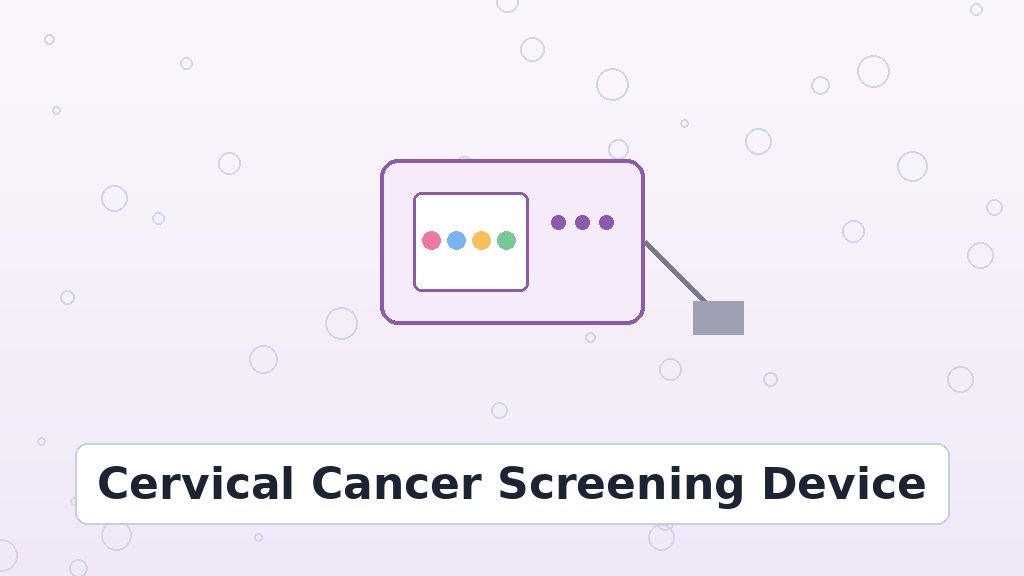
The researchers describe the full project in the Scientific Reports study. Their device builds on reader technology from Kaya17, a company in the United States. In this case, the team adapted that reader to detect four markers at once. It now handles a single swab test. Both a US patent and an Indian patent cover the reader. The full system has three parts, namely a cartridge, a reader, and software. Inside, the cartridge holds a membrane that captures target proteins from the swab. Next, the reader shines light on the cartridge and records the glow. Finally, the software turns that glow into a positive or negative result. The whole unit measures about 6 by 12 by 3 inches. In other words, it fits easily on a small clinic table.
Choosing Four Warning Signs
Picking the right markers came first. Initially, the team tested 10 candidate proteins in swab samples. They used a standard lab method called ELISA for this step. After that, they narrowed the list to four markers. Two of them, p16INK4a and Ki-67, rise when cervical cells start dividing abnormally. The other two come from HPV types 16 and 18. In fact, these two virus types cause most cervical cancers worldwide. Together, the four markers cover both the virus and the cell damage it causes. During setup, the team tuned the reader with samples from 200 hospital patients. In that phase, the device matched the reference test perfectly. Even so, hospital patients often have clearer disease than people in the community. So the real test came later, in villages.
A Screening Device That Runs on USB
Power often fails in rural clinics. For this reason, the reader draws its power from a laptop’s USB port. In practice, it does not need a wall socket at all. The reader, in addition, reports results as relative fluorescence units. Software then compares those numbers with preset cutoffs. As a result, a trained health worker can run the test without a pathologist. Each cartridge also handles one swab sample. Swabs come from the cervix during a quick pelvic exam. The reader then needs only a short run to give its answer. In this way, a woman could learn her result during the same visit. That speed could cut the number of women who never return. Of course, any positive result would still need a follow-up lab test.
Fig. 1: Key Results From 801 Village Women
How a Cervical Cancer Screening Device Reads a Swab
The reader relies on antibodies, the same proteins our immune system uses. Put simply, an antibody grabs one specific target, like a key fitting one lock. Here, each antibody carries a tiny glowing tag called a fluorophore. When the antibody grabs its marker, the tag’s glow shifts slightly. Our comparison of cytology and cell biology explains why cell-level clues matter. Meanwhile, the reader shines light of many colors onto the cartridge. At the same time, it records which colors come back, and how strongly. From these readings, it builds a three-dimensional map of light in and light out. Scientists call this map an excitation-emission matrix. For instance, each marker leaves its own pattern of peaks on it. In short, a bound marker leaves a different fingerprint than an unbound one.
Glowing Tags and Color Maps
Think of the color map as a weather chart for light. Each point shows how brightly the sample glows at one pair of colors. Peaks on the chart, therefore, reveal which tags have found their targets. Because four markers glow differently, one scan can check all four. A fast-switching set of LEDs sweeps through the incoming colors. On the other hand, a sensitive light detector records the outgoing glow. The software, in turn, corrects for differences between wavelengths. After that, it compares the glow pattern with known positive and negative samples. This approach also avoids the need to grow cells or read slides. As a result, the test skips several slow lab steps. That shortcut explains how a small box can stand in for parts of a lab.
Fig. 2: How the Reader Detects Four Markers
Results from 801 Women in 36 Villages
The community phase took place in the Bhopal and Seoni districts. In total, 801 women from 36 villages gave swab samples. That makes this phase the core of the study. Each woman also received LBC testing, which served as the reference standard. Out of 801 women, LBC confirmed 10 cases with abnormal cells. The device flagged all 10, which gives a sensitivity of 100%. Of the 791 women without abnormal cells, the device cleared 775. That result gives a specificity of 98.0%. However, 16 healthy women received false alarms. Because true cases were rare, only 38.5% of positive results proved correct. On the other hand, every negative result proved correct. The full results tables online list each number in detail. Agreement with LBC reached a kappa score of 0.545.
Limits of Point-of-Care Screening
Even so, these results need careful reading. First, a kappa score of 0.545 means only moderate agreement beyond chance. Second, the study found far fewer cases than expected. Abnormal cells showed up in about 1.2% of women, compared with an expected 6.1%. With only 10 true cases, the sensitivity estimate carries wide uncertainty. Third, the paper reports specificity of 98.0% in its results. Yet its abstract and conclusion cite 86% to 90%. For now, readers should note that mismatch until the authors clarify it. Fourth, the paper declares no conflicts of interest. Even so, one co-author lists an affiliation as chief scientific officer of EazeBio. Finally, the authors themselves call for larger multicenter studies with fixed cutoffs. Those trials will show how well the reader truly performs.
Conclusion: What Comes Next for the Cervical Cancer Screening Device
This study shows that a small reader can test cervical swabs on site. By tracking four markers, the device spotted every confirmed case in 801 women. In addition, it runs from a USB port and needs no full lab. Those features suit villages where power and staff run short. Still, false alarms and a small number of true cases limit firm conclusions. The specificity mismatch and the disclosure question also deserve answers. For now, the cervical cancer screening device remains a promising tool under study. Because of this, larger trials across many centers must come next. If those trials succeed, health workers could screen far more women each year. In the long run, that reach could move India closer to the global 90–70–90 targets. Early answers, after all, save lives.
References
Chowdhary, R., Khurana, U., Halder, A., Dwarakanath, S., Kumar, S., Kaore, S. N., Jadhav, A., Goel, S. K., Kapoor, N., Lokhande, S., Rozatkar, A., Kumar, A., Mukherjee, D., Nagar, N., Purohit, R., Yadav, M., Patil, V. D., Ray, S. K., & Kanwar, J. R. (2026). Cervical cancer on-site mass-screening device utilizing multiple biomarkers in swab samples for surveillance in the resource limited areas of India. Scientific Reports, 16, 36615. https://doi.org/10.1038/s41598-026-72310-7
I checked the brief against the published PDF. The device description matches: a cartridge, reader and microchip using fluorescence detection through a USB port, built from Kaya-17 (USA) technology, with US and Indian patent filings. The four selected biomarkers (p16INK4a, Ki-67, HPV16, HPV18) out of ten are correct, as are the 200 hospital standardization samples and the 801-woman community cohort benchmarked against LBC. The figures are correct: 10 of 10 positives detected, 775 of 791 negatives correctly classified, sensitivity 100%, specificity 98.0%, PPV 38.5%, NPV 100%, kappa 0.545. The brief rightly flags that the abstract also gives 86-90% specificity and that sensitivity rests on 10 cases. The paper declares no conflicts, though one author is listed as EazeBio CSO; the brief names that affiliation. Verdict: accurate; no corrections needed.
Editorial note
ENTECH runs this story because it is homegrown health innovation aimed at a real gap: many women in rural India never get screened for cervical cancer. An AIIMS Bhopal-led team built KayaCervi, a portable, lab-free reader that checks a cervical swab for four biomarkers, and tested it on 801 women in community camps. It caught all 10 cases found by the reference test and cleared most healthy women correctly. For teens, it connects biotechnology, biomedical engineering and public health to diagnostic startups and screening programs. Caveats: only 10 positive cases, so the 100% sensitivity is uncertain; fewer than 4 in 10 positive results were confirmed; the paper reports two different specificity figures; and larger multicenter studies are needed. Takeaway: promising field data, not yet ready for nationwide rollout.
Sailee Pakhare holds a Master's degree in Biotechnology, with a research background spanning microbiology, molecular biology, and disease biology. Her postgraduate dissertation examined the antimicrobial potential of bioactive peptides from lactic acid bacteria, and her research experience includes molecular identification of bacterial isolates (with sequencing data submitted to NCBI) and work as a Research Assistant at SafeWright Laboratory. She also completed a summer internship at IIT Hyderabad studying circadian rhythms and disease biology using Drosophila melanogaster as a model organism.
Her work has been recognized with the Best Poster award at the 3rd International Conference on Innovations in Biotechnology Research for Sustainable Bioresources and Bioeconomy (2025), and she has contributed to a book chapter on the role of AI and machine learning in climate change.
Sailee is also a co-founder of LifeXtension, a community focused on longevity, ageing, and health science awareness in India. An interdisciplinary thinker, she explores questions ranging from disease biology to space and the origins of life, approaching science as a way of asking questions rather than a fixed body of facts. As a science communicator and researcher, she is committed to translating complex research into writing that is clear, accurate, and engaging.
Doing research on quantitative claims made in the original research paper
Ishika Tawar is a biotechnology researcher and science enthusiast with a curiosity for understanding how life works at the molecular and cellular level. That curiosity started somewhere around school, wandered through a lot of unrelated corners of science and physics, and eventually settled on something she actually wants to spend her life on: aging and longevity. She supports transhumanism and believes that science and technology should be explored seriously as tools to overcome some of the biological limitations of the human body.
Ishika holds a Master's degree in Biotechnology and has experience in both wet-lab and computational research. At ACTREC, she worked on a project studying the interaction of the TG2 protein with the ribosome, where she gained experience in cloning, site-directed mutagenesis, transformation, and gene knockdown. She was also involved in studying ribosomal heterogeneity using R and publicly available single-cell RNA sequencing datasets from different cancers. As a Research Assistant at SafeWright, she worked on client-based projects involving microbial culturing, biochemical tests, and analysis, along with literature research, report writing, and preparation of laboratory protocols. She has also worked with Python-based analysis to study differential DNA methylation in breast cancer.
Her current areas of interest include epigenetics, genomics, gene therapy, stem cell biology, computational biology, and the use of AI in biological research. She is particularly interested in how these areas can contribute to understanding aging and developing ways to extend healthy human lifespan. She has explored this interest through research projects and hackathons focused on AI, aging, and longevity. She enjoys following ideas across biology, technology and physics, and she believes in evidence, questioning ideas and staying curious about things that are not yet understood.
Outside research, Ishika enjoys reading and talking about science and scientific ideas. She loves travelling and is especially fond of mountains. She also enjoys science communication and hopes to make scientific topics easier to understand without making them inaccurate or oversimplified.
Verifying the testing protocols and methods used in the original research paper
Mohammed Aftab is a Science Communicator at ENTECH STEM Magazine and a Doctor of Pharmacy (Pharm.D) graduate with a strong interest in pharmaceutical sciences, medicine, and public science education. His areas of interest include pharmacology, pharmacotherapeutics, clinical pharmacy, clinical research, rational drug use, evidence-based medicine, medication safety, and medication errors. His research focuses on assessing intravenous-to-oral drug switching practices in a tertiary-care teaching hospital, reflecting his interest in appropriate medication use and evidence-based healthcare.
Aftab specializes in explaining complex medical and pharmaceutical concepts in simple, clear, and easy-to-understand language. Using relatable everyday examples and practical analogies, he helps teenagers and the general public understand medicines, how drugs work in the body, common health conditions, and the science behind medical treatments. Through his work at ENTECH STEM Magazine, he aims to bridge the gap between scientific knowledge and public understanding, making reliable medical and scientific information engaging, accessible, and relevant to everyday life.