A silver-carbon layer lets anodeless solid-state cells run for long lives, but it stalls in the cold. One warm first charge switches it on for good, a 2026 study reports.
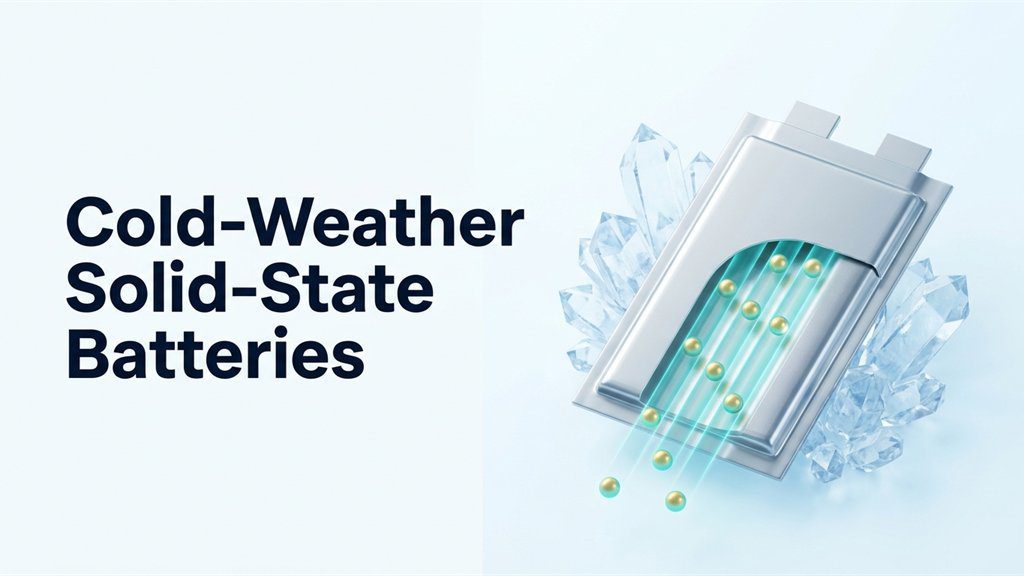
Batteries tend to lose performance when the temperature drops. A federal analysis shows electric cars losing about 41% of range at 20 degrees Fahrenheit. Next-generation cells face the same problem, and sometimes a sharper one. Cold-weather solid-state batteries are therefore a practical engineering goal. In short, they are solid-electrolyte cells that keep working in the cold. A 2026 study in Nature Communications examined one promising design at 5 degrees Celsius. Its capacity collapsed there, and the team traced the cause to a thin silver-carbon layer. More usefully, the same team also found a simple process fix. This explainer covers the cell design, the failure and the fix. It also weighs what the result means for factories, students and careers.
A conventional lithium-metal cell carries a lithium foil as its negative electrode. An anodeless design, by contrast, leaves that foil out. Instead, lithium metal forms inside the cell during charging. Because no foil is pre-applied, the cell reaches a high energy density. A solid electrolyte sits between the two sides and carries the lithium ions. Unlike liquids, such electrolytes do not freeze, as a review in Nano-Micro Letters points out. However, the design runs on a strict lithium budget. Since there is no spare lithium, even minute losses hurt long-term performance. Every cycle must therefore plate lithium evenly and strip it fully. Lithium metal also reacts readily with solid electrolytes and tends to plate unevenly. According to the paper, such problems could be more severe in cold weather. ENTECH covered a related approach in earlier research on longer-lasting solid cells.
How a Silver-Carbon Interlayer Guides Lithium
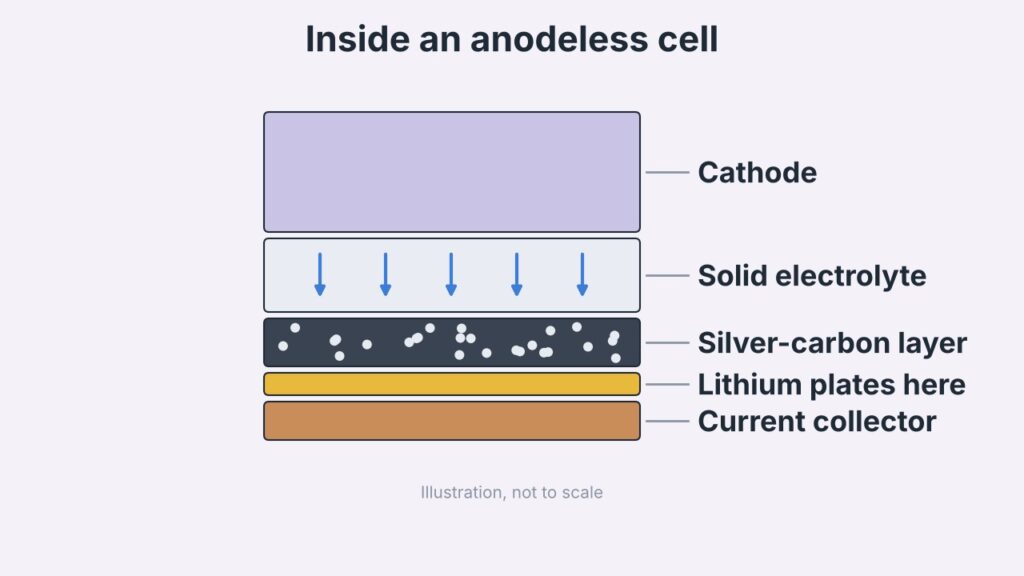
One answer is a thin interlayer between the electrolyte and the current collector. It consists of a carbon scaffold with silver nanoparticles spread through it. In the cells studied, this layer was about 10 micrometers thick. During charging, lithium travels through the layer and plates beneath it. Meanwhile, the silver particles alloy with lithium along the way. That lithium-silver alloying helps lithium deposit evenly. The layer also keeps metallic lithium apart from the solid electrolyte. As a result, unwanted reactions between the two are limited. Earlier pouch cells of this design lasted more than 1,000 cycles. Samsung’s 2020 announcement described that prototype as roughly 50% smaller than conventional cells. Those results, however, were reported only at temperatures above 45 degrees Celsius. How the layer behaves in the cold had not been explained.
Fig. 1: The Layers of the Cell, With Lithium Plating Beneath the Interlayer
The research team came from Seoul National University and the Samsung Advanced Institute of Technology. Colleagues at two institutions in Taiwan also contributed. Their paper in Nature Communications tested small single-layer pouch cells. Each cell paired the silver-carbon layer with a sulfide electrolyte and a nickel-rich cathode. First, the team cycled cells at three fixed temperatures. At 45 degrees Celsius, the cells delivered 200 milliamp-hours per gram. That figure slipped to 175 at 25 degrees. At 5 degrees, however, it fell to just 50. So a 40-degree drop erased three quarters of the capacity. Separate half-cell tests then located the weak point. The cathode side coped with the cold, whereas the silver-carbon side did not.
Fig. 2: First-Cycle Discharge Capacity at Three Fixed Temperatures (Data: Kim et al., 2026)
Explainer: Why Lithium-Silver Alloying Stalls in the Cold
Alloying is a reaction, and the paper shows it is strongly temperature-dependent. Earlier, an Oxford-led study in Joule showed lithium reacting with silver to form such alloys. To watch it happen, the team used X-rays from two synchrotrons. Their method, called operando X-ray absorption spectroscopy, tracks silver atoms inside a working cell. It captured about one spectrum per second while the cell charged. At 45 degrees, the signal of metallic silver faded quickly. Such fading is consistent with silver turning into alloy. At 5 degrees, by contrast, the silver signal barely changed. X-ray diffraction on opened cells then confirmed the finding. Cold-charged cells still held plain metallic silver, with negligible alloy. Warm-charged cells, meanwhile, held only lithium-rich alloy phases. In other words, the cold had suppressed the interlayer’s key reaction.
What Happens Inside a Cold-Charged Cell
What does unreacted silver do to the cell? Cross-sections polished and imaged under cryogenic cooling gave the answer. Without alloy, lithium moved through the interlayer too slowly. Consequently, it nucleated inside the carbon scaffold instead of beneath it. This misplaced lithium then fractured the scaffold from within. In addition, layers peeled apart, cutting the paths for ions and electrons. The plated lithium was also uneven, ranging from 6.0 to 11.2 micrometers thick. On discharge, some lithium stayed trapped in the fractures. Therefore, later cycles ran with reduced capacity. Importantly, this damage arose during the very first charge. The authors add that dendrites piercing the electrolyte were not the cause here.
How One Warm First Charge Fixes the Problem
If the first charge does the damage, the first charge can also prevent it. That reasoning led to the alloy activation protocol. The recipe is short: charge the cell once at 45 degrees Celsius. After that, the cell runs at 5 degrees as normal. During the warm charge, silver and lithium alloy readily. Those alloy phases then persist when the temperature drops. Moreover, diffraction showed them still reacting reversibly in the cold. Computer calculations offered a reason for the benefit. Specifically, they indicated that lithium meets lower diffusion barriers in the alloys than in pure lithium. So an alloyed layer can still pass lithium quickly enough at 5 degrees. The authors caution, though, that these calculations simplify the real layer.
Fig. 3: How the Temperature of the First Charge Sets the Cell’s Later Behavior
What the Test Results Showed
The difference was clear at the first cold discharge. Activated cells delivered about 173 milliamp-hours per gram. Cells charged cold from the start, in contrast, managed only 48. In the second cycle, activated cells settled near 135. Images also showed even lithium plating and an intact interlayer. Long-run testing then confirmed the gain. After one formation cycle and 250 further cycles at 5 degrees, the cells kept 87% of their capacity. Fixed-temperature cells, by comparison, delivered only about a third as much. The team also tried doubling the stack pressure to 8 megapascals. That change brought no noticeable improvement. Hence, the first-charge temperature mattered more than squeezing the cell harder.
Fig. 4: Reported Results for Activated Cells Cycled at 5 Degrees Celsius (Kim et al., 2026)
Limits of the Study
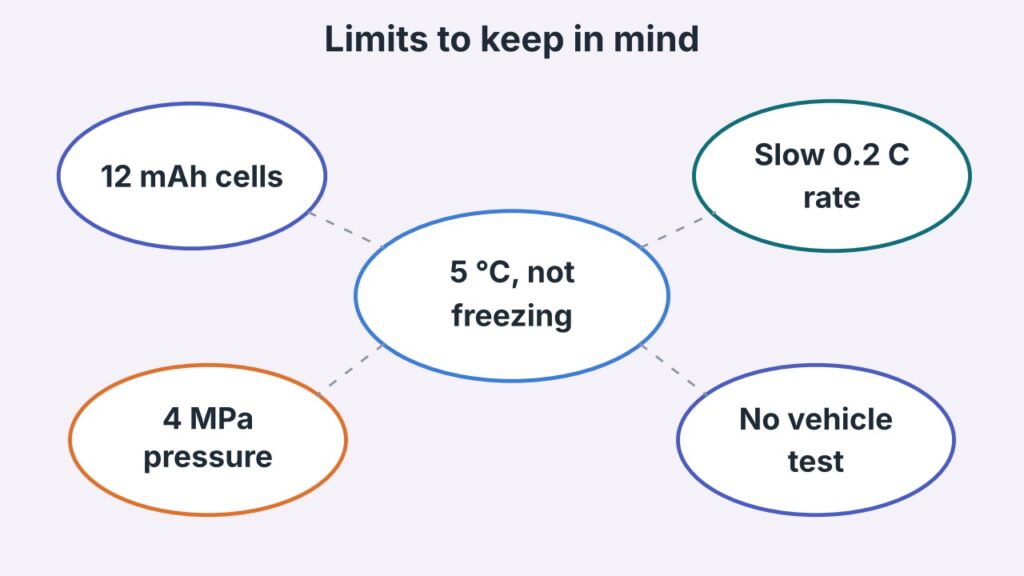
Several limits deserve attention before anyone plans a production line. First, the cells were single-layer pouches of about 12 milliamp-hours. That is a laboratory format, not a vehicle-size cell. Second, the cold tests ran at 5 degrees Celsius, not below freezing. Third, charging and discharging used a gentle rate of 0.2 C. Such a rate means roughly five hours for a full charge. The cells also sat under 4 megapascals of stack pressure. Even with activation, cold capacity stayed below the warm value of 200. According to the authors, slower cathode kinetics explain that remaining gap. Finally, the version consulted here is an early release that precedes final editing. So cold-weather solid-state batteries are closer, but not yet proven at scale.
Fig. 5: Five Limits of the Study Discussed in This Article
What It Means for Battery Manufacturing
From a manufacturing view, the appeal lies in what stays the same. The method, the authors write, needs “no modifications of materials or assembly procedures”. Only the temperature of the first charge changes. For cold-weather solid-state batteries, that is a recipe change, not a redesign. The paper itself calls the first cycle a formation cycle. A temperature-controlled chamber for that step is therefore the main requirement. Even so, engineers would need to check several things first. For instance, does the benefit hold in larger, multi-layer cells? How tightly must temperature be held across a large batch? The study does not answer these questions or estimate any cost. Still, it gives process teams a specific variable to test. ENTECH has also covered cell hardware such as lighter copper current collectors.
Where Cold-Tolerant Cells Could Be Used
The authors name three target areas: aerospace, electric vehicles and robotics in cold climates. In each case, high energy density and cold tolerance are needed together. Indeed, Idaho National Laboratory measured charging roughly three times slower in deep cold. An anodeless cell offers the first, and activation may add the second. However, the paper reports no vehicle, aircraft or robot test. Any product claim would therefore be premature. Quality teams would also want ways to confirm that alloying happened. After all, the synchrotron methods used here are research tools, not factory gauges. Simpler checks, such as first-cycle voltage curves, might serve instead. Sensors built into cells are another route, as in a gold-coated fiber that reads chemistry inside sealed cells. Finally, the authors suggest the idea could extend to other alloy-based interlayers. Such a step would widen the method beyond silver.
Lessons for Students and Teachers
For students, this work is a lesson in reaction rates. Chemistry classes teach that temperature controls how fast reactions run. Here, that rule decides whether a battery thrives or fails. The fix is equally instructive, because it changes timing instead of materials. In other words, when a reaction happens can matter as much as whether it happens. Teachers could ask why a one-time warm step has a lasting effect. The answer is that the alloy, once formed, stays in place. Students can also study how the team isolated the fault. First, the researchers compared temperatures and tested each electrode separately. Only afterward did they look inside with X-rays and electron microscopes. Similarly, engineers troubleshoot a production line one variable at a time.
Careers and Startup Ideas in Battery Engineering
Work like this draws on several professions at once. Chemists and materials scientists study the alloy phases and interfaces. Chemical engineers turn such findings into repeatable processes. Meanwhile, quality and process engineers decide how to verify each step. Beamline scientists run the X-ray instruments that follow reactions in real time. In this project, a university and an industrial research institute shared the work. Useful skills therefore include electrochemistry, materials testing, data analysis and process control. Entrepreneurs may see openings too. For example, one idea is test equipment that controls temperature and pressure during first charge. Another is software that flags cells whose first charge looks abnormal. Both ideas are untested, so treat them as possibilities only. Either way, cold-weather solid-state batteries show how much one process detail can matter.
References
Kim, H., Kunze, S., Yoon, K., Hwang, S., Hwang, Y., Kim, J., Kang, D., Na, I., Pao, C.-W., Huang, W.-H., Lee, Y.-G., Ku, J. H., & Lim, J. (2026). Low-temperature operation of Ag-C based anodeless all-solid-state pouch cells. Nature Communications. Article in press. https://doi.org/10.1038/s41467-026-79291-1
Lee, H., Suh, J. H., Kim, J., Pang, W. K., Konstantinov, K., Mun, J., Song, T., & Kim, J. H. (2026). Low-temperature all-solid-state batteries. Nano-Micro Letters, 19, Article 3. https://doi.org/10.1007/s40820-026-02270-0
Spencer-Jolly, D., Agarwal, V., Doerrer, C., Hu, B., Zhang, S., Melvin, D. L. R., Gao, H., Gao, X., Adamson, P., Magdysyuk, O. V., Grant, P. S., House, R. A., & Bruce, P. G. (2023). Structural changes in the silver-carbon composite anode interlayer of solid-state batteries. Joule, 7(3), 503-514. https://doi.org/10.1016/j.joule.2023.02.001
This explainer turns a specialist battery study into a clear process story, and the contrast between a cold and a warm first charge gives readers a simple way to grasp the mechanism. The limits section is frank that the cells were small and tested at 5 degrees Celsius, and a later update could add results below freezing or in larger cells when they are published. A short note on what a formation cycle is in general practice would help younger readers. Readers are encouraged to consult the original research paper for the full experimental detail.
Editorial note
This article is an ENTECH explainer on why anodeless solid-state cells with a silver-carbon interlayer lose capacity in the cold and how a single warm first charge prevents it, written for students, teachers and early-career readers. It draws on a peer-reviewed research paper, and the in-article diagrams are original graphics prepared for ENTECH rather than figures taken from the paper. Readers who want full details should refer to the original source paper listed in the references.
Ojas Joshi is an industrial project manager, young entrepreneur, and manufacturing process specialist. He holds a B.Tech in Production Engineering from Vishwakarma Institute of Technology (VIT Pune) and an M.Tech in Project Management from COEP Technological University, secured after achieving an All India Rank of 409 in the GATE examination.
Ojas brings diverse hands-on experience across heavy machinery and medical device manufacturing. He previously served as Process Quality Lead for the excavator production line at JCB India Ltd and completed a specialized project management residency in the MedTech division at Philips Healthcare India. His expertise spans Product Lifecycle Management (PLM), process integration, supply chain optimization, Enterprise Resource Planning (ERP) systems, and operations research.
As an author for ENTECH Magazine, Ojas shares insightful, practical analyses on modern industrial engineering, medical device manufacturing, supply chain dynamics, and data-driven project management strategies.