Northeastern University researchers coated cheap PET film with copper vapor and plating, halving collector weight while keeping lab cells stable and safer.
Pick up a phone, and part of its weight hides inside the battery. Every lithium-ion cell holds a thin copper sheet that carries electrons from the anode. However, that sheet stores no energy at all. Now a team led by Northeastern University in Shenyang has found a lighter option. Their composite copper current collector swaps most of the metal for cheap plastic film. First, copper vapor coats the plastic with a whisper-thin seed layer. Next, ordinary electroplating thickens that coating to about one micrometer. As a result of this, it weighs about half as much as today’s thinnest foils. Partners in Shenyang, Beijing, Hangzhou, and Nantes, France, joined the work. Their open-access Communications Engineering study reports lab cells that cycled just like standard copper. At the same time, the cells stayed calm when testers cut or pierced them.
A lithium-ion battery moves lithium ions between two electrodes during charging and use. Each electrode sits on a thin metal sheet called a current collector. In most cells, aluminum serves the positive side, while copper serves the graphite side. The collector supports the coating and gathers current like a highway for electrons. According to the paper, cell energy density has grown more than fourfold since early designs. However, the main active materials now approach their natural limits. In other words, chemists cannot squeeze much more energy from the same powders. For this reason, engineers are hunting for weight in parts that store nothing. Copper is also a heavily demanded metal. USGS copper statistics rank it third among metals by quantity used. As a result, every gram saved in batteries matters for supply chains too.
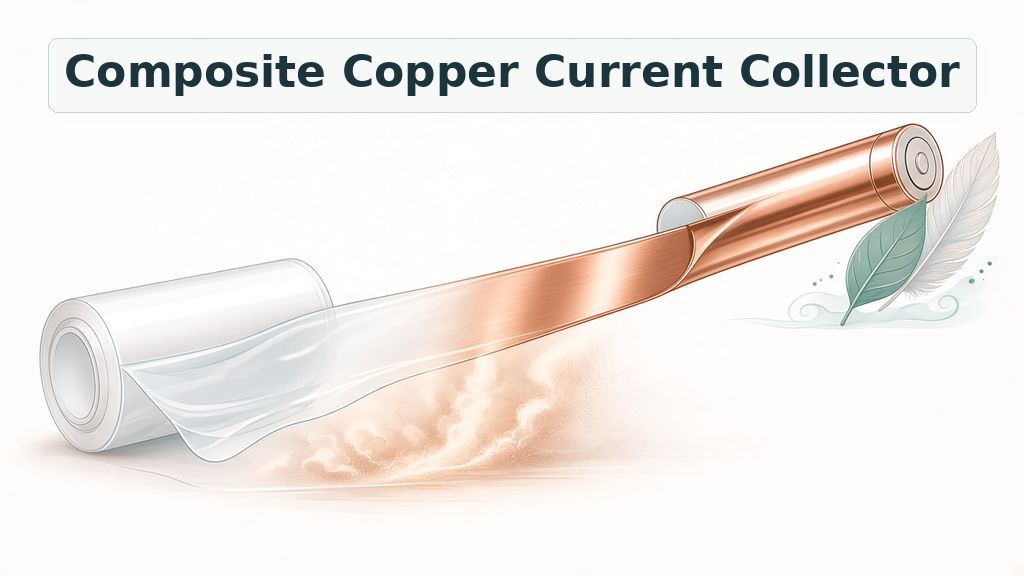
Fig. 1: Key Takeaways From Composite Copper Foil
Copper Foil Adds Weight Without Storing Energy
Engineers already know a lighter design: plastic film with a thin metal skin. In other words, these are metalized plastic current collectors. They promise less weight, thinner cells, lower cost, and better safety. Composite aluminum versions already rely on vacuum evaporation. On the other hand, copper versions have lagged behind. Many earlier designs used polyimide, a tough plastic costing over $10,000 per ton. In contrast, common PET film costs about $978 per ton, roughly one-tenth as much. Electroplating makes most battery copper foil today, but it needs a conductive surface. Bare plastic does not conduct electricity, so it needs a metal starter coat first. Sputtering, another vacuum method, gives strong grip but deposits metal slowly. ENTECH coverage of binders inside lithium-ion batteries shows how hidden parts shape performance. Not only must it be light, but it must also be fast.
The Simple Science Behind Copper-Coated Plastic Film
Think of the collector as a sandwich with a plastic center and copper crust. The plastic here is PET, the same polyester family used in drink bottles. Copper conducts electricity very well, so a thin skin is enough for the job. The challenge, on the other hand, is coating plastic without melting it. To begin with, the team heated copper inside a sealed vacuum chamber. At the same time, the metal turned into vapor near 1,500 °C. Inside, pressure dropped to roughly one hundred-millionth of normal air pressure. Because almost no air remains, copper atoms fly straight to the moving film. Then they stick and stack into a continuous metal layer. ENTECH readers met a related idea in the thinnest sheet of gold. In both cases, scientists control metal layers far thinner than a human hair.
Copper Vapor Lays A Seed Layer In Under A Second
The machine works a bit like a giant tape recorder for plastic film. Unwind and rewind rolls pull the film quickly through the copper vapor. The demonstration film measured 1.65 meters wide, roughly the height of an adult. Meanwhile, it was only 6 micrometers thick, far thinner than a human hair. Each pass leaves a seed layer about 30 nanometers thick. That coating forms in just 0.38 seconds, well under one second. The chamber uses several deposition zones, so the coating builds up gradually. As a result of this, the film collects enough copper without overheating. Infrared scans confirmed that the PET structure stayed intact after coating. At the same time, the coated film looked smooth and wrinkle-free. In other words, speed did not come at the cost of damage.
Electroplating Builds A Composite Copper Foil
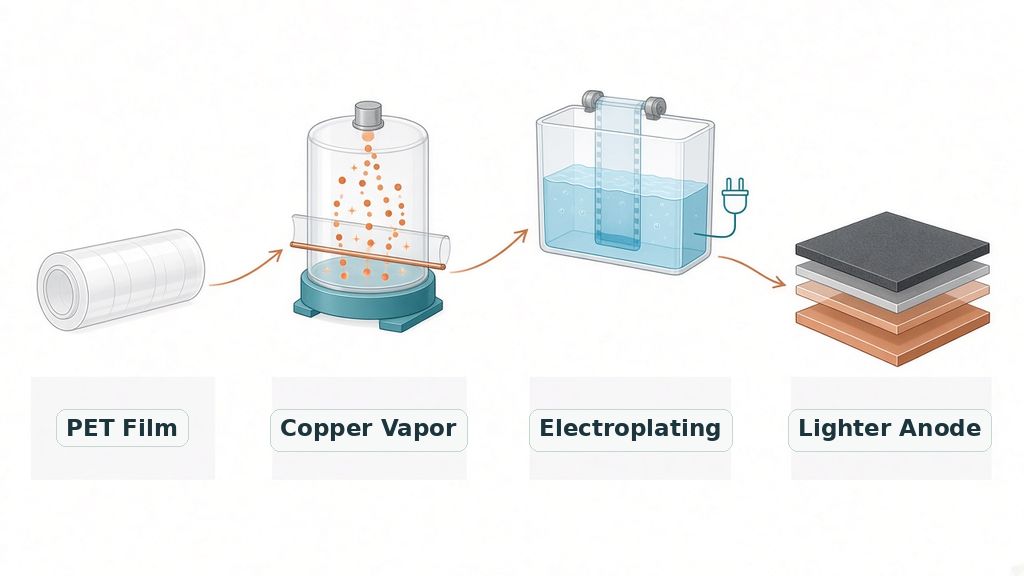
Once the seed layer conducts electricity, a familiar factory step takes over. The team dipped the film into an acid bath containing copper sulfate. Electric current then pulled copper ions onto the seed layer, thickening it. This electroplating step is the same basic method behind battery copper foil today. Consequently, existing foil factories could reuse much of their equipment and know-how. The final coating reached about one micrometer, roughly thirty times thicker than the seed. Electron microscope images showed a dense coating with no visible pores. Moreover, tightly packed copper grains help block liquid electrolyte from reaching the plastic. The finished composite copper foil conducted electricity almost as well as pure copper foil. Specifically, its conductivity reached about 96 percent of the pure foil’s value. Tape peeling tests also pulled no copper away from the surface.
Fig. 2: Vapor Then Plating Builds The Copper Skin
What The Composite Copper Current Collector Tests Showed
Every composite copper current collector must pass strength and stretch checks. Tensile strength measures the pulling stress a material survives before breaking. The composite reached about 250 megapascals, while pure copper foil reached about 358. However, the composite stretched about 59 percent before breaking. Pure foil managed only about 5.5 percent, so the composite stretches roughly ten times further. That flexibility matters because graphite swells and shrinks during every charge. In lab cells, graphite stayed firmly attached to the composite after fast cycling. Pure copper foil, in contrast, showed gaps and cracks at its graphite boundary. Three days of electrolyte soaking, even at 60 °C, caused no visible damage. Over 300 cycles, the composite kept about 278 units of stored charge per gram. The pure foil cell delivered a similar 274, so performance matched. For the full details, the open-access research article lists every test condition.
Lighter Electrodes Hold More Charge Per Gram
Because the collector is lighter, the whole electrode stores more charge per gram. Compared with today’s thinnest 4.5-micrometer copper foil, the composite weighs about 52 percent less. Next, the team tested a thick graphite electrode, like those planned for future cells. Against a standard 12-micrometer foil, whole-electrode capacity per gram rose about 40 percent. Even against the thinnest 4.5-micrometer foil, the calculated gain remained about 11 percent. The authors also estimated effects on commercial battery designs. Energy density could reach about 281 watt-hours per kilogram in electric car pouch cells. The baseline design sits near 268. In other words, the same battery mass could carry roughly five percent more energy. As a result, cars might drive farther or carry smaller battery packs. Still, these figures are calculations, not tests on real car batteries.
Cracking Copper Skin Makes Batteries Safer
Safety tests produced the most exciting result. The team fully charged small pouch cells, then cut them and drove a nail through. With pure copper foil, voltage collapsed and temperature jumped about 21 °C. That pattern signals an internal short circuit, where current rushes through the damaged spot. In contrast, the composite copper current collector cell lost at most about 0.22 volts. At the same time, its temperature rose by no more than about 1.5 °C. The thin copper skin explains the difference. Under stress, it cracks into tiny isolated pieces on the plastic. As a result of this, no lasting metal path forms around the nail. Pure foil, on the other hand, stays connected and feeds a lasting short circuit. Remarkably, the damaged composite cell could still charge a smartphone afterward.
Challenges, Motivation, And The Road To Factory Lines
The team’s motivation came from a manufacturing bottleneck. Composite copper foils looked promising, yet no fast, low-cost process used cheap plastic. Therefore, the researchers set out to pair vacuum evaporation with standard electroplating. Heat was the first big hurdle, because plastic film melts far below copper’s evaporation temperature. For this reason, they designed a multi-zone chamber to spread out the heat load. Even so, several challenges remain. To begin with, battery tests used coin cells and small pouch cells, not car cells. At 60 °C, both the composite and pure foil cells faded quickly. The authors link that decline to side reactions that additives might reduce. Moreover, the electroplating step ran on a laboratory-scale, self-built system. In addition, the large copper and energy savings come from projections, not factory data.
A Smaller Carbon Footprint For Composite Current Collectors
The team also ran a cradle-to-gate life-cycle assessment. That method tallies emissions from raw materials up to the finished product. To begin with, standard 6-micrometer foil emitted about 0.66 kilograms of CO₂-equivalent per square meter. In contrast, a double-sided composite foil produced about 0.34 kilograms, roughly half. Put simply, most savings came from using much less copper. Electroplating caused about 82 percent of the composite’s emissions, while vacuum evaporation caused the rest. So greener electricity could cut the footprint even further. Similarly, more recycled copper would help, since the model assumed mostly mined copper. Lab wastewater also added a noticeable share, which the authors expect larger systems to shrink. If every vehicle battery adopted the design by 2030, the authors project big copper savings. Their estimate reaches about 1.58 million tons in that single year.
New Careers In Thin-Film Battery Manufacturing
This project blends mechanical engineering, metallurgy, chemistry, and environmental science in one story. Indeed, the team itself spanned schools of mechanical engineering, metallurgy, and materials science. Future composite foil lines would likely need roll-to-roll coating engineers and vacuum technicians. Electroplating specialists could also adapt existing foil plants for plastic-based products. Meanwhile, battery safety testers and life-cycle analysts would check each new design. Students drawn to this field can study materials science, electrochemistry, and manufacturing engineering. Our guide to exploring metallurgy and materials engineering offers a friendly starting point. Not only does this field reward lab skills, but it also rewards systems thinking. In the same way, lighter batteries could help drones, electric cars, and phones alike. Even so, much engineering work still lies ahead. For this reason, today’s students may build the factory lines of tomorrow.
Conclusion: A Lighter Path For Battery Copper
This study shows how two familiar tools can team up in a fresh way. Vacuum evaporation gives plastic film a copper start in well under a second. Then standard electroplating finishes the job with equipment factories already understand. As a result, the composite copper current collector ends up lighter and safer. At the same time, it matched pure copper foil in lab cycling tests. Big questions remain about full-size cells, hot climates, and factory-scale plating. Even so, the path from lab to production line looks refreshingly practical. Lower copper use could ease pressure on mines and cut carbon emissions too. For students, this story proves that smart manufacturing can be as exciting as new chemistry. Readers who want every number can explore the full open-access paper.
This piece walks readers through a two-step coating process in a lively, easy-to-follow way. A brief note on how the plating step might change beyond the laboratory would round out the manufacturing picture. Future coverage could follow whether larger cells and hot-weather tests confirm the early safety and cycling gains. Readers are encouraged to consult the original research paper on which this story is based.
Editorial note
Battery stories usually chase new chemistry, so a lighter copper sheet felt like a refreshing angle for our readers. ENTECH picked this study because it links metallurgy, manufacturing, safety, and sustainability in one clear process. The copper-savings figures are the authors' projections, and the cell tests were limited to coin cells and small pouch cells. Anyone curious about the full methods will find them in the open-access Communications Engineering paper.
Charudatta Pathak was a student at St. Aloysius High School in Bhusawal, established in 1874, making it one of India's oldest convent institutions. He earned his bachelor's degree in mechanical engineering from SSVPS College of Engineering, Dhule in 1995, demonstrating exceptional academic achievement. Thereafter, he launched his career as a CNC programmer in a toolroom. He has utilized FANUC, Deckel, Maho, and Mikron controllers to operate 2-axis and 3-axis machines for the fabrication of jigs, fixtures, dies, and molds. He commenced his career as an academic in 1996, when he assumed the role of lecturer at SSVPS College of Engineering, Dhule. Additionally, he earned his post-graduate degree in CAD/CAM from L. D. College of Engineering, Ahmedabad, in 2000, and then acquired a Ph.D. from COEP in 2011 while concurrently engaged in teaching. Until 2023, he occupied many academic roles, including lecturer, assistant professor, professor, dean, principal, director, and vice chancellor at both public and private universities throughout India. From 2008 to 2010, he served as the project lead in the CAE department of a European multinational firm. During his 28-year professional tenure, he identified a need for dependable books targeted at students in grades 8 to 12, particularly for nascent career planning. He founded ENTECH Digital Magazine, a free monthly publication available on entechonline.com and magzter.com. Teens with a strong interest in Science, Technology, Engineering, and Mathematics (STEM) who aspire to pursue careers in these fields may find ENTECH Digital Magazine beneficial.