Huge stretches of the deep ocean still go unmeasured. At the same time, a team from China has built a sensor that could help. Their flexible deep-sea sensor is a soft patch that bends around curved surfaces. It measures both water depth and temperature, and it carries its own battery. First, a laser-made graphene foam inside silicone feels the crushing water pressure. Then a small neural network cleans up the readings so heat does not fool them. The work comes from the Chinese Academy of Sciences’ deep-sea institute in Sanya. In addition, partners in Beijing, Shenzhen, Hangzhou, Egypt, and Japan joined the effort. Their open-access Nature Communications study describes sea trials in the western Pacific. As a result of that work, the patch survived a trip down to 4,812 meters.
Why The Deep Ocean Needs A Flexible Deep-Sea Sensor
The deep ocean moves heat around the planet and stores huge amounts of carbon. However, large regions of it remain poorly measured, according to the paper. For this reason, scientists need many readings to track these slow ocean currents. Depth readings come from pressure, because water weighs down on everything below it. According to NOAA, ocean pressure rises steadily by one atmosphere every 10 meters. So a sensor at 1,000 meters feels about one hundred times surface air pressure. Today’s best instruments handle that load very well. Still, they are rigid metal tubes that only fit on ships and moorings. In contrast, soft sensors could ride on robot arms, gliders, and even animals. ENTECH readers have already met a bendable strain sensor for wearables. As a result, the big question became whether flexible electronics could handle the deep.
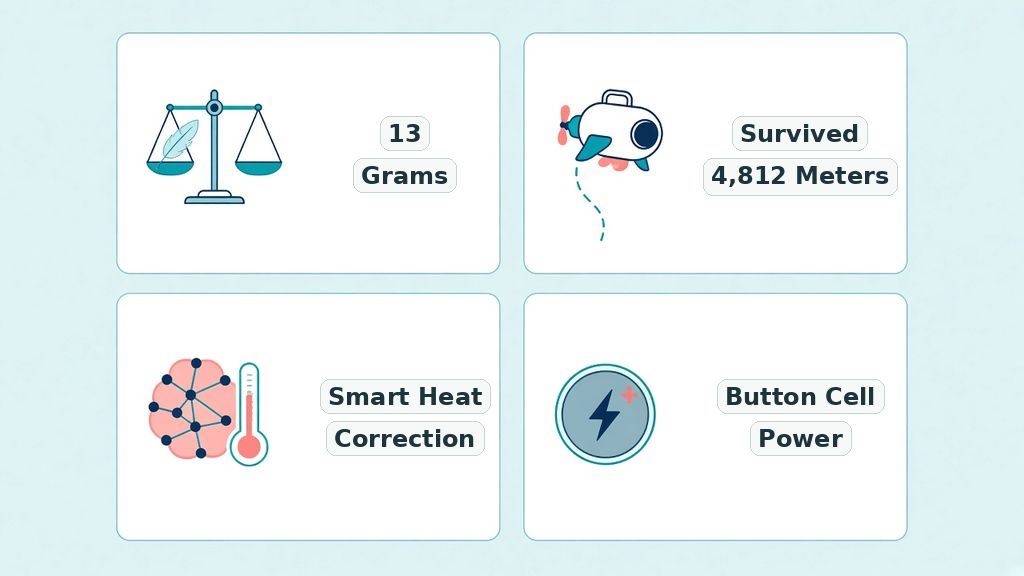
Fig. 1: Key Takeaways From The Flexible Ocean Sensor
Rigid Titanium Instruments Struggle On Curved Surfaces
To begin with, one commercial deep-rated unit is 42 centimeters long and weighs 3.8 kilograms. Its titanium case protects precise pressure transducers inside. On the other hand, its size and stiffness make curved mounting hard. Soft underwater robots, for example, cannot carry such a heavy tube easily. Flexible pressure sensors already exist, but most target health monitoring. Those sensors usually work only below about 100 kilopascals. That limit equals roughly the pressure under just 10 meters of water. In other words, they would max out long before reaching the deep sea. A few marine designs reached 4 or 5 megapascals, about half this sensor’s range. Many prototypes also lacked built-in electronics to record data on their own. For this reason, most flexible sensors never left the laboratory.
How A Flexible Temperature-Depth Sensor Feels Pressure
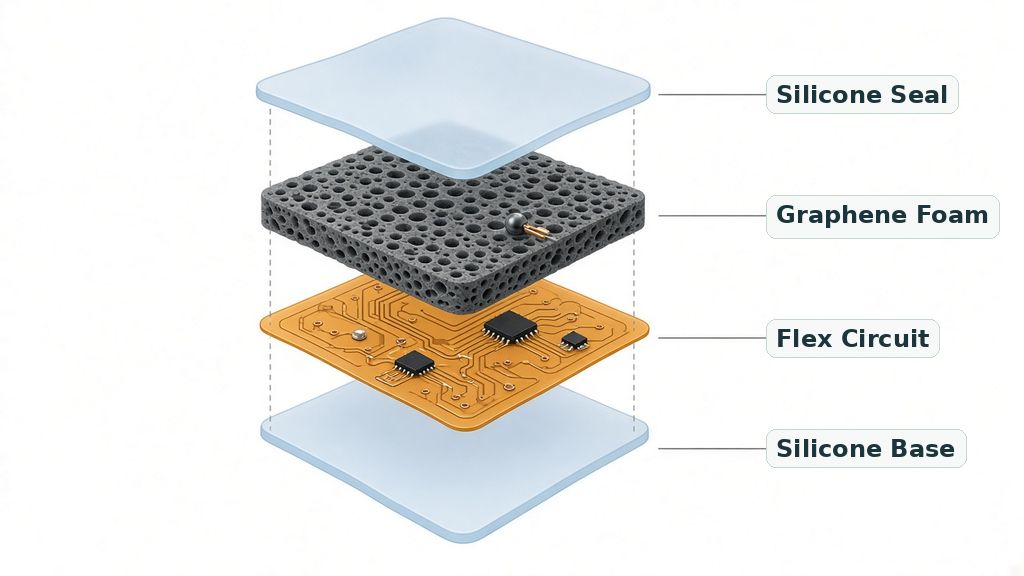
Picture a thin patch about the length of your finger. The finished flexible temperature-depth sensor measures 79 by 25 millimeters and 2.6 millimeters thick. Its total mass is 13 grams, battery included, lighter than a typical AA battery. The base is a flexible circuit board made of copper and polyimide plastic. On top sit the pressure sensor, a small temperature sensor called a thermistor, and chips. Next, soft silicone rubber called PDMS seals the whole assembly. This coating keeps seawater out while letting pressure pass through. As a result, the patch can bend around a curve just 7 millimeters in radius. In addition, it can twist by about 120 degrees without damaging the electronics. Similar laser-made carbon already appears in ENTECH’s story on de-icing graphene films.
Fig. 2: Four Soft Layers Inside The Sensor Patch
Laser-Made Graphene Foam Turns Squeezing Into Signals
The heart of the sensor is laser-induced graphene, often shortened to LIG. To begin with, a laser scans across polyimide plastic and turns it into porous carbon. That carbon forms a sponge-like network of graphene sheets with pores about 5 micrometers wide. Because the sponge conducts electricity, current can flow along its many tiny contacts. When water pressure squeezes the patch, the sheets slide and touch in new ways. Consequently, the electrical resistance of the foam changes in a measurable way. The team tested three foam thicknesses and found the thickest worked best. They also tuned the silicone’s stiffness and thickness to pass pressure efficiently. After 1,000 squeeze-and-release cycles, the sensor showed no notable loss of sensitivity. Meanwhile, it responded to pressure steps in about a third of a second. In other words, it reacts quickly and keeps going.
Tiny Electronics Sip Power From A Button Cell
A sensor alone is not enough, so the team built a complete recording system. It includes a precise signal converter, a small controller, and a memory chip for data. At first, a crystal oscillator in the timing circuit was the weak spot under pressure. Engineers then moved nearby parts closer to share the load like a tiny bridge. As a result of this, peak stress on that circuit dropped about 70 percent. ENTECH has explored how designers build rugged electronics that survive harsh forces. The firmware also puts the chips to sleep between measurements. Because of this, the average current stays around 25 microamperes, an extremely small drain. A 350-milliamp-hour button cell can run the sensor for over a month at 10-second sampling. With hourly sampling, the team estimates a lifetime near 570 days.
What Sea Trials Revealed About The Flexible Deep-Sea Sensor
First, the team tested the flexible deep-sea sensor in a 20-meter freshwater tank. They wrapped it around the curved head of a small underwater robot. A commercial reference sensor sat within 5 centimeters for a fair comparison. During descent, the patch tracked depth with a maximum error under 2 meters. Then a simple curve-fitting step improved that maximum error to about 1 meter. In the same way, temperature readings matched especially well after that correction. At the same time, the tank revealed a small lag when water temperature changed quickly. The silicone coating stores a little heat, so readings trail behind sudden shifts. Even so, the patch and reference stayed in close agreement overall. These early tests showed that the calibration method could work on a curved, moving robot. For full details, the open-access research article lists every test step.
A Neural Network Untangles Heat And Pressure
Graphene foam reacts to temperature as well as pressure, which creates a tricky mix-up. For example, a temperature change could distort the raw depth reading. Simple formulas struggle to separate these two effects because they interact in complex ways. Therefore, the team trained a small neural network with two hidden layers. A neural network is a computer model that learns patterns from example data. Here it learned how temperature bends the pressure signal, then removed that effect. After that, a fourth-order polynomial fit polished the output further. In deep-sea tests to about 1,000 meters, the results looked impressive. Before calibration, the depth error near 1,000 meters reached about 3 percent of full scale. In contrast, the final depth error stayed within about 0.91 percent. Temperature accuracy also reached about plus or minus 0.29 °C.
Surviving A Trip Nearly Five Kilometers Down
Next came the real ocean, in the western Pacific and the South China Sea. The team mounted the patch on the curved body of a ship’s water sampler. They also fixed it to the robotic arm of the crewed submersible Fendouzhe. On its deepest trip, the patch reached 4,812 meters below the surface. At that depth, pressure reaches about 50 megapascals. In other words, the water pressed with nearly 500 times surface air pressure. Remarkably, the flexible deep-sea sensor came back with its structure fully intact. A separate 30-day seawater soak changed the patch’s mass by less than 0.23 percent. That result shows the silicone seal kept water out very effectively. At the same time, three separately built sensors behaved almost identically. Not only does the design hold up, but it can also be made consistently.
Challenges, Motivation, And Next Steps For Ocean Sensing
The team’s motivation was simple: put sensors where rigid tubes cannot go. Distributed networks of small sensors could fill gaps between today’s scattered instruments. However, several challenges remain before that future arrives. The calibrated accuracy applies to about 1,000 meters, not the full 4,812 meters. In other words, the deepest trip proved survival rather than measured accuracy. Temperature lag also matters in the thermocline, a layer where water cools quickly. NOAA explains how this transition layer between warm and cold water forms. In that zone, raw temperature errors reached about 1.85 °C before calibration. Moreover, the neural network needs reference data from a trusted instrument to learn. Even so, the authors verified that the correction settings stayed stable. For this reason, each improvement brings the patch closer to real ocean networks.
Where Flexible Marine Sensors Could Go Next
The authors imagine many new homes for flexible marine sensors. To begin with, the patches could wrap around robotic arms and soft underwater robots. In the same way, bio-inspired vehicles that swim like fish could carry them. The team also suggests attaching sensors to marine animals as electronic tags. For example, seals could carry them into polar waters under sea ice. Those icy regions are hard for ships and conventional instruments to reach. As a result, scientists could gather missing data for climate models. Offshore wind farms, fish farms, and subsea cables might also benefit from low-power monitoring. Researchers sometimes call such networks an Underwater Internet of Things. Still, these uses remain future possibilities rather than tested products. Even so, the positive results give engineers a solid starting point.
Careers In Marine Electronics And Ocean Data
This project blends materials science, circuit design, software, and oceanography in one device. Marine sensor engineers design and test instruments that survive crushing pressure. Meanwhile, flexible electronics engineers develop soft circuits and stretchable materials. Embedded firmware developers write low-power code that keeps batteries alive for months. On the other hand, ocean data scientists train models that turn signals into reliable numbers. Students can prepare through electronics, instrumentation, or materials engineering degree programs at university. Programming and machine learning skills add even more value to this field. Our guide on electronics and communication engineering careers is a helpful first step. Not only do these roles involve lab work, but they also include real sea expeditions. For curious students, few careers mix technology and adventure so naturally.
Conclusion: Bendable Ocean Sensors Point To A Brighter Future
This study shows that soft electronics can handle the deep ocean’s crushing pressure. To begin with, laser-made graphene foam senses pressure, while a thermistor tracks temperature. Then a small neural network removes the confusing effect of heat on the pressure reading. As a result, the flexible deep-sea sensor delivered accurate data down to about 1,000 meters. It also survived a trip to 4,812 meters without structural damage. On top of that, a button cell can power it for weeks or even months. Some limits remain, especially for accuracy at greater depths and in fast temperature shifts. Even so, the path toward many small, smart ocean sensors looks bright. For students, this project proves that clever electronics can open new windows into nature. Readers who want every detail can explore the full open-access paper.
This article explains a complex sensor with clear, upbeat language that students can follow. A short note on how the neural network was trained and checked would help readers judge the correction step. Future coverage could track whether calibrated accuracy extends into the deeper water the patch survived. Readers are encouraged to consult the original research paper on which this story is based.
Editorial note
Ocean sensors rarely get the spotlight, yet this soft patch shows how electronics, materials, and machine learning can work together. ENTECH chose the study because it gives students a vivid picture of engineering for extreme environments. The accuracy figures apply to roughly the upper kilometer of ocean, while the deepest trip demonstrated survival rather than calibrated measurement. The complete methods and data are open to everyone in the Nature Communications paper.
Swarali Barpande is an Electronics and Telecommunication Engineer and technology enthusiast based in Pune, India. She is passionate about making complex physics and engineering concepts accessible, with a core focus on applied electromagnetics, signal transmission, and fundamental circuit theory.
As an author for ENTECH Magazine, Swarali specializes in breaking down foundational topics such as electromagnetism, electromagnetic induction, and modern telecommunication principles for students and young STEM researchers. Through her writing, she aims to bridge academic engineering fundamentals with real-world technological applications.