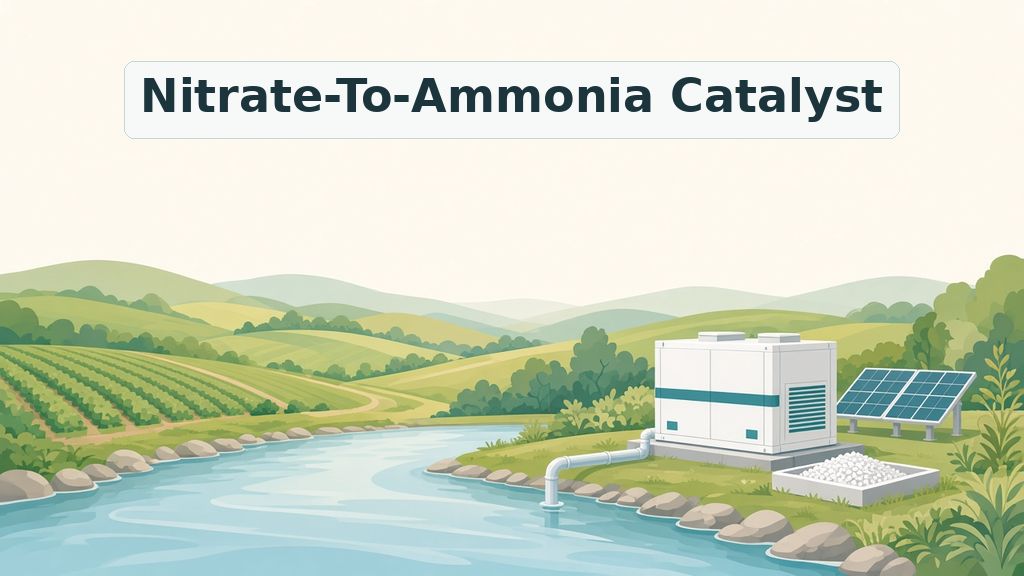
Consider a quiet river carrying an invisible load of fertilizer runoff from farms. Next, imagine a small machine that turns that pollution back into fertilizer. That loop sounds like alchemy, but chemists are building it with electricity. Researchers at Nanjing Tech University and in Singapore designed a new nitrate-to-ammonia catalyst. It uses tiny nickel-cobalt metal grains wrapped in thin jackets of carbon. At the same time, it kept about 92 percent efficiency at very high current. It did so in a compact cell like those in commercial electrolyzers. As a result, nearly all the charge made ammonia rather than waste gas. In addition, the team collected the ammonia as solid crystals. Their open-access Nano-Micro Letters study shows cleanup and chemical making sharing one machine.
Ammonia feeds the world because farmers turn it into nitrogen fertilizer. Most ammonia today comes from a high-heat, high-pressure process that runs on fossil fuels. Our article on the environmental cost of nitrogen fixation explains why that matters. Meanwhile, nitrogen also escapes from fields and factories as nitrate, a dissolved salt. Nitrate seeps into rivers, lakes, and groundwater, where it causes real harm. For example, the EPA drinking water limits cap nitrate at 10 milligrams per liter. That limit counts nitrate as nitrogen. Babies under six months can become seriously ill above it. So, one chemical problem sits at both ends of the food system. On the one hand, factories burn fuel to make ammonia. Later, the same nitrogen pollutes water. A good nitrate-to-ammonia catalyst could connect those two ends.
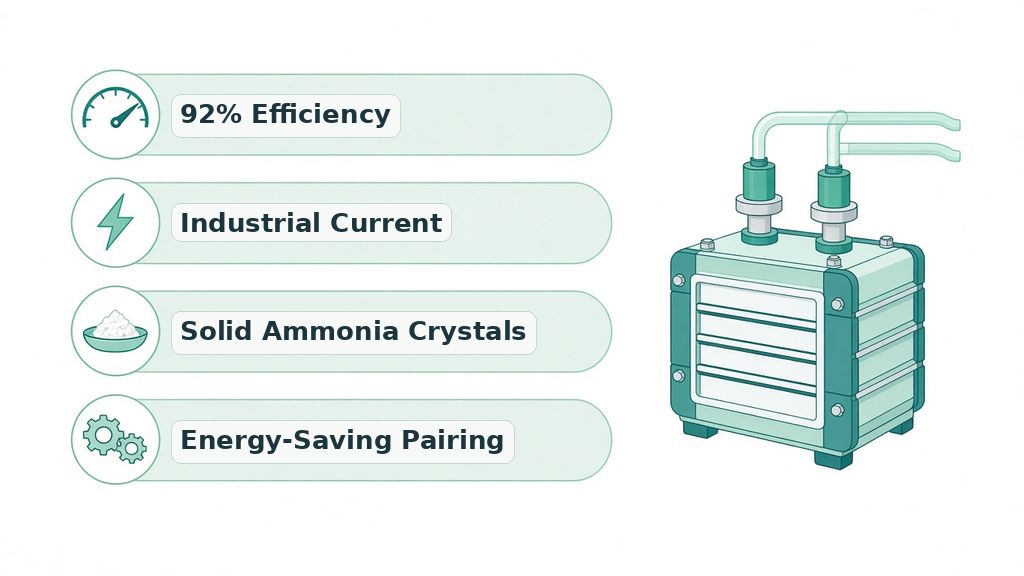
Fig. 1: Key Takeaways From The Nickel-Cobalt Catalyst
Challenges Of Turning Pollution Into Fertilizer
The motivation is simple, yet the chemistry is stubborn. Much nitrate comes from fertilizer runoff from farms, livestock, and sewage. In contrast, electricity can reverse that journey by pushing electrons onto each nitrate ion. However, the full change needs eight electrons and nine protons in a long relay. Each handoff must happen smoothly, or the reaction stalls halfway. Even worse, the same electrode can split water and make hydrogen gas instead. That side reaction wastes electricity and grows stronger at high current. Factories want high current, because faster reactions can mean smaller equipment. For this reason, most earlier catalysts shone only in gentle laboratory tests. ENTECH has covered a sunlight-driven membrane reactor that cleans nitrate from well water. This new study instead chases industrial speed while keeping ammonia as the main product.
How Nitrate Reduction Catalysts Work Inside An Electrolyzer
Think of an electrolyzer as a two-room workshop separated by a thin membrane. At the negative electrode, electrons flow into the liquid and meet nitrate ions. Meanwhile, another reaction at the positive electrode gives up electrons to complete the circuit. A catalyst coats the negative electrode and acts like a skilled assembly line. First, it grabs nitrate and holds it steady. Next, it strips away oxygen atoms one step at a time. Then it adds hydrogen atoms, which come from splitting nearby water molecules. As a result, nitrate passes through nitrite and several short-lived forms before becoming ammonia. Chemists judge success with Faradaic efficiency. It is the share of charge that ends up in the target product. Our explainer on turning nitric oxide into ammonia describes a related route. In this case, the trick lies in supplying hydrogen fast without losing it as gas.
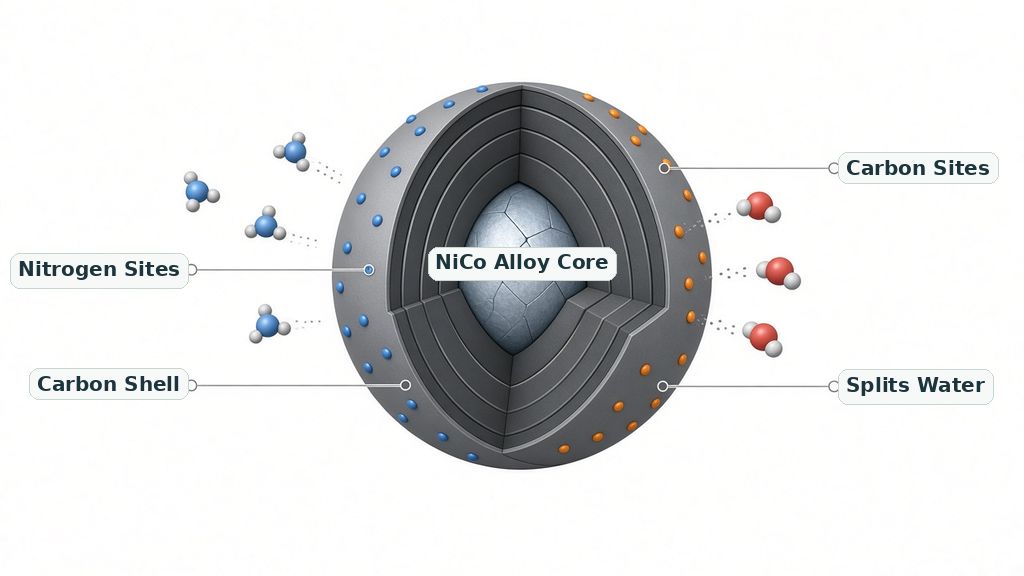
Fig. 2: Inside A Carbon-Wrapped Nickel-Cobalt Grain
Nickel-Cobalt Seeds In A Carbon Jacket
To build the catalyst, the team started with a crystal sponge called a metal-organic framework. This framework mixed nickel and cobalt atoms with carbon-rich linker molecules. Carbon black carries current well, so it makes a good base. Next, the researchers grew it on conductive carbon black, a fine powder. Then they baked the mixture at 900 °C under nitrogen gas for two hours. During baking, the metals merged into alloy grains about 30 nanometers across. In other words, each grain is over a thousand times thinner than a hair. Meanwhile, the organic linkers turned into thin shells of nitrogen-containing graphite around each grain. Lower temperatures gave weaker results, while 1000 °C made the grains clump together. Similarly, a version without carbon black produced ammonia more slowly. For this reason, the metal seeds, carbon jackets, and conductive powder each matter. Together they form what chemists call a core-shell structure.
Two Kinds Of Sites Share The Work
The real magic happens where metal meets carbon. X-ray measurements showed electrons shifting from nickel toward cobalt inside each grain. At the same time, charge moved between the metal core and its carbon shell. As a result, two neighboring kinds of spots formed on the shell’s surface. Electron-rich nitrogen sites grip nitrate and its partly converted forms. Meanwhile, electron-poor carbon sites split water and pass hydrogen to those waiting molecules. In other words, one site holds the workpiece while the other hands over tools. Computer models supported this picture and pointed to the slowest step in the relay. That step adds hydrogen to a nitric oxide fragment stuck on the surface. The models found the lowest energy hurdle for this step on the alloy catalyst. In the models, neither the bare alloy nor the carbon shell alone performed as well.
Testing The Nitrate-To-Ammonia Catalyst At Industrial Currents
The first tests used a small laboratory vessel called an H-type cell. In standard conditions, the nitrate-to-ammonia catalyst reached 93 percent Faradaic efficiency for ammonia. By comparison, cobalt alone managed 55 percent, and nickel alone only 30 percent. Hydrogen gas took just 4 percent of the charge, so selectivity stayed high. With stronger nitrate solutions, efficiency climbed to 95 percent and even 97 percent. Next, the team used nitrogen atoms with an extra neutron to trace the source. As a result, the labeled atoms showed up in the ammonia, confirming the source. Likewise, its grains barely changed after repeated runs, from about 30.4 to 31.3 nanometers. In contrast, the cobalt-only version lost performance after five cycles. The open-access research article reports every condition in detail.
Green Ammonia Electrosynthesis In A Commercial-Style Cell
Next came the real stress test. The team moved to a membrane-electrode assembly. Commercial electrolyzers use this tightly stacked cell design. Its electrode measured 2 centimeters on each side, about the size of a postage stamp. At 2.0 amperes per square centimeter, the catalyst still delivered about 92 percent efficiency. That current is roughly five times higher than the best H-cell run. In other words, the catalyst stayed selective even when electrons rushed in. Later, they ran it for 15 hours near 0.4 amperes per square centimeter. Production stayed steady without noticeable decline. After that, they trapped the ammonia in acid and evaporated the liquid. As a result, pure ammonium chloride crystals appeared, a solid that is easy to store. That final step turns a lab measurement into something a factory could actually ship.
Pairing Two Reactions Saves Energy
Every electrolyzer needs a reaction at both electrodes. Usually, the positive side splits water and releases oxygen, which has little value. Instead, this team fed methanol to the positive side and turned it into formate. Formate is a useful chemical, so both electrodes now made something valuable. Not only did this pairing add a product, but it also cut the required voltage. The paired cell needed about 0.7 volts less than conventional water splitting. As a result, its energy use at a moderate current dropped by roughly a quarter. Even at 2.1 amperes per square centimeter, ammonia efficiency stayed near 90 percent. Formate efficiency reached about 96 percent at the same time. Finally, a smaller paired cell ran for more than 120 hours with a steady voltage. Such two-for-one designs could make future pollution-to-chemical plants far more efficient.
What Comes Next For Pollution-To-Chemical Plants
Looking ahead, the authors see their alloy-in-carbon design as a general strategy. In the same way, similar core-shell catalysts could suit other multi-step electrochemical reactions. For this reason, modular cells could someday sit beside farms or treatment plants. There, they might clean nitrate-rich water while producing fertilizer salts on site. Not only could renewable electricity power them, but it could also cut fossil fuel use. At the same time, paired reactions could add income from a second product. Electrolyzer makers might also test this catalyst in larger stacks. However, these visions remain possibilities rather than results from this study. The paper describes laboratory devices, not a working plant. Still, it shows that a carbon-wrapped alloy can handle industrial-scale current. That step matters because high current often breaks promising catalysts. For now, the work offers a creative blueprint rather than a finished factory.
Limits That Still Need Solving
Several honest limits remain. Most tests used clean, concentrated nitrate solutions in a strongly alkaline liquid. In contrast, real wastewater is far more dilute and full of other substances. A gentler, carbonate-containing solution cut efficiency to 83 percent at moderate nitrate levels. At a tenfold weaker nitrate level, it fell further to 62 percent. Moreover, the electrodes were small, measuring only 1 to 4 square centimeters. The high-current run lasted 15 hours, while industry needs months or years. At the same time, the team refreshed the liquid every hour during that run. In addition, part of the explanation relies on computer simulations rather than direct observation. Consequently, larger electrodes, real water samples, and longer tests come next. Even so, each limit points to a clear experiment rather than a dead end.
Careers In Electrochemical Engineering
This research blends chemistry, materials science, and process design. Electrochemical process engineers scale reactions like this from postage-stamp electrodes to full stacks. Meanwhile, catalyst chemists design new materials and test how they behave. Materials scientists use electron microscopes and X-ray tools to study tiny metal grains. Wastewater treatment engineers decide where such units could clean real water supplies. In addition, test technicians run long experiments and track every drop of product. Students can prepare through chemistry or chemical engineering degrees with strong electrochemistry courses. Our piece on rethinking chemical engineering education explores how the field is changing. On the other hand, environmental engineering and nanomaterials courses add a water-focused angle. As a result, today’s students could design tomorrow’s pollution-eating chemical plants. Few careers let you clean water and make fertilizer in the same job.
Conclusion: A Cleaner Route To Electrochemical Ammonia Production
This study turns a familiar pollutant into a resource with clever chemistry. To begin with, nickel-cobalt grains inside carbon jackets create two cooperating surface sites. One grips nitrogen pieces, while the other supplies hydrogen at just the right pace. As a result, this nitrate-to-ammonia catalyst kept about 92 percent efficiency at industrial current. It also produced solid ammonium chloride and worked alongside a formate-making reaction. Real wastewater, larger electrodes, and longer runs still need testing. Nevertheless, the work sketches a hopeful loop for the nitrogen cycle. Fields lose nitrogen to water, and electricity could someday bring it back as useful fertilizer. For students, the story shows chemistry acting like quiet, careful craftsmanship. Readers who want every number can explore the full open-access paper and its detailed methods.
This article turns a demanding electrochemistry study into a vivid story that students can follow. A short note on how the catalyst might behave in real, mixed wastewater would help readers weigh its promise. Future coverage could follow whether larger electrodes keep the same selectivity over much longer runs. Readers are encouraged to consult the original research paper on which this story is based.
Editorial note
Nitrogen pollution and fertilizer production rarely appear in the same sentence, yet this study links them through one carefully designed catalyst. ENTECH chose it because it shows students how materials chemistry can serve both clean water and food production. The strongest results come from clean, concentrated test solutions and small electrodes, so real-water trials matter next. Anyone who wants the complete methods and data will find them openly available in the Nano-Micro Letters paper.
I am an inspirational writer and emerging science blogger with a deep-rooted passion for understanding and sharing the wonders of the world around us. My journey began with a Bachelor of Science in Chemistry from AKI’s Poona College of Arts, Commerce and Science, where I developed not only a strong foundation in scientific principles but also a mindset that values curiosity, observation, and critical thinking. Studying chemistry has taught me to approach problems with logic, to look beyond the obvious, and to see patterns where others might only see complexity. These experiences have shaped the way I perceive life and influence the way I express my thoughts, both scientifically and creatively.
I have always believed that knowledge is only as powerful as the way it is shared. This belief has guided me to create content that bridges the gap between science and everyday life. I aim to simplify complex scientific ideas so they become approachable, relatable, and engaging for everyone—whether someone has a formal background in science or is simply curious about the world. Science, in my view, is not confined to textbooks and laboratories; it is a way of thinking, understanding, and connecting with the world around us. By making science accessible, I hope to inspire curiosity, ignite learning, and encourage people to see the beauty and relevance of scientific discovery in their daily lives.
Alongside my love for science, I am deeply passionate about motivational writing. I believe words carry the power to transform perspectives, encourage self-reflection, and inspire action. By combining analytical thinking with creativity, I create content that is intellectually stimulating yet emotionally resonant. Whether I am breaking down a chemical concept, exploring a scientific phenomenon, or crafting motivational narratives, my goal is to communicate ideas in a way that is clear, meaningful, and impactful.
Through my work, I strive to empower my readers - not just by helping them understand the science around them, but by inspiring them to grow, learn, and realize their full potential. Every article, post, or story I write reflects my commitment to turning knowledge into inspiration. I want to spark curiosity, encourage self-improvement, and show that learning and personal growth are deeply connected. For me, writing is not just a craft; it is a way to touch minds, connect hearts, and make ideas come alive in a way that truly resonates.