A Sun Yat-sen University team tuned polymer pores to let lithium through while blocking magnesium, then made battery-grade lithium carbonate from Qinghai Lake brine.
At first glance, salt lakes look quiet, yet they hide a restless mix of ions. However, lithium for batteries often sits there beside far more magnesium. Because those two ions are almost the same size, ordinary membranes struggle. Most show lithium-to-magnesium selectivity below one hundred. Now a large international team paints a sharper picture for lithium brine extraction. Zhen Wang and colleagues at Sun Yat-sen University led the work. Partners joined from Hong Kong Polytechnic University and several Gulf universities. Nature Communications posted the Article in Press on October 31, 2026. Its DOI is 10.1038/s41467-026-79061-z. Wenbin Wang and Peng Wang are corresponding authors. In short, they taught a polymer sheet to choose lithium with unusual care. Still, lab cells are not salt-lake plants. As a result, this article follows that creative sieve with open eyes.
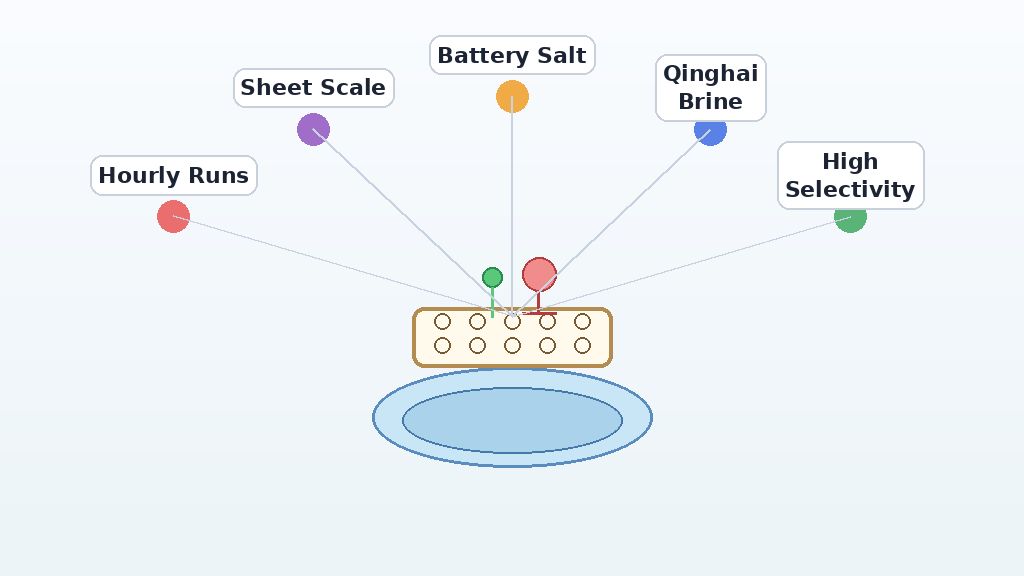
The team built a TAT-CC polymer membrane. Heating during formation set how tightly the chains crosslinked. That timing set pore sizes near 0.35 to 0.65 nanometers. Partly dehydrated lithium could slip through. Bulkier magnesium stayed behind. Under electrodialysis, the Li-to-Mg separation factor reached 6454. That run used an Mg-to-Li mass ratio of 140. In untreated Qinghai Lake brine, with Mg/Li equal to 87, the factor stayed above 1200. Concentrated brine after evaporation pretreatment pushed it above 2200. Lithium flux there hit 120 millimoles per square meter per hour. Binary LiCl/MgCl2 tests, not brine, gave 71.7 percent current efficiency. Energy use was 5.4 kilowatt-hours per kilogram of lithium carbonate. Magnesium crossover fell to 0.065 percent. Batch recovery reached 83.6 percent. Precipitated Li2CO3 reached 99.57 weight percent purity. The authors call that battery grade. Even so, sodium and potassium still needed later washing steps.
Evaporation ponds still dominate many salt-lake operations. They take time, land, and weather luck. Membrane electrodialysis offers a tighter path if selectivity holds. Yet most membranes lose the Li-versus-Mg fight. Stokes diameters for Li and Mg sit close, near half a nanometer. Water shells around each ion make the puzzle harder. Our story on high-energy lithium-rich cathodes shows why cleaner lithium streams matter downstream. In contrast to that cell-chemistry focus, this work starts at the brine itself. For this reason, membrane design becomes a materials art as much as an engineering task. Salt lake lithium will not wait for blunt filters. At the same time, creative pore control may change who can mine those lakes. Altogether, better sieves sit at the center of the resource story. Importantly, the gap remains wide today.
How Crosslinking Sets Mg Li Selectivity
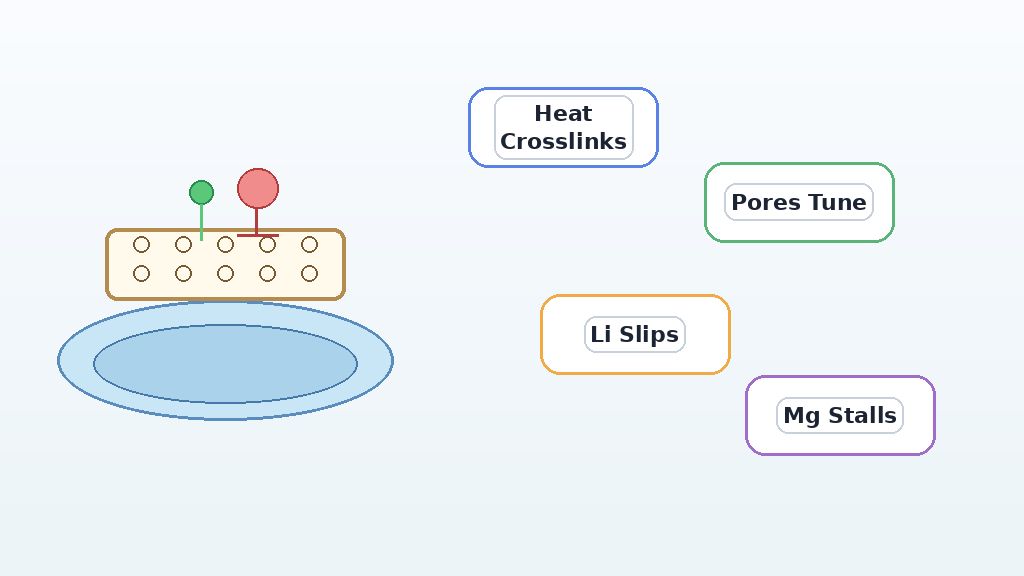
To begin with, picture polymer chains as dancers linking arms during a heated performance. Then heat the stage more, and more arms lock. Afterwards, the free spaces shrink into a narrow corridor. Lithium, after shedding some water, can weave through. Magnesium, with a tighter hydration habit in this picture, stalls at the gate. The paper ties heating temperature to crosslinking degree with XPS and other probes. Pore maps from positron methods and gas uptake support the 0.35 to 0.65 nanometer window. As a result, selectivity rose with careful crosslinking. It then eased slightly at the hottest setting. In other words, more crosslinks are not always better. Designers must hit a sweet spot. On top of that, the membrane stayed hydrophilic enough for ion hydration. That balance keeps the creative sieve from sealing shut. Mg Li selectivity lives in that narrow weave.
How Electrodialysis Lithium Tests Play Out
Electrodialysis drives ions with an electric field across the membrane. First, the team ran binary salt feeds. Next, they tested natural brine feeds. Separation factors climbed far past typical values below one hundred. Importantly, untreated Qinghai brine still cleared a factor above 1200. Competing ions did not erase the Li-over-Mg preference. Full methods appear in the Nature Communications Article in Press. Still, the strongest process metrics came from simple LiCl/MgCl2 solutions. Those numbers should not be pasted onto every brine without care. As a result of this, readers must track which feed each figure used. Our piece on fast-charging LMFP batteries hints at demand waiting for cleaner lithium salts. In practice, electrodialysis lithium work must keep feed labels honest. Otherwise, headlines will outrun the data.
What Battery-Grade Claims Mean for Lithium Membrane Separation
After separation, the team precipitated lithium carbonate. Purity reached 99.57 weight percent Li2CO3. Residual sodium carbonate was about 0.16 percent. Potassium carbonate was about 0.23 percent. The authors label that product battery grade. In practice, later washing and precipitation handled sodium and potassium. The membrane itself separates lithium well from magnesium and calcium. It separates sodium and potassium only weakly. For this reason, chemistry after the membrane still matters. Even so, starting with a strong Li-over-Mg cut simplifies that chemistry. Plant designers should map both stages together. Creative headlines about one membrane doing everything would oversell the result. Honest flowsheets keep the story sharp. Meanwhile, lithium membrane separation stays one chapter in a longer book. In short, purity claims need that fuller context on every page.
Fig. 1: Key Results From Brine Electrodialysis Tests
Scaling the Sheet Without a Full Plant Yet
Next, the team cast a 25 by 35 centimeter membrane. They tested it in nine sections rather than as one full module. Performance held across those regions. A larger active area, from 1.77 to 9.0 square centimeters, kept similar flux and selectivity. Repeated runs lasted fifteen days at one hour per day. Flux eased from 0.91 to 0.81 moles per square meter per hour. Separation factors stayed between 1350 and 1656. In short, the sheet can grow beyond postage-stamp coupons. Yet electrodialysis cells still topped out near 9 square centimeters for key tests. Pilot plants do not appear in the paper. Cost models are also missing. Meanwhile, industrial trains will need those missing pages before anyone scales a lake. Even so, the early sheet work is more than a sketch.
Explainer: A Creative Picture of Subnanometer Gates
First, imagine a night market where only the smallest lanterns fit a woven gate. Lithium ions act like those slim lanterns after they shed some water. Magnesium ions arrive bulkier in this sieve story. The gate is not a single hole size but a tuned distribution. Crosslinking during membrane birth sets that weave. If the weave runs too loose, magnesium sneaks through. When it runs too tight, lithium flux collapses. The winning window sits near a third to two-thirds of a nanometer. Electric fields then usher preferred ions across during electrodialysis. As a result, the brine on one side loses lithium faster than magnesium. Related membrane work on a sun-powered nitrate reactor shows other thin-film solutions for dirty-water puzzles. Altogether, lithium membrane separation joins that family of precise filters.
Fig. 2: How Tuned Pores Prefer Lithium Over Magnesium
Why Flux and Selectivity Must Dance for Salt Lake Lithium
A membrane that blocks everything helps no one. One that passes everything also fails. In other words, the art is a duet between speed and choice. Here, high separation factors arrived with useful lithium flux in the reported windows. Concentrated pretreated brine showed flux near 120 millimoles per square meter each hour. Selectivity there stayed above 2200. Untreated brine kept selectivity above 1200. Binary tests added efficiency and energy figures for Li2CO3. On the other hand, those energy numbers are not brine plant bills. In addition, sodium and potassium still demand downstream care. For this reason, process poets must keep both rhythm and pitch. Overselling either metric alone breaks the song. In the end, the dance only works when both partners move. Notably, the paper keeps both metrics in view.
Challenges Facing Brine Plants Today
To begin with, natural brine chemistry is messy. Nevertheless, Qinghai samples carried many competing ions. Even then, the membrane still favored lithium over magnesium there. Still, weak Na and K rejection forced extra precipitation and washing. Additionally, small cell areas limit direct plant claims. Likewise, the 25 by 35 centimeter sheet was section-tested, not run as one continuous module. Moreover, fifteen-day stability meant one hour each day, not continuous duty. Meanwhile, funding from Chinese and UAE-linked programs supported the science. Funding, however, is still not a factory permit. As a result of this, scale-up teams must prove full-module sealing and fouling control. They must also prove true energy costs. Moreover, they should publish clear brine-specific mass balances. Without those, salt lake lithium dreams stay partly sketch. Our Nature Communications source page keeps the open paper public for that check.
Limits the Authors Leave in View
First, the manuscript is an Article in Press. Details may still shift in final typesetting. Second, top process metrics came from binary salts, not every brine. Third, no techno-economic analysis appears. Fourth, pilot-scale electrodialysis stacks are absent. Fifth, sodium and potassium handling remains a separate unit operation. Even so, the pore-tuning idea is vivid and testable. Chemical engineers, membrane scientists, and electrochemical engineers can build on it. Careers in critical minerals will need people who read both polymers and plant flowsheets. In particular, teams that pair creative membrane design with honest brine trials may move fastest. By contrast, retrofits without new pore science will keep fighting magnesium the hard way. Mg Li selectivity research still has open chapters. Ultimately, those limits define the next experiments.
Conclusion: Next Steps for Lithium Brine Extraction
This study gives lithium brine extraction a memorable new tool. Crosslinking during membrane formation set a narrow pore window. Electrodialysis then favored lithium over magnesium at record separation factors in the paper’s comparisons. Qinghai Lake brine still cleared a factor above 1200. A larger sheet and short repeated runs supported early scale hints. At the same time, binary-salt energy numbers and small cells limit plant claims. Sodium and potassium still need later chemistry. As a result, the work invites both wonder and careful homework. Next, researchers should run continuous pilots and full-module tests. Finally, honest cost sheets must follow. Until then, treat the result as a strong laboratory advance. Keep the study DOI record close while those pilots write the next chapter. In short, creativity here still needs industrial proof.
References
Wang, Z., Zeng, G., Li, Y., Wang, C., Liu, Y., Peng, B., Feng, J., Ma, R., Kuang, W., Cao, J., Liu, B., Wang, F., Al-Maadeed, M. A. A., Hassan, M. K., Almatrafi, E., Bin Bandar, K., Alhussaini, M., Aldrees, S., Baroud, T. N., Al Shamsi, D. M., Al Raeesi, A., Wang, Y., Zhang, H., Li, K., Zhang, L., Wang, W., & Wang, P. (2026). Scalable crosslinking-regulated membranes with ultra-high Li+/Mg2+ selectivity for lithium recovery from brines. *Nature Communications*. Advance online publication (Article in Press). https://doi.org/10.1038/s41467-026-79061-z
The brine-membrane story carries a creative voice that fits the byline without drifting into hype. I would still move the binary-salt versus natural-brine distinction earlier so readers never mix those feeds. A short plant-scale wish list near the challenges section would sharpen next steps. Please consult the original source paper from which this article is sourced for the full methods picture.
Editorial note
Desk note: regenerated under the latest explainer routine with Chemical Engineering as the sole category and Juveriya Khan's creative persona. Readers are invited to check the original source paper from which this story is sourced.
I am an inspirational writer and emerging science blogger with a deep-rooted passion for understanding and sharing the wonders of the world around us. My journey began with a Bachelor of Science in Chemistry from AKI’s Poona College of Arts, Commerce and Science, where I developed not only a strong foundation in scientific principles but also a mindset that values curiosity, observation, and critical thinking. Studying chemistry has taught me to approach problems with logic, to look beyond the obvious, and to see patterns where others might only see complexity. These experiences have shaped the way I perceive life and influence the way I express my thoughts, both scientifically and creatively.
I have always believed that knowledge is only as powerful as the way it is shared. This belief has guided me to create content that bridges the gap between science and everyday life. I aim to simplify complex scientific ideas so they become approachable, relatable, and engaging for everyone—whether someone has a formal background in science or is simply curious about the world. Science, in my view, is not confined to textbooks and laboratories; it is a way of thinking, understanding, and connecting with the world around us. By making science accessible, I hope to inspire curiosity, ignite learning, and encourage people to see the beauty and relevance of scientific discovery in their daily lives.
Alongside my love for science, I am deeply passionate about motivational writing. I believe words carry the power to transform perspectives, encourage self-reflection, and inspire action. By combining analytical thinking with creativity, I create content that is intellectually stimulating yet emotionally resonant. Whether I am breaking down a chemical concept, exploring a scientific phenomenon, or crafting motivational narratives, my goal is to communicate ideas in a way that is clear, meaningful, and impactful.
Through my work, I strive to empower my readers - not just by helping them understand the science around them, but by inspiring them to grow, learn, and realize their full potential. Every article, post, or story I write reflects my commitment to turning knowledge into inspiration. I want to spark curiosity, encourage self-improvement, and show that learning and personal growth are deeply connected. For me, writing is not just a craft; it is a way to touch minds, connect hearts, and make ideas come alive in a way that truly resonates.