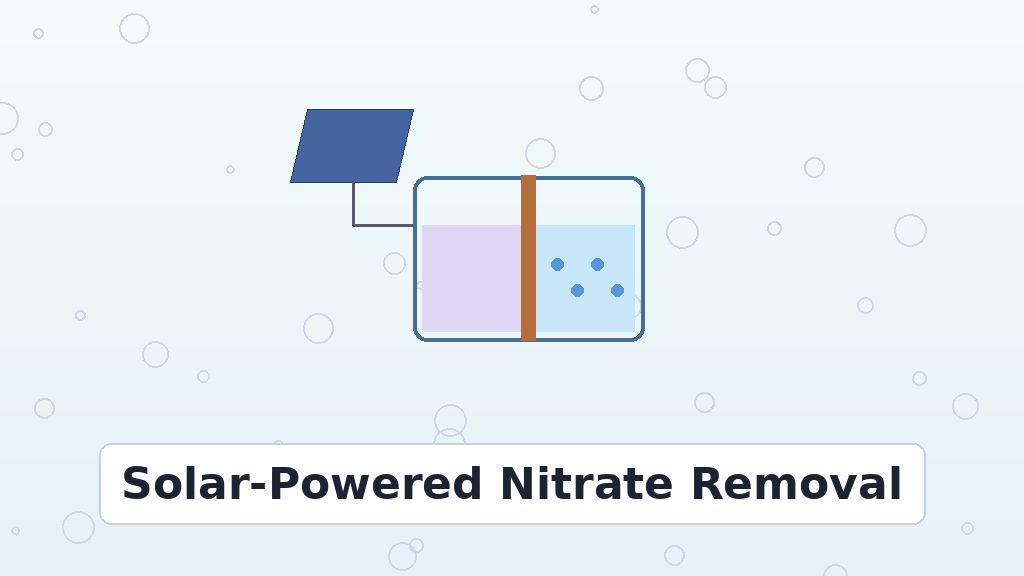
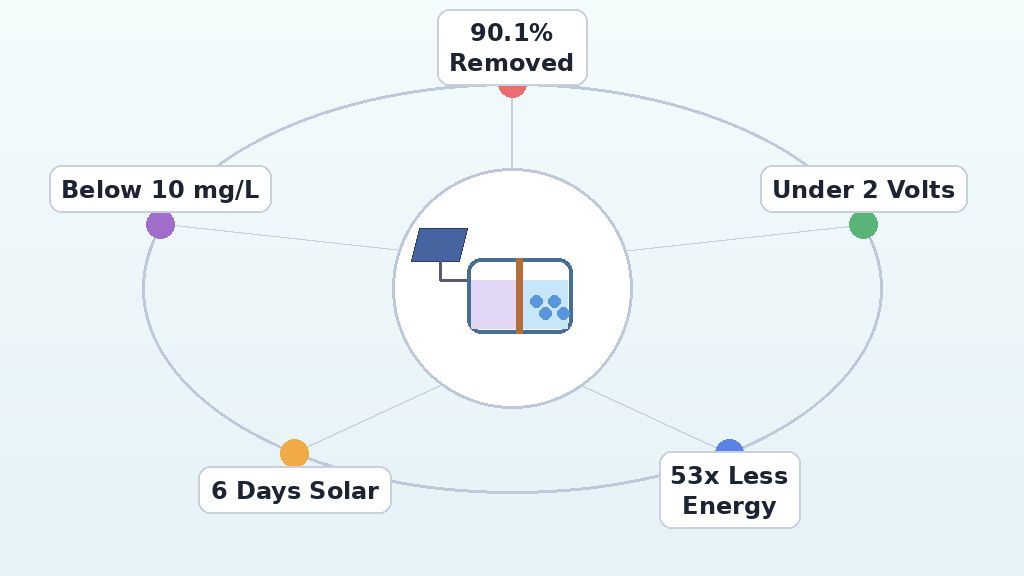
A copper-coated nickel membrane let a solar-charged reactor cut nitrate in groundwater below 10 mg/L for six days, using far less energy than a standard design.
Nitrate is a common pollutant in well water. It often comes from fertilizer and sewage, and it is hard to remove cheaply. Now a team in China and Singapore reports a new route to solar-powered nitrate removal. Their device uses a thin nickel sheet coated with copper. Chunhua Feng at South China University of Technology co-led the work. Chuyang Tang at the National University of Singapore also led it. Researchers from the University of Hong Kong and Qingdao University of Technology joined too. The team published its study in Nature Communications on November 3, 2026. Its DOI, for reference, is 10.1038/s41467-026-78930-x. In short, the device works even in water that carries electricity poorly. That matters because most groundwater has few dissolved salts. As a result, standard electrochemical reactors waste lots of energy on such water.
In lab tests, the reactor removed 90.1% of nitrate within three hours. A conventional reactor with the same metal removed only 12.8%. Energy use, in addition, fell from 3.074 to 0.058 kilowatt-hours per gram of nitrogen. The team then built a version powered by a solar panel and battery. For six days, it treated real groundwater containing 32 mg/L of nitrate nitrogen. Throughout that time, nitrate in the outflow stayed below 10 mg/L. A life cycle study also suggested 4.7 times lower greenhouse emissions than the standard design. Even so, the main product is ammonium, which still needs handling. The salt solution inside the reactor also needs periodic topping up. On top of that, the test treated only about 3.2 liters of water. In this article, we explain how the device works and where its limits lie.
Why Solar-Powered Nitrate Removal Matters
Nitrate dissolves easily and moves freely through soil. Because of this, it can seep into the aquifers that feed wells. The paper describes nitrate as a widespread pollutant with risks to people and ecosystems. Many countries, for this reason, set strict limits for drinking water. Our guide to drinking water standards explains how such limits protect health. Removing nitrate, on the other hand, is not simple. One promising method is electrochemical hydrogenation. It uses electricity and water to convert nitrate into other compounds. Standard reactors, in contrast, need water that conducts electricity well. Groundwater usually conducts poorly because it holds few dissolved salts. As a result, voltages climb and energy use soars. High voltages can also create heat, toxic mist, and metal leaching. So the team set out to remove this conductivity barrier.
Lessons From Palladium Reactors
Earlier researchers had tried a clever split design. In these reactors, a thin palladium sheet separates two chambers. One chamber holds a salty liquid that conducts electricity well. The other chamber holds the polluted water. Hydrogen atoms form on one side of the palladium. They then pass through the metal to react on the other side. In this way, the polluted water never needs to conduct electricity. Even so, palladium is costly and must be very pure. Many of these designs also need strongly acidic liquids. On top of that, hydrogen moves through metal much more slowly than electrons do. The authors argue this mismatch may slow the whole process. For this reason, they tried a cheaper metal with a different coating. Nickel and copper, in fact, cost far less than palladium.
How the Cu/eNMR Experiments Worked
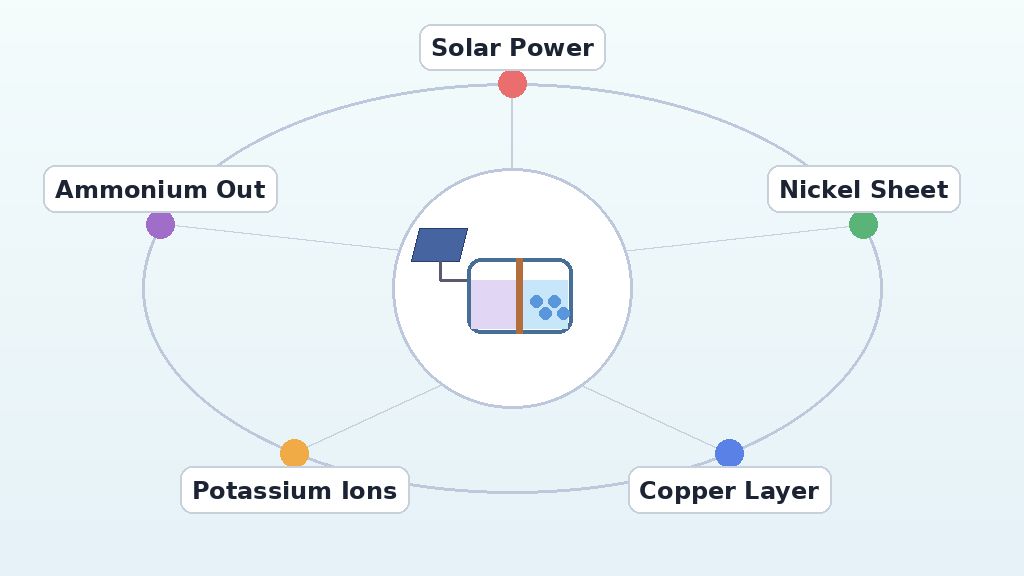
The team started with a dense nickel membrane. Next, they deposited copper onto one side using electricity. This created a copper layer about 3 micrometers thick. Electron microscopes showed copper particles roughly 100 nanometers across. The coated sheet then served three roles at once. It acted as the cathode, the catalyst, and the wall between chambers. One chamber held a strong potassium hydroxide solution, or KOH. The other held nitrate dissolved in purified water. To compare, the team built a conventional reactor using the same coated sheet. In that design, the polluted water touched the electrode directly. Full details appear in the Nature Communications study. The researchers then tested different currents, nitrate levels, and acidity. In addition, they ran the reactor through 30 repeated batches.
Lab Results for Nitrate Removal
At 5 milliamps per square centimeter, the new reactor removed 90.1% of nitrate. That took three hours with 50 mg/L of nitrate nitrogen. The conventional reactor, in contrast, managed only 12.8%. Its cell voltage also climbed to between 10.2 and 25.9 volts. At the same time, the new design needed only about 1.76 to 1.98 volts. Energy use per gram of nitrogen fell dramatically as a result. In other words, the split design saved most of the power. The main product was ammonium, with almost no nitrous oxide gas. Performance stayed steady over 30 batch cycles. No copper or nickel leaked into the water at detectable levels. Common ions such as chloride and calcium did not hurt performance. At lower starting nitrate levels, however, removal dropped to between 43.6% and 80.6%. Even so, leftover nitrate stayed below 10 mg/L in every case.
Fig. 1: Key Results of the Membrane Reactor
Testing Acidity, Stronger Waste, and Other Pollutants
The team also pushed the reactor beyond its standard test. First, they changed the acidity of the polluted water. At pH 3, removal rose slightly to 93.3%. By contrast, at pH 2 it dipped to 86.5% because hydrogen gas formed faster. Even at strongly alkaline pH 9 to 13, removal stayed near 80%. Next, they tried much stronger nitrate solutions, up to 1 gram per liter. After six hours, removal reached between 74.2% and 92.8%. In addition, the reactor broke down two other pollutants. It converted 95% of bromate at the highest current tested. Likewise, 88.4% of 4-chlorophenol became phenol. In one variation, an iron plate replaced the usual anode. That version, along with an acid solution, removed 94.9% of nitrate in six hours. Overall, the reactor handled a wide range of conditions well.
Six Days on Solar Power
Next, the team tested the idea outside ideal lab water. They built a larger reactor with two coated cathodes. A commercial silicon solar panel charged a battery. That battery then powered the reactor day and night. A pump pushed groundwater through at 0.5 milliliters per minute. The water came from near the university campus in Guangzhou. According to the paper, it contained 32 mg/L of nitrate nitrogen. Over six days, the reactor kept outflow nitrate below 10 mg/L. That level matches the limit the paper cites from the WHO. In total, it treated about 3.2 liters. The conventional reactor, by contrast, could only run at a lower current. Its outflow averaged 17.2 mg/L of nitrate nitrogen. Iron particles, another common treatment, removed at most 9.4% in a quick comparison. In this test, the solar setup clearly outperformed both alternatives.
Explainer: How Electrons Reach the Polluted Water
The team expected hydrogen atoms to cross the membrane, as with palladium. Instead, their tests pointed to a different path. Hydrogen moves through nickel and copper about ten million times slower than through palladium. So the researchers swapped ordinary water for heavy water in the polluted chamber. Heavy water contains deuterium, a heavier form of hydrogen. The ammonium produced then carried deuterium, not ordinary hydrogen. In other words, the hydrogen came from the polluted water itself. Electrons, therefore, travel through the metal sheet directly to the copper surface. There they combine with water and nitrate to form ammonium. Our article on green ammonia from nitric oxide covers a related reaction. Put simply, the metal sheet acts like a wire into the polluted chamber. As a result, the slow hydrogen crossing becomes unnecessary.
Why Potassium Ions Keep the Membrane Reactor Balanced
Sending electrons into one chamber creates a problem. Negative charge would pile up there and stop the reaction. To prevent this, positive potassium ions cross the membrane. The team detected about 40 millimolar potassium in the treated water. In fact, potassium rose in step as silver ions used up electrons. A dye tracer, on the other hand, did not cross the membrane at all. Bare nickel sheets also blocked potassium completely. So copper coating seems to open tiny ion pathways in the nickel. The authors admit the exact mechanism remains unresolved. They also found that resistance at each surface steers the electrons. Copper offers low resistance toward nitrate, which draws electrons its way. For example, other coatings such as ruthenium, silver, and palladium removed far less nitrate.
Fig. 2: How Electrons Reach the Polluted Water
Challenges and Motivation Behind Removing Nitrate
The team aimed to make treatment practical for remote, low-salt water. Its split design keeps the anode away from the polluted water. Because of this, the anode cannot create chlorinated by-products there. In tests, the conventional reactor turned phenol and chloride into chlorinated compounds. The new design, in contrast, left phenol unchanged. Cheap nickel foam also worked as an anode in the new design. Even so, several challenges remain before use in homes or farms. The current US limits appear in the EPA drinking water regulations. Meeting such limits reliably will require longer and larger trials. On top of that, the product ammonium must still be removed or reused. The authors showed one possible fix using bleach made inside the reactor. Still, that step needs more testing.
Limits the Researchers Report
The paper points out several limits. To begin with, much of the electrical energy went into making hydrogen gas. Faradaic efficiency, a measure of useful current, ranged from just 11.1% to 37.9%. Second, the KOH solution may need replacing during long operation. The authors expect this to stay manageable because nitrate levels in natural water are low. Third, the ion pathways in the copper-coated nickel remain unexplained. Further imaging and flux studies, they say, must test their idea. On top of that, the solar test lasted only six days. It also treated just 3.2 liters, which is far from a household supply. The paper’s web abstract also lists slightly different numbers from the article text. Finally, the life cycle assessment relied on modeled inputs. For these reasons, larger field trials must come next.
Conclusion: Next Steps for Cleaner Groundwater
This study offers a promising design for solar-powered nitrate removal from low-salt groundwater. A copper-coated nickel sheet carries electrons straight into the polluted water. Potassium ions then cross the sheet to keep charges balanced. As a result, the reactor runs at low voltage and low energy. A solar test kept nitrate below 10 mg/L for six days. At the same time, the device makes ammonium and wastes much current on hydrogen. Longer, larger trials must show whether the idea scales up. Such work brings together chemists, materials scientists, and environmental engineers. Our article on the impact of nitrogen fixation shows where much nitrate begins. In the end, better tools could help rural families trust their wells. For now, the reactor remains an encouraging lab prototype.
References
Duan, W., Feng, Z., Gao, J., Jiang, B., Tian, L., Zhu, Y., Lei, Z., Zheng, W., Feng, C., & Tang, C. Y. (2026). Copper-modified nickel membrane reactor for electrochemical hydrogenation in low-conductivity water. Nature Communications. Advance online publication. https://doi.org/10.1038/s41467-026-78930-x
I checked the brief against the Article in Press PDF. Correct: about 90% nitrate removal at 5 mA/cm2 in 3 h for 50 mg/L nitrate-nitrogen versus 12.8% for the conventional reactor; stable performance over 30 cycles with no detectable Cu or Ni leaching; a solar-powered dual-membrane unit (18 cm2 membrane, 970 cm2 commercial panel) keeping real groundwater spiked to about 32 mg/L below 10 mg/L for 6 days and about 3.2 L; and 0.01645 versus 0.0775 kg CO2-eq per liter, a 4.7-fold reduction. Energy figures need care: the PDF abstract gives 0.058 versus 3.074 kWh/g-N, while the article-page abstract gives 0.139 versus 8.6 kWh/g-N. The brief reports both and uses the ratio (roughly 50-60 times) rather than one absolute value. The brief correctly notes that the product is ammonium and that the groundwater was spiked with nitrate. Verdict: accurate; no corrections needed.
Editorial note
ENTECH runs this story because nitrate from fertilizer pollutes drinking-water wells around the world, and this paper shows a small, solar-powered reactor that brought real groundwater below the WHO nitrate limit for six days. The design is clever and easy to picture: a copper-coated nickel sheet acts as a wall, so the polluted water never touches the anode, and the reactor uses far less energy than a conventional one. For teens, it links chemistry and environmental engineering to jobs in water treatment and clean-tech equipment. Caveats: the nitrate turns into ammonium, which still has to be dealt with; the field test was small; and the energy figures differ between the article-page abstract and the Article in Press PDF. Takeaway: a promising off-grid water-cleanup approach that now needs larger trials.
Sailee Pakhare holds a Master's degree in Biotechnology, with a research background spanning microbiology, molecular biology, and disease biology. Her postgraduate dissertation examined the antimicrobial potential of bioactive peptides from lactic acid bacteria, and her research experience includes molecular identification of bacterial isolates (with sequencing data submitted to NCBI) and work as a Research Assistant at SafeWright Laboratory. She also completed a summer internship at IIT Hyderabad studying circadian rhythms and disease biology using Drosophila melanogaster as a model organism.
Her work has been recognized with the Best Poster award at the 3rd International Conference on Innovations in Biotechnology Research for Sustainable Bioresources and Bioeconomy (2025), and she has contributed to a book chapter on the role of AI and machine learning in climate change.
Sailee is also a co-founder of LifeXtension, a community focused on longevity, ageing, and health science awareness in India. An interdisciplinary thinker, she explores questions ranging from disease biology to space and the origins of life, approaching science as a way of asking questions rather than a fixed body of facts. As a science communicator and researcher, she is committed to translating complex research into writing that is clear, accurate, and engaging.