A KETI and UNSW team heated silicon cells with an induction coil, peeled them from EVA glue in seconds, and recovered over 99.8% of mass in modified glass-to-glass test modules.
Old solar farms look clean until the panels age out. After about twenty to thirty years, those panels become heavy waste. Glass, silicon, silver, and plastic sit locked together. Today, many recycling lines burn, grind, or soak that stack. Cells often crack. Moreover, glue residue sticks. Now a KETI team, with a UNSW partner, pushes a tougher claim. They target solar panel recycling without solvent baths. An induction coil heats metal electrodes and frees intact cells. Da Young Kwon and Yonghwan Lee led the study. Moonyong Kim at UNSW joined them. Communications Materials posted the Article in Press on October 31, 2026. Its DOI is 10.1038/s43246-026-01403-7. Still, lab seconds do not equal factory minutes. As a result, this article tests that gap with care. In short, the claim needs industrial proof.
The bottleneck is ethylene vinyl acetate, or EVA. That clear glue bonds cells to glass for decades. Thermal, chemical, and mechanical routes already exist. Yet each leaves damage, waste, or long cycle times. Here, simulations used 300 kilohertz. Next, lab coils ran at 270 to 300 kilohertz. Currents ranged from 25 to 200 amperes. Importantly, heating faster than 28 degrees Celsius per second mattered. As a result, only the EVA touching the cell broke down. Then acetic acid gas formed at that thin interface. Peel force fell from 75.8 newtons on a fresh sample. After fifteen seconds, it fell to 10.2 newtons. In a separate cell-size test, full separation came within ten seconds. Later, modified glass-to-glass coupons hit 99.8 percent mass recovery. Even so, those coupons were only centimeters across. As a result of this, scale-up proof is still missing.
Global solar capacity keeps rising fast. The paper cites more than 602 gigawatts of new modules in 2024. Cumulative capacity already passed 2.24 terawatts. By mid-century, end-of-life mass could reach 54 to 160 million tons. Crystalline silicon still holds more than 98 percent of the market. Each module packs tempered glass, wafers, silver, aluminum, and polymers. Those materials become urban ore only after clean separation. Otherwise, landfills and low-value shredding still win. Our story on recovering silver from old panels shows another route under pressure. In contrast to that laser focus on metal, this work targets the glue. For this reason, process engineers cannot treat EVA as a minor detail. Solar waste piles will not wait for perfect plants. Meanwhile, recyclers still need better tools.
Why Glue Layers Block Clean PV Module Recovery
EVA protects cells from moisture and impact for decades. That same toughness fights recyclers every day. Burning the polymer risks cracked wafers and fumes. Solvents create hazardous waste streams. Hot knives move fast yet still leave mixed residue. In short, speed without clean surfaces is not enough. The authors argue for residue-free cells and intact EVA. Such streams would raise recovery value. They also note that bifacial glass-to-glass modules trap gas tightly. As a result, vapor from local EVA breakdown cannot escape open edges. On top of that, commercial modules lack the study’s edge-release film. In practice, today’s stock cannot copy the highest recovery numbers. Readers should therefore treat 99.8 percent as a modified-lab result. It is not a claim about every rooftop panel today.
How Induction Heating Recycling Attacks the Glue
Electromagnetic induction heats conductive metal without touching the glass face. The team modeled p-PERC cells with front silver fingers. A full rear aluminum electrode completed the stack. Finite-element runs showed both metals drive heating. Aluminum carried much of that load. Next, a pancake coil sat under rear-less glass-EVA-cell stacks. Consequently, cell temperatures rose far faster than the glass. At 100 amperes, the cell-to-glass gap topped 200 degrees Celsius. Soon, microbubbles formed near the cell after a few seconds. After that, peel tests quantified the weakened bond. In other words, the coil does not melt the whole sandwich. It only weakens the thin contact zone. Full methods appear in the Communications Materials Article in Press. Still, rear-less stacks are not finished commercial modules. As a result of this, glass-to-glass work needed extra engineering.
What Lab Numbers Show for EVA Delamination
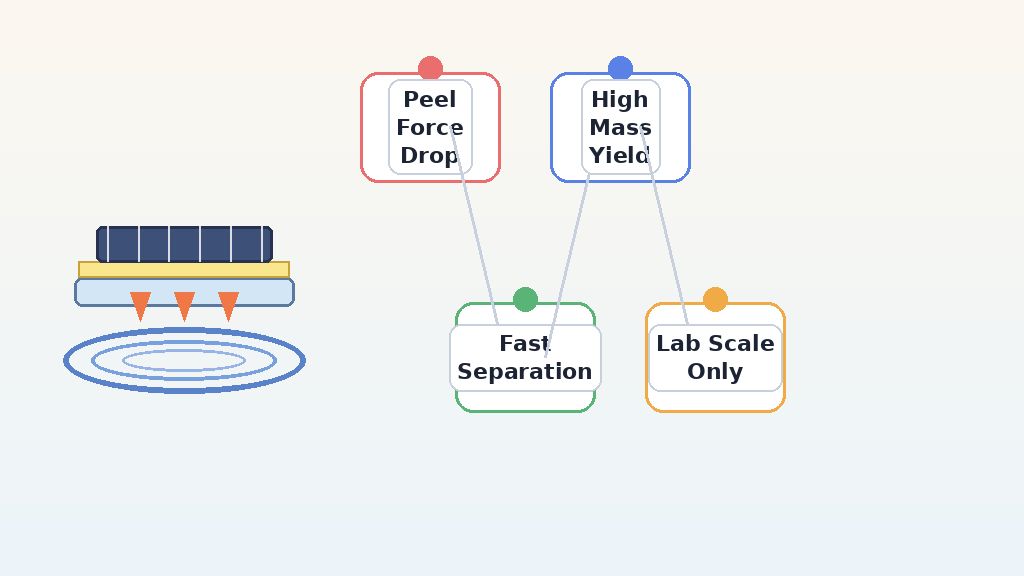
After ten seconds of heating, peel force fell to about 18.7 newtons. Fifteen seconds later cut it further to 10.2 newtons. The fresh baseline sat at 75.8 newtons. Meanwhile, infrared images tracked hot cells and cooler glass. In addition, thermocouples embedded in the stack confirmed steep gradients. The team also mapped heating in other cell styles. Trials included bifacial PERC, TOPCon, and heterojunction samples. However, those runs mapped thermal behavior rather than full recycling lines. Even so, the data hint that metal layout matters. In particular, finger-only fronts heat less readily than full-area aluminum backs. For this reason, process recipes cannot stay one-size-fits-all. Our guide to eco-friendly technology paths places such trade-offs in context. In practice, plant designers must match coil settings to each architecture. Throughput promises without that match look hollow.
Fig. 1: Key Results From Induction Delamination Tests
Glass-to-Glass Modules Need Design Changes
Glass-to-glass stacks trapped acetic acid gas and slowed separation. The fix was a thin PTFE edge-release film. Specifically, workers placed it in the non-cell rim before lamination. As a result, that film kept EVA from sealing the edge shut. Then a jig let gravity finish the split. At 100 amperes, glass edges began to move at 18.3 seconds. Full separation took 18.6 seconds at that current. Similarly, raising current to 150 amperes cut the time to 8.3 seconds. At 200 amperes, separation finished in 5.4 seconds. Afterwards, average mass retention hit 99.94 percent. Next, a knife cleared leftover EVA. Final component recovery reached 99.8 percent by mass, including the polymer. Notably, cells looked residue-free under EDS checks in the paper. Even so, the glass measured only 5 by 8 centimeters. In short, the headline yield rides on a redesigned miniature module.
Explainer: How a Coil Softens Only the Glue
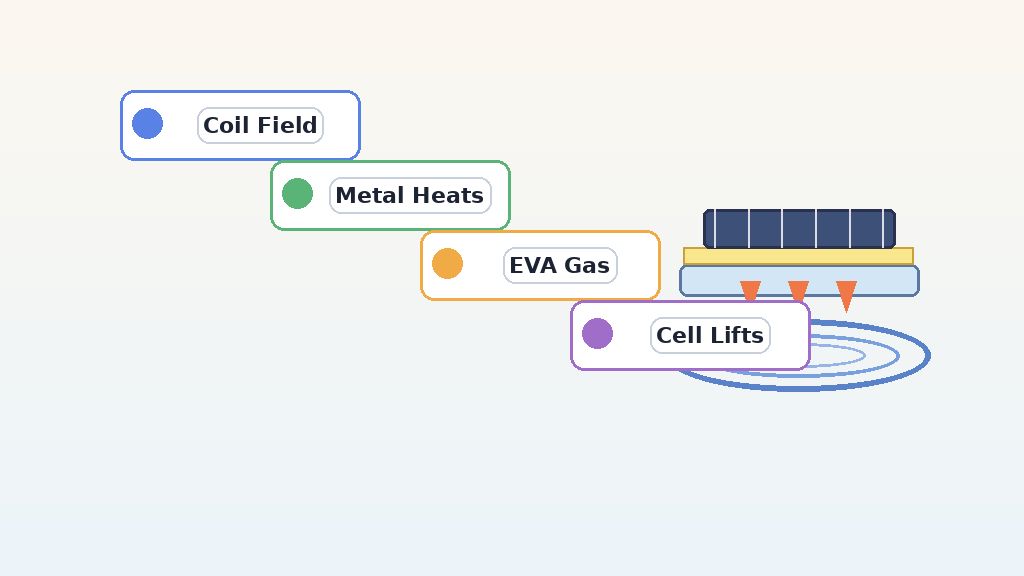
To begin with, picture a wireless charger under a phone. Then swap the phone for a solar cell instead. Alternating current in the coil makes a changing magnetic field. That field drives currents in silver and aluminum electrodes. First, metal warms. Next, heat races into the thin EVA touching the wafer. Above roughly 350 degrees Celsius at that interface, acetate groups break. Afterwards, acetic acid vapor escapes. As a result, gas expands, lifts the cell, and leaves bulk EVA intact. Because the glass stays cooler, the outer polymer does not burn away either. As a result, recyclers can keep cell and encapsulant as separate streams. However, the same idea fails if heating is slow. In that case, slow ramps warm the whole stack and destroy selectivity. By contrast, induction aims energy where the metal sits. Selective heat is the method’s point.
Fig. 2: How An Induction Coil Softens Only The Glue
Why Seconds Matter for Induction Heating Recycling
Recycling lines live or die on cycle time and scrap rate. For example, freeing cells in tens of seconds could beat long solvent soaks. In addition, it could beat energy-heavy furnaces that cook entire modules. On the other hand, induction hardware adds capital cost. Likewise, coil design and safety shielding add more. No cost model appears in the paper. In the same way, continuous conveyor trials are missing. For this reason, plant managers cannot yet price recovered silicon from this route. Related work on whole glass fabrics from wind blades shows end-of-life research across clean-energy assets. In the same way, solar recyclers need mass-balance sheets. Put simply, stopwatch demos alone do not pay for a plant. Until those sheets exist, claims about scalable solar panel recycling remain provisional. Ultimately, challenging the hype is part of reading the science well.
Challenges That Still Block Factory Floors
The authors themselves flag the edge-release film as a limitation. Currently, glass-to-glass products do not use that film. Instead, they suggest laser or wet-etch edge treatments as possible substitutes. Yet those substitutes remain unproven here. In addition, pseudo-modules omit frames, junction boxes, and outdoor aging. Meanwhile, real end-of-life panels carry dirt, cracks, and mixed parts. Korea’s energy technology program funded the work through listed KETEP and MOTIE grants. Funding, however, is still not a factory. On top of that, recovery percentages come from carefully prepared samples. As a result of this, investors should ask for pilot data on full-size modules. Moreover, they should ask for energy per module. At the same time, worker controls around hot coils and acid vapor matter. Without those answers, the method stays only a strong lab strategy. Our Communications Materials source page keeps the open-access paper public.
Limits the Paper Puts in Plain Sight
First, every standout time and yield traces to small coupons. Second, glass-to-glass success depends on an edge path commercial laminates lack. Third, the study reports no techno-economic analysis. It also skips a plant-scale wastewater and emission inventory. Fourth, heating maps for newer cell types stop short of full demos. Fifth, the manuscript is still an Article in Press. Consequently, typesetting may still change. Even so, the physics story remains coherent. In other words, fast interfacial heat, local gas, and a clean peel fit together. Readers who want careers here can study power electronics and polymer science. Along with that, photovoltaic manufacturing skills belong on that list. Altogether, process engineers, materials engineers, and circular-economy analysts will meet at that junction. In particular, teams that redesign modules for recycling may gain more value. By contrast, retrofits of yesterday’s panels alone will struggle.
Conclusion: Next Steps for Solar Panel Recycling
Induction heating gives solar panel recycling a sharper tool against EVA glue. KETI and UNSW showed residue-free cell release in seconds on lab stacks. Afterwards, modified glass-to-glass coupons posted high mass recovery. Peel forces dropped. Meanwhile, cells stayed intact. Bulk EVA largely survived. At the same time, the best yields need an edge-release design. Currently, panels do not use that design. Sample sizes stayed small. Likewise, costs stayed unreported. As a result, the work challenges both landfill habits and easy marketing claims. Next, researchers must test full-size modules and aged panels. Finally, honest energy and cost sheets must follow. Until then, treat this only as a credible laboratory advance. Nevertheless, open industrial questions remain. Careful readers will keep the study DOI record close. They will demand pilot proof before they rewrite recycling roadmaps.
References
Kwon, D. Y., Yoon, S., Kim, M., Ryu, J., Park, Y., Han, J., Back, H. N., Park, N., & Lee, Y. (2026). Inductive heating for photovoltaic module recycling and near-complete component recovery. *Communications Materials*. Advance online publication (Article in Press). https://doi.org/10.1038/s43246-026-01403-7
International Energy Agency Photovoltaic Power Systems Programme. (n.d.). *IEA PVPS*. https://iea-pvps.org/
The induction recycling piece keeps a challenging edge that fits the byline voice. I would still sharpen the contrast between rear-less stacks and glass-to-glass coupons earlier in the findings. A tighter plant-economics paragraph would help readers see what data are still missing. Readers are encouraged to refer to the original source paper from which this story is sourced.
Editorial note
Editorial desk: this draft follows the latest explainer routine with a single Environmental Engineering category and Shreyas Kulkarni's challenging persona. For full methods and caveats, consult the original source paper from which this article is sourced.
Shreyas Kulkarni is a Chartered Electrical Engineer and renewable energy pioneer with over eight years of hands-on experience in the clean energy sector. He is the Co-Founder of UNICUS Energy, a leading provider of solar energy solutions in India, where he drives technical execution, system architecture, and clean tech deployment.
As an author for ENTECH Magazine, Shreyas focuses on making solar technology practical and understandable for students, engineers, and homeowners. His contributions include detailed guides on the inner workings of rooftop solar systems and deep dives into modern hardware advancements, such as lightweight solar panels and flexible photovoltaic materials.