Millions of solar panels will reach the end of their working lives soon. Each one holds a small but valuable amount of silver. Getting that silver back, however, has proved surprisingly hard. Now a new study offers a cleaner path to solar panel silver recovery using lasers. Engineers at the University of Glasgow in Scotland led the work. Partners came from Princess Nourah bint Abdulrahman University in Saudi Arabia. Fraunhofer CSP in Germany, in addition, supplied the aged panels. The team published its findings in Communications Materials on November 3, 2026. Its DOI, for reference, is 10.1038/s43246-026-01424-2. Jeff Kettle at Glasgow served as the corresponding author. In short, the team used a laser to peel apart the layers inside old panels. After that, two mild chemical baths pulled out silver and aluminium separately.
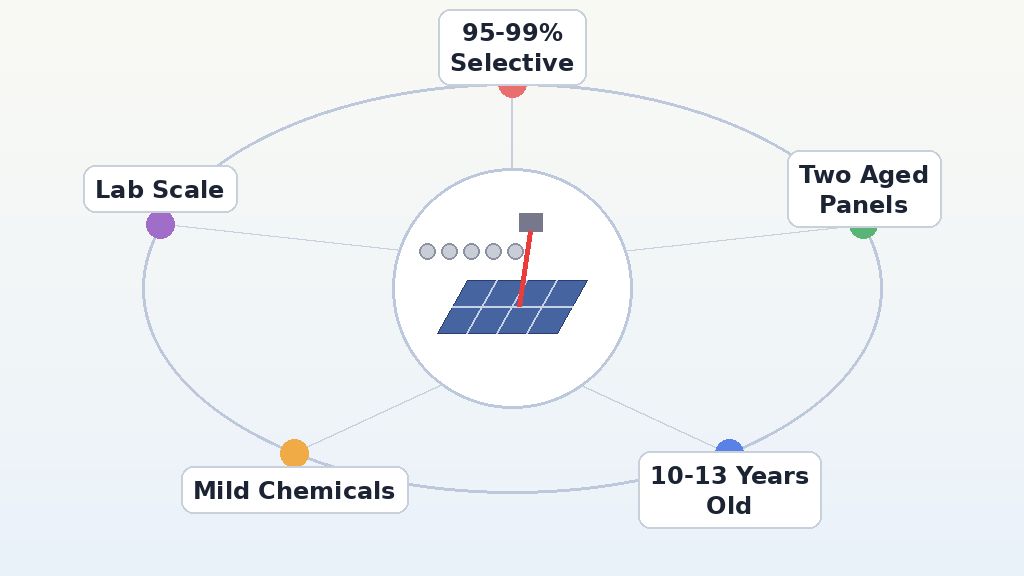
The panels came from real rooftops and solar farms. In fact, they had worked for about 10 to 13 years before retirement. The researchers tested two commercial models from different makers. For both, the laser freed a silicon-rich powder from the plastic layer. Silver extraction then reached 99% selectivity for one model. For the other model, in contrast, it reached 95%. Selectivity measures how much of the dissolved material is actually silver. To the team’s knowledge, no earlier work on aged panels has matched this. Even so, the study stayed at laboratory scale. The laser also needs about 5.5 hours per square meter with one head. On top of that, the team has not yet measured full energy use or costs. In this article, we explain how the method works and what it still needs.
Why Solar Panel Silver Recovery Matters
Solar power has grown at an astonishing pace. In 2024 alone, the world installed over 600 gigawatts of new capacity. As a result, total installations reached 2.25 terawatts. Waste, in turn, will follow that growth in time. The authors cite estimates of over 4 million tonnes of panel waste by 2030. By 2050, that figure could exceed 212 million tonnes. Most of this waste comes from crystalline silicon panels. By weight, glass and aluminium dominate each panel. In contrast, silver makes up only about 0.05% of the mass. Yet silver supplies roughly 66% of the recoverable value. For this reason, recyclers need good ways to capture it. Our guide to lithium-ion battery recycling shows a similar problem with batteries. In both cases, valuable metals hide inside tightly packed layers.
The Glue That Holds Panels Together
A typical panel stacks several layers like a sandwich. On top sits tempered glass, which protects the cells. Below it lies a plastic called ethylene-vinyl acetate, or EVA. This clear layer wraps around the thin silicon cells. A backsheet then seals the rear side. EVA bonds strongly to both the glass and the cells. That strength helps panels survive decades of sun and rain. In recycling, however, it becomes the main bottleneck. Crushing panels mixes every material into a messy blend. In addition, heating them to 450 to 600 °C burns off the plastic. Unfortunately, that step uses lots of energy and releases harmful gases. Solvent baths, on the other hand, can take days and create toxic waste. For example, one earlier method soaked panels in a solvent for 10 days. So the team looked for a dry, targeted alternative.
How the Laser Delamination Experiments Worked
Fraunhofer CSP first removed the front glass from each panel. To do this, workers used a hot steel blade heated to 350 °C. This hot-knife method keeps the glass pane intact. The remaining stack held the backsheet, two EVA layers, and the cells. Workers then peeled off the backsheet at room temperature. Next, the team cut the stack into 20 mm squares. These pieces mimic the fragments a shredder might produce. Researchers then scanned each square with a 1064 nm fibre laser. They varied the laser power and the pulse rate. Afterward, they weighed each sample to measure how much material came off. Larger 6 by 7 cm pieces received the same treatment as a check. Full details appear in the Communications Materials paper. In this way, the team mapped the best laser settings.
Finding the Right Laser Setting
Below about 12 to 14 watts, almost nothing happened. In other words, mass loss stayed under 5%. Once power passed that threshold, mass loss jumped sharply. It rose by 30% to 40% across a narrow power window. Above roughly 20 watts, the curves flattened at about 48% to 52%. At that point, the EVA and cell had fully separated. Heating tests on untreated samples also supported this result. Those tests left 47.7% of the mass after the plastic burned off. Pulse rate also mattered at low power. At 30 kHz, separation started at the lowest power. Higher pulse rates, by contrast, needed slightly more power to begin. They also caused more browning on the plastic. On the larger sample, the EVA lifted off as one intact sheet. Meanwhile, the silicon cell broke into a fine powder.
Silver Recovery Results From Two Panels
The team next tested the method on two full panel models. One was a REC240PE panel built in 2011. The other was a Canadian Solar CS6P-245P from 2014. First, a sodium hydroxide bath removed aluminium from the powder. Silver stayed behind during this step. Second, an iron chloride and choline chloride brine dissolved the silver. For the REC panel, silver made up 1.38% of the debonded sample. Its selectivity reached 99%. For the Canadian Solar panel, on the other hand, silver reached 1.08%, with 95% selectivity. The thinner silver lines in that panel help explain its lower amount. After both baths, crystalline silicon remained as a filtered solid. X-ray tests, in particular, showed no silver or aluminium peaks left behind. Because of this result, the team claims a record for aged panels.
Fig. 1: Key Results of Laser Silver Recovery
Gentler Chemicals Instead of Strong Acid
Many recyclers dissolve silver with strong nitric acid. That acid works well but is highly corrosive and hazardous. So the team tested milder options against it. On a smaller sample, the brine matched nitric acid for silver capture. In fact, it recovered almost all of the silver present. The sodium hydroxide step, meanwhile, pulled out aluminium selectively. Only trace silver showed up in that first bath. According to the authors, sodium hydroxide appears in some household cleaning products. Choline chloride, meanwhile, is a common bulk chemical. Together, these choices reduce the hazards of the process. Still, the paper notes a warning. At higher temperatures, sodium hydroxide will start to attack silicon. Some iron and chromium traces also appeared in the cleaned powder. The iron likely came from the brine itself.
Explainer: Why the Laser Heats Only the Silicon
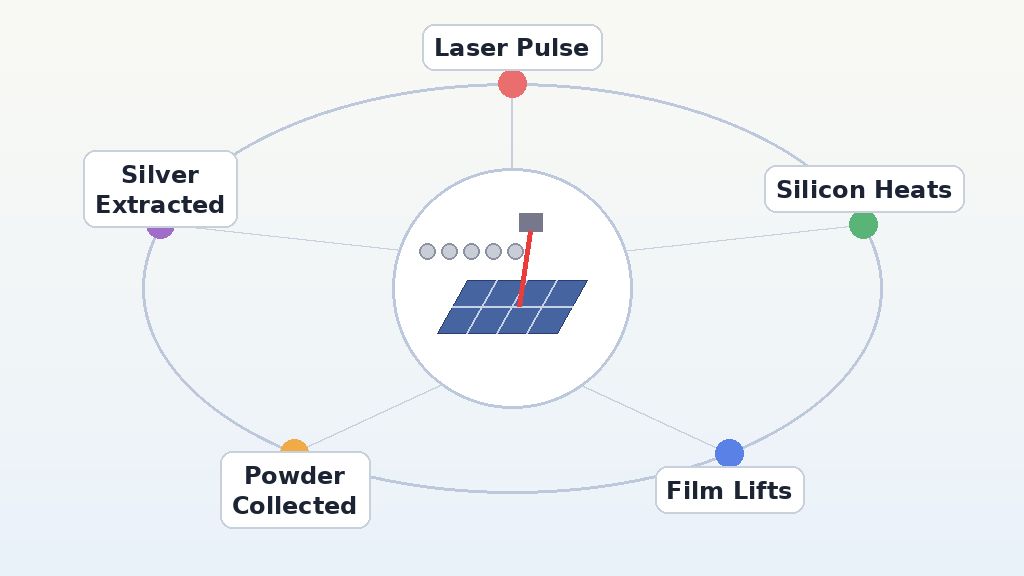
Different materials respond to light in different ways. EVA plastic is almost transparent at the laser’s wavelength. As a result, the beam passes through it with very little loss. Silicon, by contrast, absorbs some of this infrared light. The laser’s photons carry 1.16 electronvolts of energy. In fact, that value sits just above silicon’s bandgap of 1.12 electronvolts. Because of that, silicon absorbs the energy and heats up. The heat concentrates exactly where the plastic meets the cell. That thin hot zone weakens the bond and frees the plastic. Our article on fiber laser cutting systems explains how factories use similar lasers. The bulk of the panel, in other words, stays relatively cool. This targeted heating contrasts sharply with an oven, which heats everything. Put simply, the laser warms only one thin boundary.
Laser Delamination Without Burning the Film
Metals behave differently from silicon under the beam. Silver, aluminium, and copper reflect about 95% to 98% of this light. For this reason, separation starts in the gaps between silver lines. Wide silver strips, called busbars, soak up and spread heat. As a result, they do not release on their own. Instead, workers had to lift them gently by hand. Infrared and Raman tests then checked the freed plastic. Most of the film kept its normal chemical signature. Only narrow stripes under the metal lines showed charring. Heating tests also showed the film behaved much like untreated EVA. In other words, the laser changed the plastic only at the contact points. Even so, the film cannot return to new panels. EVA forms permanent chemical crosslinks, so it cannot melt and reshape.
Fig. 2: How the Laser Frees Silicon Powder
Challenges and Motivation Behind Solar Panel Recycling
The team wanted cleaner waste streams from the start. Their method splits each panel into three separate parts. To begin with, one part is an intact EVA film with tiny metal traces. Next come the busbar strips, which consist mostly of copper. Finally, a silicon powder holding aluminium and silver forms the last part. Shredding, in contrast, would mix the copper with the silver. Such a mix, in turn, makes silver much harder to purify. The film near busbars, however, held up to 0.26% silver. Under a US test, waste can count as hazardous above 5 mg/L of silver. The authors report that the brine can strip this leftover silver too. Rules for handling old panels appear on the EPA panel recycling page. Above all, the work aims to make recycling simpler and safer.
Limits the Researchers Report
The authors list several limits clearly. To begin with, they tested only two commercial panel models. Newer cell designs, such as PERC and TOPCon, still need testing. On top of that, all work used one laser at laboratory scale. A single laser head needs about 5.5 hours per square meter. Factories, however, would need several heads working in parallel. The team’s energy comparison also leaves out laser efficiency and plant equipment. So the paper says it is not a system-level energy figure. A full techno-economic assessment remains future work. Likewise, the team has not yet reused the brine across many cycles. They also have not tested the quality of the recovered silicon and silver. Finally, workers still lift busbars by hand. Each of these gaps needs answers before industry can adopt the method.
Conclusion: The Next Steps for Retired Panels
This study shows a promising route for solar panel silver recovery from aged modules. A laser lifts the plastic away by heating only the silicon surface. Two mild baths then pull out aluminium and silver in turn. Silver selectivity reached 99% and 95% in two real panel models. At the same time, the work remains small, slow, and lab-based. Faster multi-head lasers and a full cost study must come next. The team also wants to reuse its brine many times. Such work blends materials science, chemistry, optics, and engineering. For students, it shows how physics can solve a practical waste problem. Our piece on robotic electronic waste disassembly explores another tool for this challenge. In the end, panels designed for recycling could make the job even easier.
References
Alsulami, B. N., Cameron, J., Obst, A., Prentice, P., Roghaieh, P., Feeney, A., & Kettle, J. (2026). Laser-induced delamination of aged silicon photovoltaic modules to achieve >95% selective silver recovery. Communications Materials. Advance online publication. https://doi.org/10.1038/s43246-026-01424-2
U.S. Environmental Protection Agency. (n.d.). Solar panel recycling. https://www.epa.gov/hw/solar-panel-recycling
I checked the brief against the Article in Press PDF. The numbers are correct: aged REC240PE and Canadian Solar CS6P-245P modules; 1064 nm fiber laser with clean delamination above about 20 W; silver at 1.38% (99% selectivity) and 1.08% (95% selectivity) after NaOH removal of aluminum and FeCl3 leaching in a choline chloride brine; silver at about 0.05% of mass and about 66% of recoverable value; EVA residue below 0.1 wt% over most of the film; about 5.5 h per square meter with one laser head; and waste projections of more than 4 Mt by 2030 and 212 Mt by 2050. The 'up to 99%' in the headline refers to selectivity, not recovery yield, and the brief says so. The limitations match the paper's own list. Verdict: accurate; no corrections needed.
Editorial note
ENTECH runs this story because solar power is booming, and the first big generation of panels is reaching retirement; what happens to them is a business question as much as an environmental one. A University of Glasgow team, with Princess Nourah bint Abdulrahman University and Germany's Fraunhofer CSP, used an industrial laser to separate real 10-13-year-old panels into clean streams and then recovered silver with 95-99% selectivity. For teens, it links materials science, chemistry and engineering to new jobs in solar recycling. Caveats: only two panel types were tested, the process is slow with a single laser head, the costs and environmental footprint have not yet been fully assessed, and the manuscript is still unedited. Takeaway: a promising, solvent-free route for recycling solar panels that now needs scale-up.
Shreyas Kulkarni is a Chartered Electrical Engineer and renewable energy pioneer with over eight years of hands-on experience in the clean energy sector. He is the Co-Founder of UNICUS Energy, a leading provider of solar energy solutions in India, where he drives technical execution, system architecture, and clean tech deployment.
As an author for ENTECH Magazine, Shreyas focuses on making solar technology practical and understandable for students, engineers, and homeowners. His contributions include detailed guides on the inner workings of rooftop solar systems and deep dives into modern hardware advancements, such as lightweight solar panels and flexible photovoltaic materials.