The shift to heat pumps and mildly flammable A2L refrigerants is changing what HVAC technicians need to know, from leak detection and ventilation to inverter diagnostics and data logging.
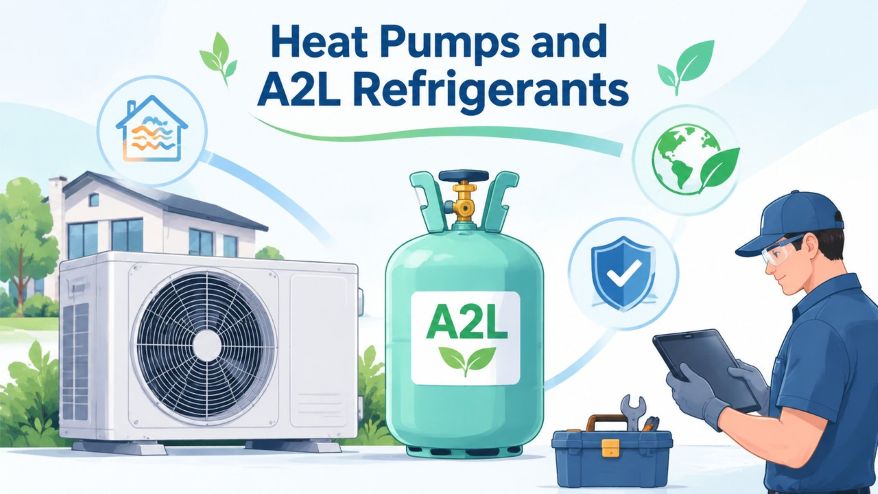
As homes and commercial buildings move toward lower-emission heating and cooling, HVAC equipment is changing quickly. Heat pumps are taking on a larger role in space heating, while new refrigerants are reshaping how systems are designed, installed and serviced. For every HVAC technician, this shift brings more than new equipment to learn: it calls for new technician skills in refrigerant safety, electrical diagnostics, system commissioning and digital recordkeeping. Heat Pumps and A2L Refrigerants are at the center of this transition. Variable-speed compressors and electronic controls make modern heat pumps more adaptable, but also require technicians to interpret sensor data and troubleshoot complex systems. Meanwhile, A2L refrigerants introduce handling and safety procedures that differ from those used with older refrigerants. Together, these developments are expanding the role of HVAC engineering in everyday fieldwork.
This article looks at what these changes mean on the technical side and which skills HVAC technicians and training programs need to add.
Hydrofluorocarbons such as R-410A have a high global warming potential. Under the HFC phasedown in the United States and similar rules in Europe and elsewhere, manufacturers have moved new residential and light commercial equipment to alternatives. In the US residential split-system market, the main replacements are R-454B and R-32.
Both belong to safety class A2L under ASHRAE Standard 34: low toxicity and lower flammability. An A2L refrigerant can ignite under specific conditions, but it burns slowly and needs a higher concentration and more energy to ignite than a fully flammable refrigerant like propane (class A3).
For an HVAC technician, “mildly flammable” still changes the job:
Leak detection. Equipment using A2L refrigerants often includes refrigerant detection sensors and mitigation controls that run the indoor fan to dilute a leak. Technicians need to test and troubleshoot these sensors.
Tools. Recovery machines, vacuum pumps and leak detectors must be rated for A2L use. Older tools may contain ignition sources.
Work practice. Ventilation of the work area, control of ignition sources during brazing and correct charge limits all become part of the routine.
Cylinders and fittings. A2L refrigerant cylinders use left-hand threads in many markets to prevent mix-ups with non-flammable refrigerants.
Training programs and manufacturers now offer A2L-specific certification modules, and many distributors may also require proof of training before selling the refrigerant.
Heat pumps move from niche to mainstream
Cold-climate heat pumps have improved to the point where they can heat homes in regions that once depended on gas or oil. Variable-speed inverter compressors, enhanced vapor injection and better defrost control keep efficiency reasonable at low outdoor temperatures.
Inverter technology brings new diagnostic challenges. A fixed-speed compressor is either on or off. An inverter-driven compressor modulates continuously, controlled by a board that reads multiple sensors. When something goes wrong, a technician often needs to:
Read fault codes from the outdoor unit’s control board or a manufacturer app.
Understand communication protocols between indoor and outdoor units on proprietary systems.
Test inverter boards and electronic expansion valves, components that barely existed in older residential equipment.
Superheat and subcooling still matter, but on a modulating system the technician has to know at which operating point to measure.
Heat Pumps and A2L Refrigerants: Data becomes part of the repair
Modern equipment generates far more data than its predecessors. Many heat pumps and communicating systems log runtime, fault history and sensor readings. Some can share this data through manufacturer cloud platforms.
For a service company, this data is only useful if it gets connected to the job. A technician who knows that the last visit recorded a certain suction pressure and a specific fault code can diagnose a recurring issue far faster. For this reason, more HVAC companies record measurements and photos inside their job management system rather than on paper tickets. Tools such as Planado’s HVAC scheduling app let technicians attach readings, photos of nameplates and checklist results to each visit, so the equipment history follows the unit rather than the technician’s memory.
Heat Pump and A2L Refrigerants Installation Quality Matters
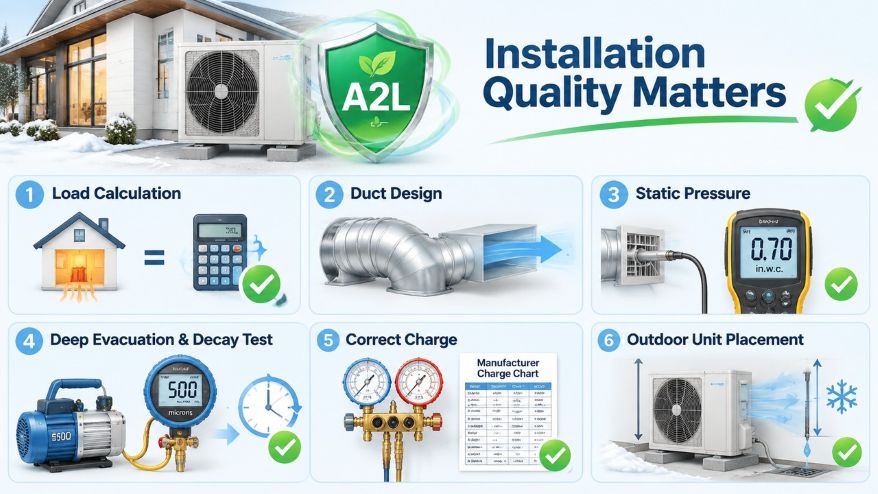
Heat pump performance depends heavily on correct installation. An oversized unit short-cycles and wastes energy. Poorly sized ducts raise static pressure and restrict airflow. Kinked refrigerant lines or poor evacuation can damage compressors.
Firstly, installers should calculate heating and cooling loads (using Manual J in the US). This approach avoids guesswork and supports accurate equipment sizing. Next, they should design the ductwork and measure static pressure during commissioning. They should also evacuate the system deeply, verify the vacuum with a micron gauge, and perform a decay test.
Finally, installers must charge the system correctly. They can weigh in the refrigerant or follow manufacturer charts. They should also place the outdoor unit where airflow remains clear. In cold climates, they must allow space for snow clearance and defrost drainage.
Heat Pump and A2L Training Programs Should Consider Adding
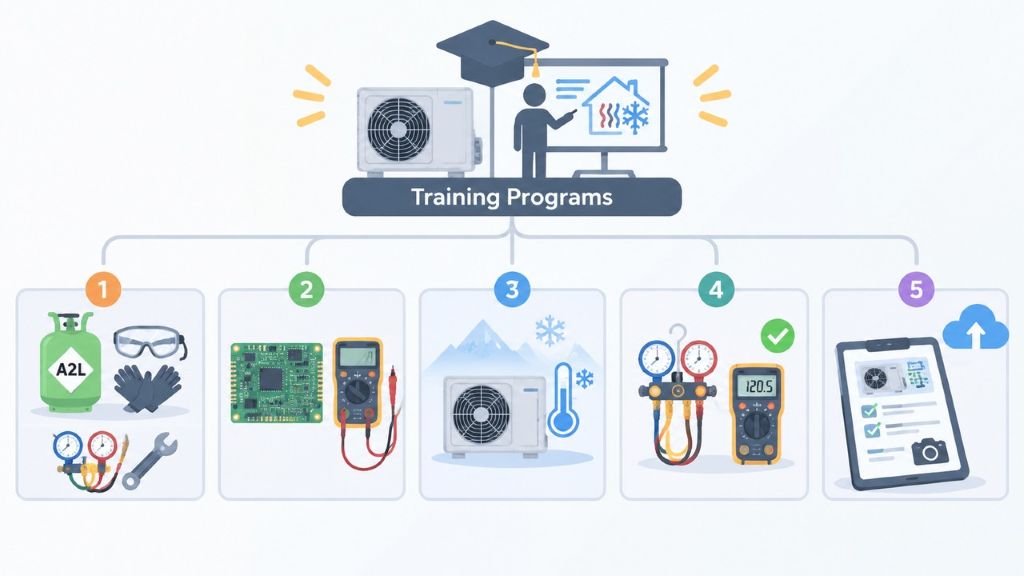
Vocational schools and employers should update HVAC training for modern systems. First, they should teach A2L safety and refrigerant handling. Students need hands-on practice with tools rated for A2L refrigerants. Next, programs should cover inverter and variable-speed diagnostics, including control-board testing.
Fig. 2: Heat Pump and A2L Training Programs Addition (illustration – AI Generated)
They should also teach heat pump selection and cold-climate sizing. Then, students should practice commissioning systems using measured data, not visual checks alone. Finally, programs should build digital documentation habits. Technicians should record readings, equipment photos and fault codes for every job.
New Skills for a Changing HVAC Industry
Heat pump technician skills now extend well beyond replacing parts. Technicians must understand refrigerant handling, electrical systems and digital records. As heat pumps become more common, these skills matter even more. A2L refrigerants also require careful handling and appropriate safety procedures. Technicians need to detect leaks and use tools rated for A2L refrigerants. They must also diagnose inverter controls and variable-speed components. In addition, accurate commissioning helps systems deliver reliable performance. Good installation practices support airflow, correct refrigerant charge and efficient operation.
Training programs can help technicians prepare for these demands. They should teach heat pump installation, cold-climate sizing and HVAC diagnostics. They should also include practical exercises with measurements and service records. As a result, technicians can make informed decisions and explain their findings clearly. The trade will continue to evolve as buildings electrify. With focused training, HVAC technicians can adapt to modern systems. Strong heat pump technician skills can support quality service throughout the refrigerant transition.
FAQs:
What are A2L refrigerants?
A2L refrigerants are low-toxicity, mildly flammable refrigerants used in many newer systems. Technicians must follow equipment instructions and A2L safety procedures when handling them.
How are Heat Pumps and A2L Refrigerants changing HVAC work?
Heat Pumps and A2L Refrigerants are bringing new safety and diagnostic requirements to the trade. Technicians need skills in refrigerant handling, inverter systems and electronic controls.
What tools do technicians need for A2L refrigerants?
Technicians need leak detectors and recovery equipment rated for the refrigerant they service. They should also check manufacturer guidance before using tools or equipment.
What skills do heat pump technicians need?
They need to understand system sizing, airflow, commissioning and variable-speed controls. They should also know how to interpret fault codes and sensor readings.
Why is commissioning important for heat pumps?
Commissioning confirms that the system operates as designed. Technicians should check airflow, refrigerant charge and system measurements, then record their findings.
References:
Background on HFCs and the AIM Act | US EPA. (2026, November 2). US EPA. https://www.epa.gov/hfcs/background-hfcs-and-aim-act
Substitutes in residential and light commercial air conditioning and heat pumps | US EPA. (2026, March 19). US EPA. https://www.epa.gov/snap/substitutes-residential-and-light-commercial-air-conditioning-and-heat-pumps
Technology Transitions HFC Restrictions by sector | US EPA. (2026, August 28). US EPA. https://www.epa.gov/hfcs/technology-transitions-hfc-restrictions-sector
Hrutanshu Kurankar is a Computer Engineering graduate from Marathwada Mitra Mandal’s College of Engineering, Pune. His interests span artificial intelligence, machine learning, cybersecurity, data science, and science communication. He enjoys exploring how emerging technologies work and translating complex technical concepts into clear, accessible explanations for students and young audiences.
His practical experience includes developing FlashCTI, a Retrieval-Augmented Generation (RAG) system for cyber threat intelligence and log analysis, exploring privacy-focused browser extensions, and building machine learning applications. His technical background includes Python, data analysis, machine learning frameworks, web development, vector databases, and cybersecurity tools. Through these projects, he has developed an interest in applying technology to real-world problems and making technical knowledge easier to understand.
Hrutanshu is associated with ENTECH STEM Magazine, where he contributes to science communication and editorial initiatives, including research outreach and activities supporting the Machine Learning Special Issue 2026. His work involves connecting with potential contributors and academic reviewers to encourage participation in STEM research and knowledge sharing. As a science communicator, he aims to bridge the gap between complex scientific ideas and everyday understanding through relatable examples, clear writing, and evidence-based explanations. He is particularly interested in making science and technology engaging and accessible to the next generation of learners.