Star-shaped DNA molecules can link into soft gels, but choosing the right sequence is hard. A learning algorithm and some graph math now connect sequence to stiffness on the computer.
Most of us meet DNA in biology class as the molecule of heredity. Yet DNA is also a building material that scientists can program. For example, short strands can assemble into soft, jelly-like gels with adjustable stiffness. The hard part, however, is choosing the right sequence for the job. DNA materials Bayesian optimization offers a smart way to do that. In short, it uses a learning algorithm to connect DNA sequences with material behavior. A 2026 study in npj Computational Materials shows the idea working in computer models. This explainer walks you through the building blocks, the method and the open questions. Along the way, you will also find ideas for classrooms and careers.
DNA stores genetic information through highly specific base pairing. Because of this, the same pairing lets researchers design strands that stick as planned. One popular building block is the DNA nanostar. In other words, think of a tiny star with several double-stranded arms. Moreover, each arm ends in a short single strand called a sticky end. When sticky ends on different stars pair up, the stars link into a network. As a result, the liquid turns into a water-rich gel, known as a hydrogel. According to a study in PNAS, these networks form as the solution cools. Because the links open again on heating, the gels are called thermoreversible. ENTECH has also explored building 3D shapes from DNA strands.
Why Arm Number and Stickiness Matter
Small design choices change how such a gel feels. For example, the PNAS team tested stars with three, four, five and six arms. At equal arm density, six-arm gels were roughly ten times stiffer than three-arm gels. So the number of arms, called valence, strongly shapes the material. The sticky-end sequence matters as well, since it sets how firmly stars hold together. Scientists describe the outcome with two numbers. One is the storage modulus, which captures spring-like, elastic behavior. The other is the loss modulus, which captures liquid-like, viscous behavior. Together, these values reveal whether a gel bounces back or slowly flows. Meanwhile, uses under study include biosensing, biomedicine and information processing. Biomaterials in general can also carry medicines, as a National Institutes of Health overview explains.
Fig. 1: A Four-Armed Star, a Bound Pair and the Network That Forms a Gel
Why Designing DNA Gels Is So Hard
If the rules are known, why not simply calculate the best sequence? The trouble lies in the range of scales involved. Indeed, a single base change acts at the smallest scale. Stiffness, however, emerges from many molecules moving together. Detailed simulations that follow every nucleotide are accurate but limited in size and time. Therefore, they cannot cover a whole network on their own. Simpler coarse-grained models instead group several nucleotides into single beads. These run fast, yet they give up the sequence detail that designers care about. On top of that, the space of possible sequences is vast. Certainly, testing each candidate in the laboratory would take far too long. Consequently, researchers need a method that learns quickly from only a few trials.
Explainer: How Bayesian Optimization Learns From Few Trials
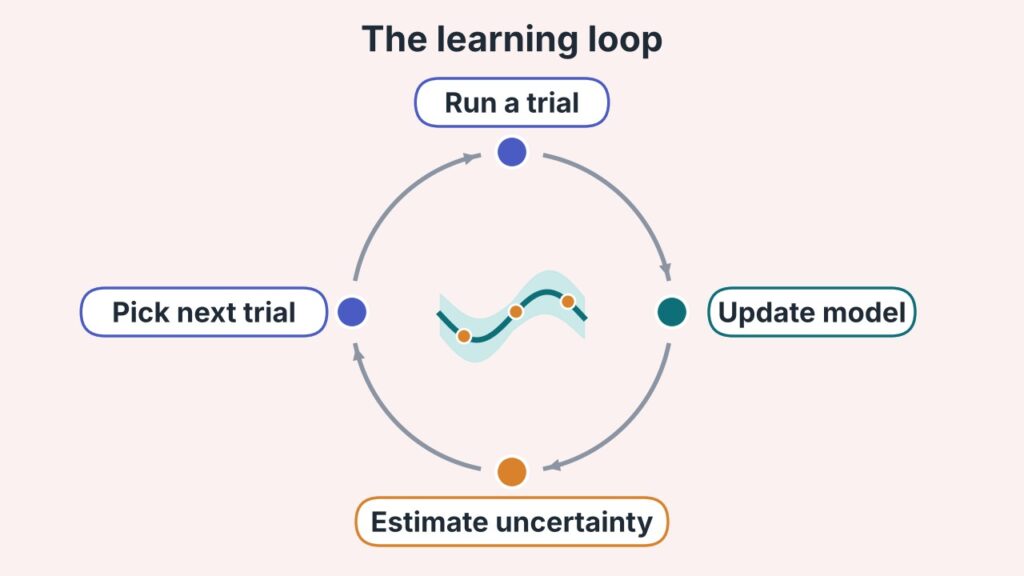
Bayesian optimization is a search strategy built especially for expensive problems. An open review in Digital Discovery describes its two key ingredients. First, a surrogate model estimates the unknown answer and its uncertainty. Second, an acquisition function uses that estimate to pick the next trial. Specifically, it balances promising regions against poorly explored ones. After each trial, the model updates and the cycle then repeats. Because every step uses all earlier results, few trials are wasted. In one solar-cell example there, the method found the best recipe in under 20 rounds. A full grid search, by comparison, would have needed 400 points. Materials laboratories are also adopting similar ideas for real experiments. For instance, SLAC National Accelerator Laboratory counts over 10 billion possible four-element materials.
Fig. 2: The Repeating Cycle of a Bayesian Search (After Wu et al., 2024)
How DNA Materials Bayesian Optimization Works Step by Step
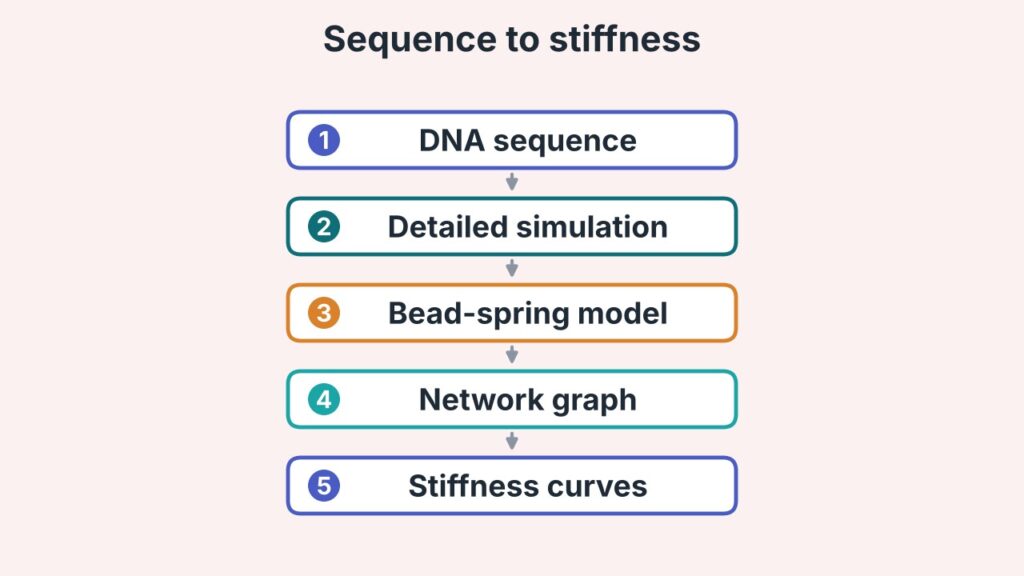
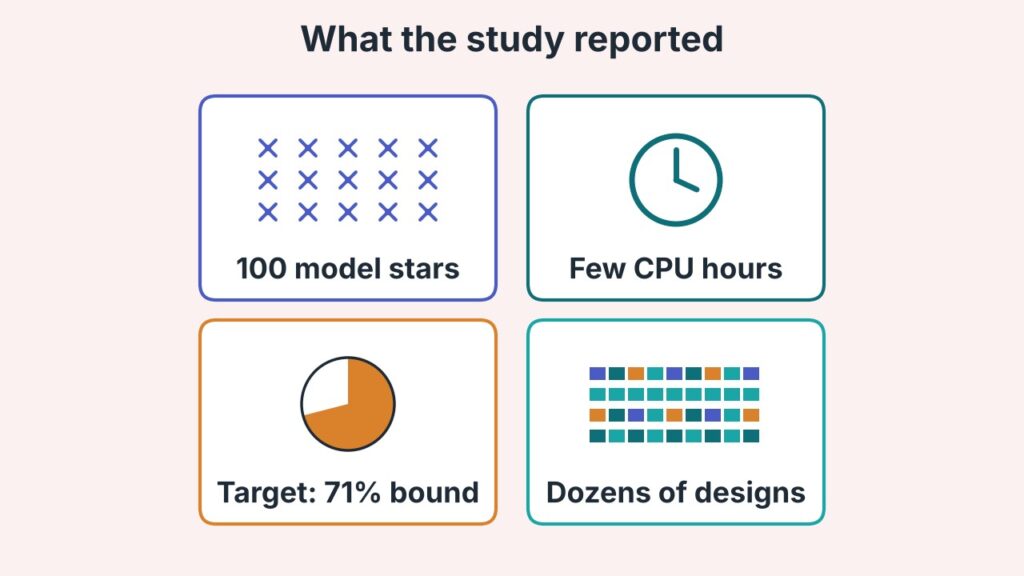
The new workflow comes from Aaron Gadzekpo and Lennart Hilbert at Karlsruhe Institute of Technology. Their paper in npj Computational Materials chains several tools together. To begin, a nucleotide-level program called oxDNA simulates one four-armed nanostar in detail. From it, the team measured six angles that describe the star’s shape and flexibility. Next, Bayesian optimization tuned a simpler bead-spring model to match those angles. Altogether, eight settings of that model were adjusted in this way. The tuned model then runs in ReaDDy, an open-source particle simulator described in PLOS Computational Biology. Meanwhile, oxDNA and a second tool, NUPACK, estimated how strongly sticky ends bind. With both pieces ready, 100 model stars were left to form a network. Overall, each such run needed only a few CPU hours.
How Graph Math Turns a Network Into Stiffness
How do you get stiffness from a tangle of stars? Here, the authors turned to a branch of mathematics called graph theory. Specifically, every nanostar became a node and every bound sticky-end pair an edge. A standard matrix built from this graph then yields a spectrum of relaxation times. Each relaxation time tells how quickly one mode of the network settles. From the full spectrum, the storage and loss moduli follow across all frequencies. In addition, the authors accounted for the drag of the surrounding fluid. That step narrowed the spectrum and improved predictions at low frequencies. Importantly, the method needs only the resting structure of the network. Long simulations of shaking or stirring are therefore unnecessary. The conventional Maxwell model, by contrast, uses a single relaxation time.
Fig. 3: The Workflow’s Five Stages, From Sequence to Predicted Stiffness Curves
What the Study Found
The authors checked their predictions against published measurements on real nanostar gels. Specifically, those measurements came from the PNAS experiments mentioned earlier. For four-armed stars, predicted curves aligned closely with the measured ones. Moreover, the graph method beat the single-time Maxwell model across a broad frequency range. For five- and six-armed designs, simple theoretical graphs also matched well. Three-armed stars, however, showed clear deviations from the data. The simulations also revealed what weaker binding does. When almost all sticky ends were bound, the gel followed the simple model closely. With about 61% bound, by contrast, a new in-between regime appeared. There, elastic and viscous responses ran close together. Experiments near the melting temperature have also shown similar behavior.
Working Backward: From Target Stiffness to DNA Sequence
The most appealing part is running the workflow in reverse. Suppose you want a gel with a particular response curve. Instead of guessing sequences, you let the algorithm work backward. In a test case, a model trained on four simulations predicted the needed bound fraction. Its answer, about 71%, matched the hidden target within the error margin. Bayesian optimization then searched with NUPACK for sticky ends that deliver this fraction. Within minutes, it proposed dozens of sequences with matching salt and temperature conditions. Still, the authors call this only a proof of concept for inverse design. Because the parts are modular, other simulation tools could be plugged in. In their words, the workflow suits “any simulation framework with Python-accessible input and output”. Similar thinking guides how AI searches for battery catalysts.
Fig. 4: Four Numbers From the Study (Gadzekpo and Hilbert, 2026)
Limits of the Study
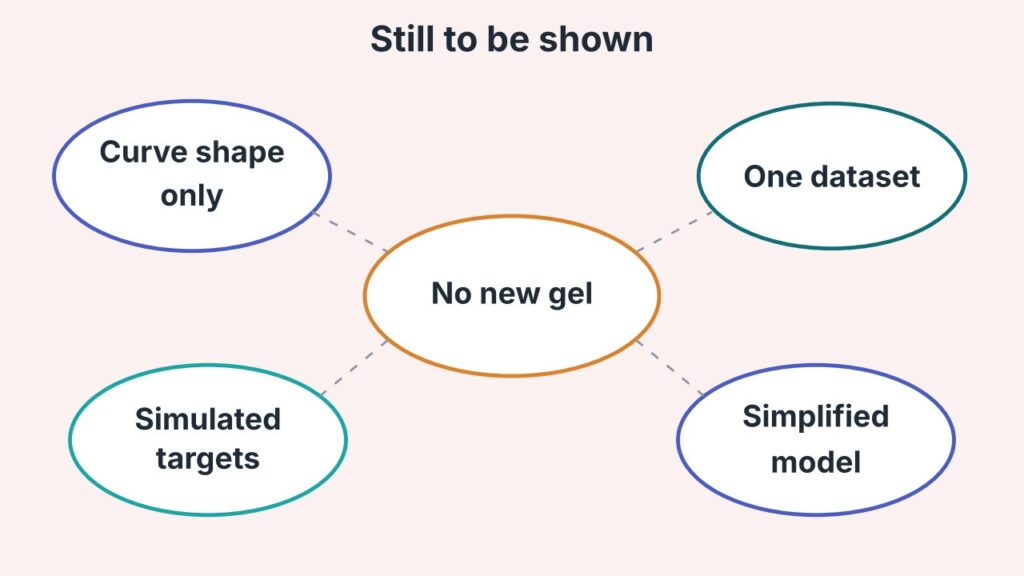
Friendly as the idea sounds, it comes with honest limits. First, the method predicts the shape of the stiffness curves, not their absolute values. To compare with experiments, the curves were rescaled to one measured point. Second, the main comparison rests on a single experimental dataset. Indeed, the authors themselves call for validation on independent systems. Third, the inverse design was tested on simulated targets only. Accordingly, no new gel was made and measured in this work. In addition, the simplified model does not resolve some shape changes seen in detailed simulations. NUPACK also leaves out how the arms constrain each sticky end. At higher temperatures, experiments often lack a plateau that the model assumes. So DNA materials Bayesian optimization still needs laboratory confirmation.
Fig. 5: Five Limits of the Study Discussed in This Article
What It Could Mean for Biotechnology, Education and Careers
Why should anyone outside a physics laboratory care? Programmable gels could one day serve as sensors or carriers for medicines. Reaching that point requires faster design cycles, and simulation can help. Hilbert’s group has also made the same case for other DNA structures. In a university press release, the team described simulating designs before testing the best ones. “This speeds up the research process enormously,” Hilbert said there. For companies, the lesson is about screening on computers before buying reagents. However, the present study reports no product, cost figure or timeline. Any commercial forecast would therefore be guesswork. Still, ReaDDy is open source, which lowers the barrier for small teams. Soft machines are another possible outlet, as in a gel arm that bends in sunlight.
Lessons for Students and Teachers
For students, this topic ties several school subjects together. Base pairing comes from biology, while springs and viscosity come from physics. Graphs, meanwhile, belong to mathematics and computer science. Indeed, a simple classroom model makes the idea concrete. For example, use paper stars with four arms and paper clips as sticky ends. Then count how many links hold the network together. As a result, students will see that more arms create a better-connected network. Teachers can also discuss why scientists simplify models on purpose. A bead-spring star is less exact than a full simulation, yet far quicker to run. Finally, the study also shows good scientific manners in its reporting. Specifically, its authors state plainly what remains unproven.
Careers and Startup Ideas Around Programmable Materials
Work of this kind needs people with mixed skills. Bioengineers combine biology, chemistry and computing to design useful systems. Computational scientists, in turn, write the simulations and tune the models. Laboratory researchers then make the gels and measure them. If this blend appeals to you, start with Python, statistics and molecular biology. A little graph theory will help as well. Entrepreneurs may also spot a few opportunities here. One idea is design software that suggests sticky-end sequences for a requested gel response. Another is a testing service that measures candidate gels for research groups. Both ideas are untested, so please treat them as possibilities only. For now, DNA materials Bayesian optimization is a research method with clear promise. It lets curiosity, code and chemistry work on the same problem.
References
Gadzekpo, A., & Hilbert, L. (2026). Bayesian optimisation and graph-based rheology enable sequence-dependent modelling of DNA materials. npj Computational Materials, 12, 406. https://doi.org/10.1038/s41524-026-02378-2
Conrad, N., Kennedy, T., Fygenson, D. K., & Saleh, O. A. (2019). Increasing valence pushes DNA nanostar networks to the isostatic point. Proceedings of the National Academy of Sciences, 116(15), 7238-7243. https://pmc.ncbi.nlm.nih.gov/articles/PMC6462066/
Wu, Y., Walsh, A., & Ganose, A. M. (2024). Race to the bottom: Bayesian optimisation for chemical problems. Digital Discovery, 3(6), 1086-1100. https://doi.org/10.1039/D3DD00234A
Hoffmann, M., Fröhner, C., & Noé, F. (2019). ReaDDy 2: Fast and flexible software framework for interacting-particle reaction dynamics. PLOS Computational Biology, 15(2), e1006830. https://doi.org/10.1371/journal.pcbi.1006830
This explainer makes a demanding multiscale study approachable, and the step from star-shaped molecules to a network graph gives readers a clear thread to follow. The limits section is frank that the method predicts curve shapes only and that no new gel was made, and a later update could report laboratory tests of the predicted sequences when they are published. A one-line everyday comparison for the storage and loss moduli would help younger readers. Readers are encouraged to consult the original research paper for the full technical detail.
Editorial note
This article is an ENTECH explainer on how a learning algorithm, molecular simulations and graph mathematics can connect DNA sequences to the stiffness of DNA-based gels, written for students, teachers and early-career readers. It draws on a peer-reviewed research paper and on six supplementary sources from journals, a national laboratory, a university and a government institute, and the in-article diagrams are original graphics prepared for ENTECH. Readers who want full details should refer to the original source paper listed in the references.
Ishika Tawar is a biotechnology researcher and science enthusiast with a curiosity for understanding how life works at the molecular and cellular level. That curiosity started somewhere around school, wandered through a lot of unrelated corners of science and physics, and eventually settled on something she actually wants to spend her life on: aging and longevity. She supports transhumanism and believes that science and technology should be explored seriously as tools to overcome some of the biological limitations of the human body.
Ishika holds a Master's degree in Biotechnology and has experience in both wet-lab and computational research. At ACTREC, she worked on a project studying the interaction of the TG2 protein with the ribosome, where she gained experience in cloning, site-directed mutagenesis, transformation, and gene knockdown. She was also involved in studying ribosomal heterogeneity using R and publicly available single-cell RNA sequencing datasets from different cancers. As a Research Assistant at SafeWright, she worked on client-based projects involving microbial culturing, biochemical tests, and analysis, along with literature research, report writing, and preparation of laboratory protocols. She has also worked with Python-based analysis to study differential DNA methylation in breast cancer.
Her current areas of interest include epigenetics, genomics, gene therapy, stem cell biology, computational biology, and the use of AI in biological research. She is particularly interested in how these areas can contribute to understanding aging and developing ways to extend healthy human lifespan. She has explored this interest through research projects and hackathons focused on AI, aging, and longevity. She enjoys following ideas across biology, technology and physics, and she believes in evidence, questioning ideas and staying curious about things that are not yet understood.
Outside research, Ishika enjoys reading and talking about science and scientific ideas. She loves travelling and is especially fond of mountains. She also enjoys science communication and hopes to make scientific topics easier to understand without making them inaccurate or oversimplified.