A classroom plant tilts toward a sunny window, and every student knows why. Light drives that slow, elegant turn. Engineers have long wanted machines that move the same way, without motors, wires, or batteries. A…
A classroom plant tilts toward a sunny window, and every student knows why. Light drives that slow, elegant turn. Engineers have long wanted machines that move the same way, without motors, wires, or batteries. A new study now shows how to borrow that trick from nature itself. Researchers grew a film of living microalgae on a soft gel strip. When light hit the strip, the algae changed the gel’s local chemistry and made the whole arm bend. Darkness reversed the motion. The result is a light powered soft robot arm that runs on photosynthesis alone. It needs no plug, no switch, and no genetic editing. That single idea could quiet the hum of small robots forever.
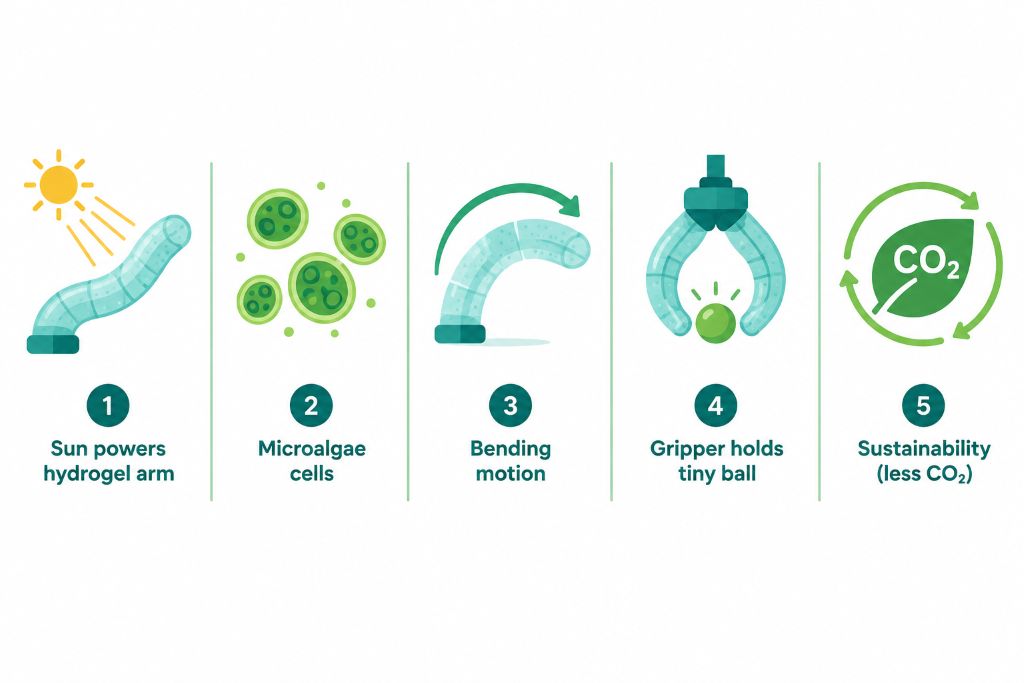
Five takeaways span sun, algae, motion, gripping, and carbon capture
How a Light Powered Soft Robot Arm Turns Sunlight Into Motion
Soft robots bend and flex like living tissue, unlike their rigid metal cousins. This gentle movement suits delicate tasks such as handling fragile objects and gripping soft surfaces. Still, most soft machines depend on external power, pumps, or electrical control systems. A light powered soft robot arm would free those machines from heavy hardware. The team behind this work chose a much simpler energy source. They used the everyday chemistry inside a single-celled green alga.
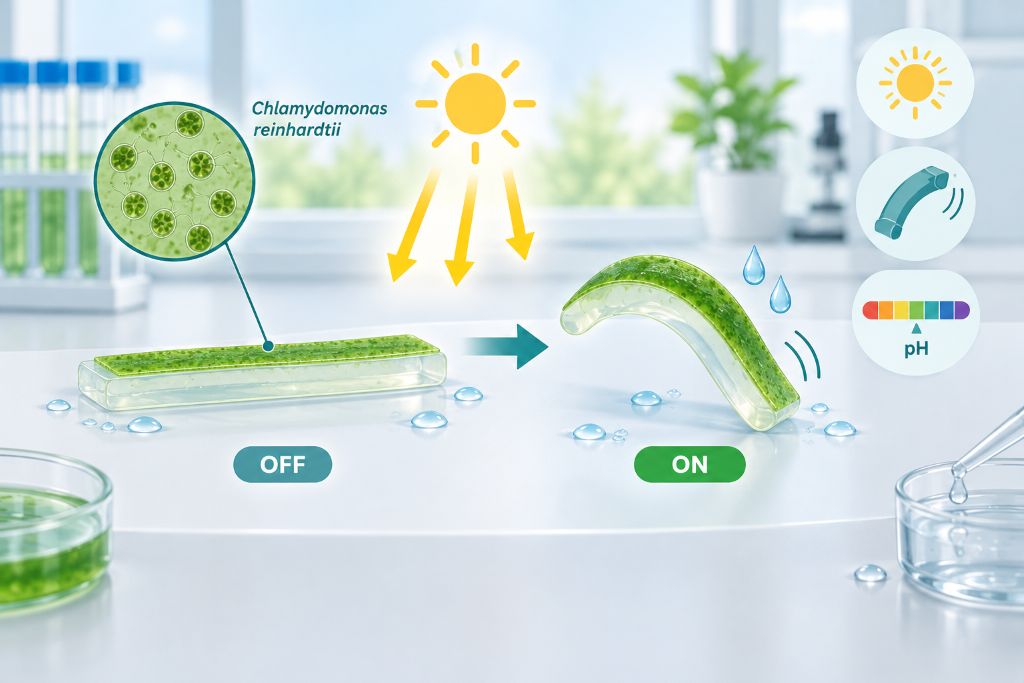
The alga, Chlamydomonas reinhardtii, is a freshwater species scientists know well. The researchers grew it as a thin biofilm on one face of a two-layer hydrogel. One layer responds to pH changes, while the other stays inert. Under bright light, photosynthesis and nitrogen uptake make the nearby gel more alkaline. That shift ionizes the polymer and swells the active layer. The swelling bends the strip toward the passive side. In darkness, respiration pumps out carbon dioxide instead. This acidifies the gel, shrinks the active layer, and straightens the arm back out.
Light Powers the Bend, and Darkness Reverses It
The bending action follows a clean, repeatable cycle. Illumination spikes the local pH from about 8 to around 11 within hours. A rapid rise from 8.1 to 10.8 appeared in just 2.7 hours of light. The change then plateaued near 11.0. Turning the light off dropped the pH steadily back to 8.1 over 18 hours. The arm traced this rhythm in step, bending one way in light and returning in the dark. Peak motion swapped direction over and over without wearing the gel out.
Small, Fast, and Built to Last
The device moves slowly overall, but its first reaction is quick. A measurable bend begins within 20 seconds of light and within 10 seconds of darkness. Full amplitude arrives over hours, not minutes. Even so, the arm held roughly 300 degrees of bend across ten back-to-back light and dark cycles. Longer tests proved its stamina. The algae kept photosynthesizing normally after 60 days of use. Plant health markers, measured as chlorophyll fluorescence, stayed in the healthy range throughout.
This resilience matters for real-world use. Soft robots built from living cells often fail because the cells die or leak out. Here the cell counts in the surrounding liquid stayed low and stable. The design kept its algae fixed in place on the gel. For context on how living cells power modern machines, entechonline has covered magnetic soft robots that also rely on gentle, flexible materials to do delicate work.
Why Researchers Built It, and What Slowed Them Down
Every engineering project begins with a frustration. Living actuators have long struggled with poor stability, strict cell-care needs, and limited reversibility. Teams have tried heart muscle cells, yeast, and bacteria to drive motion. Each came with its own heavy upkeep. The researchers wanted a design that carried no genetic modification and no wired power. Photosynthetic algae offered a clean answer. They make their own energy from light and absorb carbon dioxide from the air. A soft actuator running on sunlight could cut the carbon cost of small robots dramatically.
Motivation: A Softer, Greener Machine
The team aimed for a machine with no plug and no battery. Conventional electromechical robots draw power from a grid or an onboard cell. A photosynthetic arm sidesteps both. Sunlight becomes the fuel, and atmospheric carbon dioxide becomes a byproduct the system pulls in, not out. The authors argue this could shrink the carbon footprint of soft robotics. That goal alone justifies the effort for many green-technology advocates.
The Obstacles They Had to Clear
Several hard problems stood in the way. First, the gel had to swell and shrink inside the right pH window. The algae naturally swing pH between roughly 8 and 11. An off-the-shelf gel barely budged in that range. So the team built a new copolymer tuned precisely to that band. Second, the algae had to stick to the gel and stay alive there. They grew a biofilm by soaking the strip in algae culture for seven days. Third, the motion had to survive many cycles without the cells dying. Careful medium design and mild light kept the microbes healthy for weeks.
I have seen this same tension in the classroom. Students expect a living sample to stay vigorous for a single period, yet a petri dish of algae fades by the end of the week on the windowsill. Keeping cells happy across sixty days is no small feat. That lived frustration makes the team’s stability claim feel hard-won rather than routine.
The Science Behind the Light Powered Soft Robot Arm
Three ideas come together in this device. Each sounds complex on paper but is simple in practice. Grasping them unlocks the whole paper for a curious reader.
What Is Photosynthesis Doing Here?
Plants and algae convert light, water, and carbon dioxide into sugars and oxygen. That process also shifts the acid and base balance around the cell. In light, the algae pull in bicarbonate and release products that make their surroundings more alkaline. In the dark, they breathe instead, releasing carbon dioxide that makes the water more acidic. This natural pH swing is the engine of the whole arm. The algae do not push anything mechanically. They only change the chemistry, and the chemistry does the moving.
What Makes a Hydrogel Bend?
A hydrogel is a water-swollen network of polymer chains, a bit like firm jelly. Some gels expand or shrink when pH changes. The active layer here carries boronic acid groups. In alkaline conditions, those groups ionize and repel each other, so the gel swells and pushes outward. The second, passive layer ignores pH entirely. When two layers behave differently, the strip curls. It curls toward the layer that shrank. That imbalance is the source of the bend.
The Algae Are the Switch
Control comes from a clever division of labor. The algae act as a living sensor and power source rolled into one. They read the light and adjust the local pH on command. The gel translates that chemical signal into mechanical motion. Nothing else is needed. No circuit, no motor, no pump. Light serves as the only command the machine ever receives. That elegance is what makes the work stand out from older actuators.
The researchers proved this control with a blocking test. They measured the arm pressing on a force sensor and recorded a push of 0.8 millinewtons. Gentle as that sounds, it is enough to lift small, fragile objects without crushing them. A four-finger gripper folded shut under light, lifted an 18.4-milligram ball, and released it in darkness. A second gripper picked up a 52.5-milligram rubber band the same way. A flower-shaped actuator even bloomed under light and closed again in the dark. For more on how sunlight powers chemical systems, see entechonline’s coverage of a semi-artificial leaf that performs solar chemical synthesis.
What This Means for Soft, Sustainable Machines
This work points toward robots that feed themselves on light. A light powered soft robot arm needs no battery swap and no charging dock. It could suit underwater tasks where changing water chemistry would be harmful. The authors note the arm barely alters the pH of the surrounding medium, a clear advantage for gentle aquatic use. Future uses might include lab-on-a-chip fluid control, agricultural automation, or even artistic displays. The algae also tolerate shifts in temperature, salt, and light, which widens the places such devices could go.
Challenges remain before this leaves the lab. The arm is slow by robotic standards, and scaling motion to useful strength will take more work. The authors stay measured about these limits. Still, the core claim is a real step: living photosynthesizers can drive repeatable, reversible motion in a soft gel for months. That is a foundation worth building on.
Conclusion
A strip of algae-covered gel now bends under light and relaxes in the dark, entirely on its own energy. This light powered soft robot arm turns a photosynthesis trick into controlled motion. It reaches a large angle within hours, answers light within seconds, and lasts through months of cycling. Its creators built it to remove power cords and batteries from soft machines. The chemistry is subtle, yet the takeaway is simple. Sunlight, a humble alga, and a clever gel can together do the work of a motor. That quiet idea may one day power the gentler robots of the future.
References
Jiang, F., Kleiner, F. H., Kieffer, R., de Jong, D., Oh, J.-J., & Aubin-Tam, M.-E. (2026). Light-powered photosynthetic living actuator. Nature Communications, 17, 10827. https://doi.org/10.1038/s41467-026-78653-z
This news-analysis piece translates Jiang et al. (2026, Nature Communications) into accessible language for students, educators, and science-curious readers. All technical claims — the Chlamydomonas reinhardtii biofilm, the pH 8–11 swing, the 18-hour bend time, the 10–20 second response, the 0.8 mN force, and the 18.4 mg and 52.5 mg gripper lifts — trace directly to the primary paper.
Charudatta Pathak was a student at St. Aloysius High School in Bhusawal, established in 1874, making it one of India's oldest convent institutions. He earned his bachelor's degree in mechanical engineering from SSVPS College of Engineering, Dhule in 1995, demonstrating exceptional academic achievement. Thereafter, he launched his career as a CNC programmer in a toolroom. He has utilized FANUC, Deckel, Maho, and Mikron controllers to operate 2-axis and 3-axis machines for the fabrication of jigs, fixtures, dies, and molds. He commenced his career as an academic in 1996, when he assumed the role of lecturer at SSVPS College of Engineering, Dhule. Additionally, he earned his post-graduate degree in CAD/CAM from L. D. College of Engineering, Ahmedabad, in 2000, and then acquired a Ph.D. from COEP in 2011 while concurrently engaged in teaching. Until 2023, he occupied many academic roles, including lecturer, assistant professor, professor, dean, principal, director, and vice chancellor at both public and private universities throughout India. From 2008 to 2010, he served as the project lead in the CAE department of a European multinational firm. During his 28-year professional tenure, he identified a need for dependable books targeted at students in grades 8 to 12, particularly for nascent career planning. He founded ENTECH Digital Magazine, a free monthly publication available on entechonline.com and magzter.com. Teens with a strong interest in Science, Technology, Engineering, and Mathematics (STEM) who aspire to pursue careers in these fields may find ENTECH Digital Magazine beneficial.