A supersolid is ordered like a crystal yet flows like a superfluid, and a liquid-crystal cavity filled with light now shows the signs of one without any extreme cooling.
Ice is solid, water flows, and nobody expects one thing to do both. Physics, however, allows a strange exception called a supersolid. It keeps a regular pattern like a crystal, yet it flows without friction. Until recently, such states appeared only in gases chilled almost to absolute zero. A room-temperature supersolid removes that extreme cold from the recipe. In short, it is a supersolid that forms on an ordinary laboratory bench. For example, one recent experiment built such a state from light trapped between mirrors. This explainer covers what a supersolid is, how the experiment worked and what remains uncertain.
A supersolid combines two properties that normally exclude each other. The first is crystalline order, meaning a pattern that repeats regularly in space. Its partner is superfluidity, the ability to flow without friction. Physicists first proposed the idea for helium, but it proved hard to observe there. Success came later with a different system, the Bose-Einstein condensate (BEC). In a BEC, many particles share one quantum state and behave as a single wave. ENTECH describes that state in the astonishing behavior of Bose-Einstein condensates. Researchers then found ways to imprint a repeating pattern on such condensates. As a result, several kinds of atomic supersolid have been made in laboratories. All of them, though, were made in ultracold gases below a millionth of a kelvin.
Fig. 1: Four Ingredients of the State Reported in the Experiment
Why Extreme Cold Has Been the Barrier
That cold requirement is not a minor detail. In fact, reaching such temperatures takes vacuum chambers, lasers and careful isolation. Consequently, supersolids have so far stayed inside a few specialized laboratories. Atoms need the cold because heavy particles condense only when they move very slowly. So physicists asked whether a much lighter particle could do the same job. Light itself offers one answer, although not on its own. Inside certain structures, photons can mix with matter and form hybrid particles. These hybrids are extremely light, so they can condense at far higher temperatures. Earlier work had already shown such condensates in an organic polymer at room temperature. Therefore, the open question was whether they could also become supersolid. Readers new to these ideas may like a tour of the core states of matter.
Explainer: Exciton-Polaritons, Particles That Are Part Light
The hybrid particles in question are called exciton-polaritons. To make them, light is trapped between two mirrors facing each other. This trap is known as an optical microcavity. A material placed inside then absorbs and re-emits the light again and again. In such a material, the excited states are called excitons. When the exchange is fast enough, light and exciton stop being separate things. Instead, they form a new particle with properties of both. Physicists call this condition strong coupling between light and matter. Because polaritons are part light, they are extremely light and move easily. Since they are also part matter, they can push on one another. Together, those traits let a crowd of polaritons act as a quantum fluid of light.
How a Room-Temperature Supersolid Is Built
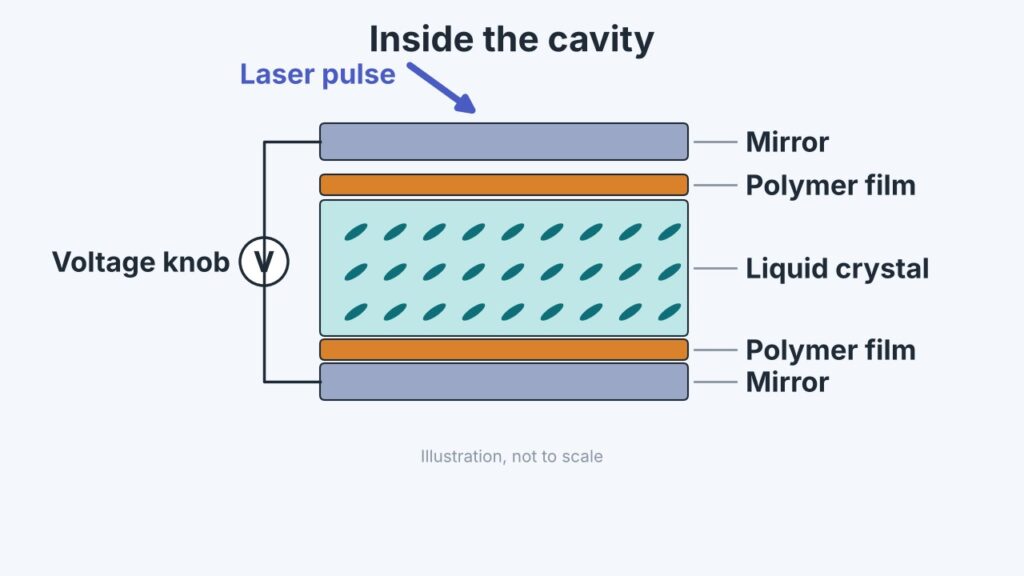
The experiment was led from the University of Warsaw and a CNRS laboratory in France. IBM Research in Zurich and three other institutions also took part. Their paper in Science Advances describes a layered microcavity. Two mirrors form the outside of the sandwich. Inside them sit two films of an organic polymer, each only 35 nanometers thick. This polymer, called MeLPPP for short, supplies the excitons. Between the films lies a layer of nematic liquid crystal. Liquid crystals are the same class of material used in flat displays. Here, a voltage across the cavity rotates the liquid-crystal molecules. That rotation changes how the cavity treats different polarizations of light. In effect, the voltage becomes a tuning knob for the whole device.
Fig. 2: The Microcavity Sandwich, With Voltage as the Tuning Knob
How Spin-Orbit Coupling Draws the Stripes
The tuning knob matters because of an effect called spin-orbit coupling. For light, spin refers to its circular polarization. In this cavity, a polariton’s energy can depend on its spin and travel direction. At the right voltage, that link reshapes the energy profile. Specifically, a single energy valley gives way to two valleys of equal depth. Polaritons moving in opposite directions then settle into those two valleys. A condensate can therefore form in both at once. The two parts then overlap and interfere, just as two water waves do. As a result, bright and dim bands appear across the condensate. These bands are the density stripes that give the state its crystal-like order. In the experiment, the stripes repeated every few micrometers.
Fig. 3: Two Valleys, Overlapping Waves and the Stripes They Produce
What the Experiment Showed
To start the process, the team fired short laser pulses at the cavity. In the key runs, each pulse lasted about 50 picoseconds and created one condensate. Above a threshold of pump energy, the emitted light brightened sharply and narrowed in color. Together, those changes are standard signs of polariton condensation. The resulting condensate measured roughly 25 micrometers across. With the voltage set for two valleys, the stripes appeared. Meanwhile, the glow of the uncondensed particles matched a temperature near 313 kelvin. That value is about 40 degrees Celsius, slightly above room temperature. Stripes alone, however, do not prove a supersolid. After all, a fixed pattern could simply be printed by flaws in the sample.
The Test: Do the Stripes Choose Their Own Place?
The decisive check used single-shot images, one per laser pulse. If flaws fixed the pattern, every shot would look identical. Instead, the stripes landed in a different position from one shot to the next. Across 500 shots at higher density, their positions were spread almost evenly. In other words, the condensate chose its own pattern each time. Physicists call this spontaneous symmetry breaking, and it marks genuine crystal-like order. The fluid side of the evidence is less direct. For example, the stripes ignored the random disorder of the sample, as a superfluid would. In addition, quantum vortices appeared in about 10% of the shots. Vortices are tiny whirlpools that are typical of superfluids. At lower density, by contrast, the stripes became partly pinned by disorder.
Fig. 4: What the Single-Shot Measurements Reported (Muszynski et al., 2026)
Limits of This Room-Temperature Supersolid
Even so, several cautions belong next to these results. For one thing, the authors say the superfluid behavior needs further quantitative analysis. In particular, they did not measure frictionless flow directly. The state was also created by brief pulses of a pump laser. All of the single-shot data were taken close to the condensation threshold as well. Moreover, the samples aged quickly, losing optical quality within days to weeks. According to the team, the polymer and the liquid crystal probably interact. Importantly, the paper reports no device, computing or sensing application. Its stated outlook is new physics for quantum fluids of light. So a room-temperature supersolid is, for now, a laboratory platform. Other routes to frictionless flow exist too, such as superfluid behavior in tiny hydrogen clusters.
Fig. 5: Five Cautions the Paper Itself Raises or Implies
What It Could Mean for Research, Industry and Education
Why does a short-lived striped fluid deserve attention? The main reason is that the physics is easier to access. Cold-atom supersolids, by comparison, depend on complex cooling equipment. An optical cavity that works at room temperature is, in principle, simpler to run. As a result, more groups could study this peculiar state. Voltage control adds a second advantage, because stripes can be switched without rebuilding anything. Liquid crystals and polymer films are also familiar materials to industry. Even so, any commercial use remains speculation at this stage. Related polariton research does explore signal processing with light, as in ultrafast light switches. Whether striped condensates help there is an open question. In the long run, a room-temperature supersolid may matter most by making quantum experiments more accessible.
Lessons for Students and Teachers
For students, this topic stretches the familiar list of solids, liquids and gases. It shows that states of matter are defined by order and symmetry, not by appearance. Wave interference, meanwhile, explains the stripes without advanced mathematics. For example, two ripples crossing in a tray of water make a similar pattern. Similarly, polarization can be explored with the filters in sunglasses or old screens. Teachers might ask how scientists separated a real pattern from a printed one. The single-shot test is a fine example of careful experimental design. It also shows honest reporting, since the authors flag what remains unproven. Likewise, repeating a measurement 500 times teaches the value of statistics. Above all, the work shows curiosity-driven physics built from display-type materials.
Careers and Startup Ideas in Quantum Photonics
Research of this kind draws on several professions at once. Physicists design the experiments and build the theory. Chemists, in turn, synthesize polymers such as the one used here. Engineers, meanwhile, fabricate the mirrors, electrodes and liquid-crystal cells. In this collaboration, universities and an industrial research laboratory worked side by side. Useful skills therefore include optics, quantum mechanics, programming and clean laboratory technique. Entrepreneurs may also see possibilities in this field. For instance, one idea is tunable liquid-crystal cavities sold as research tools. Another is teaching kits that demonstrate polarization and interference. Both ideas are untested, so they should be treated as possibilities only. Still, a room-temperature supersolid shows how quantum physics can leave the deep freeze. Students who learn optics now will be well placed to follow it.
References
Muszyński, M., Kokhanchik, P., Mirek, R., Urbonas, D., Tassan, P., Kapuściński, P., Oliwa, P., Georgakilas, I., Stöferle, T., Mahrt, R. F., Forster, M., Scherf, U., Dovzhenko, D., Mazur, R., Morawiak, P., Piecek, W., Kula, P., Piętka, B., Solnyshkov, D., Malpuech, G., & Szczytko, J. (2026). Observation of a supersolid phase in a spin-orbit coupled exciton-polariton Bose-Einstein condensate. Science Advances, 12, eaee4875. https://doi.org/10.1126/sciadv.aee4875
This explainer handles a difficult quantum topic with care, and the question of whether the stripes choose their own place gives readers a clear way to understand the key test. The limits section is frank that frictionless flow was not measured directly, and a later update could report follow-up measurements when they are published. A short everyday analogy for spin-orbit coupling would help younger readers. Readers are encouraged to consult the original research paper for the full experimental detail.
Editorial note
This article is an ENTECH explainer on supersolids and on how a liquid-crystal optical cavity can produce the signs of one at room temperature, written for students, teachers and early-career readers. It draws on a peer-reviewed research paper, and the in-article diagrams are original graphics prepared for ENTECH rather than figures taken from the paper. Readers who want full details should refer to the original source paper listed in the references.
Dr. Girish Sharad Barpande is an Associate Professor, aerospace researcher, and engineering design specialist with over 27 years of professional experience, including 24 years dedicated to academic excellence and student mentorship. He holds a Ph.D. in Mechanical Engineering with a specialized focus on Scramjet propulsion and high-speed aerodynamics from Savitribai Phule Pune University.
Dr. Barpande’s primary areas of expertise encompass Engineering Design, Design Thinking, Computational Fluid Dynamics (CFD), Tribology, and Total Quality Management (TQM). An active researcher with 11 international publications, his peer-reviewed works in reputable journals such as the SAE International Journal of Aerospace explore numerical simulations, scramjet combustor geometry, and fuel injection configurations for supersonic combustion systems.
A passionate champion of student-led innovation, Dr. Barpande founded and headed the renowned SUPRA SAEINDIA automotive design team at MIT in 2011, driving impressive records in national and international engineering competitions. As an author for ENTECH Magazine, he shares deep technical insights on aerospace dynamics, mechanical engineering design, and creative problem-solving in STEM.