Lithium-oxygen cells promise very light energy storage but fade fast, and explainable AI is now helping chemists choose catalysts that keep them alive longer.
Your phone battery carries every chemical it needs inside a sealed case. A lithium-oxygen battery tries something bolder, because it borrows one ingredient from outside. It takes in oxygen gas, much like lungs take in air. As a result, such a cell could be far lighter for the same energy. However, these cells have long suffered from short working lives. A machine learning lithium-oxygen battery project attacks that weakness in a new way. In other words, software helps chemists choose the catalyst before anyone mixes a sample. Machine learning (ML) simply means algorithms that find useful patterns in data. One recent study shows how well this teamwork between code and chemistry can perform. This explainer walks through the problem, the fix and the possible ripple effects.
What Is a Lithium-Oxygen Battery, and Why Chase It?
A lithium-oxygen battery pairs a lithium metal electrode with a porous oxygen electrode. You may also see the name lithium-air battery for the same idea. During discharge, lithium ions cross the cell and meet oxygen there. Together they form a solid product, while electrons flow through your circuit. Charging should then break that solid apart and release the oxygen again. Since the oxygen comes from outside, the cell carries far less dead weight. On paper, the chemistry stores about 3,500 watt-hours per kilogram. That theoretical figure counts only the lithium and oxygen that react. The researchers behind the new work describe it as comparable to gasoline. Chemistry classes already cover the many forms oxygen takes in chemistry, and this cell uses several. Still, a beautiful number on paper is not a working product.
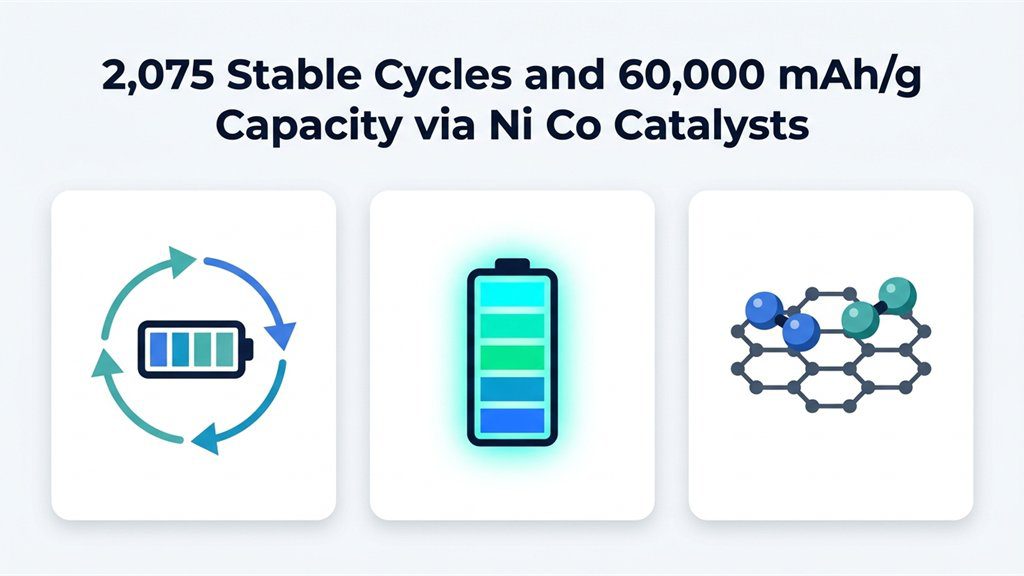
Fig. 1: Key Results at a Glance (Capacity Counted per Gram of Catalyst)
The Clogging Problem Inside the Oxygen Electrode
Here is where the dream usually stalls. In the conventional reaction, each oxygen molecule accepts just two electrons. As a result, the cell fills up with lithium peroxide, a stubborn solid. This product is an electrical insulator, and it does not dissolve. So it coats the electrode surface like limescale inside a kettle. After that, fresh oxygen and lithium ions struggle to reach the active sites. Charging also demands extra voltage, which engineers call overpotential. Think of overpotential as a toll paid on every single trip. The higher the toll, the more energy the cell wastes. Eventually the pores clog, the reactions slow down and the cell fades. Any serious fix must therefore change what forms inside those pores.
Explainer: Two Electrons or Four per Oxygen Molecule?
Redox chemistry is really a form of electron bookkeeping. In the usual route, one oxygen molecule takes two electrons and forms lithium peroxide. The alternative route lets the same molecule take four electrons instead. With a proton source present, the product then becomes lithium hydroxide, or LiOH. Chemists call this second route the four-electron LiOH pathway. According to the paper, it offers better chemical stability and a higher theoretical capacity. It also eases the pore clogging linked to peroxide. A similar counting trick appears in an iodine cell that doubles its electron tally. But there is a catch, and it is a big one. The catalyst surface must grip reaction intermediates neither too tightly nor too loosely. That balance is known as the Sabatier principle. Single-metal sites often miss it, because their grip on different intermediates rises and falls together.
Fig. 2: Two Electrons or Four? The Product Changes With the Count
How a Machine Learning Lithium-Oxygen Battery Search Works
Pairing two different metal atoms offers a way around that limit. In such dual-atom catalysts, one atom can tune its neighbor’s electrons. Yet the possible pairs multiply quickly, so trial and error becomes slow and costly. For that reason, researchers led from Harbin Institute of Technology in Shenzhen turned to data. Their paper in Nature Communications began with 200 records from published reports. Each record described a catalyst through nearly 50 atomic, electronic and physical descriptors. The team then trained eight regression models to predict overpotential. Four were linear methods, while four were non-linear ensemble methods. The best performer, called XGBoost, reached an R-squared score of about 0.88. In other words, it explained most of the variation in records held back for testing. That is how a machine learning lithium-oxygen battery search begins.
Explainable AI Shows Why a Pair Works
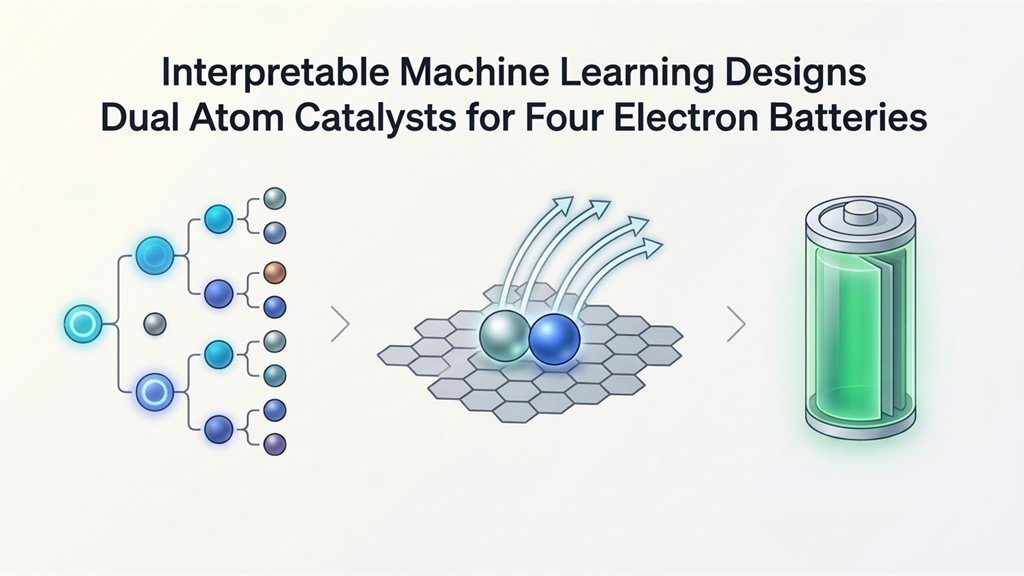
A bare prediction would not satisfy a chemist, though. Therefore, the team added SHAP, short for SHapley Additive exPlanations. SHAP ranks which inputs push a prediction up or down. Here, it pointed firmly to the electronic properties of the metal atoms. Specifically, d-electron counts and electronegativity mattered most, along with the d-band center. The trained model then scored combinations drawn from 28 candidate elements. As a result, a cobalt-nickel pair showed the lowest predicted overpotential. This is explainable AI at work, since the model reveals its reasoning. Afterward, quantum-mechanical calculations called density functional theory (DFT) checked the idea. They placed the pair’s d-band center between those of cobalt and nickel alone. Such a middle position suggests a balanced grip, just as the Sabatier principle asks.
Fig. 3: From Screening Elements to a Paired Catalyst and a Longer-Lived Cell
Inside the Dual-Atom Catalyst Design
Software can only suggest, so the chemists still had to build the thing. They anchored single nickel and cobalt atoms on nitrogen-doped reduced graphene oxide. That support is a thin, graphene-like carbon sheet. Under an electron microscope, the metals appeared mostly as pairs. On average, the two partners sat about 0.33 nanometers apart. X-ray measurements also showed charge shifting between them, as the calculations had predicted. Surprisingly, the metals made up less than 0.2% of the material by weight. A pinch of metal therefore does a great deal of work. Then came the second trick, which involved the liquid electrolyte. The researchers added a controlled 5% of water by volume. That water supplies the protons needed for the four-electron LiOH pathway.
What the Test Cells Showed
The numbers from small coin cells were striking. With the water added, the discharge product switched fully to lithium hydroxide. Capacity rose to roughly 60,000 milliamp-hours per gram of catalyst. By comparison, a cobalt-only catalyst managed about 35,000 under the same conditions. Counted against the whole electrode’s mass, the paired figure is about 3,600. Endurance improved even more than capacity did. In capacity-limited cycling, the paired catalyst lasted 2,075 cycles with reduced voltage decay. The cobalt-only cell, in contrast, failed after 790 cycles. Without water, the paper reports 177 low-overpotential cycles for the same catalyst. So the route change, not just the catalyst, supports the long life. The authors call their approach “a data-guided strategy for the rational design of atomic-scale architecture.”
Fig. 4: Reported Cycle Counts in Capacity-Limited Coin-Cell Tests (Bai et al., 2026)
One Coating, Two Jobs
Water inside a lithium cell sounds like trouble, and it can be. Lithium metal is unstable near proton sources, so the negative electrode needs protection. Here the team reused its own invention in a clever way. They coated the lithium with a thin layer of the same catalyst. Under an optical microscope, bare lithium quickly grew whisker-shaped dendrites. These metal needles are a familiar safety worry in lithium metal cells. The coated lithium, meanwhile, stayed smooth during the same test. In a harder cycling test without added water, the protected cell ran for 185 cycles. The unprotected one, however, failed after only 32. Other teams tackle dendrites differently, for example with straight ion lanes inside a separator. Either way, one material doing two jobs keeps a design simple.
Limits of This Machine Learning Lithium-Oxygen Battery Work
Before anyone orders an air-breathing car, some caution is due. For one thing, every result comes from small laboratory coin cells. Those cells also breathed pure oxygen rather than ordinary air. The long cycling runs used only a small slice of the full capacity. In addition, the headline capacity is counted per gram of catalyst, not per cell. Even with the new catalyst, the water-based route still showed an overpotential of 0.85 volts. The training set was modest too, at 200 literature records. Likewise, the authors say their energy calculations support the mechanism rather than establish it. ENTECH has examined why proof is now the hard part for AI-led science. The paper does not report larger pouch cells or tests in everyday air. So this machine learning lithium-oxygen battery remains a laboratory result for now.
What AI-Designed Catalysts Could Mean for Business
Suppose the remaining hurdles fall over the coming years. Lighter energy storage would matter most where every kilogram counts. Aircraft, drones and long-haul trucks are obvious candidates, although nothing is promised here. The more immediate disruption, however, may be the workflow itself. Traditionally, catalyst discovery meant long stretches of patient mixing, baking and testing. Now a model can rank many options before the furnace even warms up. As a result, small teams could compete with much larger laboratories. The authors add that the same strategy could extend to other multi-electron reactions. Many energy conversion processes fall into that group. Companies that learn this hybrid method early may therefore move faster. In the long run, data-guided design could become ordinary practice in materials firms.
Lessons for Students and Teachers
For students, this work ties several classroom topics together neatly. Counting two versus four electrons is plain redox bookkeeping from school chemistry. Similarly, R-squared and cross-validation come straight from a statistics course. The modeling tools are within reach too, since XGBoost and SHAP are public software libraries. Better still, the authors have posted their data and code for anyone to study. A motivated class could therefore rerun parts of the analysis. Teachers might ask why an explainable model matters more than a merely accurate one. Another good question is why a little water helps here but harms elsewhere. Try sketching both reaction routes and labeling each electron. Above all, the study shows that coding and chemistry now belong together. That pairing is well worth practicing early.
Careers and Startup Ideas in AI-Guided Battery Design
Who actually does this kind of work for a living? Research like this blends several jobs that once sat apart. Materials scientists design and test the catalysts. Electrochemical engineers, in turn, build and cycle the cells. Data specialists train the models and then question their outputs. In this study, for instance, different authors handled the modeling and the laboratory work. Useful skills therefore include Python, statistics, electrochemistry and careful lab habits. Entrepreneurs may also spot openings here. One is software that screens catalysts for clean-technology companies. Another is protective coatings for lithium metal electrodes, inspired by the dual-role layer. Neither idea is proven in the market yet, so treat both as possibilities. Still, a machine learning lithium-oxygen battery hints at where energy careers are heading. Curious students can start building those skills today.
References
Bai, T., Hu, Y., Zhai, W., Zhong, X., Huang, J., Wang, J., Song, W., Rao, T., Du, S., Gao, D., Lu, J., Shi, R., Ci, L., & Li, D. (2026). Machine learning-driven regulation of the four-electron LiOH pathway in lithium–oxygen batteries with prolonged cycling. Nature Communications, 17, 11801. https://doi.org/10.1038/s41467-026-79335-6
Bai, T., Hu, Y., et al. (2026). Data and code for “Machine learning-driven regulation of the four-electron LiOH pathway in lithium–oxygen batteries with prolonged cycling” [Data set]. Zenodo. https://doi.org/10.5281/zenodo.22731985
This explainer does a careful job of separating what the software predicted from what the laboratory cells actually showed, and the electron-counting section should help students connect it to school chemistry. The limits section is welcome, though a future update could add how such cells behave in ordinary air once that work appears. A short note on how the training records were gathered would also strengthen the machine learning discussion. Readers are encouraged to consult the original research paper on which this article is based.
Editorial note
This article is an ENTECH explainer on lithium-oxygen batteries and data-guided catalyst design, written for students, teachers and early-career readers. It draws on a peer-reviewed research paper, and the illustrations are original graphics prepared for ENTECH rather than figures taken from the paper. Readers who want the full methods and data should refer to the original source paper listed in the references.
I am an inspirational writer and emerging science blogger with a deep-rooted passion for understanding and sharing the wonders of the world around us. My journey began with a Bachelor of Science in Chemistry from AKI’s Poona College of Arts, Commerce and Science, where I developed not only a strong foundation in scientific principles but also a mindset that values curiosity, observation, and critical thinking. Studying chemistry has taught me to approach problems with logic, to look beyond the obvious, and to see patterns where others might only see complexity. These experiences have shaped the way I perceive life and influence the way I express my thoughts, both scientifically and creatively.
I have always believed that knowledge is only as powerful as the way it is shared. This belief has guided me to create content that bridges the gap between science and everyday life. I aim to simplify complex scientific ideas so they become approachable, relatable, and engaging for everyone—whether someone has a formal background in science or is simply curious about the world. Science, in my view, is not confined to textbooks and laboratories; it is a way of thinking, understanding, and connecting with the world around us. By making science accessible, I hope to inspire curiosity, ignite learning, and encourage people to see the beauty and relevance of scientific discovery in their daily lives.
Alongside my love for science, I am deeply passionate about motivational writing. I believe words carry the power to transform perspectives, encourage self-reflection, and inspire action. By combining analytical thinking with creativity, I create content that is intellectually stimulating yet emotionally resonant. Whether I am breaking down a chemical concept, exploring a scientific phenomenon, or crafting motivational narratives, my goal is to communicate ideas in a way that is clear, meaningful, and impactful.
Through my work, I strive to empower my readers - not just by helping them understand the science around them, but by inspiring them to grow, learn, and realize their full potential. Every article, post, or story I write reflects my commitment to turning knowledge into inspiration. I want to spark curiosity, encourage self-improvement, and show that learning and personal growth are deeply connected. For me, writing is not just a craft; it is a way to touch minds, connect hearts, and make ideas come alive in a way that truly resonates.