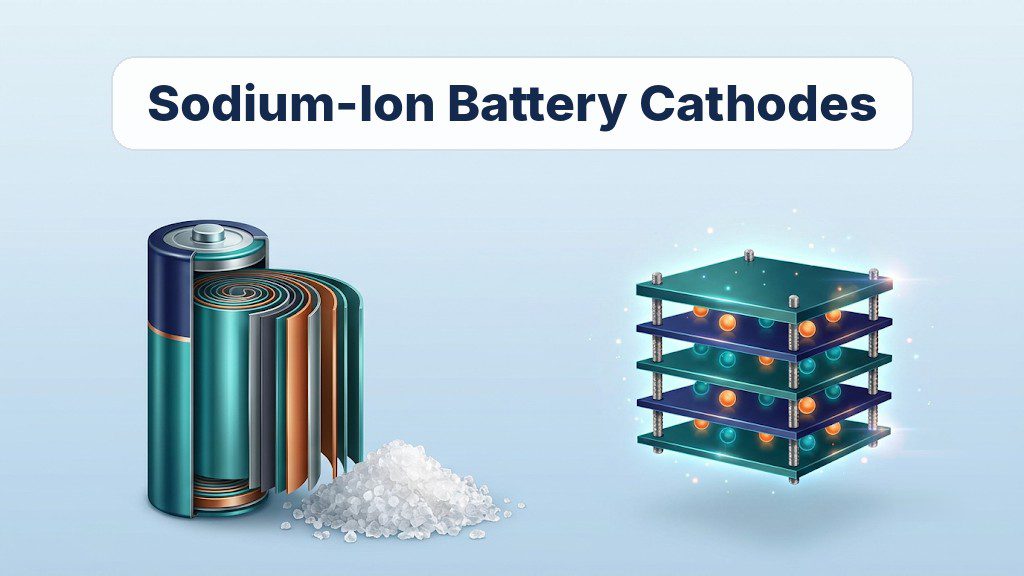
Sodium is plentiful, but the positive electrode decides whether a sodium-ion cell can compete, and one answer may come from a familiar lithium-era crystal.
Every rechargeable battery is a story about ions finding a home. During charging, they leave one electrode and settle inside the other. Later, they travel back, and that return trip powers your device. Until now, lithium has been the favorite traveler for over thirty years. Sodium, however, is far more plentiful and sits just below lithium in the periodic table. That is why salt-based cells are gaining attention for grid storage and budget vehicles. Still, a bigger ion needs a roomier, sturdier home. Designing sodium-ion battery cathodes is therefore the hardest part of the puzzle. One surprising answer starts with a crystal from the lithium era. This explainer follows the problem, the trick and what it might change.
First, a battery has two electrodes, and each stores ions differently. The negative side of most sodium cells uses hard carbon. That material is already fairly mature, although it has limits. As a result, future gains must come mainly from the positive side. This positive electrode is called the cathode. It sets how much energy a cell holds and how long it lasts. Much of the materials cost also sits in that electrode. Governments have noticed, and funding is following. In late 2024, for example, the US Department of Energy backed a $50 million sodium-ion consortium. Specifically, its goal is cells that match lithium iron phosphate batteries on energy.
Two Families, One Stubborn Trade-Off
Practical sodium-ion battery cathodes mostly come from two families. The first family, called polyanionic compounds, is built like a rigid scaffold. Such scaffolds are stable, but they tend to store less energy. Layered oxides, by contrast, stack metal and oxygen in flat sheets. Sodium slips between those sheets, so the energy stored can be high. However, the sheets can shrink, slide and crack as sodium leaves. Consequently, designers face a trade-off between energy and stability. A third option, Prussian blue materials, is also under study. What the field wants is a structure that bends without breaking. Oddly enough, a clue was hiding in an older lithium recipe.
Spinel: A Veteran Crystal From the Lithium Era
Lithium manganese oxide is, above all, a classic lithium-ion cathode. Chemists write it as LiMn2O4, and its crystal type is called spinel. In other words, a spinel is a three-dimensional framework with many empty sites. Because it contains no cobalt or nickel, it is relatively cheap. Factories also know how to produce such materials at large scale. Naturally, researchers wondered whether sodium could use the same framework. The direct route, unfortunately, has proved difficult. Baking sodium, manganese and oxygen together rarely yields a stable spinel. So the framework stayed largely unexplored for sodium, despite its many vacant sites. A team led by Xiamen University decided to try a different door.
How the Crystal Rebuilds Itself From Inside
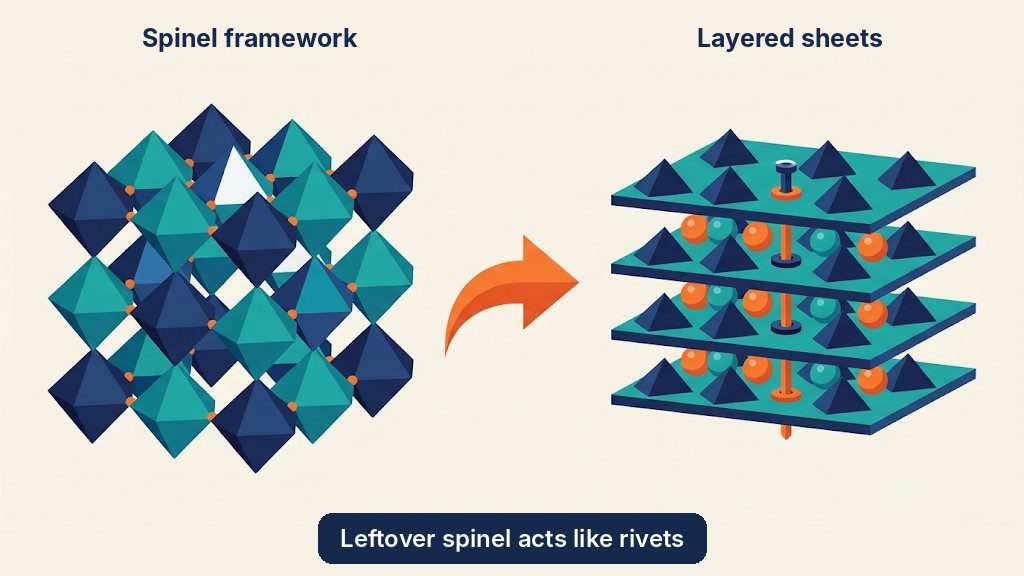
Their idea for sodium-ion battery cathodes was to skip the furnace. First, the lithium is pulled out of the spinel by charging it. Then the emptied material is cycled in a sodium cell. As sodium pushes in, something remarkable happens to the manganese. According to the team’s paper in Nature Communications, manganese ions begin to hop. Specifically, each hop passes from an octahedral site, through a tetrahedral site, to another. Gradually, the three-dimensional framework reorganizes into flat, stacked layers. Altogether, this makeover takes about 20 charge cycles to finish. Afterward, the material behaves like a layered sodium manganese oxide. In effect, the old crystal served as a mold for a new one.
Fig. 1: From Spinel Framework to Layered Sheets
Leftover Spinel Works Like Rivets
The transformation, interestingly, never quite completes. Instead, about 2% of the material by weight remains as spinel. At first glance, that leftover looks like an imperfection. In fact, the authors argue it is the key to the design’s strength. Their microscopy and simulations suggest the spinel patches act like rivets. These rivets pin the layers, so they shrink and slide less. For comparison, the team also made sodium manganese oxide in a furnace. That conventional version lost more capacity in its first cycle. It also faded faster over long cycling than the electrochemically made one. A small flaw, in other words, became a structural feature.
What the Test Cells Showed
Promising sodium-ion battery cathodes still have to survive real testing. In small laboratory cells, the converted cathode delivered 215 mAh per gram. That unit, in short, describes how much charge each gram can store. The authors also estimated a materials cost of 54 yuan per kilowatt-hour. Their analysis placed it favorably against several mainstream sodium cathodes. Importantly, that cost figure is the authors’ own estimate. Next, the team built a flat pouch cell against sodium metal. It delivered 150 mAh and kept 84% of its capacity after 100 cycles. Such steps matter, because many materials shine only in coin-sized cells. The bigger question was whether the idea would work in a standard format.
A Full-Size Cylinder Joins the Test
For that test, the team built a 26650 cylindrical cell. This is a common industrial size, noticeably larger than a household AA battery. In addition, battery maker CATL helped to build the larger cells. The cylinder paired the new cathode with a hard carbon negative electrode. An additive, meanwhile, supplied extra sodium before the first charge. The finished cell delivered 3.85 Ah and kept 95.7% of its capacity after 900 cycles. Moreover, it stored 128 watt-hours per kilogram of cell weight. By comparison, a common lithium iron phosphate cell of that size stores about 125. The cell also needed only a 4.0-volt upper limit. Lower voltage is gentler on the liquid electrolyte, which helps durability.
Fig. 2: The Full-Size Cylindrical Cell Test
Limits of These Sodium-Ion Cathode Materials
Promising numbers deserve careful reading, and this study has clear limits. First, all the laboratory tests ran at room temperature, around 26 °C. The paper therefore says nothing about freezing winters or hot summers. It reports no safety or abuse tests and no fast-charging data. An industry partner helped build the cells and supplied one comparison material. The authors declare no competing interests. They also list the work still ahead. Supplying extra sodium, tuning electrolytes and winding cells all need refinement. Controlling how much spinel remains is another open task. Manganese-rich cathodes, moreover, can suffer from a distortion that shortens life.
What Sodium-Ion Battery Cathodes Could Mean for Industry and Careers
If results like these hold at scale, the business effects could be wide. Grid storage is the obvious first market, because weight matters less there. Low-cost electric vehicles and two-wheelers could follow. Manufacturers would also benefit from a familiar starting material. After all, lithium manganese oxide is already made in bulk. That lowers the risk of building entirely new supply chains. Countries with little lithium could, in addition, gain more energy independence. Better sodium-ion battery cathodes may not replace lithium, but they could share the load. Lithium would then be saved for uses that truly need it. A broader mix of chemistries usually makes an industry more resilient.
What Students Can Take From This
For students, the work is a lesson in how structure shapes function. The same atoms, arranged differently, give a very different battery. Therefore, solid-state chemistry and crystallography are worth serious attention. Electrochemistry explains why ions move, and physics explains how we watch them. The team used X-rays, electron microscopes and magnetic resonance to follow the change. Computer simulations, similarly, tested the rivet idea atom by atom. Modern battery science, in short, is a team sport across disciplines. Even sensors placed inside sealed cells are now part of the toolkit. A curious student can start with simple questions about everyday batteries. Why does a phone battery fade, and what changed inside it?
Careers and Startup Ideas
The career map around sodium-ion battery cathodes keeps growing. First, materials scientists design and test new electrode recipes. Process engineers, meanwhile, turn gram-scale recipes into tonnes of powder. Testing engineers then cycle cells for months to prove their lifetime. Electrochemists link what happens at the atomic scale to performance. There is room for entrepreneurs as well. For instance, startups could offer cell testing, recycling or specialist additives. Similarly, software for predicting battery life is a promising niche. Each of these roles rewards patience, because batteries improve by small steps. Still, small steps repeated across an industry can reshape energy systems.
A Wider Lesson for Sodium-Ion Battery Cathodes
The deeper idea here may outlast this particular material. Instead of inventing a crystal from scratch, the team remodeled an existing one. Electricity, not heat, did the rebuilding. Therefore, that approach could be tried on other well-known frameworks. Newer and better sodium-ion battery cathodes will surely appear. Even so, the principle of transforming familiar materials should remain useful. It reminds us that old knowledge is rarely wasted in science. Sometimes, in fact, a retired idea only needs a new assignment. For future engineers, that is an encouraging thought. The next breakthrough might already be sitting on a laboratory shelf.
References
Wu, Z., Chen, D., Lin, T., Yang, M., Hu, C., Zhang, D., Chen, L., Tang, Y., Liu, Q., Chen, Y., Yan, Y., Zhang, K., Kuai, X., Wang, Q., Xiao, Y., Li, C., Sun, Y., Liu, X., Gu, L., Qiao, Y., & Sun, S.-G. (2026). Transforming spinel LiMn2O4 into a Na-layered cathode. Nature Communications. https://doi.org/10.1038/s41467-026-79390-z
Turning an established lithium-ion cathode into a sodium host through controlled ion migration is a clever route, and the cylindrical-cell test makes the story more than a materials curiosity. The article makes clear that the cost figure is the authors' own estimate and that an industry partner helped build the larger cells. It also states that testing was done at room temperature, and that safety, fast charging and large-scale manufacturing have not yet been shown. Readers who want the full set of experiments should check the original research paper this article draws on.
Editorial note
ENTECH is running this explainer because sodium-ion batteries could ease pressure on lithium supplies, and this work shows a familiar lithium-battery material being rebuilt, atom by atom, into a sodium-ion cathode. It gives students a clear example of how crystal structure decides what a battery can do. The team also went beyond coin-sized lab cells and, with help from a major battery maker, tested a full cylindrical cell that stores about as much energy per kilogram as a common commercial lithium battery. Performance in hot and cold weather, safety and mass production are still open questions, so this is an early step and not a finished product. The illustrations are AI-generated and simplified. For the full methods and data, we suggest readers turn to the original research paper behind this article.
I am an inspirational writer and emerging science blogger with a deep-rooted passion for understanding and sharing the wonders of the world around us. My journey began with a Bachelor of Science in Chemistry from AKI’s Poona College of Arts, Commerce and Science, where I developed not only a strong foundation in scientific principles but also a mindset that values curiosity, observation, and critical thinking. Studying chemistry has taught me to approach problems with logic, to look beyond the obvious, and to see patterns where others might only see complexity. These experiences have shaped the way I perceive life and influence the way I express my thoughts, both scientifically and creatively.
I have always believed that knowledge is only as powerful as the way it is shared. This belief has guided me to create content that bridges the gap between science and everyday life. I aim to simplify complex scientific ideas so they become approachable, relatable, and engaging for everyone—whether someone has a formal background in science or is simply curious about the world. Science, in my view, is not confined to textbooks and laboratories; it is a way of thinking, understanding, and connecting with the world around us. By making science accessible, I hope to inspire curiosity, ignite learning, and encourage people to see the beauty and relevance of scientific discovery in their daily lives.
Alongside my love for science, I am deeply passionate about motivational writing. I believe words carry the power to transform perspectives, encourage self-reflection, and inspire action. By combining analytical thinking with creativity, I create content that is intellectually stimulating yet emotionally resonant. Whether I am breaking down a chemical concept, exploring a scientific phenomenon, or crafting motivational narratives, my goal is to communicate ideas in a way that is clear, meaningful, and impactful.
Through my work, I strive to empower my readers - not just by helping them understand the science around them, but by inspiring them to grow, learn, and realize their full potential. Every article, post, or story I write reflects my commitment to turning knowledge into inspiration. I want to spark curiosity, encourage self-improvement, and show that learning and personal growth are deeply connected. For me, writing is not just a craft; it is a way to touch minds, connect hearts, and make ideas come alive in a way that truly resonates.