Sodium is 100× more abundant than lithium on Earth.
Scientists Say Common Salt Could Power Your Next Electric Car
Estimated reading time: 7 minutes
Imagine charging your electric scooter in minutes. Picture powering an entire city using the ocean’s salt. All of a sudden, this sounds like science fiction. But at this instant, it is becoming real science. Researchers Machín and Márquez (2026) published a major review in Batteries journal. They mapped the full roadmap of latest battery technology i.e. sodium-ion batteries (SIBs). These batteries use sodium — the same element in table salt. As a result, they could change how we store energy. For grade 11 and 12 students studying chemistry and physics, this is your science class coming to life.
Key Takeaways: Sodium ion Batteries (SIBs)
- Sodium is 100× more abundant than lithium on Earth.
- SIBs can store renewable energy from solar and wind.
- Major companies like CATL and Faradion are already building them.
- SIBs connect directly to electrochemistry, thermodynamics, and redox reactions you study in class.
- Career paths in this field are growing fast.
What Are Sodium Ion Batteries — And Why Should You Care?
The Basic Science
Prior to understanding SIBs, recall what you learned about electrochemical cells. At first, batteries seem complex. But after that, the idea is simple.
Here is how a sodium-ion battery works:
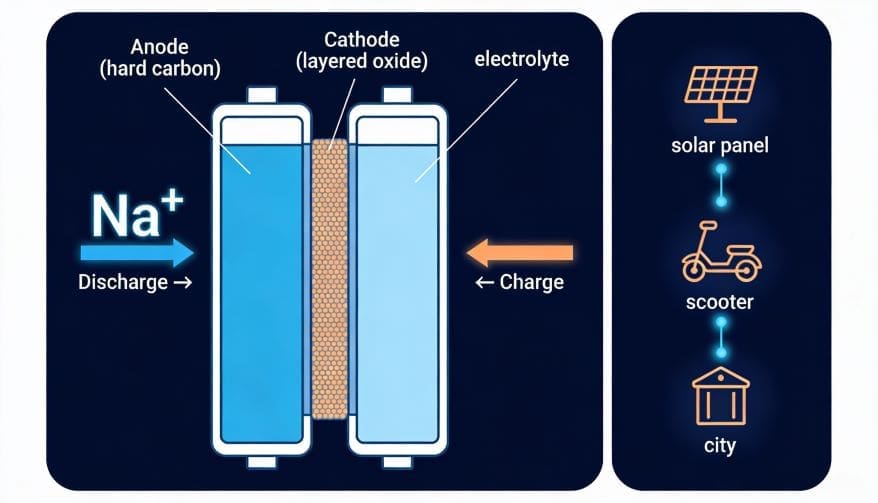
- Sodium ions (Na⁺) move from the anode to the cathode during discharge.
- Electrons flow through the external circuit — that is your electric current.
- During charging, the process reverses. The ions go back.
- The electrolyte is the liquid in between that lets ions travel.
To illustrate, think of it like a seesaw. Sodium ions go one way to give energy. They come back the other way to store energy. What’s more, this is exactly the redox chemistry you study in Class 12. Oxidation happens at the anode. Reduction happens at the cathode. Seeing that you already know this, SIBs are not as scary as they sound!
Why Sodium and Not Lithium? Sodium ion Batteries
Analogous to latest battery technology lithium-ion batteries, SIBs use ion movement to store energy. But there are big differences.
| Feature | Lithium-Ion | Sodium-Ion |
|---|---|---|
| Abundance | Rare (only some countries) | Extremely common worldwide |
| Cost | High (and rising) | Much lower |
| Safety | Can catch fire | More thermally stable |
| Energy Density | Higher | Slightly lower |
| Eco-Friendliness | Moderate | Better |
As a matter of fact, sodium is the 6th most abundant element on Earth. It is found in seawater, salt flats, and rocks everywhere. By comparison, lithium is scarce. It is mostly mined in Chile, Australia, and Argentina. To put it differently, depending only on lithium is like depending on one shop for all your groceries — risky.
You can also read about how rapid-charging sodium batteries are being developed for high-energy applications right here on ENTECH Online.
The Science Behind the Materials — Your Chemistry, Brought to Life
Cathode Materials: What Holds the Sodium?
The cathode is where sodium ions are stored. Researchers have found three main cathode types. To enumerate, they are:
- Layered transition-metal oxides — These are compounds like NaMnO₂. They offer high capacity. But they can break down at high voltages.
- Polyanionic compounds — These include phosphates and sulfates. They are very stable. Their structure does not collapse easily. The “inductive effect” of the anion group — something you study in organic chemistry — actually raises the battery voltage here!
- Prussian Blue Analogues (PBAs) — These are open-frame crystal structures. They look like metal cages. Sodium ions can move in and out quickly. As a result, these batteries charge and discharge very fast. They are also made through simple water-based chemistry.
Anode Materials: Where Sodium Goes During Charging
The anode receives sodium ions when the battery charges. At the present time, the best anode material is hard carbon. Here is why it matters:
- Hard carbon is made by heating organic materials like biomass or resins.
- It stores sodium in tiny pores and defects in its structure.
- It can hold about 250–350 mAh of charge per gram.
- Above all, it is affordable and scalable.
While it may be true that harder carbons store less energy than some exotic materials, their practical stability makes them the commercial favourite. So far, no anode beats hard carbon for real-world use.
The Electrolyte: Your Ion Highway
The electrolyte lets sodium ions travel between anode and cathode. It must:
- Be chemically stable at both high and low voltages.
- Allow fast ion movement.
- Not react with the electrodes.
Sooner or later, a thin protective layer called the Solid Electrolyte Interphase (SEI) forms on the anode. This is critical. A good SEI means a long battery life. A bad SEI means the battery fades quickly. In fact, controlling the SEI is one of the biggest challenges in this whole field.
Sodium ion Batteries — Who Is Building These Batteries?
Companies Leading the Charge
All things considered, SIBs are no longer just lab experiments. At this time, several companies are commercialising them:
- CATL (China) — The world’s largest battery maker. They launched their first SIB in 2023.
- Faradion (UK) — One of the earliest SIB companies. They focus on layered oxide cathodes.
- HiNa Battery (China) — Uses Prussian Blue cathodes. Targeting large grid storage.
- Tiamat (France) — Focuses on polyanionic cathodes for fast-charging applications.
Provided that these companies scale up production, SIBs could make electric vehicles cheaper. As can be seen from their progress, the technology is moving fast.
Real-World Applications of Sodium ion Batteries
To list the most exciting uses of SIBs:
- Grid-scale energy storage — Storing solar and wind power for the whole city.
- Electric vehicles — Cheaper, safer car batteries for everyday use.
- Two-wheelers and e-bikes — Especially important for countries like India.
- Backup power — For hospitals, data centres, and remote areas.
- Seasonal energy storage — Storing summer solar energy for winter use.
With this in mind, SIBs are not competing with lithium. They are filling the gaps lithium cannot fill affordably.
What This Means for Your Career
Subjects You Study That Directly Apply Here
All in all, SIB research connects to nearly everything in your science syllabus.
- Chemistry — Redox reactions, electrochemistry, ionic bonding, crystal structures.
- Physics — Electric current, voltage, energy, thermodynamics.
- Biology — Sodium’s role in nerve signals is why it is so well-studied.
- Mathematics — Battery capacity is calculated using Faraday’s Law: Q = nF.
Career Paths to Explore
With attention to the skills needed in this field, here are careers you could pursue:
- Electrochemist — Designs new electrode materials.
- Materials Scientist — Finds better cathodes, anodes, and electrolytes.
- Chemical Engineer — Scales up battery manufacturing.
- Environmental Scientist — Works on recycling and circular economy.
- Energy Policy Analyst — Advises governments on clean energy.
- Data Scientist — Uses AI to predict battery ageing and failure.
To that end, all of these careers start with the subjects you are studying right now. At last, you can see that studying electrochemistry is not just for exams — it is for building the future.
FAQs
Q1. Are sodium-ion batteries available to buy today?
Yes! CATL launched commercial SIB cells in 2023. They are used in some electric vehicles and grid storage projects in China.
Q2. Is sodium the same as table salt?
Sodium (Na) is the element in salt (NaCl). Batteries use sodium ions, not salt directly. But the raw material is far more accessible than lithium.
Q3. Why don’t we just use seawater to make SIBs?
Sodium must be purified and used in specific chemical forms. But yes — the sodium ultimately comes from abundant natural sources like seawater and salt mines.
Q4. Are SIBs safer than lithium-ion batteries?
Generally, yes. SIBs tend to be more thermally stable. They are less likely to catch fire under extreme conditions. But safety depends on the full cell design, not just the chemistry.
Q5. How does this connect to renewable energy?
Solar and wind energy are not always available. Batteries store that energy. SIBs could make large-scale storage cheaper, helping entire cities run on clean energy.
Q6. What is the biggest challenge for SIBs right now?
The main challenge is energy density — SIBs store slightly less energy per kilogram than lithium-ion. Researchers are working to close this gap through better materials and smarter cell design.
Reference:
- Machín, A., & Márquez, F. (2026). Sodium-Ion Batteries: Advances, Challenges, and Roadmap to Commercialization. Batteries, 12(4), 131. https://doi.org/10.3390/batteries12040131
- Author
- Latest Posts

I am an inspirational writer and emerging science blogger with a deep-rooted passion for understanding and sharing the wonders of the world around us. My journey began with a Bachelor of Science in Chemistry from AKI’s Poona College of Arts, Commerce and Science, where I developed not only a strong foundation in scientific principles but also a mindset that values curiosity, observation, and critical thinking. Studying chemistry has taught me to approach problems with logic, to look beyond the obvious, and to see patterns where others might only see complexity. These experiences have shaped the way I perceive life and influence the way I express my thoughts, both scientifically and creatively.
I have always believed that knowledge is only as powerful as the way it is shared. This belief has guided me to create content that bridges the gap between science and everyday life. I aim to simplify complex scientific ideas so they become approachable, relatable, and engaging for everyone—whether someone has a formal background in science or is simply curious about the world. Science, in my view, is not confined to textbooks and laboratories; it is a way of thinking, understanding, and connecting with the world around us. By making science accessible, I hope to inspire curiosity, ignite learning, and encourage people to see the beauty and relevance of scientific discovery in their daily lives.
Alongside my love for science, I am deeply passionate about motivational writing. I believe words carry the power to transform perspectives, encourage self-reflection, and inspire action. By combining analytical thinking with creativity, I create content that is intellectually stimulating yet emotionally resonant. Whether I am breaking down a chemical concept, exploring a scientific phenomenon, or crafting motivational narratives, my goal is to communicate ideas in a way that is clear, meaningful, and impactful.
Through my work, I strive to empower my readers – not just by helping them understand the science around them, but by inspiring them to grow, learn, and realize their full potential. Every article, post, or story I write reflects my commitment to turning knowledge into inspiration. I want to spark curiosity, encourage self-improvement, and show that learning and personal growth are deeply connected. For me, writing is not just a craft; it is a way to touch minds, connect hearts, and make ideas come alive in a way that truly resonates.