The battery charges faster as it gets bigger — opposite to normal batteries.
Scientists Just Built a Battery That Charges Instantly: Quantum battery Charging
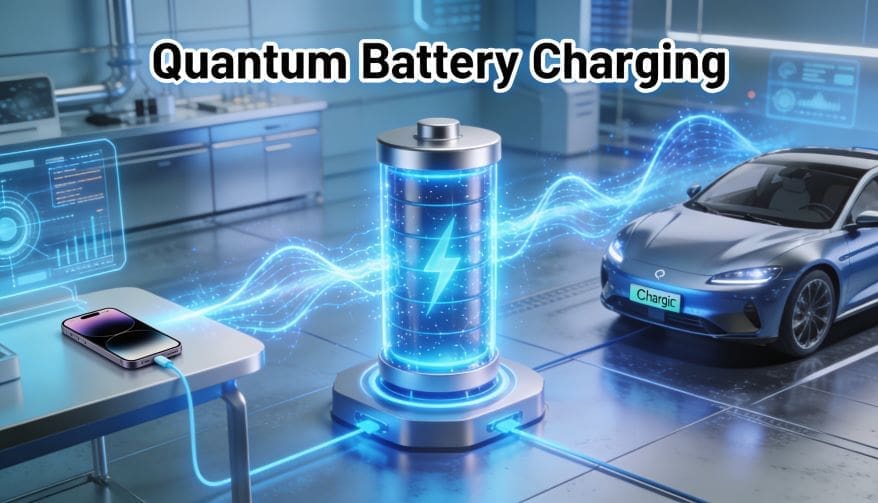
Your phone is at 2%. The charger is across the room. You know the panic. But what if your phone fully charged in seconds? Not minutes – seconds. Scientists in Australia have just built the world’s first working quantum battery prototype. It charges, stores, and releases energy – just like a normal battery. But it uses the laws of quantum physics instead of chemical reactions. At first, this sounds like science fiction. As a matter of fact, it is real science happening right now. This discovery could change phones, electric vehicles (EVs), and clean energy forever.
Key Takeaways: Quantum battery Charging
Before we go further, here is a quick summary:
- Quantum battery charging uses quantum physics, not chemistry.
- However, Scientists built the first prototype.
- The battery charges faster as it gets bigger — opposite to normal batteries.
- It can be charged wirelessly using a laser.
- Additionally, This technology could reshape EVs and smartphones.
What Is Quantum Battery Charging? The Science Behind It
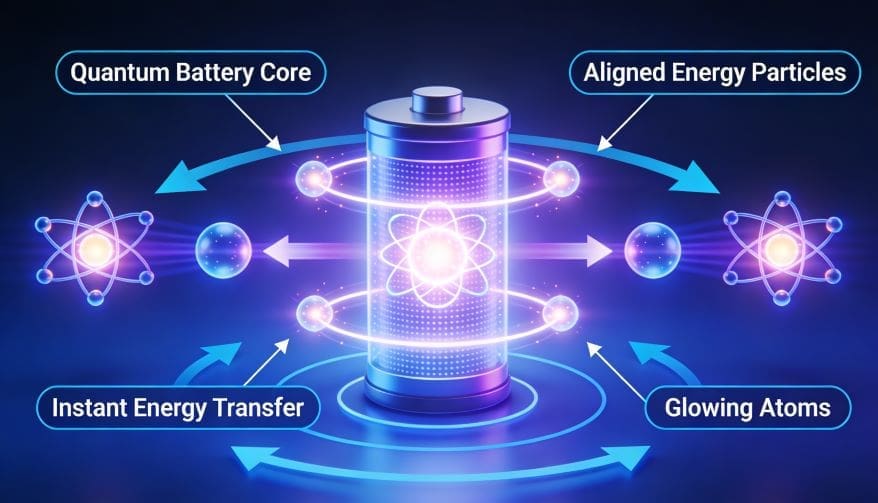
These concepts are the foundation of quantum battery technology. So, prior to thinking this is “too advanced,” know that you already have the base.
Unlike traditional batteries, which rely on chemical reactions, quantum batteries use quantum superposition and interactions between electrons and light.
- Superposition means a particle can be in two states at once.
- Entanglement means particles are linked, even at a distance.
- Above all, these allow energy to be stored and released at quantum speed.
The Bigger the faster: Quantum Battery Charging
Here is one of the most mind-bending facts about quantum battery charging. Normal batteries slow down as they get bigger. Quantum batteries do the opposite. Study found quantum batteries however charge faster as they get larger. This is different from how today’s batteries work.
The charging rate of quantum batteries is a super extensive property, meaning it grows exponentially with size. In other words, the larger the battery, the faster it charges per unit. This is completely counterintuitive — and completely exciting.
How Was the Prototype Built?
The team’s prototype is a small, layered organic device that can be wirelessly charged with a laser. Here is how it works, step by step
- A laser fires at the organic microcavity device.
- Super absorption occurs — energy floods in all at once.
- Quantum effects hold the energy in a stable state.
- The energy releases as usable electric current.
To verify the prototype’s performance, the team conducted experiments at the University of Melbourne’s Ultrafast Laser Laboratory in the School of Chemistry. Advanced spectroscopy confirmed the charging behavior.
The Unique Features: Quantum Battery Charging
- First experimental proof of a full operational quantum battery cycle
- Uses organic microcavity — a safe, manageable material
- Works at room temperature — no extreme cooling needed
- Charges wirelessly via laser — no cable required
- Scales well — bigger size means faster charging
Real-World Impact: Phones, EVs, and Clean Energy
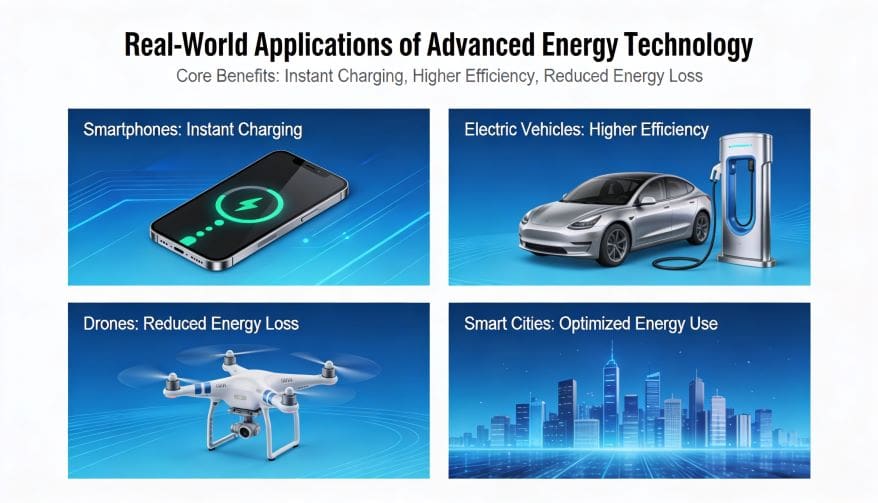
What This Means for Your Smartphone
At the present time, your phone battery takes anywhere from 30 minutes to 2 hours to charge. With quantum battery charging, that time could drop to seconds. Here is what that future could look like:
- Plug in for 5 seconds → 100% battery
- No more power banks needed
- Batteries that last longer between charges
- Wireless charging over longer distances
While it may be true that fully commercial quantum phone batteries are years away, the prototype proves the physics works. That is the most important first step.
What This Means for Electric Vehicles (EVs)
One of the biggest complaints about EVs is charging time. Even fast chargers take 20–45 minutes. Quantum battery charging could change this completely.
The global quantum batteries market is forecast to grow from $18.5 million in 2024 to $65.4 million by 2030, reflecting a remarkable compound annual growth rate of 24.5%.
- QuantumScape — exploring quantum potential in solid-state batteries
- IONQ Inc. — quantum technology expanding into energy storage
- D-Wave Systems — leveraging quantum expertise for energy applications
So far, all of these are early-stage. But seeing that this Australian prototype has proven the concept, commercial investment will likely follow.
Clean Energy Storage
What’s more, quantum batteries could transform how we store solar and wind energy. Renewable energy is often wasted because storage is slow or inefficient. Quantum battery charging could store energy almost instantly. It could release it just as fast. All in all, this could make the clean energy revolution faster and more reliable.
Also read: Sodium-ion Batteries
Career Paths Inspired by Quantum Battery Charging
Sooner or later, quantum battery technology will need teams of scientists — not just physicists. Here are careers this discovery opens up, especially B.Sc. Chemistry graduates:
- Pharmaceutical Materials Scientist — designing drug delivery systems using quantum-compatible organic materials
- Electrochemical Researcher — studying how energy moves through organic systems
- Regulatory Affairs Specialist — ensuring new battery materials are safe for public use
- Analytical Chemist — using spectroscopy to test quantum material properties
- Green Technology Consultant — advising EV and energy companies on safe chemical use
Challenges Ahead
While this may be true that the breakthrough is exciting, it is also important to be honest about challenges. At this point, quantum batteries are not ready for your pocket.
Here are the key hurdles:
- Scalability — Can tiny prototypes be made larger without losing quantum properties?
- Energy retention time — In July 2025, researchers extended quantum battery lifetime by 1,000 times, from nanoseconds to microseconds. That is progress — but microseconds is still very short.
- Material engineering — Developing durable, affordable organic microcavity materials at scale.
- Temperature sensitivity — Keeping quantum effects stable in real-world conditions.
At least the foundation is now proven. All things considered, this is exactly how science works — one breakthrough at a time.
Frequently Asked Questions
Q1. What is quantum battery charging in simple words?
It is a way to store and release energy using quantum physics rules — like superposition and entanglement — instead of chemical reactions. It can charge much faster than regular batteries.
Q2.Quantum Battery Charging is real or still just a theory?
It is real. Scientists have taken an important step toward next-generation energy technology by developing a proof-of-concept quantum battery that can charge, store, and release energy. It is not a final product yet, but the physics has been proven.
Q3. When will my phone use quantum battery charging?
Although fully operational quantum batteries are not yet available, progress like this could eventually reshape how energy is stored and used. Experts suggest commercial use is likely 10–20 years away.
References:
- Hymas, K., Muir, J. B., Tibben, D., van Embden, J., Hirai, T., Dunn, C. J., Gómez, D. E., Hutchison, J. A., Smith, T. A., & Quach, J. Q. (2026). Superextensive electrical power from a quantum battery. Light: Science & Applications. https://doi.org/10.1038/s41377-026-02240-6
- Camposeo, A., Virgili, T., Lombardi, F., Cerullo, G., Pisignano, D., & Polini, M. (2025). Quantum batteries: A materials science perspective. Advanced Materials, 202415073. https://doi.org/10.1002/adma.202415073
- Author
- Latest Posts

I am an inspirational writer and emerging science blogger with a deep-rooted passion for understanding and sharing the wonders of the world around us. My journey began with a Bachelor of Science in Chemistry from AKI’s Poona College of Arts, Commerce and Science, where I developed not only a strong foundation in scientific principles but also a mindset that values curiosity, observation, and critical thinking. Studying chemistry has taught me to approach problems with logic, to look beyond the obvious, and to see patterns where others might only see complexity. These experiences have shaped the way I perceive life and influence the way I express my thoughts, both scientifically and creatively.
I have always believed that knowledge is only as powerful as the way it is shared. This belief has guided me to create content that bridges the gap between science and everyday life. I aim to simplify complex scientific ideas so they become approachable, relatable, and engaging for everyone—whether someone has a formal background in science or is simply curious about the world. Science, in my view, is not confined to textbooks and laboratories; it is a way of thinking, understanding, and connecting with the world around us. By making science accessible, I hope to inspire curiosity, ignite learning, and encourage people to see the beauty and relevance of scientific discovery in their daily lives.
Alongside my love for science, I am deeply passionate about motivational writing. I believe words carry the power to transform perspectives, encourage self-reflection, and inspire action. By combining analytical thinking with creativity, I create content that is intellectually stimulating yet emotionally resonant. Whether I am breaking down a chemical concept, exploring a scientific phenomenon, or crafting motivational narratives, my goal is to communicate ideas in a way that is clear, meaningful, and impactful.
Through my work, I strive to empower my readers – not just by helping them understand the science around them, but by inspiring them to grow, learn, and realize their full potential. Every article, post, or story I write reflects my commitment to turning knowledge into inspiration. I want to spark curiosity, encourage self-improvement, and show that learning and personal growth are deeply connected. For me, writing is not just a craft; it is a way to touch minds, connect hearts, and make ideas come alive in a way that truly resonates.