Splitting water with electricity sounds simple, yet keeping the machine alive is hard. Alkaline water electrolysis is the most widely used large-scale route to electrolytic hydrogen. For the most part, it relies on nickel electrodes, caustic solution and cheap equipment. However, today’s commercial units are bulky because they run at low current. Pushing them harder would shrink the machines, but the anode then wears out quickly. Now a team from three Chinese institutions reports a remarkably durable anode catalyst. In a lab test, a cobalt-nickel material ran for more than 8,000 hours. By comparison, a widely studied nickel-iron catalyst failed after about 200 hours. Equally important, both faced the same hot, caustic, factory-like conditions. The study appeared on November 12, 2026, in the open-access journal Nature Communications. So why does the anode matter so much, and what changed?
Why Alkaline Water Electrolysis Needs a Tougher Anode
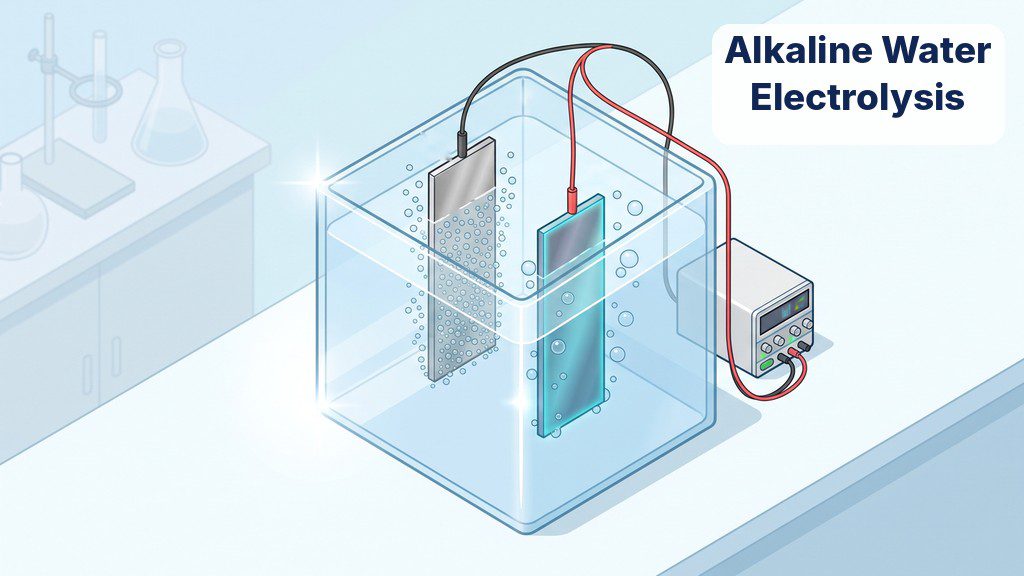
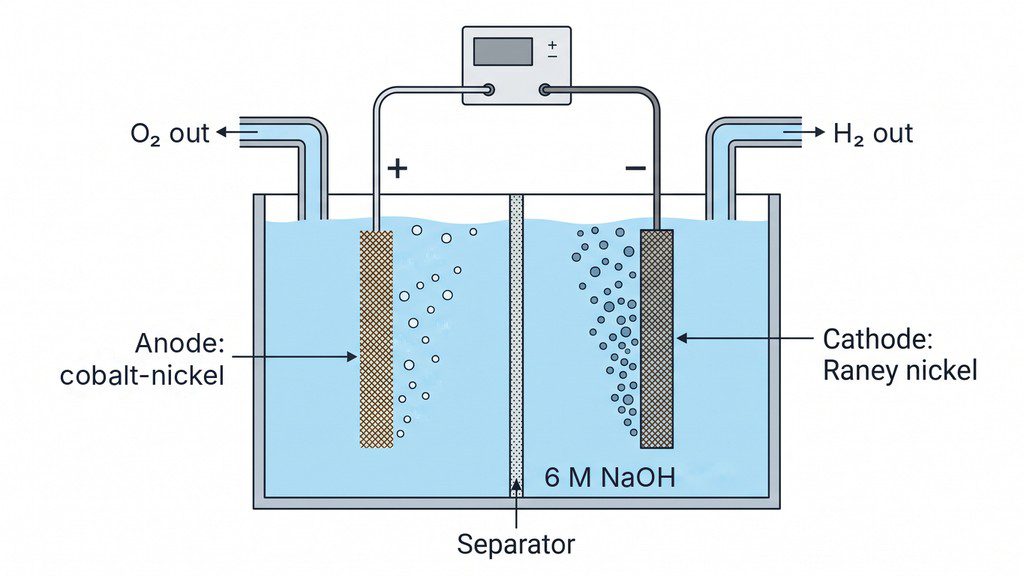
An electrolyzer has two electrodes sitting in a conducting liquid called an electrolyte. Hydrogen bubbles form at the cathode, while oxygen forms at the anode. The oxygen-making step, called the oxygen evolution reaction, is the slow one. In fact, the authors call it the main bottleneck of alkaline water electrolysis. Commercial alkaline units typically run at only 0.2 to 0.3 amperes per square centimeter. As a result, they need large electrode areas to make useful amounts of gas. In addition, they have low power density and some risk from gases mixing. Smaller, harder-working machines would solve several of these problems at once. For that reason, engineers want electrodes that survive much tougher operating conditions. In other words, the anode decides whether a compact electrolyzer can last.
What Industrial Conditions Really Mean
Compact electrolyzers would need to run hot, concentrated and fast all at once. To be specific, the paper describes temperatures of 80 to 90 °C. Likewise, the electrolyte would hold 20 to 30 percent sodium or potassium hydroxide by weight. On top of that, current density would reach at least 1 ampere per square centimeter. That is several times the current of today’s commercial cells. Under these conditions, many catalysts that shine in mild lab tests start to dissolve. With this in mind, the team picked 80 °C, 6 M NaOH and 1 A/cm². They also ran at least two experiments for each catalyst. In short, every material faced the same punishing, realistic test.
Three Catalysts, One Brutal Endurance Test
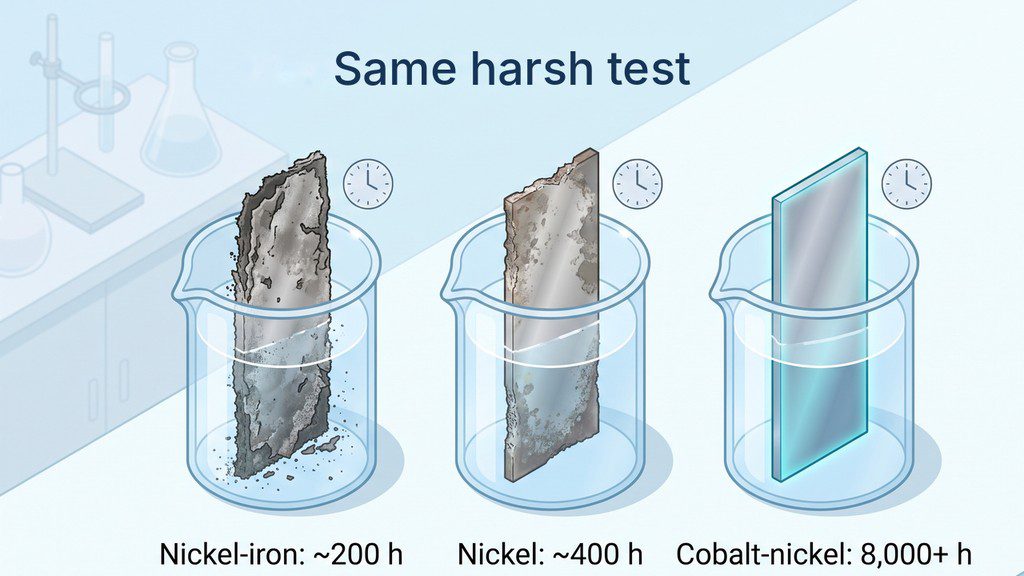
The researchers compared three catalysts, all grown on nickel by the same method. To begin with, they tested a nickel-iron layered double hydroxide, often called NiFe-LDH. As a matter of fact, it ranks among the most active anode catalysts in lab studies. After that, they tested plain nickel hydroxide, a long-standing standard. Finally, they tested a cobalt-nickel layered double hydroxide that the authors call long-neglected. At first glance, NiFe-LDH looked best, needing the least extra voltage of about 226 millivolts. By contrast, the cobalt-nickel catalyst needed about 281 millivolts at the same current. Nickel hydroxide, meanwhile, trailed far behind at about 432 millivolts. With activity measured, the long endurance test then began. NiFe-LDH degraded after roughly 200 hours, while nickel hydroxide failed after about 400. In sharp contrast, the cobalt-nickel anode ran beyond 8,000 hours and kept its shape.
Fig. 1: Three Anode Catalysts Faced the Same Harsh Test
Explainer: Lattice Oxygen and Why It Matters
Anode catalysts can make oxygen gas in two main ways. In the first route, oxygen comes entirely from the water and hydroxide around the catalyst. The second route works differently, because the catalyst borrows oxygen atoms from its own crystal. That borrowing route, the lattice oxygen mechanism, often makes catalysts more active. On the other hand, each borrowed atom leaves a gap that must be refilled. If refilling is too slow, metal atoms dissolve and the structure slowly falls apart. To illustrate, think of a wall that loses a brick with every push. Next, the team labeled oxygen with a heavier isotope to trace each route. Specifically, NiFe-LDH and nickel hydroxide released 16 and 10 times more lattice oxygen. As a result, the cobalt-nickel catalyst clearly relied mostly on the gentler first route.
How the Cobalt-Nickel Anode Holds Its Shape
Microscope images told the same story from a different angle. After testing, the nickel-iron catalyst separated into nickel-rich and iron-rich regions. It also grew needle-like iron oxyhydroxide crystals with low activity. Meanwhile, nickel hydroxide clumped together, losing much of its active surface. Chemical analysis of the used electrolyte confirmed metal loss from both materials. Both also shifted into a crystal phase considered structurally unstable. In contrast, the cobalt-nickel catalyst formed a more stable phase without obvious defects. Computer calculations then helped explain where the difference came from. Removing an oxygen atom from the cobalt-nickel lattice took about 1.98 electron volts. For the other two catalysts, it took less than 1 electron volt. Put simply, stronger metal-oxygen bonds hold the cobalt-nickel anode together.
Finding the Right Cobalt-to-Nickel Mix
The team did not stop at a single recipe. Instead, they tested several cobalt-to-nickel ratios to balance activity and durability. Pure cobalt hydroxide was not active enough on its own. Adding nickel improved activity, but too much nickel brought the problems back. In particular, nickel-rich versions leaned more on the lattice oxygen route and lost stability. After weighing both factors, the researchers chose a 3:1 cobalt-to-nickel ratio. All things considered, this offers a useful lesson for young engineers. The most active material in a short test is not always the best for industry. Above all, real equipment must keep working for months or years. For that reason, the authors argue future catalysts should be judged under industrial conditions.
From Lab Coupon to a Two-Cell Green Hydrogen Electrolyzer
The 8,000-hour result came from a small electrode about one square centimeter in size. To test practical use, they then coated a larger nickel mesh of about 54 cm². By the same token, four areas across the mesh matched within 8 millivolts. Next, they paired this anode with a commercial Raney nickel cathode. Both electrodes went into an alkaline electrolyzer built from two single cells. A commercial separator membrane kept the hydrogen and oxygen sides apart. The device ran continuously for more than 2,000 hours at 80 °C and 1 A/cm². At first, each cell needed about 2 volts. Over time, however, the voltage settled to about 1.80 to 1.85 volts per cell. According to the authors, the separator and electrodes were likely settling in.
Fig. 2: How an Alkaline Electrolyzer Splits Water Into Hydrogen and Oxygen
What 4.2 Kilowatt-Hours Per Cubic Meter Means
Engineers rate electrolyzers by the energy needed per normal cubic meter of hydrogen. That is to say, it is gas measured at standard temperature and pressure. Making that much hydrogen always needs about 2,390 ampere-hours of electric charge. Therefore, the energy used depends mostly on each cell’s voltage. Lower voltage per cell means less electricity for the same amount of hydrogen. For example, an average of 1.75 volts per cell works out to about 4.2 kilowatt-hours. The tested electrolyzer used 3.87 kilowatt-hours at 0.4 A/cm² and 4.24 at 1 A/cm². In other words, running faster costs some efficiency but allows smaller hardware. Balancing the two is a daily job for designers of alkaline water electrolysis systems.
Business Opportunities in Alkaline Water Electrolysis
In the first place, hydrogen is needed for ammonia, refining and, increasingly, cleaner steel. Electrolyzers running on renewable electricity can make it without fossil fuels. For businesses, the anode’s lifetime affects how often costly parts need replacing. As a consequence, longer-lasting anodes could make compact, high-current machines easier to justify. In the near term, electrolyzer makers could test cobalt-nickel anodes for durability. Provided that larger trials confirm the lifetime, equipment size and cost could fall. In the long run, smaller units might make on-site hydrogen practical at factories. Of course, cobalt has supply and cost questions, which the paper does not address. Our story on a carbon-wrapped catalyst built for factory current explores a related idea. Taken together, such studies show durability becoming as important as activity.
Careers and What to Study
Work like this sits where chemistry, materials science and engineering meet. Electrochemical engineers design and test electrolyzers, while materials scientists invent new catalysts. Process engineers, in turn, fit these machines into hydrogen plants. Reliability engineers run long tests like the 8,000-hour run described here. For chemical engineers, the US Bureau of Labor Statistics reports $125,040 median pay. That figure is from May 2025, with 5% job growth projected through 2035. Materials scientists earned a median of $117,790 in May 2025. These are US figures, although similar roles are growing worldwide. For study, consider chemical engineering, materials science or chemistry with electrochemistry. Our guide to skill stacking for energy careers offers more ideas. Above all, careers in alkaline water electrolysis reward patience with long tests.
Limits Worth Keeping in Mind
Note that both results come from laboratory-scale hardware, not a full industrial stack. For one thing, the 8,000-hour run used a tiny electrode and platinum counter electrode. During that run, the team also replaced the electrolyte about every 1,000 hours. Similarly, the larger two-cell electrolyzer ran for about 2,000 hours, not 8,000. Commercial stacks, by comparison, are expected to last for years at much larger sizes. The paper’s title says the stability goes beyond industrial requirements. However, it does not state a specific industrial lifetime target. It also includes no cost analysis or field trial. With these limits in mind, the work still makes a strong case for durability-first design. Over time, that approach could help alkaline water electrolysis become smaller and cheaper.
References
Zhu, J., Qiu, T., Zhang, S., Han, C., Xu, W., Feng, S., Chen, H., Wen, Y., Tian, X., Dai, S., & Lu, Z. (2026). Cobalt based anode for highly stable alkaline water electrolysis under operation conditions beyond industrial requirements. Nature Communications. https://doi.org/10.1038/s41467-026-79537-y
The article explains the oxygen evolution reaction and the lattice oxygen mechanism in clear, student-friendly terms. Its figures match the open-access paper, including the 8,000-hour lab test and the 2,000-hour two-cell device test. The limits section correctly separates the small-electrode result from the larger device and notes the missing cost data. Readers who want the methods and measurements in full should check the original paper this story draws on.
Editorial note
ENTECH is running this story because cheaper, smaller hydrogen machines depend on electrodes that last, and the anode usually fails first. The study shows students that the most active material in a quick test is not always the best for industry. It also links clean energy chemistry to real careers in electrochemical, materials and process engineering. The results come from lab-scale electrodes and a two-cell electrolyzer, so full industrial stacks and cost data are still to come. For the full details, we suggest readers turn to the original open-access research paper.
I am an inspirational writer and emerging science blogger with a deep-rooted passion for understanding and sharing the wonders of the world around us. My journey began with a Bachelor of Science in Chemistry from AKI’s Poona College of Arts, Commerce and Science, where I developed not only a strong foundation in scientific principles but also a mindset that values curiosity, observation, and critical thinking. Studying chemistry has taught me to approach problems with logic, to look beyond the obvious, and to see patterns where others might only see complexity. These experiences have shaped the way I perceive life and influence the way I express my thoughts, both scientifically and creatively.
I have always believed that knowledge is only as powerful as the way it is shared. This belief has guided me to create content that bridges the gap between science and everyday life. I aim to simplify complex scientific ideas so they become approachable, relatable, and engaging for everyone—whether someone has a formal background in science or is simply curious about the world. Science, in my view, is not confined to textbooks and laboratories; it is a way of thinking, understanding, and connecting with the world around us. By making science accessible, I hope to inspire curiosity, ignite learning, and encourage people to see the beauty and relevance of scientific discovery in their daily lives.
Alongside my love for science, I am deeply passionate about motivational writing. I believe words carry the power to transform perspectives, encourage self-reflection, and inspire action. By combining analytical thinking with creativity, I create content that is intellectually stimulating yet emotionally resonant. Whether I am breaking down a chemical concept, exploring a scientific phenomenon, or crafting motivational narratives, my goal is to communicate ideas in a way that is clear, meaningful, and impactful.
Through my work, I strive to empower my readers - not just by helping them understand the science around them, but by inspiring them to grow, learn, and realize their full potential. Every article, post, or story I write reflects my commitment to turning knowledge into inspiration. I want to spark curiosity, encourage self-improvement, and show that learning and personal growth are deeply connected. For me, writing is not just a craft; it is a way to touch minds, connect hearts, and make ideas come alive in a way that truly resonates.