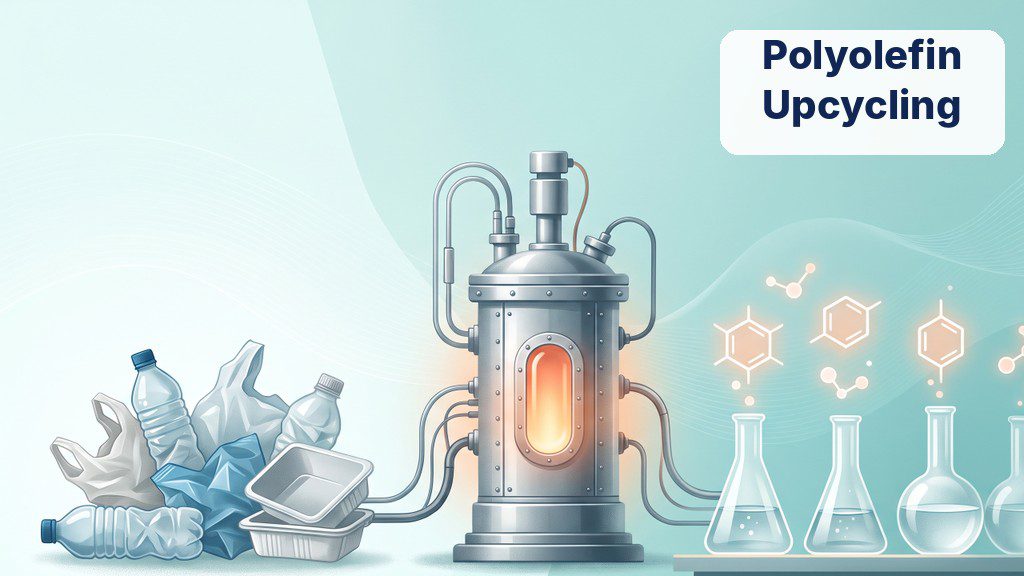
Plastic bottles, bags and food boxes are mostly made of polyolefins. Most of this waste is still buried in landfills or burned. Now a Tianjin University team in China reports a faster chemical recycling route. Their method turns used plastic into aromatic chemicals worth far more than fuel. In particular, it performs polyolefin upcycling in two temperature steps inside one sealed pot. As a result, mixed waste gave about 60% aromatics in half an hour. The study appeared on November 13, 2026, in the open-access journal Nature Communications. So how does splitting one reaction into two steps help so much?
Polyolefins include polyethylene and polypropylene, the world’s most common plastics. Their long chains are made of strong and very similar carbon-carbon bonds. For that reason, it is hard to break them in a controlled way. On the whole, recycling methods simply crack the chains into a messy fuel mix. However, chemists would rather make specific, high-value products. Aromatics such as benzene, toluene and xylenes are an attractive target. After that, they feed the production of new plastics, fibers, detergents and fuel additives. To make them, however, the long chains must first be broken into small pieces. Only then can those pieces be rebuilt into ring-shaped aromatic molecules.
Explainer: Zeolite Catalysts and Aromatics
A catalyst speeds up a reaction without being used up itself. To illustrate, zeolites are porous minerals that work as catalysts in oil refineries. Their crystals contain tiny channels about the size of small molecules. Acid sites inside those channels help molecules break, join and form rings. In addition, the narrow channels favour certain shapes, such as six-carbon rings. For this reason, zeolites are very good at producing aromatics. On the other hand, whole plastic chains are far too large to enter those channels. In other words, the best tool for making aromatics cannot reach the raw plastic.
Two Catalysts, Two Temperature Steps
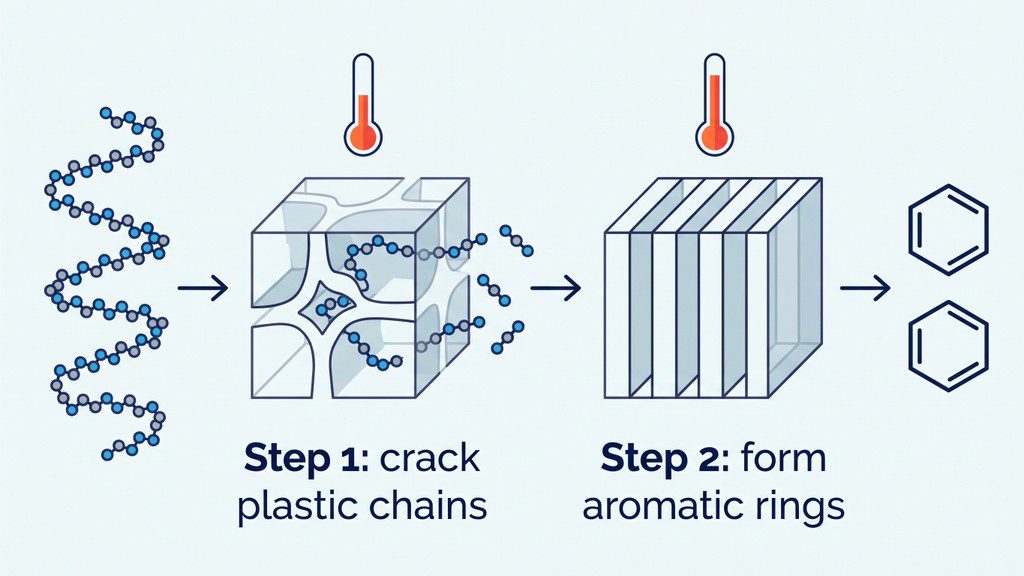
Normally, cracking and ring-making happen together in a single step. As a result, the two jobs compete and limit how much aromatics form. The Tianjin team instead separated the jobs in time within one reactor. First, a self-pillared pentasil zeolite with open, branching pores cracks the plastic. It works quickly below 320 °C, making molecules with four to eight carbons. Then, as the reactor heats towards 380 °C, a second zeolite takes over. This modified MFI zeolite has neighbouring acid sites inside its narrow channels. There, the small molecules are then turned into aromatic rings. Notably, neither catalyst uses precious metals, and no hydrogen gas is needed.
Fig. 1: One Catalyst Cracks the Plastic, the Second Builds Aromatic Rings
Why Separating the Steps Helps
The researchers call their idea temporal decoupling of the two steps. That is to say, each catalyst gets its own time window to work. For example, the cracking catalyst converted 75.6% of polyethylene at only 320 °C. At that temperature, more than 85% of the products were small olefin molecules. These olefins are exactly the pieces the second zeolite needs. In the same way, the MFI zeolite can focus on ring-making once it gets hotter. To confirm this, the team moved cracked products into a separate hot reactor. Together, these tests showed why timed steps improve polyolefin upcycling.
Tested on Real Bottles, Bags and Boxes
Importantly, the team used real household waste rather than clean lab plastic. In particular, the samples included shampoo and hand-sanitizer bottles, resealable bags and food containers. Each test used about 3.6 grams of plastic in a sealed reactor at 380 °C. Within 30 minutes, more than 95% of each plastic was converted. For instance, shampoo bottles gave 59.6% aromatics at 96.7% conversion. By comparison, the MFI zeolite alone reached only 37.9% aromatics selectivity. An equal mix of four common plastics gave a 60.3% aromatic yield. In other words, each gram of catalyst made 11 grams of aromatics per hour. With this in mind, the method is more than twice as productive as earlier routes.
Fig. 2: Mixed Household Plastics Become Aromatics and Fuel Gas
Forty Cycles and Messy Additives
A useful catalyst must survive many runs and dirty feedstocks. To test this, the team regenerated and then reused the catalysts 40 times. Even so, conversion stayed near 98%, and the aromatic yield stayed around 56%. The authors suggest that slow coke build-up is the main cause of any decline. In addition, they added common plastic additives to the feed. These included antioxidants, white titanium dioxide pigment as well as calcium stearate. Surprisingly, none of them noticeably changed conversion or the product mix. Meanwhile, most of the gas formed was propane and butane, sold as liquefied petroleum gas.
Could a Full Plant Pay Off?
To judge real-world value, the authors modelled a full recycling plant. Their design would process 200,000 metric tons of mixed polyolefin waste a year. It would yield about 121,300 tons of aromatics plus fuel gas and gasoline components. At a smaller scale of 17,000 tons a year, the model already breaks even. There, the minimum selling price of aromatics matches the market price of $834 per ton. By comparison, at full scale that minimum price falls to about $396 per ton. Consequently, the model predicts a yearly profit of $52.3 million and a 5.8-year payback. Of course, these are model estimates rather than numbers from a real plant.
Cutting Greenhouse Gas Emissions
The team also ran a life-cycle assessment of greenhouse gas emissions. Such studies compare a new process with the usual routes it replaces. For instance, recycling one kilogram of plastic would release about 1.02 kilograms of CO2 equivalent. That is roughly 26% lower than making the same chemicals from fossil fuels. Compared with burning the same plastic, the saving even rises to about 66%. In short, the process could cut emissions while keeping plastic out of landfills. Still, these figures also come from modelling rather than measured plant data. Our story on single-atom catalysts that convert plastic waste describes another chemical route.
Business Opportunities in Chemical Recycling
Chemical recycling is attracting growing interest from petrochemical and waste firms alike. In the near term, catalyst makers could test these metal-free zeolite pairs on sorted waste. Within five years, pilot reactors could turn bottles and bags into aromatic feedstocks. Such plants would also sell propane and butane as fuel gas. Polyolefin upcycling plants would need workers for sorting, reactor operation and catalyst regeneration. In the long run, plastic-derived aromatics might compete with fossil-based supplies. However, that depends on the model’s economics holding at full plant scale. Our article on enzymes designed to break down PET bottles shows a biological alternative.
Careers and What to Study
Polyolefin upcycling needs chemists, engineers and analysts working together. For example, catalysis scientists design and test zeolites in the lab. Chemical process engineers, in turn, scale reactions up into safe, efficient plants. Meanwhile, life-cycle analysts measure the costs and emissions of each new route. Equally, data skills help teams model plant costs and emissions. According to the US Bureau of Labor Statistics, chemical engineers earned a median $125,040. That figure is from May 2025, with 5% growth projected through 2035. By comparison, chemists earned a median $91,240 in the same period. These are US figures, and pay varies by country. For study, consider chemical engineering, chemistry, materials science or environmental engineering.
Limits Worth Keeping in Mind
Note that every polyolefin upcycling test used small batch reactors with gram-scale samples. The headline 60.3% yield also came from a mix that included polystyrene. Polystyrene already contains aromatic rings, so the yield is easier to reach. Single polyolefin feeds gave aromatic selectivities above 50%, up to about 60%. Moreover, the plant costs and emission savings are model results, not measured data. Real waste may also contain PVC, PET and dirt that these tests did not include. Even so, the results show a clear and simple design idea. In the long run, polyolefin upcycling could turn waste plastic into a steady chemical resource.
References
Xu, X., Ding, Y., Qi, G., Wang, R., Bai, L., Guo, C., Gao, R., Feng, G., Feng, Y., Chen, S., Zhao, Z.-J., Pei, C., Fu, D., & Gong, J. (2026). Selective aromatization of polyolefins by temporal decoupling from cracking. Nature Communications. https://doi.org/10.1038/s41467-026-79441-5
The article explains zeolites, cracking and aromatization in clear, student-friendly terms. Its figures match the paper, including the 60.3% aromatic yield, 40 regeneration cycles and the .3 million modelled yearly profit. The limits section notes that the headline yield came from a feed containing polystyrene, and that PVC, PET and dirt were not tested. Readers who want the full experiments should check the original research paper this story draws on.
Editorial note
ENTECH is running this Discovery because plastic waste is a global problem, and this paper shows a clever reaction-engineering idea. Doing two steps at two temperatures turns real household plastic into chemicals that industry already buys. It shows students how chemical engineers think about timing, heat and catalyst design, not only new materials. The tests used small batch reactors, and the plant costs and emission savings are model estimates. For the full methods and data, we suggest readers turn to the original open-access paper.
Ishika Tawar is a biotechnology researcher and science enthusiast with a curiosity for understanding how life works at the molecular and cellular level. That curiosity started somewhere around school, wandered through a lot of unrelated corners of science and physics, and eventually settled on something she actually wants to spend her life on: aging and longevity. She supports transhumanism and believes that science and technology should be explored seriously as tools to overcome some of the biological limitations of the human body.
Ishika holds a Master's degree in Biotechnology and has experience in both wet-lab and computational research. At ACTREC, she worked on a project studying the interaction of the TG2 protein with the ribosome, where she gained experience in cloning, site-directed mutagenesis, transformation, and gene knockdown. She was also involved in studying ribosomal heterogeneity using R and publicly available single-cell RNA sequencing datasets from different cancers. As a Research Assistant at SafeWright, she worked on client-based projects involving microbial culturing, biochemical tests, and analysis, along with literature research, report writing, and preparation of laboratory protocols. She has also worked with Python-based analysis to study differential DNA methylation in breast cancer.
Her current areas of interest include epigenetics, genomics, gene therapy, stem cell biology, computational biology, and the use of AI in biological research. She is particularly interested in how these areas can contribute to understanding aging and developing ways to extend healthy human lifespan. She has explored this interest through research projects and hackathons focused on AI, aging, and longevity. She enjoys following ideas across biology, technology and physics, and she believes in evidence, questioning ideas and staying curious about things that are not yet understood.
Outside research, Ishika enjoys reading and talking about science and scientific ideas. She loves travelling and is especially fond of mountains. She also enjoys science communication and hopes to make scientific topics easier to understand without making them inaccurate or oversimplified.