A statistical model built from natural protein families produced hundreds of active PET-breaking enzymes, and the best beat a leading benchmark in most test conditions.
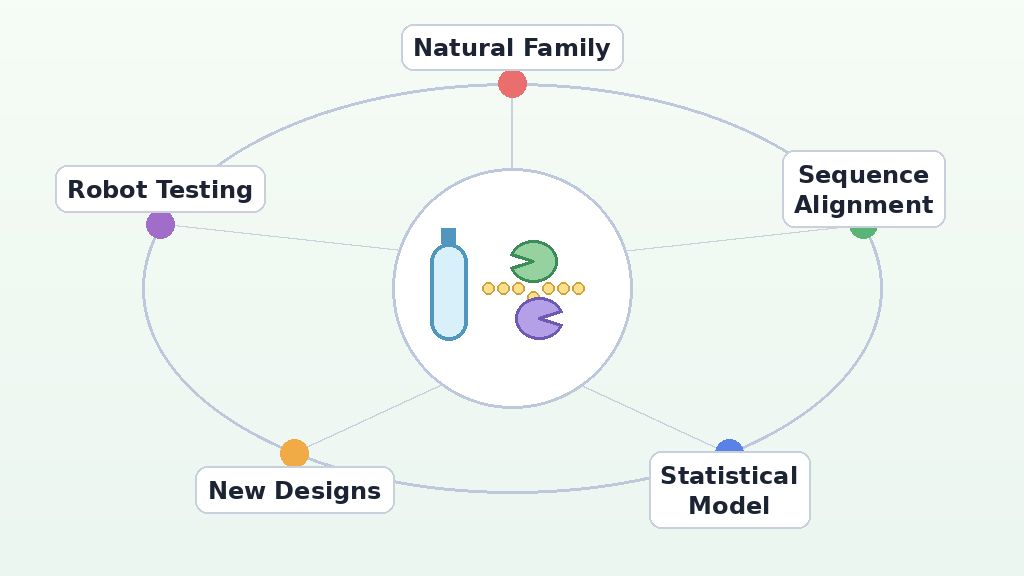
Plastic bottles last for centuries in landfills. Some microbes, however, make proteins that can slowly break this plastic apart. Scientists call these plastic-eating enzymes, and they hope to use them for recycling. Now a large US team has designed hundreds of new versions on a computer. Gregg Beckham at the National Laboratory of the Rockies co-led the work. Nicholas Gauthier, a researcher linked to Harvard Medical School, also co-led it. Partners came from Dana-Farber Cancer Institute, SLAC, and several other groups. The team published its study in Nature Communications on November 3, 2026. Its DOI, for reference, is 10.1038/s41467-026-78471-3. Brenna Norton-Baker served as first author. In short, the team used patterns from natural protein families to guide new designs. After that, robots helped build and test the proteins in large batches.
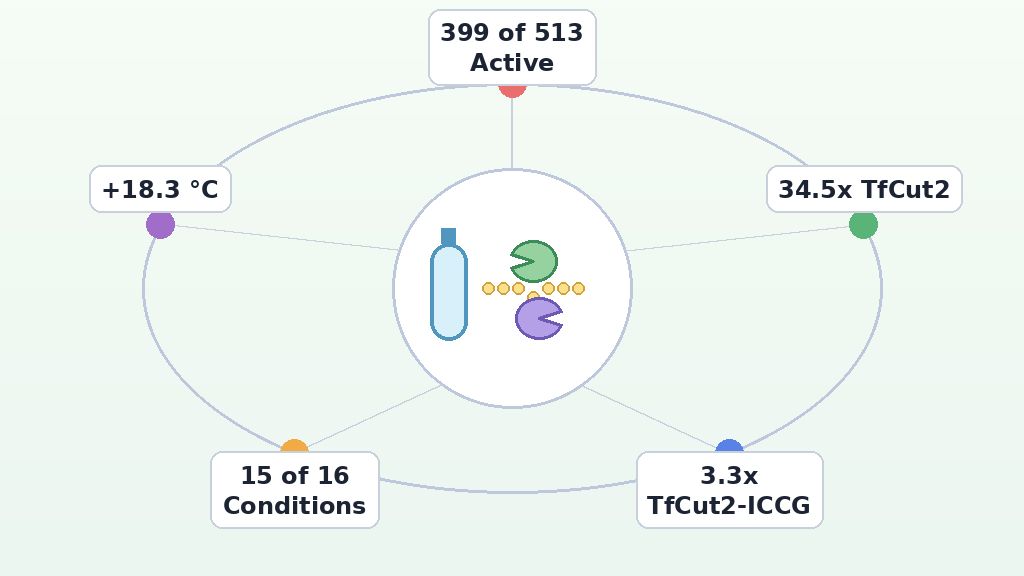
The plastic in question is PET, used in drinks bottles and polyester fabric. In total, the team made and tested hundreds of designed proteins. For one starting enzyme, called TfCut2, 399 of 513 designs worked. On average, these designs carried 41 mutations each. The best designs, in addition, broke down PET up to 34.5 times faster than TfCut2. Some design matched or beat a famous engineered enzyme in 15 of 16 conditions. Two crystal structures also showed that the designs kept their natural shape. Even so, the tests ran only at small scale for 48 hours. Many designs also lost some heat tolerance. On top of that, headlines may call it AI, but it is statistical modeling. In this article, we explain how the method works and what it still needs.
Why Plastic-Eating Enzymes Matter
PET, or polyethylene terephthalate, is a long chain of small repeating units. Breaking that chain releases its building blocks for reuse. In principle, recyclers could then make new plastic of the same quality. Enzymes offer one way to cut the chain at mild temperatures. Our guide to how biological catalysts work explains the basics. Scientists reported the first PET-cutting enzyme in 2005. Later, in 2016, researchers found a bacterium that feeds on PET. Since then, labs have engineered many improved versions. One famous example is LCC-ICCG, which carries four helpful mutations. Even so, real recycling faces several hurdles. For example, the reaction releases acids that lower the pH. Crystalline PET, on top of that, resists enzymes far more than soft, amorphous PET. Because of this, better enzymes remain an active research goal.
The Trouble With Natural PET Hydrolases
Natural enzymes did not evolve to digest bottles. As a result, most work slowly on this tough material. Scientists usually improve them one mutation at a time. That approach, however, explores only a tiny part of the possible changes. A typical enzyme contains a few hundred amino acids. Each position could hold any of 20 building blocks. In other words, the number of possible sequences is enormous. Random changes also tend to break proteins rather than improve them. For this reason, the team wanted a smarter way to choose many mutations at once. Their idea was to learn from evolution itself. Related enzymes in nature share patterns that keep them folded and working. A model trained on those patterns, in theory, could suggest safe changes. That model became the core of the team’s method.
How the EVdesign Experiments Worked
The team called its method EVdesign. First, it gathers thousands of related protein sequences from nature. Next, it lines them up in a sequence alignment. A statistical model then learns which amino acids appear together across the family. The model gives each possible sequence a score. Higher scores suggest sequences that nature would likely accept. After that, a sampling step proposes new sequences with high scores. Notably, the team did not use a deep neural network for this step. The approach builds on an earlier tool called EVcouplings. Moreover, full methods appear in the Nature Communications study. The team began with eight different natural or known PET enzymes. These parents included IsPETase, TfCut2, and LCC. Designs changed between 5% and 20% of each enzyme’s positions. In this way, the team explored both small and large jumps.
Building and Testing Hundreds of Proteins
Testing so many proteins by hand would take years. Instead, the team used a liquid-handling robot to purify them. Bacteria, specifically E. coli, produced each protein from its gene. The team then measured how well each protein resisted heat. They also tested activity on two kinds of PET. One was a thin film with only 4% crystallinity. The other was a powder with 39.3% crystallinity. Each test ran at pH values from 4.5 to 8.5. Tests also ran at 50 °C and 70 °C, giving 16 conditions in total. In each case, enzymes worked on the plastic for 48 hours. Afterward, the team measured the released building blocks with ultraviolet light. Such a broad screen, in particular, showed how designs behaved across many settings. In this way, the team compared designs fairly with their parents.
Results From the First Design Rounds
In round one, designs carried between 24 and 44 mutations. Five of the eight parents gave active designs. TfCut2 designs performed especially well, averaging about 3.1 times the parent’s activity. The best reached 14 times the parent’s level. All 16 active TfCut2 designs beat their parent in at least one condition. However, designs based on LCC never outperformed LCC itself. Next, the team tested more sequence variety. Designs that stayed close to the parent averaged 2.33 times its activity. By contrast, designs that moved farthest away averaged only 0.19 times. Still, the top design came from a fairly distant set. It reached 5.4 times the parent’s activity. The team then added the four LCC-ICCG mutations to TfCut2. As a result, the enzyme’s melting point rose by 18.3 °C, to 90.4 °C.
Plastic-Eating Enzymes That Beat a Leading Benchmark
The team then ran several more design rounds on this tougher enzyme. In total, the team could test 74 of 80 designs from that first heat-tolerant set. All 74 showed activity in at least one condition. Over later rounds, each step changed only 1% to 4% of the sequence. Across conditions, the top designs averaged 34.5 times the activity of TfCut2. Likewise, they beat the heat-tolerant TfCut2 version by 3.3 times. Better still, some design matched or beat LCC-ICCG in 15 of 16 conditions. On average, the best design in each condition reached 1.48 times its activity. At pH 4.5 and 70 °C, the gains looked especially strong. There, designs reached about 2.2 times on powder and 3.3 times on film. Even so, absolute activity at low pH stayed fairly low. In particular, those acidic conditions matter because the reaction itself releases acid.
Fig. 1: Key Results of the EVdesign Study
Explainer: How Evolution Guides Protein Design
Proteins in one family share an ancestor. Over time, their sequences drift apart through mutation. Still, natural selection keeps the changes that preserve shape and function. As a result, some positions change together across the family. If one amino acid changes, its partner often changes too. Scientists call this pattern coevolution. A model that captures these pairs can predict which combinations fit. Our article on cross-species genetics research shows another use of family comparisons. Within EVdesign, the model scores a sequence by how natural it looks. In other words, higher scores mean the sequence resembles a real family member. The sampling step then walks through sequence space, keeping promising changes. Put simply, evolution’s history acts as a guide for safe mutations. As a result, designers can change many positions together.
Why Distant PET Hydrolases Still Fold
Many designs carried dozens of changes compared with their parents. Normally, so many mutations would wreck a protein. Yet 399 of 513 TfCut2 designs still worked. To check their shape, the team solved two crystal structures. One design carried 46 mutations. Even so, its fold looked almost identical to the parent. The average atomic shift was only about 0.3 angstroms. Because of this, the authors argue the model kept the core design rules intact. Many designs, however, became less heat tolerant. In round one, for example, the average melting point dropped by about 5.1 °C. The team fixed this partly by adding known stabilizing mutations. After that step, designs gained between 9.0 and 18.9 °C. In the end, high activity and good stability came together in the same proteins.
Fig. 2: How Evolution Guides Enzyme Design
Challenges and Motivation Behind PET-Degrading Enzymes
The team wanted enzymes that work under real factory conditions. Industry, for example, must control pH as acids build up. Plastic often needs grinding or other preparation before enzymes can act. Crystalline PET also resists attack much more than thin film. For these reasons, the team screened designs across many conditions at once. Their robotic workflow, in turn, made such a large screen possible. Federal researchers have pursued enzyme recycling for years. The NLR enzyme recycling update describes earlier progress at the laboratory. However, the new study does not test a full recycling plant. Instead, it focuses on finding varied starting points for further engineering. Above all, the team wants many good enzymes rather than just one. That variety could help match enzymes to different plastics and processes.
Limits the Researchers Report
The paper notes several limits. To begin with, all tests used small volumes and a single 48-hour endpoint. Second, the team did not yet measure detailed reaction speeds over time. Third, industrial reactors run with far more plastic and need near-complete conversion. On top of that, many designs lost some heat tolerance compared with their parents. Activity at low pH also stayed modest in absolute terms. Next, the method depends on large families of related natural sequences. Enzymes with few known relatives may not suit this approach. Finally, news coverage sometimes calls these AI-designed enzymes. In fact, the method relies on statistical models of evolution, not a chatbot-style system. For this reason, readers should treat that label as a simplification. Larger tests under factory conditions must come next.
Conclusion: What Comes Next for Bottle Recycling
This study shows a fast way to create many working plastic-eating enzymes. A model trained on natural protein families suggested dozens of mutations at once. Robots then built and screened hundreds of designs. The best beat a leading engineered enzyme in 15 of 16 conditions. At the same time, the work remains small-scale and short-term. Factories will need enzymes that convert nearly all of the plastic. Such work blends biology, chemistry, data science, and engineering. For students, it shows how statistics and biology can work together. Our article on one-shot protein binder design explores another protein design tool. In the end, a varied toolbox of enzymes could help recycle bottles more cleanly. For now, these designs offer strong starting points for further engineering. With more testing, they could reach real recycling plants.
References
Norton-Baker, B., Fram, B., Thadani, N. N., Komp, E., Su, Y., Storment, O. O., Murphy, N. P., Lim, S., Erickson, E., Rollins, N., Gado, J. E., Shearer, C. A., Mathews, I. I., Truebridge, I., Llases, M., Bahl, C. D., Sarangi, R., Marks, D. S., McGeehan, J. E., . . . Gauthier, N. P. (2026). Iterative computational and rational design generates varied PET hydrolases for plastic depolymerization. Nature Communications, 17, 11371. https://doi.org/10.1038/s41467-026-78471-3
I checked the brief against the published PDF. Correct: 603 designs from eight parent PETases; more than 400 active variants with 12-68 substitutions, nearly all outperforming their parents; TfCut2 as the most design-amenable scaffold; an 18.3 °C stability gain in TfCut2 from the four ICCG mutations; and at least one design matching or exceeding LCC-ICCG 48-h product formation in 15 of 16 conditions, with about 2.2-fold (powder) and 3.3-fold (film) gains at pH 4.5 and 70 °C. The paper describes EVdesign as evolution-informed statistical modeling rather than 'AI' in the narrow sense; the topic label 'AI-Designed' is a reasonable simplification, and the brief text describes the method accurately. The brief rightly flags that industrial conditions (high solids loading, pH control, high conversion) remain untested. Verdict: accurate; no corrections needed.
Editorial note
ENTECH runs this story because plastic recycling is a major industry challenge, and enzymes that break PET down to its building blocks could make recycling cleaner and closer to a closed loop. A team from the National Laboratory of the Rockies, Harvard Medical School and partners used an evolution-guided computer method to design and test 603 enzymes, and many of them matched or beat a well-known benchmark enzyme. For teens, it shows how biology, chemistry and computer science combine in protein design, one of science's fastest-moving fields. Caveats: the tests were small lab assays, not factory conditions; activity at low pH is still modest; and many designs were less heat-stable than the original enzymes. Takeaway: a powerful design tool for recycling enzymes that still has to prove itself at scale.
Ishika Tawar is a biotechnology researcher and science enthusiast with a curiosity for understanding how life works at the molecular and cellular level. That curiosity started somewhere around school, wandered through a lot of unrelated corners of science and physics, and eventually settled on something she actually wants to spend her life on: aging and longevity. She supports transhumanism and believes that science and technology should be explored seriously as tools to overcome some of the biological limitations of the human body.
Ishika holds a Master's degree in Biotechnology and has experience in both wet-lab and computational research. At ACTREC, she worked on a project studying the interaction of the TG2 protein with the ribosome, where she gained experience in cloning, site-directed mutagenesis, transformation, and gene knockdown. She was also involved in studying ribosomal heterogeneity using R and publicly available single-cell RNA sequencing datasets from different cancers. As a Research Assistant at SafeWright, she worked on client-based projects involving microbial culturing, biochemical tests, and analysis, along with literature research, report writing, and preparation of laboratory protocols. She has also worked with Python-based analysis to study differential DNA methylation in breast cancer.
Her current areas of interest include epigenetics, genomics, gene therapy, stem cell biology, computational biology, and the use of AI in biological research. She is particularly interested in how these areas can contribute to understanding aging and developing ways to extend healthy human lifespan. She has explored this interest through research projects and hackathons focused on AI, aging, and longevity. She enjoys following ideas across biology, technology and physics, and she believes in evidence, questioning ideas and staying curious about things that are not yet understood.
Outside research, Ishika enjoys reading and talking about science and scientific ideas. She loves travelling and is especially fond of mountains. She also enjoys science communication and hopes to make scientific topics easier to understand without making them inaccurate or oversimplified.