Factories need thousands of small parts delivered in the right order every day. Today, that tiring prep work is mostly done by people. On November 10, 2026, Google DeepMind announced Gemini Robotics 2.5, a new robot-control AI. The company calls it its most capable vision-language-action model so far. In a pilot on Mercedes-Benz production lines, it guided humanoid robots that sorted car parts. According to DeepMind’s official blog, the robots succeeded 96% of the time. However, these are the company’s own reported results from a proof-of-concept. So what does this kind of AI actually do inside a robot?
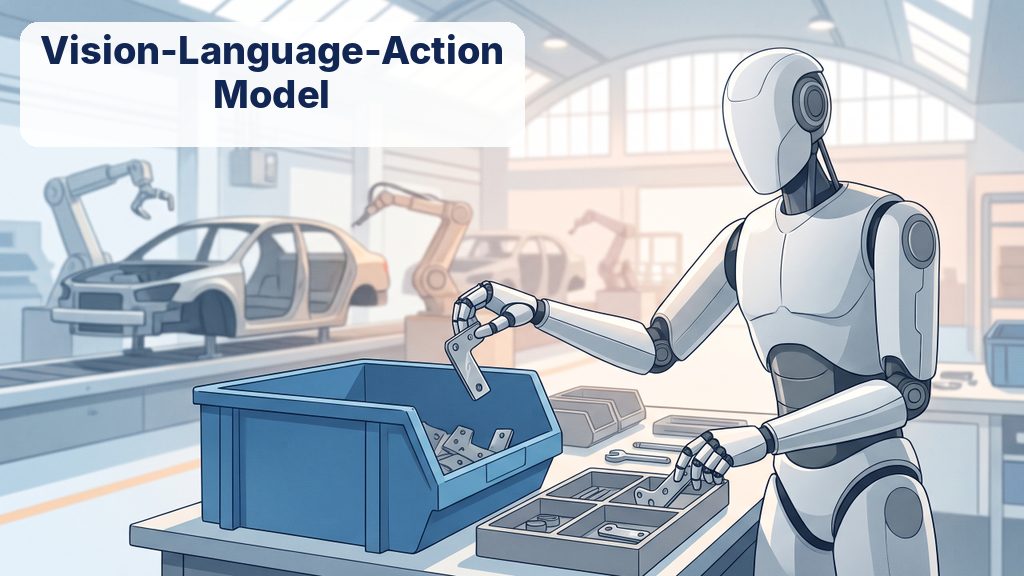
Most AI chatbots only read and write text on a screen. A robot, by contrast, must also see its surroundings and move its body safely. In short, a vision-language-action model joins these three abilities in one system. First, it looks at camera images of the scene in front of the robot. Then, it reads an instruction written in ordinary language, like a spoken request. Finally, it turns that understanding into motor commands for the arms and hands. In other words, the model links seeing, understanding and doing in a single loop. That is why engineers call such systems a kind of physical AI.
Explainer: How a VLA Model Learns Skills
Imagine asking a friend to pass the salt across a crowded table. To that end, your friend must find the salt, plan a path and grip gently. Robots need the same steps, but each one is hard for a machine. For example, objects can be shiny, floppy or partly hidden behind other things. Traditional factory robots avoid this problem by repeating one fixed motion forever. A VLA model instead learns general skills from many examples and demonstrations. As a result, the same robot can, in principle, switch between different tasks. Even so, every new skill still needs testing before it is trusted at work.
Gemini Robotics 2.5 in the Lab
DeepMind says it tested the new model on 200 distinct tasks. Examples included serving food with tongs, tying gift bows and pipetting liquid. In effect, such jobs combine tool use, soft materials and delicate handling at once. Against previous baselines, the vision-language-action model raised success rates by 30% to 100%. As a matter of fact, the gain depended on the type of task. At the same time, robots finished tasks 20% to 30% faster than before. Note that DeepMind compared the model with its own earlier systems. In particular, it did not compare the robots with human workers or rival systems.
Fig. 1: One AI Links What the Robot Sees, Reads and Does
Two Hands, Many Robot Bodies
The vision-language-action model works with several robot designs, according to DeepMind. One is Apptronik’s Apollo 2, a humanoid robot with five-fingered hands. In particular, each SharpaWave hand has 22 degrees of freedom, or joint motions. Another is the Franka Duo platform, which uses simple two-fingered grippers instead. To speed up training, DeepMind also used its Gemini 4 Argon model as a simulator. For instance, Argon can turn one real camera scene into thousands of practice runs. Together with real demonstrations, these virtual runs help robots handle new scenes faster. Our story on rehearsing delicate assembly work in simulation explains this idea.
Automotive Kitting Robots on Real Lines
Next, DeepMind tested the system with Apptronik and Mercedes-Benz in real factories. The pilot ran on active production lines in Kecskemét, Hungary, and Sindelfingen, Germany. There, Apollo 2 robots performed a job called automotive kitting. In essence, kitting means sorting individual parts from bulk bins into organised trays. Each tray must hold the parts in the exact order needed for one vehicle. Because this work is repetitive and tiring, it suits a patient machine. Equally important, human technicians can then focus on more complex building tasks. In this proof-of-concept, the automotive kitting robots worked without remote control.
Fig. 2: Kitting Sorts Loose Parts Into Trays in Build Order
How the Two Models Share the Work
Two AI models split the job between them during the pilot. First, an embodied reasoning model called Gemini Robotics ER kept track of the workflow. In addition, it decided which part came next and checked progress along the way. Meanwhile, the Gemini Robotics 2.5 actions model controlled the robot’s hands and arms. In this way, Apollo 2 reached into supply bins and picked up metal brackets. It then placed each bracket into a sequencing container, correcting for any gaps. Overall, DeepMind reports a 96% success rate for this kitting pilot. Apptronik’s chief executive said the models improved greatly within a few weeks. What is more, he said the skills carried over with little loss.
Safety Around People and Obstacles
Robots that work near people must avoid bumping into them or into equipment. To help with this, Gemini Robotics 2.5 uses reasoning guidance while it is running. That is to say, it checks planned moves against nearby hazards in real time. In the same way, safety filters already guard Gemini’s text answers, DeepMind notes. During its evaluations, safe task completion around obstacles rose by 33%. Likewise, safe completion around nearby people improved by 43%. Still, these are lab evaluation results rather than independent safety certifications. Factories would also need their own safety checks and rules before any wider use.
Testing Robots Against Tricky Prompts
A jailbreak is a cleverly worded request designed to trick an AI into unsafe behaviour. For robots, such tricks could mean real physical harm rather than just bad text. To study this risk, DeepMind released an open benchmark called ASIMOV-Jailbreak. For this purpose, it contains hundreds of prompts hiding unsafe requests across dozens of scenes. According to DeepMind, Gemini 4 Argon resisted 99.5% of these disguised attacks. By comparison, the earlier Gemini Robotics ER 2 model resisted 82% of them. Because the benchmark is public, other researchers can now test their own robot models. In the long run, shared tests like this could make robot safety easier to compare.
Business Opportunities for Robot Dexterity
Right now, carmakers working with DeepMind’s partners can test the vision-language-action model on more lines. Robot makers, likewise, can try the model on different arms and hands. Within five years, reliable humanoids could take over more repetitive factory preparation work. As a result, that shift could create jobs in fleet operations and AI-robotics integration. Human-robot safety would also become a growing specialty in modern factories. At the same time, some manual line-preparation roles could change or shrink. In the long run, general-purpose robot dexterity could spread to warehouses and other workplaces. Of course, that depends on safety, cost and reliability holding up at scale.
Careers and What to Study
Smart factory robots need teams that mix mechanics, software and safety skills. For example, robotics engineers design arms, hands and sensors that survive daily factory use. Machine learning engineers, in turn, train the models that turn camera images into motions. Meanwhile, manufacturing engineers plan where robots fit into an assembly line. According to the US Bureau of Labor Statistics, mechanical engineers earned a median $104,110. That was in May 2025, with 11% job growth projected through 2035. Industrial engineers earned a median $102,440, with 12% growth projected over the same decade. Of course, these are US figures, and pay differs between countries. With this in mind, consider studying robotics, mechanical engineering, computer science or industrial engineering.
Limits Worth Keeping in Mind
Note that every performance figure here comes from DeepMind’s own reports. The factory work was a proof-of-concept and pilot, not a commercial deployment. Moreover, DeepMind did not say how many robots took part. Nor did it say how long the trial ran. It also did not report how many attempts were counted toward the 96% figure. ENTECH found no matching Mercedes-Benz or Apptronik release confirming that number. In addition, the model is rolling out only to DeepMind’s robotics partners for now. Our article on an earlier Gemini robot reasoning release gives useful background. Even so, the pilot shows how fast a vision-language-action model can approach factory work.
The article explains vision-language-action models, automotive kitting and the two-model split in clear, student-friendly terms. Its figures match DeepMind's post, including 200 tasks, 30% to 100% higher success, 20% to 30% faster work and the 96% pilot. It attributes every number to DeepMind, keeps the pilot framing and paraphrases the Apptronik chief executive. Readers who want the full context should check the original announcement this story draws on.
Editorial note
ENTECH is running this Innovation because it shows a robot-control AI working on real car production lines, not only in a lab. It explains in plain terms how one model links seeing, reading instructions and moving. Students can see how machine learning, mechanical design and manufacturing engineering come together. All performance figures are DeepMind's own reports from a proof-of-concept, and no partner release confirms the 96% figure. For the full details, we suggest readers turn to the original DeepMind announcement.
Sneha More is an Information Technology specialist, data analyst, and technology writer with a strong focus on data science, big data frameworks, and modern web technologies. Guided by a philosophy of continuous, hands-on learning, she explores how distributed systems and analytical models can be leveraged to extract meaningful insights from massive datasets.
With practical experience in data analytics, dataset manipulation, and statistical modeling, Sneha examines the intersection of machine learning, big data infrastructure, and practical software engineering. She is particularly interested in how emerging data architectures can drive informed decision-making and solve real-world technical challenges.