At CoRL 2026, NVIDIA and its partners showed how robots practice fitting gears, nuts and cables in simulation, with new physics tools, benchmarks and smarter training.
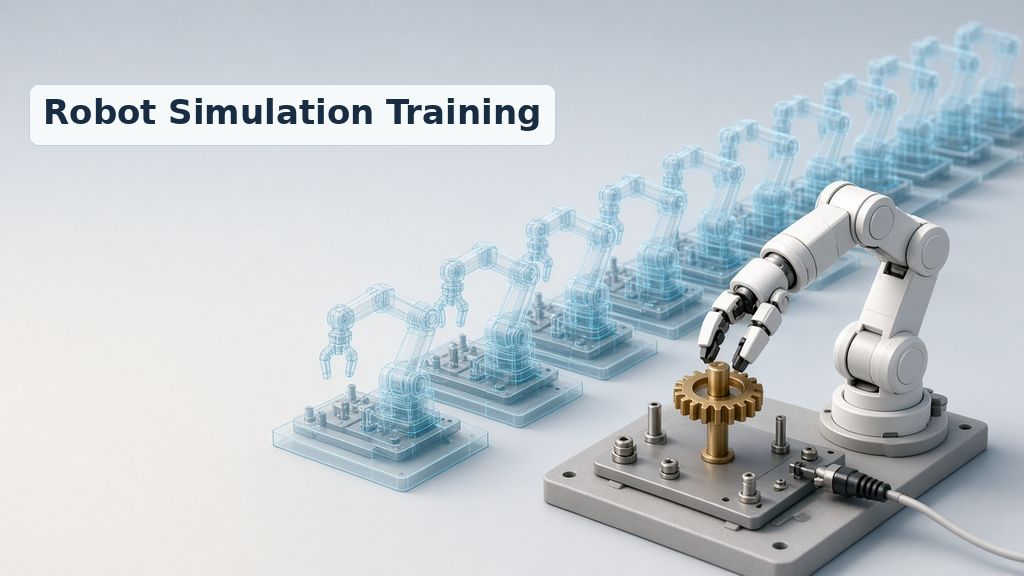
Robots have practiced walking in virtual worlds for years. Now they rehearse fussier jobs, such as fitting gears and plugging in cables. On November 9, 2026, NVIDIA described this shift in an official NVIDIA blog post. It appeared during the Conference on Robot Learning in Austin, Texas. To begin with, you might wonder what CoRL is. Each year, robotics and machine learning experts meet there. At the same time, NVIDIA released new open tools, benchmarks and models for researchers. Partners such as the University of Washington and UC Berkeley also joined in. The big idea is simple. A robot can practice a delicate task again and again inside a computer. As a result, it reaches the real world with skills already tuned. That is the promise of robot simulation training, and it keeps getting sharper. So let’s look at how it works.
Why Robot Simulation Training Is Moving Beyond Walking
Robot walking is hard, but it forgives small mistakes. A dog-like robot can stumble, catch itself and keep going. ENTECH covered a quadruped that learned to walk in simulation earlier in 2026. Delicate handling, in contrast, punishes even tiny errors. A gear must line up with its post before it slides down. Similarly, a cable plug needs the right angle, or it simply jams. For this reason, researchers call these tasks contact-rich work. The robot has to press, slide and twist parts while touching them. Every touch changes the forces in ways that are hard to predict. NVIDIA describes this as a shift from locomotion to manipulation. Locomotion means moving the whole body around. Manipulation, on the other hand, means handling objects with grippers or hands. Still, the trick that taught robots to walk can help here too. The practice just needs a safe, cheap place.
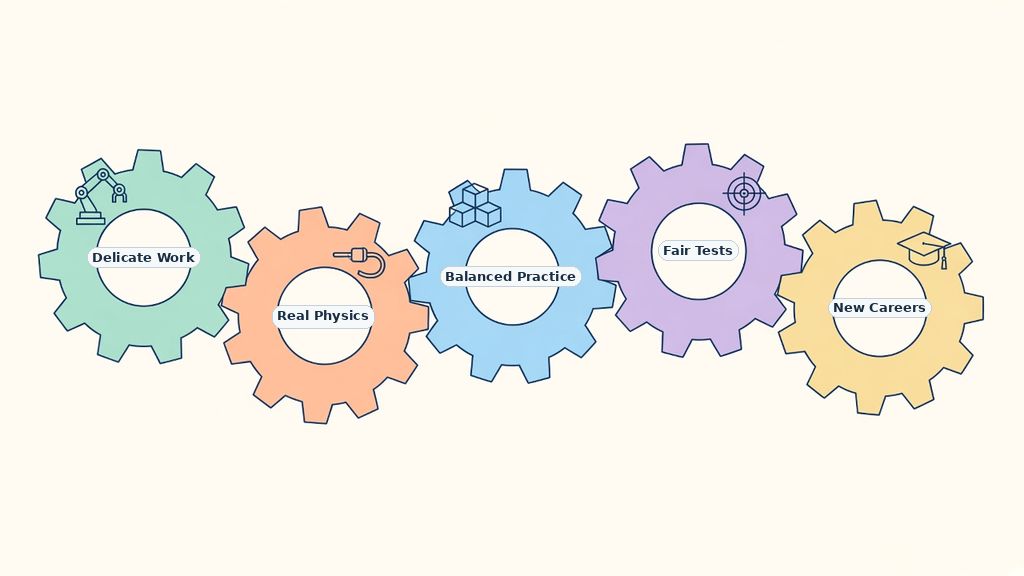
Fig. 1: Key Takeaways on Robot Practice in Simulation
The Tiny Parts on the NIST Task Board
So what counts as a truly fussy job? The US National Institute of Standards and Technology has an answer. NIST develops assembly test methods for robots built around common parts. For example, these include screws, nuts, washers, gears and electrical connectors. In other words, labs can compare robot skills on the same small parts. The AlphaNIST project uses NIST Assembly Task Board #1. This board holds twenty assembly tasks, with parts as small as 4 mm. That is under half a centimeter. One part can take several changes of grip and angle to fit. Tight gaps also leave little room for error. Because of this, a tilted nut can jam or cross-thread on its bolt. In addition, an installed part may block the gripper’s next move. As a result, the robot must also pick a sensible order. Put simply, it has to plan a few steps ahead.
Explainer: How a Robot Practices Inside a Computer
Most of this work relies on reinforcement learning, or RL. RL works a lot like mastering a video game by trial and error. The robot tries an action and then gets a score. A good result earns a reward, while a bad one earns nothing. Over time, it builds a policy, its rulebook for acting. Real robots, however, learn slowly and can break things along the way. In other words, practice on real hardware costs time and money. To begin with, a virtual robot never wears out its motors. In addition, a simulation can run thousands of virtual robots side by side. NVIDIA’s open source Isaac Lab framework handles this kind of training. Its latest release, Isaac Lab 3.0, lets AI agents set up practice scenes quickly. Researchers can then switch physics engines and renderers. So a robot can gather far more practice than real hardware allows.
Physics Engines That Bend Cables and Squash Strawberries
Practice only helps if the virtual world behaves like the real one. In a cheap game, a cable might pass through a wall. A real cable, in contrast, bends, snags and pushes back. For this reason, NVIDIA calls accurate physics critical for moving skills to real robots. Isaac Lab now works more tightly with Newton, an open source physics engine. Newton can model soft, bendy objects such as cables and cloth. It also handles robot hands with many joints that touch each other. One NVIDIA demo shows a strawberry squashing under a robot’s grip. NVIDIA also measured speed on a camera-based hand-control benchmark. There, Isaac Lab 3.0 with Newton reached up to 2.5 times the training throughput. That compares with the older Isaac Lab 2.3 running on PhysX. In other words, the same setup churned through far more practice. Meanwhile, Skild AI built a solver called STEEL on Newton.
The Balanced Data Diet Behind Simulated Robot Training
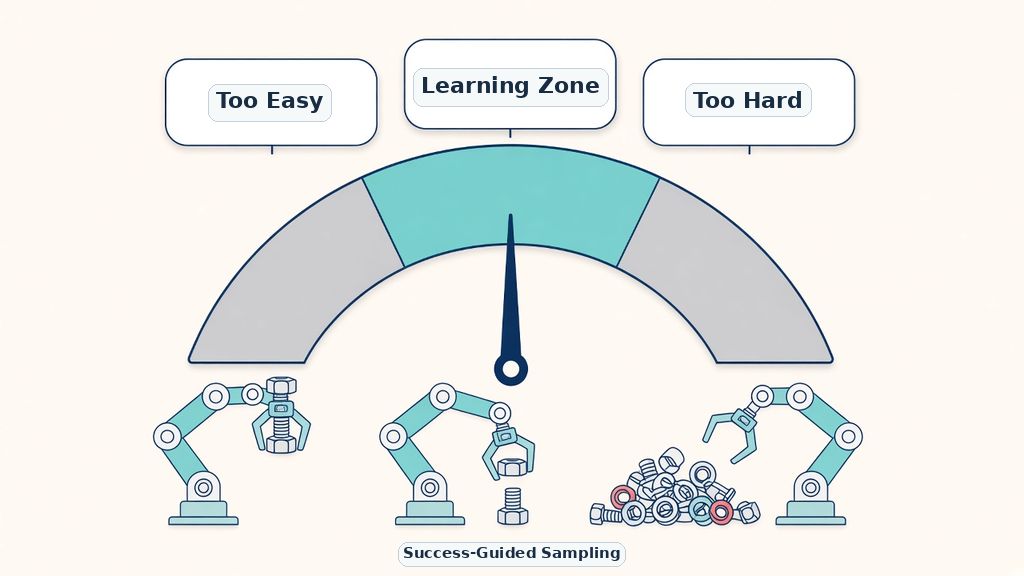
More virtual robots should mean faster learning, right? Not always, says a CoRL 2026 paper from the University of Washington and NVIDIA. Anyone can read A Balanced Data Diet for free. The authors found that random practice wastes a lot of effort. Many tries go to setups the robot has already mastered. Others, meanwhile, go to setups it cannot even attempt yet. So the team built Success-Guided Sampling, or SGS. This method steers practice toward setups the robot solves about half the time. Good coaches do much the same with athletes. Under the hood, SGS is standard RL with a small extra loop. In other words, it only changes which setup each virtual robot restarts from. As a result, the robots kept improving up to about a million parallel copies. On a nut-and-bolt task, SGS then reached 70% success. Uniform random practice, in contrast, managed only 6%.
Fig. 2: How Success-Guided Sampling Picks Robot Practice
Inside AlphaNIST: Robot Training in Simulation Meets Millimeter Parts
SGS also powers AlphaNIST, a project built in Isaac Lab. Its name nods to AlphaZero, which mastered board games without human examples. AlphaNIST brings that same idea to robot assembly. To begin with, one single policy learns all twenty tasks on the NIST board. The robot gets only a yes-or-no signal for success. Nobody tells it how to grip, tilt or twist each part. Even so, NVIDIA reports more than 98% training success for this policy. Separate policies for each task, in contrast, reached only 81%. In addition, the single policy needed roughly 39 times less GPU time. GPUs are the graphics chips that run these huge simulations. How does it practice so well, then? First, the team stores many starting states inside the simulation. These include loose parts, parts already gripped and half-built assemblies. Near-finished starts let the robot rehearse the final step before the whole job.
Surprising Moves the Robot Found on Its Own
Here comes the fun part. With room to explore, the robot found its own clever tricks. For example, it rolled an M12 nut from its edge onto a flat face. Then it set the nut on the bolt. A smaller M4 nut turned with one-sided fingertip taps. The gripper also put a D-sub connector down and regrasped it to line it up. In the same way, it pushed an 8 mm rod before lifting it. Nobody programmed any of these moves. Extra rewards for reaching and alignment actually lowered success in one test. In other words, too much hand-holding got in the way. The SGS team then went a step further. A UR5e arm trained only in simulation worked on a real task board. It used camera images and never practiced on real hardware first. As a result, it fitted nuts, rods and gears zero-shot on that board.
New Tests for Robots Under Changing Conditions
A new skill is one challenge. Reliable results under changing conditions are another. For this reason, NVIDIA brought a developer preview of Isaac Lab-Arena 0.4 to CoRL. This open source tool runs a robot policy across thousands of varied test scenes. Then it shows which conditions caused the failures. In other words, researchers learn exactly what to fix next. Two new open benchmarks build on it. DexBench from RLWRLD, made with NVIDIA, offers 15 tasks across four scenes. They span retail, logistics, factory work and hospitality. Meanwhile, the VABAR benchmark comes from researchers at UC Berkeley, NVIDIA and Siemens. It covers six task types, such as tool hanging, syringe packing and cable routing. In addition, each task has difficulty tiers and clear success measures. VABAR also offers a library of 33 reusable robot skills. The open-access VABAR paper explains the full design.
What Sim-to-Real Robot Learning Means for Future Engineers
Skills alone do not finish a job, though. A robot often needs to chain several skills and recover from slips. That is where agentic robotics comes in. Here, AI agents write and test robot programs. UC Berkeley’s Graph-as-Policy framework, or GaP, links single skills into one program. Agents then test each program in NVIDIA’s simulation tools. After that, they fix it based on what failed. At the same time, engineers can still read and check the program before deployment. Ken Goldberg, a robotics professor at UC Berkeley, helps lead VABAR and GaP. He calls agentic robotics the most exciting technological development since the internet in 1995. Not only that, NVIDIA also introduced GR00T 2, an open world action model. With one demonstration per task, it averaged 71% success across 50 tasks. Five demonstrations pushed that figure to 95%. In short, few examples can still teach a lot.
New Roles for Students Who Love Building Robots
So what does all this mean for you as a student? First, robot learning needs people who mix coding with real engineering sense. Robotics engineers on O*NET research, design, develop or test robotic applications. Simulation work adds tasks to that list, such as building virtual test scenes. In addition, someone must check that a virtual skill holds up on real hardware. The University of Texas at Austin uses Isaac Sim and Isaac Lab too. Its students can start developing before the physical robots are even available. Because many tools are open source, curious learners can explore them. ENTECH has also explained compliant arms that learn factory tasks recently. In the same way, our story on robots that adjust movements instantly shows another path. Not only software skills but also mechanical and electrical ones have a place here.
Where Robot Simulation Training Still Falls Short
Still, a little caution helps here. AlphaNIST’s headline numbers describe training success inside simulation. The real-world SGS tests shown so far cover only a few tasks. In addition, the SGS code was still listed as coming soon. Many partner results also come from NVIDIA’s own blog rather than outside tests. So it makes sense to watch for independent replications over the coming months. Even so, the direction is clear and exciting. Robots no longer need to break real parts to learn delicate work. Instead, they can fail countless times in a virtual world first. Then they carry those lessons to a real factory bench. As a result, robot simulation training may soon help with fiddly factory jobs. For students, that opens a field where coding, physics and hands-on building meet. And that sounds like a pretty good place to start a career.
Xie, S., Chen, K., Yoo, U., Zhu, X., Shen, M., Drake, J., Solowjow, E., Gulich, L., Millane, A., Cathomen, R., Stuyck, T., Subramanian, S., Pan, Y., McGowan, B., Benedict, M., Fan, L., Zhu, Y., Huang, S., & Goldberg, K. (2026). VABAR: A variational automation benchmark for agentic robotics (arXiv:2611.06881). arXiv. https://arxiv.org/abs/2611.06881
Zhang, O., Guaman Castro, M., Yin, P., Dagnino, I., Gupta, A., Scalise, R., & Boots, B. (2026). A balanced data diet: Addressing the exploration bottleneck in mega-scale RL for robot control (arXiv:2610.12465). arXiv. https://arxiv.org/abs/2610.12465
This story explains how robots practice delicate assembly in simulation, with friendly comparisons that keep the ideas easy to follow. The coach comparison makes a tricky training method feel natural for young readers. A follow-up could track how these practiced skills hold up on real factory floors over time. Readers who want every detail can explore NVIDIA’s original blog post and the research pages it links.
Editorial note
We chose this story because it shows robots learning the careful, hands-on work that factories still find hard to automate. The article explains the training ideas in plain language and keeps the limits of simulation results in view. Many partner results come from NVIDIA’s own announcement, so they are reported here as the company described them. For the complete account, readers can turn to NVIDIA’s original blog post and the open research papers it links.
Dinesh Joshi is a leading consultant in the field of product design and development, production engineering, industrial engineering, and program management. He has worked with esteemed domestic as well as European and US organizations.
Mr. Dinesh G. Joshi has completed Graduation in Mechanical Engineering from Pune University and thereafter pursued Post Graduation in Production Engineering from Walchand College of Engineering Sangli (Shivaji University). He is member of Project Management Institute (PMI), Pennsylvania, USA as well as Indian Institute of Welding (IIW) Kolkata. He has good blend of diversified experience of about 22 years in Product Design and Development, Production Engineering, Industrial Engineering and Program Management by virtue of working in the esteemed domestic as well as European and US organizations in addition to 5 years of academic experience.