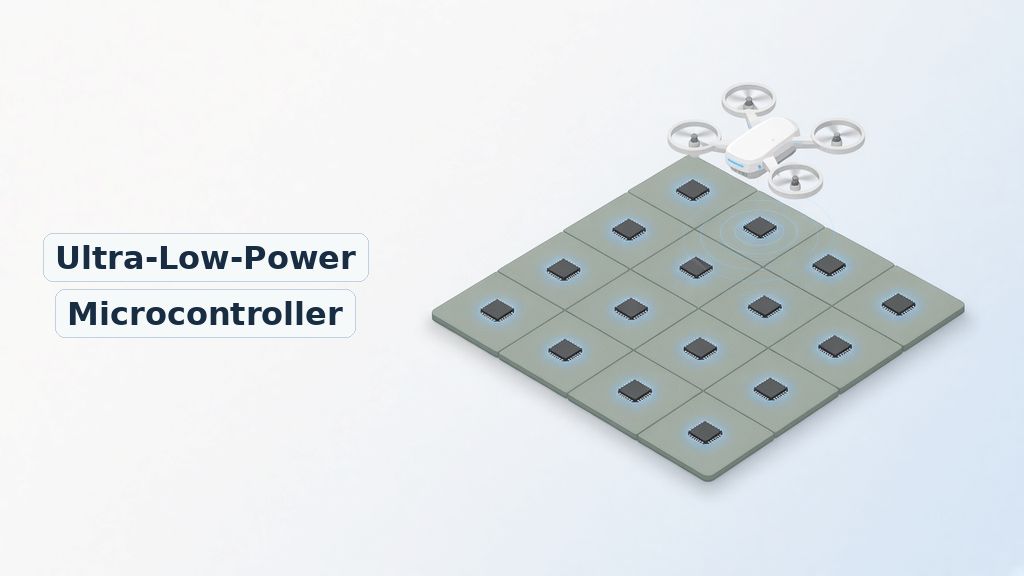
Engineers at Jiangnan University built an 8-bit chip that sleeps on 24.9 nanowatts and wakes to sort touchdowns, uneven loads and bending on a flexible landing pad.
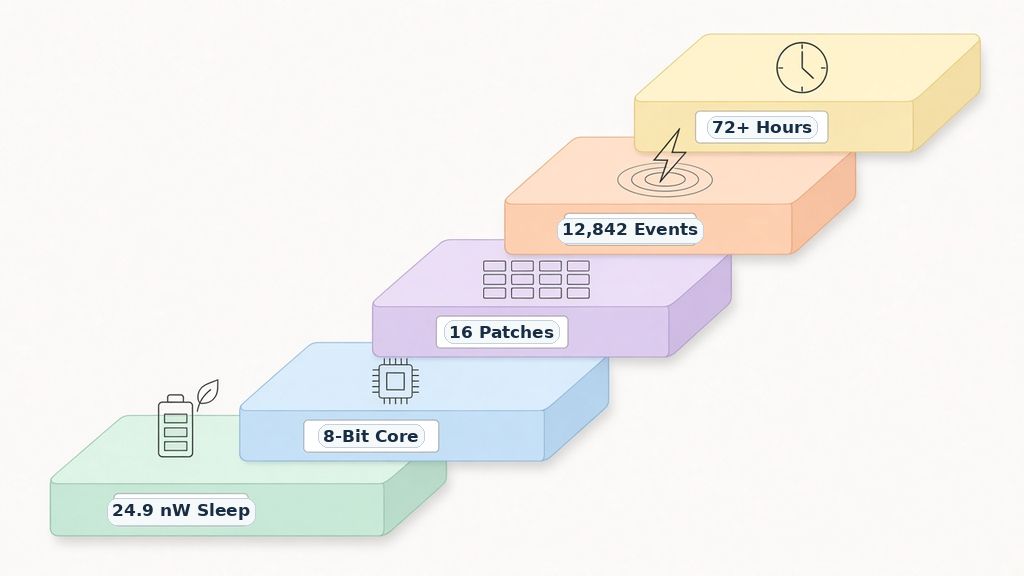
A drone landing pad can look like a plain mat. Future versions, however, may hide hundreds or even thousands of sensors. Those sensors must stay alert for months. Yet they rarely have real work to do. On November 10, 2026, engineers at Jiangnan University in Wuxi, China, revealed one answer. Their ultra-low-power microcontroller, called Pico-X, sleeps on just 24.9 nanowatts. In other words, it uses about one forty-millionth of a watt. At the same time, the chip keeps its memory intact while it naps. Then, when a load presses the pad, it wakes, checks its sensors and reports. Yuyang Xiong conceived the study, and Xinlong Mao designed the hardware. Yanfeng Jiang supervised the work. The team described the chip in Nature Communications. So how can a processor do useful work on so little energy? To begin with, it keeps less. As a result, it leaks less.
Why Drone Landing Pads Need an Ultra-Low-Power Microcontroller
Small aircraft are moving steadily toward everyday use. The paper ties this trend to drones and electric vertical takeoff and landing aircraft. People call them eVTOLs. An FAA overview calls powered lift the first new aircraft type in nearly a century. They also need places to land. According to the authors, flexible landing pads will track occupancy, loads and structural safety. For this reason, each pad needs dense arrays of pressure and strain sensors. Each sensor node, however, spends most of its life idle. In contrast, a touchdown or a sudden shove happens only now and then. As a result, peak speed matters far less than quiet waiting. The authors set a budget of below roughly 100 nanowatts per node. Below that level, a node could run for a year or more without upkeep. So that budget shapes every design choice in Pico-X.
Fig. 1: Key Takeaways From the Pico-X Chip
When Tiny Leaks Add Up Across Thousands of Nodes
Every chip leaks a little current, even when it does nothing. On one node, that leak seems trivial. Across a whole pad, however, it multiplies. The authors call this the leakage multiplier effect. In other words, thousands of tiny leaks can add up to a serious drain. As a result, standby power decides whether the pad can run on its own. General-purpose microcontrollers make this harder. Many carry wide 32-bit datapaths, extra registers and rich bus systems. Yet, according to the paper, a threshold-checking workload rarely uses those parts. Even so, those parts leak around the clock. Hardwired circuits, in contrast, avoid the waste. But they cannot adapt when sensors age or thresholds change. For this reason, the team wanted a programmable chip that kept only essentials. That goal led straight to Pico-X.
Explainer: Nanowatts, Leakage and Body Bias
A watt measures how fast a device uses energy. One nanowatt, then, is one billionth of a watt. So Pico-X sips power at an almost absurd trickle. Think of a dripping tap in an empty house. Nobody uses the water, yet the meter keeps turning. In the same way, switched-off transistors still let a tiny leakage current slip through. Active switching hides that leak in a busy chip. In contrast, the leak becomes the main bill in a sleeping chip. Memory also adds cost. A chip that keeps data during sleep must keep those memory cells powered. Each stored bit, therefore, adds a small but constant cost. For this reason, Pico-X attacks both sides of this problem. First, it stores fewer bits. Then it controls how its transistors leak.
A Back-Gate Dial for Speed or Savings
The chip uses a manufacturing process called fully depleted silicon-on-insulator, or FD-SOI. Its 28-nanometer transistors sit on a thin insulating layer. Beneath that layer lies a back gate. Engineers can apply a small voltage there, known as body bias. Suppose the bias acts like a dial on each transistor. Turn it one way, and transistors switch faster but leak more. Set it the other way, and they leak less but slow down. Pico-X uses both settings. To begin with, it applies a mild 0.3-volt forward body bias during active work. As a result, signals move faster and timing margin returns. In deep sleep, however, the bias drops to zero. At the same time, the chip avoids extra leakage while it waits. Its memory array, meanwhile, stays at zero bias in both modes.
Inside the Pico-X Chip
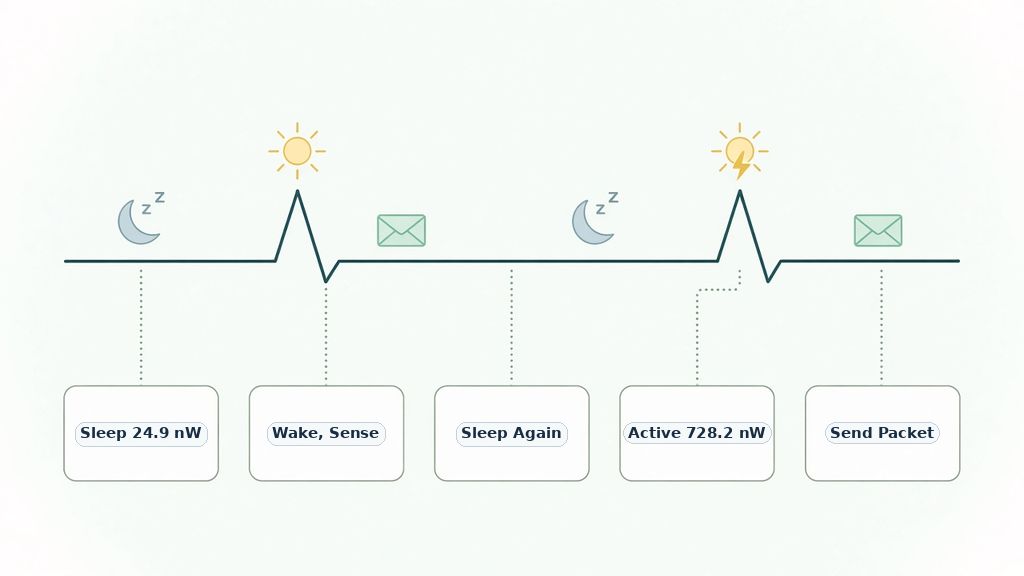
The finished die measures just 315 by 315 micrometers. In other words, each side spans about a third of a millimeter. Inside sit an 8-bit processor core and 4 kilobytes of memory. The memory alone fills about 69% of the core area. Unlike many processors, the Pico-X chip has no pipeline and no cache. Instead, it runs each instruction through a short series of steps. Engineers call it multi-cycle. As a result, it trades raw speed for fewer circuits and less stored state. The chip also uses a custom instruction set with fixed 16-bit words. According to the authors, they kept an instruction only when its cost made sense. Rare operations, such as division, therefore run slowly through an iterative unit. At 25 kilohertz, the chip draws 728.2 nanowatts while active. Not only does it sleep lightly, but its busy mode also stays below one microwatt.
Keeping Only the Bits That Matter
How did the team decide what to keep? First, they built a method called sequential-bit budgeting. It starts with sleep power. Next, it works out how many stored bits the chip can afford. That number then guides choices about registers, control logic and saved state. Program code and working data also share one memory block. Because that memory holds its contents during sleep, the chip skips software reloads after naps. As a result, it simply wakes and continues. The team checked this by writing known patterns into memory before sleep. After waits of up to one hour, they read the memory back. In the normal operating range, they found no read errors. Under deep sleep at 0.4 volts, the total came to 24.96 nanowatts. Of that, memory leakage made up an estimated 17.77 nanowatts. In addition, other retained logic added the remaining 7.19 nanowatts.
A Landing Pad That Feels Each Touchdown
Next, the team built a working test pad. It measured 0.8 by 0.8 meters and held a 4-by-4 grid of patches. Each patch covered 200 by 200 millimeters. In other words, one Pico-X node ran each patch. Every patch also carried four pressure sensors, one strain sensor and a piezoelectric trigger. A piezoelectric material produces a small voltage when pressed. As a result, a touchdown itself can jolt the sleeping chip awake. A timer also wakes it for routine health checks. Once awake, the chip reads its sensors and filters the signals. Then it sorts the event into one of five classes. These cover touchdown, occupancy, uneven load, deformation and health checks. Finally, it packs the result into a 48-bit message for a gateway. The gateway handles the radio link, so Pico-X carries no radio at all. After that, the chip slips back to sleep.
Fig. 2: How Pico-X Sleeps, Wakes and Reports
What the Five-Minute Test Showed
The researchers put the pad through controlled tests for five minutes. They pressed patches, loaded them off-center, bent the surface and struck it. During that window, the system logged 12,842 events. Health-check packets, for example, made up 3,945 of them. The system caught 96.3% of real occupancy events. It also caught 94.6% of bending events and 92.1% of uneven loads. In other words, these figures measure recall, the share of true events detected. False alarms, meanwhile, stayed at 1.82%. On average, each report reached the gateway 38 milliseconds after the event. A heartbeat takes longer. At the same time, 99.12% of packets arrived safely. In a separate run, the system worked for more than 72 hours without reset. Not only accuracy but also stability held up across both tests.
What a Nanowatt Microcontroller Means for Future Engineers
Projects like Pico-X sit where circuits meet sensors and aircraft. First, someone must design the chip at the transistor and logic level. Then someone must write firmware that fits in 4 kilobytes. After that, others must bond flexible sensors to a sturdy pad. The O*NET hardware engineer profile says they research, design, develop or test computer equipment. In other words, Pico-X fits that description at a tiny scale. Students who enjoy digital design might start with logic, memory and power analysis. Those who prefer code, on the other hand, can focus on embedded firmware. At ENTECH, our guide to the electronics and communication engineering syllabus maps these subjects. In addition, a nanowatt microcontroller connects to flexible electronics. For example, see our story on a bendable sensor patch for ocean depth.
Skills Behind an Event-Driven Processor
An event-driven processor demands a particular mindset. Desktop processors chase speed. Here, in contrast, every stored bit and every clock tick carries a cost. For this reason, engineers must ask which features the job truly needs. Then they must measure power at the nanowatt level, which takes careful lab work. Memory design matters too. Our explainer on magnetoresistive random-access memory also looks at a different memory technology. A third skill is timing analysis. The Pico-X team, for example, simulated timing across voltages, temperatures and process corners. In addition, system engineers must link many nodes through a gateway. They set packet formats, track delivery rates and log each event. Not only circuits but also code and testing matter here. So whichever skill draws you in, this kind of project needs it.
Where the Ultra-Low-Power Microcontroller Still Needs Testing
Every lab result has limits. This one does too. The pad had 16 patches. Real pads, however, would face rain, dust, heat and repeated landings. For this reason, the authors call for longer and larger trials. Also, the 24.9-nanowatt figure covers only the Pico-X chip. In other words, it excludes the sensors, analog circuits, power management, gateway and radio. A complete node, therefore, will draw more power. The authors also note that comparisons with other chips are only contextual. Those chips differ in technology, memory and measurement methods. In addition, the paper still appears as an Article in Press. As a result, some details could still change. Next, the team plans to add energy harvesting and adaptive calibration. They also plan outdoor tests under repeated landing loads. For now, this ultra-low-power microcontroller remains a lab-scale advance.
So what does Pico-X teach about smart infrastructure? On the one hand, its raw computing power looks modest. Its design, on the other hand, shows that less hardware can mean longer life. The chip keeps only the state it needs, then sleeps with memory intact. When a load lands, it wakes, judges the event and reports within milliseconds. As a result, a pad full of such nodes could stay alert on little energy. In addition, that matters as drones and air taxis near daily service. Bigger trials come next. Even so, the core lesson already stands. An ultra-low-power microcontroller succeeds by matching its design to the job. Sometimes the smartest chip is the one that does the least. It waits, listens and answers when something lands.
References
Xiong, Y., Mao, X., & Jiang, Y. (2026). Pico-X: A 24.9 nanowatt microcontroller for long-duration autonomous operation in flexible landing-pad sensor networks. Nature Communications. Advance online publication. https://doi.org/10.1038/s41467-026-79332-9
Federal Aviation Administration. (n.d.). Advanced air mobility & eVTOLs. https://www.faa.gov/aam
This explainer makes a demanding chip-design paper easy to follow, and the dripping-tap comparison turns leakage current into something readers can grasp at once. The section on body bias gives students a clear mental model of the trade between speed and standby power. A simple side-by-side sketch of a pipelined core and a multi-cycle core would help newer readers see that difference at a glance. Readers who want the full circuit details are encouraged to consult the original paper in Nature Communications.
Editorial note
We picked this study because it shows how careful hardware choices can let large sensor surfaces stay alert for long periods on very little energy. The article keeps the limits in view, including the lab-scale test pad and the fact that the headline power figure covers only the processor. Comparisons with other chips appear as context rather than a ranking. For the complete design and measurement details, readers can turn to the original research paper.
I am a Physics graduate with a strong academic interest in statistical mechanics, complex systems, computational physics, and the study of collective behaviour in interacting systems. During my undergraduate studies, I developed an interest in understanding physical phenomena not only through theoretical concepts but also through computational modelling and simulation. As part of my academic work, I explored the Ising model using Monte Carlo simulations and studied the Active Ising Model to investigate collective behaviour, density variations, and phase transitions in active systems. These projects introduced me to computational approaches in physics and strengthened my interest in understanding how simple microscopic interactions can give rise to complex macroscopic behaviour. Alongside my academic interests, I am passionate about education and science communication. I have experience helping students and peers understand concepts in physics and mathematics, with an emphasis on intuitive explanations rather than simply memorising formulas. I enjoy connecting scientific ideas to everyday experiences and presenting complex topics in a way that is clear, engaging, and accessible. I am also interested in the role of technology in education and the development of digital learning resources. Through writing, teaching, and educational projects, I hope to contribute to making scientific knowledge more accessible to students and curious learners. My broader interests include non-equilibrium statistical mechanics, active matter, phase transitions, computational modelling, complex systems, and science education. Through my work, I aim to continue developing as a researcher while contributing to science communication and education.