IIT Madras engineers swapped bulky condensers for gasketed plate heat exchangers and built a compact unit that turns seawater into fresh water at 15 liters an hour.
Fresh water can feel endless when it pours from a tap. In contrast, the planet tells a different story. According to IIT Madras, water covers at least 70% of Earth. However, only 2.5% of that water is potable. So what if a smaller machine could help? IIT Madras researchers have built a compact desalination system for exactly that job. In other words, it turns salty water into fresh water. At the same time, it uses gasketed plate heat exchangers instead of bulky tube bundles. As a result, the setup stays smaller, lighter and easier to maintain. Dr. Thilagan K., Dr. Advaith S., and Prof. Mani A. are the researchers behind it. They work in the Mechanical Engineering Department at IIT Madras. The institute shared the work in a Tech Talk feature on November 3, 2026. Then it followed up with an official post on X on November 10.
Most of Earth’s water sits in the oceans. A US Geological Survey salinity guide puts ocean salt at about 35,000 parts per million. In other words, each kilogram of seawater carries roughly 35 grams of salt. Nobody wants to drink that! For this reason, coastal regions turn to desalination, which strips salt from water. The Tech Talk feature also says such processes are in high demand. Large plants already do this job well. However, they bring their own headaches. According to IIT Madras, commercial systems need a large area for installation. They also rely on shell-and-tube heat exchangers, which the feature calls not very effective. So engineers face a clear puzzle. How do you shrink the hardware without hurting output? At the same time, how do you lower the cost of each liter?
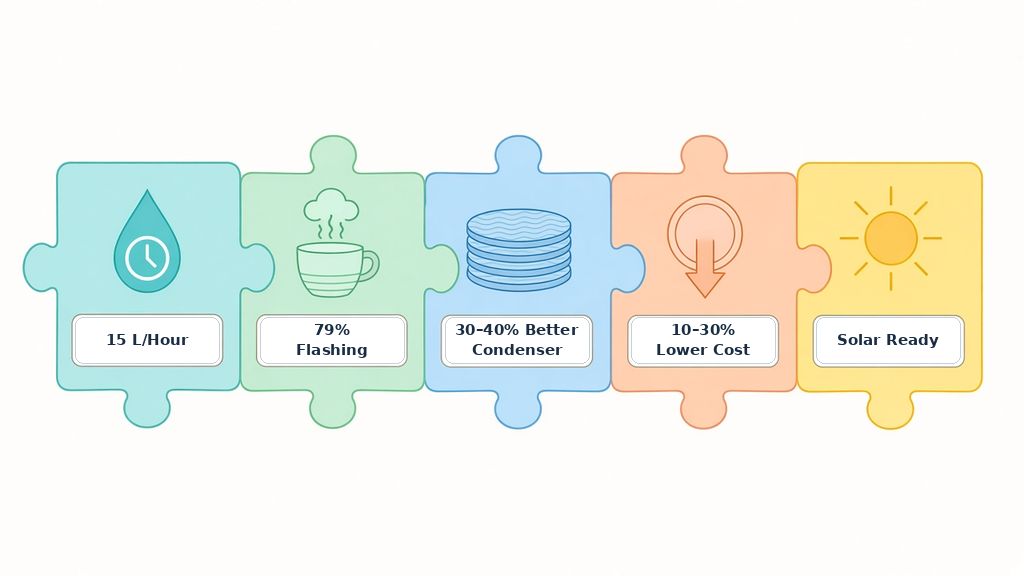
Fig. 1: Key Takeaways From the IIT Madras Study
Big Plants Need Big Spaces
The IIT Madras group already knows large systems well. Earlier, it built a stand-alone solar multi-effect desalination plant in Kanyakumari. In addition, that plant drew seawater from the Gulf of Mannar at Vivekananda Kendra. During March 2019, it produced 7,000 liters of fresh water. Its distilled water also measured just 1 to 3 parts per million of salt. That is impressively pure! However, the plant needed plenty of room. An earlier Tech Talk story on Kanyakumari lists 315 solar flat plate collectors. It also describes a four-stage evaporator and a 20-kilowatt solar power system. Not only does such a setup need land, but it also needs many parts. For this reason, a bold question follows naturally. Could a smaller design keep the efficiency and still cut the cost per liter?
Explainer: Flashing, Condensing and Heat Exchangers
Before we meet the new machine, let’s decode three terms. First comes flashing. Suppose hot water suddenly enters a space at lower pressure. Part of it then boils almost instantly and turns into steam. The salt, meanwhile, stays behind in the leftover liquid. Next comes condensing. When steam touches a cooler surface, it turns back into liquid water. It also gives up its stored heat, called latent heat. In other words, that liquid is the fresh distilled water we want. Finally, a heat exchanger moves heat between two fluids without mixing them. Think of it as a handshake between a hot stream and a cold stream. Heat passes through, yet the fluids never touch. As a result, engineers can move energy wherever they need it.
Why a Gasketed Plate Heat Exchanger Packs More Punch
A classic shell-and-tube exchanger runs one fluid through a bundle of tubes. Meanwhile, the other fluid flows around them inside a large shell. It works, but it takes up room. In contrast, a gasketed plate heat exchanger takes a different approach. It stacks thin metal plates, and gaskets seal the channels between them. Hot and cold fluids then flow through alternate gaps. Because the plates sit close together, heat crosses quickly over a large area. According to IIT Madras, plate exchangers are attracting attention across many industries. For example, these include food, chemical and pharmaceutical plants, plus HVAC and refrigeration systems. The reasons are simple. They are compact, lighter and easier to maintain than shell-and-tube units. In other words, they suit tight spaces beautifully. As a result, they make a natural fit for a smaller desalination design.
Inside the IIT Madras Compact Desalination System
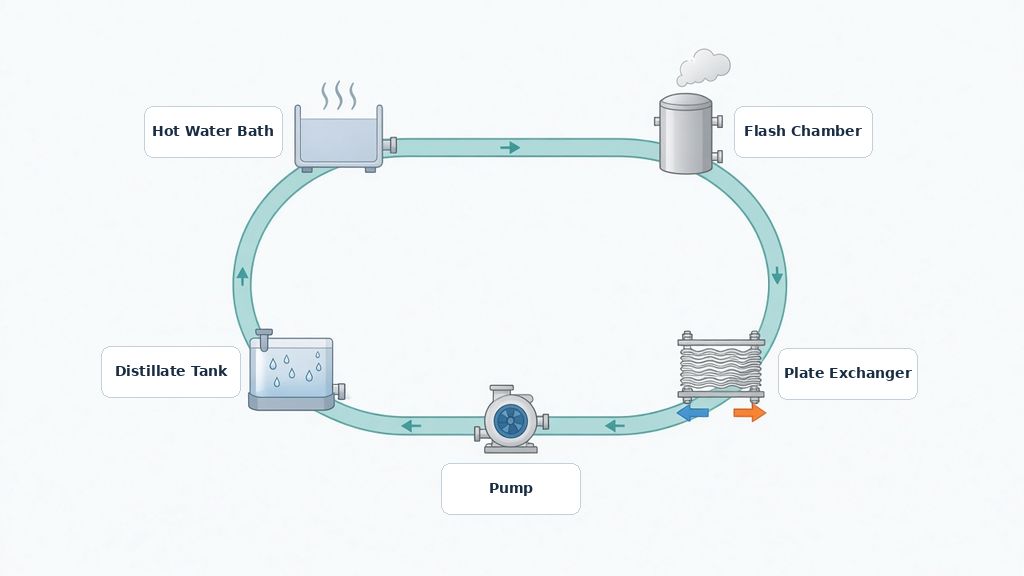
So what does the new machine look like? The compact desalination system, or CDS, has three main parts. These are a flash chamber, a gasketed plate heat exchanger and an ejector. First, a constant-temperature water bath feeds hot water into the flash chamber. There, the water flashes into steam. Next, the steam reaches the hot side of the plate exchanger. Meanwhile, cold water circulates on the other side and absorbs the heat. As a result, the steam condenses into distillate. The distillate collects in a tank, and a pump returns it to the water bath. In the same way, the brine follows a similar path. A water bath supplies the lab heat, not the sun. Even so, IIT Madras says the system is compatible with solar energy.
Fig. 2: How the Compact Desalination System Loop Works
What the Numbers Say
Now for the exciting part! The system has a capacity of 15 liters per hour. So if it ran nonstop, that would add up to 360 liters a day. It also achieved an average flashing efficiency of 79% in the flash chamber. In other words, the chamber did a strong job of making steam. The plate exchanger, meanwhile, served as the condenser. In that role, it outperformed shell-and-tube exchangers by 30% to 40%. At the same time, it cut costs by 10% to 30% versus traditional systems. Not only is it smaller, but it also costs less to set up. According to IIT Madras, it drastically lowers the cost per liter too. For this reason, the design suits places where every rupee counts. In short, the small machine punches well above its weight.
An Expert Weighs In
Outside experts noticed the work as well. Prof. Alberto Coronas is a Full Professor at the University Rovira i Virgili in Catalonia, Spain. He also founded and directs the CREVER research group in applied thermal engineering. In addition, he shared his view in the Tech Talk feature. According to him, the system uses “innovative gasketed plate heat exchangers” and ejectors. He noted that the team tested it “with both tank water and seawater” too. The distillate reached 10 to 15 parts per million of salinity, he added. In contrast, seawater carries about 35,000 parts per million. That works out to well over 2,000 times less salt! For this reason, the distillate quality looks very encouraging. He also credited the study’s experimental, thermodynamic and economic analyses. So such outside praise gives the work extra weight.
Solar Power and Seawater Desalination Make a Great Team
Here is where things get even brighter. IIT Madras links the system to UN Sustainable Development Goal 7 on clean energy. It also addresses fresh water demand under Goal 6. The UN page on Goal 6 covers water and sanitation for all. Moreover, the team’s Kanyakumari plant already ran on sunshine. With more storage and battery backup, it could run for 24 hours, the feature says. For this reason, that lesson matters for seawater desalination in sunny coastal towns. The feature also notes potential for a higher coefficient of performance at larger capacities. In other words, bigger versions might get more water from the same energy. So the small machine could grow into something mighty. At the same time, solar heat could keep running costs low.
What This Means for Future Mechanical Engineers
Projects like this one are a real playground for mechanical engineers. The O*NET profile for mechanical engineers mentions overseeing heat, gas, water, and steam systems. In other words, this desalination rig touches almost all of those! First, someone designs the flash chamber and the plates. Then someone tests the flow, the vacuum and the water quality. After that, someone runs the numbers on cost. Students curious about these subjects can explore our B Tech mechanical engineering course outline. Because pumps move water through every loop, they matter here too. For example, see our story on smart pump control that saves energy. In addition, thermodynamics links every step, from boiling to condensing. So if you love machines that solve real problems, this field welcomes you.
Skills Behind Plate Heat Exchanger Design
Good plate heat exchanger design blends physics with practical sense. First, engineers must calculate how much heat crosses each plate. They also pick gasket materials that survive hot, salty water. Corrosion, after all, is a constant enemy near the sea. In fact, the Kanyakumari plant used titanium in parts of its evaporator. Its excellent corrosion resistance made it the right choice. At the same time, economics matters as well. The IIT Madras study weighed cost alongside performance, which helps designs reach real users. ENTECH readers can also explore brine-free solar desalination in an earlier story. In the same way, both stories show many paths to cleaner water. Next, consider maintenance. Gasketed plates can come apart for cleaning, so upkeep stays simple. In other words, smart design keeps a machine useful for years. Not only does it save money, but it also saves time.
What Comes Next for the Compact Desalination System
Every good story has a next chapter. The current system makes 15 liters an hour, a lab-scale amount. Its tests also used a water bath for heat rather than solar collectors. In addition, future work could test a double-stage version, according to IIT Madras. The team may also study modified plate surfaces for better performance. After that, full-scale trials could fine-tune the design capacity and efficiency. The research appeared in the journal Energy. So the road from lab bench to coastal tap is still ahead. Even so, each step builds on solid results. At the same time, many engineers will likely watch the double-stage version closely. Meanwhile, students can follow the progress through IIT Madras updates. As a result, this is a great project to keep an eye on.
So, can a smaller machine really make a big splash? This study says yes, at least in the lab! The IIT Madras compact desalination system pairs a flash chamber with a plate exchanger. Together, they turn salty water into very pure distillate. Best of all, the setup is smaller and easier to maintain than older designs. In addition, its condenser beat shell-and-tube units by 30% to 40%. It also trimmed costs by 10% to 30%. Solar compatibility adds another big plus. Of course, bigger trials come next. Even so, the direction looks bright. For this reason, the project deserves a loud cheer from future engineers. Not only students but also coastal towns stand to gain. After all, clean water for more people is a goal worth celebrating!
Thilagan, K., Advaith, S., & Mani, A. (2026). Experimental insights into the performance of a compact desalination system. Energy, 360, Article 141846.
United Nations Department of Economic and Social Affairs. (n.d.). Goal 6: Ensure availability and sustainable management of water and sanitation for all. https://sdgs.un.org/goals/goal6
This cheerful explainer turns flashing, condensing and heat exchange into ideas any curious student can follow. The comparison between plate exchangers and shell-and-tube designs is especially clear and useful. A simple sketch of how steam meets a cool plate would make the condenser section even easier to grasp for first-time readers. Readers who want the full experimental and economic analysis can look up the team’s study in the journal Energy.
Editorial note
We chose this story because it shows how a smart change in heat exchanger design can make clean water cheaper and easier to produce. The article keeps the scale in view, since the current unit is a lab prototype and full-scale trials are still ahead. Earlier work by the same laboratory appears as background rather than as a direct comparison. Readers can find the original feature on IIT Madras Tech Talk.
Charudatta Pathak was a student at St. Aloysius High School in Bhusawal, established in 1874, making it one of India's oldest convent institutions. He earned his bachelor's degree in mechanical engineering from SSVPS College of Engineering, Dhule in 1995, demonstrating exceptional academic achievement. Thereafter, he launched his career as a CNC programmer in a toolroom. He has utilized FANUC, Deckel, Maho, and Mikron controllers to operate 2-axis and 3-axis machines for the fabrication of jigs, fixtures, dies, and molds. He commenced his career as an academic in 1996, when he assumed the role of lecturer at SSVPS College of Engineering, Dhule. Additionally, he earned his post-graduate degree in CAD/CAM from L. D. College of Engineering, Ahmedabad, in 2000, and then acquired a Ph.D. from COEP in 2011 while concurrently engaged in teaching. Until 2023, he occupied many academic roles, including lecturer, assistant professor, professor, dean, principal, director, and vice chancellor at both public and private universities throughout India. From 2008 to 2010, he served as the project lead in the CAE department of a European multinational firm. During his 28-year professional tenure, he identified a need for dependable books targeted at students in grades 8 to 12, particularly for nascent career planning. He founded ENTECH Digital Magazine, a free monthly publication available on entechonline.com and magzter.com. Teens with a strong interest in Science, Technology, Engineering, and Mathematics (STEM) who aspire to pursue careers in these fields may find ENTECH Digital Magazine beneficial.