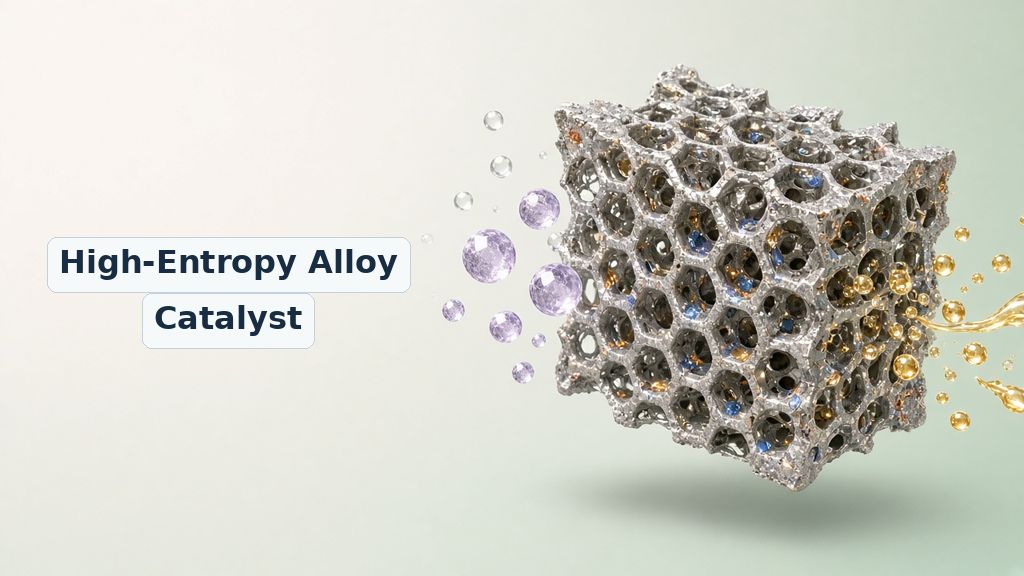
Chemists built a sponge-like catalyst from five metals that turns glycerol into the fine chemical tartronate with about 81% selectivity while making hydrogen.
A bottle of hand lotion often lists glycerin near the top of its label. That sweet, syrupy liquid also has a busy backstory. Biodiesel plants make it as a coproduct of their fuel. So what if this humble byproduct could become a pricier medical chemical? On November 10, 2026, chemists from Inner Mongolia University and Fudan University showed one way. Their high-entropy alloy catalyst blends five metals into a sponge-like solid called an aerogel. It turns glycerol into tartronate, a fine chemical with medical and pharmaceutical uses. Then, in lab tests, about 81% of the liquid product came out as tartronate. In other words, roughly four of every five product molecules landed on target. At the same time, the cell made hydrogen gas at its other electrode. Hengyi Chen ran the lab work under Rui-Ting Gao, Lei Wang and Limin Wu. The study appeared in Nature Communications.
Why Biodiesel Waste Needed a Better Glycerol Oxidation Catalyst
Think of glycerol as a small three-carbon backbone with three hydroxyl (OH) handles. Two handles sit at the ends, while one sits in the middle. The US Department of Energy explains that biodiesel production makes glycerin alongside the fuel. About 100 pounds of oil or fat yields roughly 10 pounds of glycerin. As a result, every batch of fuel leaves a sizable side stream. Chemists would love to upgrade that stream into tartronate, a high-value fine chemical. On the one hand, older routes use heat-driven cracking or biological fermentation. An electric route, on the other hand, needs no added oxidizing chemicals. The authors also point to simpler processing and flexible control over products. Electricity, in short, does the chemical heavy lifting. Even so, one stubborn problem kept this electric route on the sidelines.
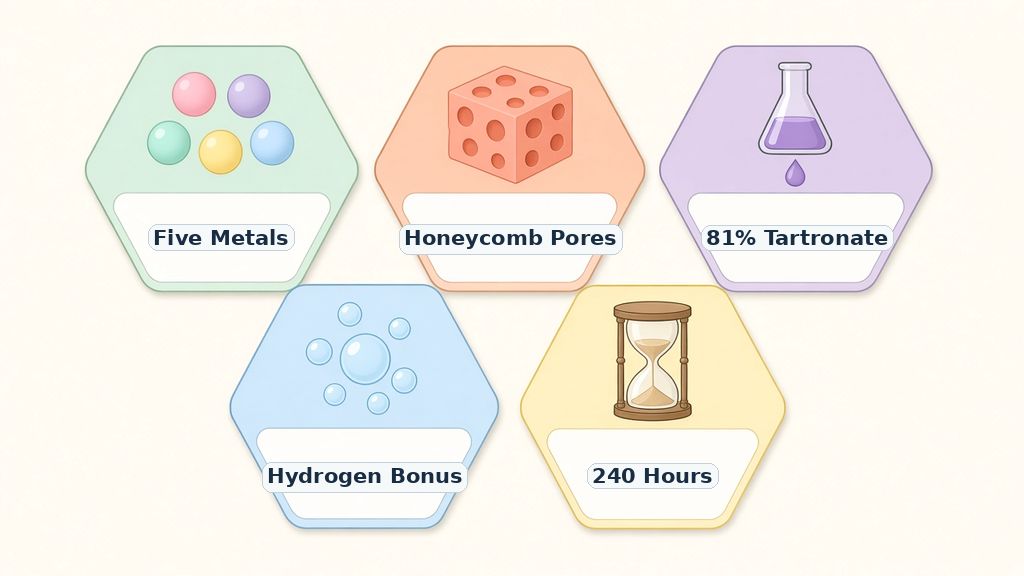
Fig. 1: Key Takeaways From the Five-Metal Aerogel
The Fragile Carbon Chain at the Heart of the Problem
To make tartronate, a catalyst must oxidize both end handles of glycerol. Meanwhile, it must leave the carbon backbone in one piece. That balancing act is hard. Intermediates often float away from the surface too early. As a result, the reaction stops halfway at glyceric acid instead of tartronate. But push harder, and the carbon chain can snap apart. Then cheaper fragments with one or two carbons appear, such as formate and oxalate. According to the paper, most reported catalysts give tartronate selectivity below 60%. That leaves a messy mixture that needs costly separation. High-entropy alloys looked promising, yet they hit a speed limit. In other words, their current density stayed below about 200 milliamperes per square centimeter. For this reason, the team wanted a glycerol oxidation catalyst that was picky and fast.
Explainer: How a Catalyst Chooses One Product
A catalyst speeds up a reaction without getting used up itself. The Department of Energy has a guide on how catalysts lower energy barriers. It also describes a key property called selectivity. Selectivity tells you how much of the product is the one you want. Here, 81% selectivity means about four out of five product molecules are tartronate. Suppose you bake cookies, and a few always burn at the edges. A better oven is not only faster but also burns fewer cookies. In the same way, a good catalyst steers molecules toward one finish line. It does this through how tightly it grips each molecule. A loose grip lets intermediates escape too soon. In contrast, a grip that is too tight snaps the carbon chain. So the art lies in a just-right grip.
Current Density and the Glycerol Electrooxidation Swap
Next comes the electric side. An electrolyzer uses electricity to drive a chemical change at two electrodes. The Department of Energy explains how a water-splitting electrolyzer makes hydrogen at one electrode. Oxygen then forms at the other electrode. However, oxygen is cheap, and its reaction needs a lot of voltage. So the researchers swapped that reaction for glycerol electrooxidation. Consider a current density of 500 milliamperes per square centimeter. At that level, the swap cut the needed potential by 1.1 volts. Current density is simply current divided by electrode area. Think of it as traffic per lane on a highway. So more traffic per lane means more product from the same equipment. In addition, industry wants high current density, often near one ampere per square centimeter. As a result of this demand, fast catalysts matter as much as picky ones.
Inside the High-Entropy Alloy Aerogel
A high-entropy alloy mixes several metals in nearly even amounts. This one blends platinum, copper, cobalt, cerium and tin, written as PtCuCoCeSn. According to the authors, its mixing entropy crosses the usual high-entropy threshold. In plain terms, the five metals mix so thoroughly they act as one material. Next, the team gave the alloy an airy shape. They mixed metal salts with sodium borohydride, which releases hydrogen bubbles as it reacts. Those bubbles then act like a mold for tiny tunnels. As a result, the high-entropy alloy aerogel forms a honeycomb full of pores. The pores measure between 2 and 50 nanometers wide. In addition, a single gram offers about 57 square meters of surface. That huge inner area gives glycerol many places to land. Platinum brings strong activity. At the same time, cheaper transition metals help cut the platinum cost.
Cerium Grips and Tin Lets Go
Each newcomer metal plays its own role. To begin with, cerium changes how glycerol sits on the surface. Without cerium, glycerol grabs on with one handle. With cerium, it holds on with two, which the paper calls bidentate binding. This firmer two-point grip keeps glyceric acid in place long enough to react again. In other words, the halfway product stops escaping and moves on to tartronate. Tin, meanwhile, solves the opposite problem. A grip that strong could also hold tartronate too long and break it. However, tin weakens the hold just enough for tartronate to leave. Computer models show the energy barrier for its release dropping roughly by half. At the same time, tin raises the barrier for snapping the carbon chain. It also holds back the competing oxygen reaction at high voltage. Together, the two metals work like a careful catch-and-release team.
Fig. 2: How Cerium and Tin Guide the Reaction
What the Lab Tests Revealed
The numbers tell a lively story. Voltages here use a standard reference electrode. At 1.0 volt, the catalyst delivered 461 milliamperes per square centimeter. There, it reached its peak tartronate selectivity of 81.4%. In contrast, a three-metal version without cerium or tin managed only 46.1%. That gap is close to double. Selectivity also stayed above 70% across a wide voltage window. Not only that, but the current kept climbing. The catalyst reached one ampere per square centimeter at about 1.39 volts. Over a 14-hour run, it converted 94.5% of the glycerol. Then came an endurance test of 250 hours. Even so, average selectivity held at 80.3% across that long run. Platinum itself showed only minor oxidation afterward. According to the authors, the other metals may act as buffers for platinum. In this view, they shield its active sites from heavy oxidation.
From Lab Bench to a Tartronate Electrosynthesis Line
A small beaker test is one thing. However, a cell that resembles industrial equipment is another. So the team built a membrane electrode assembly. It works like a compact sandwich of electrodes around a thin membrane. The aerogel oxidized glycerol on one side. Opposite it, a slightly platinum-richer version of the same alloy produced hydrogen. At a cell voltage of 1.6 volts, tartronate selectivity peaked at 78.9%. As a result, the cell made 4.9 millimoles of tartronate per hour. That beats a simpler H-shaped lab cell by nearly twice. Meanwhile, the hydrogen side ran near 100% efficiency, so side reactions barely used current. The assembly then ran for 240 hours. Even so, it kept an average selectivity of 78.2%. In short, this tartronate electrosynthesis cell drew two useful products from one stream of electricity.
What This Means for Future Chemical Engineers
Stories like this sit right where chemistry meets process design. First, someone must invent the catalyst. Then someone must scale it, clean the product and run the plant safely. Chemical engineers on O*NET design plant equipment and devise manufacturing processes. The paper’s supplementary file even sketches a cost model for a large plant. That plant would handle 10,000 tonnes of glycerol a year. Still, the model rests on assumed prices, so treat it as an early estimate. ENTECH recently covered a carbon-wrapped catalyst for nitrate pollution at factory-speed currents. Our story on a lanthanoid oxide catalyst for methane shows, for example, similar many-element thinking. In addition, electrochemistry skills now link fuels, medicines and clean hydrogen. So which piece of this puzzle would you want to build?
Where the High-Entropy Alloy Catalyst Still Has Limits
Every bright result carries fine print. The tests used purified glycerol from a supplier, not crude biodiesel leftovers. Reactions also ran in a strong alkaline solution at 60 °C. In addition, platinum remains part of the recipe, and platinum is expensive. Selectivity slipped slowly during long runs as well. Over 14 hours, it fell from about 81% to about 76%. According to the authors, computer models cannot fully capture a real working electrode. For this reason, the team used them mainly to cross-check experiments. The paper appears as an Article in Press, so its final version may still change. Engineers also need better ways to separate tartronate from the mixture. Because of these gaps, this remains a lab-scale advance, not a finished factory process. Even so, it charts a clear direction for cleaner chemical manufacturing.
So where does this leave the humble glycerin in your lotion bottle? On the one hand, glycerin already has steady jobs in cosmetics and medicines. This study, on the other hand, hints at a richer future for the leftover stream. The high-entropy alloy catalyst shows that five metals can share one job neatly. Cerium holds the molecule steady, while tin knows exactly when to let go. Because of this teamwork, the catalyst stays picky even at high current. Hydrogen also arrives as a bonus at the other electrode. Next, tests with real crude glycerol and bigger cells would make sense. At the same time, cheaper metal blends could trim the platinum bill. Until then, this aerogel offers a hopeful sketch. In other words, a waste stream might one day feed medicine makers and clean fuel.
References
Chen, H., Gao, R.-T., Wang, L., & Wu, L. (2026). High-entropy alloy aerogels promote selective glycerol oxidation to tartronate at industrial current densities. Nature Communications. Advance online publication. https://doi.org/10.1038/s41467-026-78330-1
This piece turns a demanding electrochemistry paper into a warm, story-like read, and the catch-and-release image makes the roles of cerium and tin easy to follow. The cookie and highway comparisons help newer readers handle selectivity and current density without strain. A small labeled sketch of the glycerol molecule, with its end and middle handles marked, would make the opening sections even clearer. Readers who want the full chemistry are encouraged to consult the original paper in Nature Communications.
Editorial note
We picked this study because it links a familiar household ingredient to cleaner chemical manufacturing and hydrogen production. The article keeps the lab-scale limits in view, including purified glycerol, the use of platinum and the early version of the paper. The cost model in the supplementary file appears here as an early sketch rather than a forecast. For the complete methods and data, readers can turn to the original research paper.
I am an inspirational writer and emerging science blogger with a deep-rooted passion for understanding and sharing the wonders of the world around us. My journey began with a Bachelor of Science in Chemistry from AKI’s Poona College of Arts, Commerce and Science, where I developed not only a strong foundation in scientific principles but also a mindset that values curiosity, observation, and critical thinking. Studying chemistry has taught me to approach problems with logic, to look beyond the obvious, and to see patterns where others might only see complexity. These experiences have shaped the way I perceive life and influence the way I express my thoughts, both scientifically and creatively.
I have always believed that knowledge is only as powerful as the way it is shared. This belief has guided me to create content that bridges the gap between science and everyday life. I aim to simplify complex scientific ideas so they become approachable, relatable, and engaging for everyone—whether someone has a formal background in science or is simply curious about the world. Science, in my view, is not confined to textbooks and laboratories; it is a way of thinking, understanding, and connecting with the world around us. By making science accessible, I hope to inspire curiosity, ignite learning, and encourage people to see the beauty and relevance of scientific discovery in their daily lives.
Alongside my love for science, I am deeply passionate about motivational writing. I believe words carry the power to transform perspectives, encourage self-reflection, and inspire action. By combining analytical thinking with creativity, I create content that is intellectually stimulating yet emotionally resonant. Whether I am breaking down a chemical concept, exploring a scientific phenomenon, or crafting motivational narratives, my goal is to communicate ideas in a way that is clear, meaningful, and impactful.
Through my work, I strive to empower my readers - not just by helping them understand the science around them, but by inspiring them to grow, learn, and realize their full potential. Every article, post, or story I write reflects my commitment to turning knowledge into inspiration. I want to spark curiosity, encourage self-improvement, and show that learning and personal growth are deeply connected. For me, writing is not just a craft; it is a way to touch minds, connect hearts, and make ideas come alive in a way that truly resonates.